# Best AI for Python Coding in 2026 (Top 8 Tools Compared)
> The 8 best AI tools for Python coding in 2026. Cursor, GitHub Copilot, PyCharm AI, Claude Code, Windsurf and more. Compared for fastest way to build and deploy.
- **Author**: jaikishan-singh-rajawat
- **Published**: 2026-01-19
- **Modified**: 2026-09-01
- **Category**: AI & DevOps
- **URL**: https://kuberns.com/blogs/best-ai-for-python-coding/
---
“**What is the best AI for Python coding?**” If this is the question you are searching for, then this guide gives you the answer. The best AI for Python coding depends on your needs: Cursor for advanced code editing and multi-file Python projects, GitHub Copilot for editor flexibility across VS Code and PyCharm, PyCharm AI (Junie) for integrated Python IDE development, Claude Code for Python scripts and terminal-first automation, Windsurf for the best free option, and Kuberns for launching Python applications to production after using any of the tools above.
If you're searching for the best AI for Python coding in 2026, the answer depends on which Python you're writing.
Python is the #1 programming language in the world in 2026. The [TIOBE Index for March 2026](https://itdaily.com/news/software/python-remains-most-popular-programming-language/) puts Python at 21.25%, a lead so large that the second-place language (C at 11.55%) isn't close. Python overtook JavaScript as the most used language on GitHub in 2025 with a 22.5% year-over-year increase in contributions. The Stack Overflow 2025 Developer Survey recorded Python's largest single-year jump ever, a 7 percentage point increase, driven almost entirely by its expanding role in AI development, data science, and backend engineering.
But Python isn't one world, it's three. There's the web development world (Django, Flask, FastAPI), the data science world (NumPy, Pandas, PyTorch, Jupyter notebooks), and the scripting world (automation, CLI tools, one-off utilities). The best AI coding tool for a Django API developer is different from the best one for a data scientist debugging a Pandas pipeline at 11 pm, which is different again from the best one for a DevOps engineer writing Python automation scripts.
We evaluated these tools specifically on Python performance, not generic coding benchmarks. Framework understanding, data science library support, multi-file Python project handling, script generation quality, and PyCharm integration.
At the end, you'll get the complete AI stack for taking a Python project from the first line of code to a live production URL.
### TL;DR: Best AI for Python by Use Case
* If you want the most powerful overall AI for Python development, use **Cursor**. It handles large codebases and multi-file changes very well
* If you already use PyCharm and don’t want to switch tools, use **PyCharm AI** (Junie) for a smooth, built-in experience
* If you want a strong free option with good capabilities, use Windsurf. It offers unlimited basic usage
* If you work in data science or machine learning, use **PyCharm AI** or **Gemini Code Assist** for better notebook and large context support
* If you build web apps with Django, Flask, or FastAPI, use **Cursor** or **GitHub Copilot** for framework-aware coding
* If you prefer working in the terminal and automating scripts, use **Claude Code**
* If you need strict privacy and enterprise-grade security, use **Tabnine**, especially for on-premise setups
* If you are learning Python or want zero setup, use **Replit** to start instantly in the browser
* For deployment, use any of the above tools for coding, then use **Kuberns as your agentic AI platform for deployment** to ship, manage, and scale your app without handling DevOps
> 💡 **Already built your Python project? Use [Kuberns](https://kuberns.com/) as your agentic AI platform for deployment and move your Flask, Django, or FastAPI app from GitHub to production without manual server setup. Start with our [Python deployment guide](https://kuberns.com/blogs/how-to-deploy-python-app-with-ai/) or [launch your app on Kuberns](https://dashboard.kuberns.com).**
## Quick Comparison of the Best AI Tools for Python Coding in 2026
Choosing the right AI tool for Python depends on how you work, whether you are building web apps, writing scripts, doing data science, or just learning. This table gives you a simple side-by-side view of the most useful tools, so you can quickly decide what fits your workflow and setup.
| **Tool** | **Free Plan** | **Starting Price** | **Best Python Use Case** | **IDE Support** |
| ---------------------- | ---------------------- | --------------------- | ---------------------------------------------- | ------------------------------------- |
| **Cursor** | Limited | $20 per month | Django, Flask, FastAPI, multi-file projects | VS Code-based, PyCharm support (2026) |
| **GitHub Copilot** | 2K completions | $10 per month | Works across all Python use cases | VS Code, PyCharm, Neovim, Xcode |
| **PyCharm AI (Junie)** | Requires Pro plan | $249 per year | Data science, deep PyCharm workflows | PyCharm only |
| **Claude Code** | Bring your own API key | $17 per month or API | Python scripts, automation, terminal workflows | Works in the terminal with any editor |
| **Windsurf** | Unlimited basic plan | $15 per month | Python web apps, a strong free option | Windsurf IDE |
| **Gemini Code Assist** | Generous free tier | Free or $19 per month | Python with GCP, notebooks, large context | VS Code, JetBrains |
| **Tabnine** | No free plan | $39 per month | Enterprise Python, secure environments | VS Code, PyCharm, JetBrains |
| **Replit** | Basic free plan | $25 per month | Learning Python, quick scripts, prototypes | Browser based |
## The 8 Best AI Tools for Python Coding in 2026
We tested each tool on Python-specific tasks: generating a FastAPI endpoint with Pydantic validation, refactoring a Django model, debugging a multi-file Pandas pipeline, writing a Python automation script from a prompt, and generating unit tests for an existing Python class.
### 1. Cursor: Best for Complex Python Projects

**What it is:** A fork of VS Code with AI built into every layer. For Python developers, Cursor's defining advantage is codebase-wide context. It reads your entire project, not just the open file, which matters enormously when your Django models, views, and serialisers are spread across dozens of files.
**Python-specific strengths:**
* Understands Django's ORM patterns: when you ask "add a method to this model that returns active users," Cursor knows the correct QuerySet syntax and where the method belongs in the class hierarchy
* Handles FastAPI's dependency injection, generates correct Depends() patterns, Pydantic schemas, and async endpoint signatures from natural language descriptions
* Agent mode works well for Python refactoring: "rename this field across all models, migrations, serialisers, and views" executes correctly without you touching each file
* As of March 2026, Cursor runs inside PyCharm via the Agent Client Protocol, removing the friction of leaving your IDE if you're a PyCharm user
* Multi-model support: choose Claude Sonnet for fast completions, Claude Opus for complex Django architecture tasks
**Honest cons:**
* Requires switching to a new editor (or the newer PyCharm integration, which is still maturing)
* Agent mode burns through token credits quickly on large Django projects, monitor usage
* At $20/month, it's twice the cost of Copilot; the premium is worth it for large codebases, less so for simple scripts
**Pricing:** Free (limited). Pro: $20/month. Teams: $40/user/month.
**Best for:** Professional Python developers building complex web applications, APIs, or data pipelines across multiple files.
> 💡 **Cursor builds the Python app. Kuberns helps ship it.** After building in Cursor, connect your GitHub repo and [launch your Flask, Django, or FastAPI app on Kuberns](https://dashboard.kuberns.com). Kuberns detects your framework and prepares the deployment workflow automatically.
### 2. GitHub Copilot: Best for Existing Python Workflows

**What it is:** The most widely adopted AI coding assistant. Works as an extension inside VS Code, PyCharm, JetBrains IDEs, Neovim, and Xcode. AI assistance without changing your editor. GitHub Copilot reached over 4.7 million paid subscribers by January 2026, and is used by 90% of Fortune 100 companies.
**Python-specific strengths:**
* Trained on millions of Python repositories, with a strong understanding of idiomatic Python, common patterns, and standard library usage
* Excellent at Python's implicit conventions: suggests list comprehensions instead of loops, with statements for context managers, @dataclass over manual \_\_init\_\_
* Strong across all major Python frameworks. Django, Flask, FastAPI, SQLAlchemy, Celery
* GitHub's published research found that developers using Copilot completed tasks 55% faster on average. The gains are most consistent for boilerplate, API integrations, and standard Python patterns
* Works inside PyCharm natively, making it the default choice for PyCharm users who want AI without switching IDEs
**Honest cons:**
* Context window is limited compared to Cursor or Claude Code, struggles with very large Python codebases where changes span many interconnected files
* For data science notebooks, Copilot requires manual context setup because it can't see across cells efficiently; it adds 3 to 5 minutes per complex debugging session
* The free tier model is noticeably weaker than Pro, with a meaningful feature gap
**Pricing:** Free (2,000 completions/month). Pro: $10/month. Business: $19/user/month. Enterprise: $39/user/month.
**Best for:** Python developers who want AI inside their existing editor, teams on GitHub, and anyone who wants the widest IDE compatibility.
### 3. PyCharm AI (Junie): Best for Dedicated PyCharm Users

**What it is:** JetBrains' AI Assistant, nicknamed Junie, built directly into PyCharm, the most popular dedicated Python IDE. According to JetBrains' developer surveys, PyCharm has 37.2% adoption among developers. For developers fully committed to the PyCharm ecosystem, Junie offers AI that feels native rather than bolted on.
**Python-specific strengths:**
* Deeply integrated with PyCharm's existing Python tooling: refactoring suggestions are aware of PyCharm's project model, import resolution, and type inference
* Strong for data science: understands Jupyter notebook integration inside PyCharm, scientific library patterns (NumPy, SciPy, Matplotlib, pandas), and scientific Python conventions
* Full project context awareness, PyCharm already indexes your entire Python project, and Junie builds on top of that
* AI-assisted test generation understands PyCharm's testing runner, generates pytest fixtures correctly, and places test files in the right locations
* Included with PyCharm Professional, no separate AI subscription if you're already a Pro user
**Honest cons:**
* Only available inside PyCharm, no cross-editor value if your team uses mixed IDEs
* Less capable than Cursor or Claude Code on the most complex agentic tasks requiring a multi-repository context
* PyCharm Professional at $249/year is not cheap; the free Community edition doesn't include AI features
**Pricing:** Included with PyCharm Professional ($249/year, free for students and open source).
**Best for:** Python developers who already use or plan to use PyCharm as their primary IDE, especially data scientists and Django developers.
### 4. Claude Code: Best for Python Scripts and Automation

**What it is:** Anthropic's terminal-based AI coding agent. For Python developers, Claude Code is the most powerful tool for scripts, automation, CLI tools, and any Python work that lives in the terminal. It reads your entire codebase, executes commands, writes files, installs packages, and iterates autonomously.
**Python-specific strengths:**
* Exceptional at Python scripting: describe what you want ("write a script that reads a CSV, normalises column names, and outputs a cleaned version with logging"), get a working, well-commented Python file
* Understands Python packaging: installs missing dependencies with pip, updates requirements.txt, handles virtual environments correctly
* Zero data retention via API, important for Python developers working with proprietary business logic or sensitive data pipelines
* 1 million token context window, can hold an entire Python codebase in context, including test files, configuration, and documentation
* Strong for debugging: paste a full Python traceback, and Claude Code traces the root cause through your actual code, not just the line that threw the error
**Honest cons:**
* Terminal only, no inline completions, no GUI, no visual diff in an editor
* Steeper learning curve for developers not comfortable with terminal-first workflows
* API-based usage can be unpredictable in cost for heavy sessions
**Pricing:** Free (bring your own API key). Pro: $17/month. Max: $100+/month.
**Best for:** Python developers who write scripts, automation tools, and data pipelines and are comfortable working in the terminal.
> 💡 Writing Python API or backend services with Claude Code? See our [FastAPI deployment guide](https://kuberns.com/blogs/fastapi-deployment-guide/) and [Django deployment](https://kuberns.com/blogs/how-to-deploy-django-app-in-one-click-with-ai/) guide for deploying what Claude Code builds directly to Kuberns.
### 5. Windsurf: Best Free AI Editor for Python

**What it is:** An AI-native code editor from Codeium, competing directly with Cursor. For Python developers on a budget, Windsurf's free tier is the most compelling offer in the market, unlimited basic completions and a capable Cascade agent, without paying $20/month.
**Python-specific strengths:**
* Cascade agent handles Python-specific multi-file tasks: can add a new endpoint to a Flask app, update the corresponding test, and add the route to the router, across three files from one instruction
* Strong at Pythonic suggestions: prefers idiomatic Python over verbose alternatives, suggests type hints and docstrings naturally
* Good Django and Flask support; slightly less trained on FastAPI than Cursor
* Simpler UX than Cursor, easier onboarding for Python developers coming from standard editors
**Honest cons:**
* Daily/weekly quota system on paid plans: if you burn through your quota early, you're locked out until reset, frustrating for Python developers in long coding sessions
* Agent mode is competitive but not quite at Cursor's level for the most complex Django codebase refactors
* Smaller community than Cursor or Copilot, fewer Python-specific tips and workflows documented
**Pricing:** Free (unlimited basic completions). Pro: $15/month.
**Best for:** Python developers who want Cursor-level AI without the cost, or anyone evaluating AI editors before committing to a paid subscription.
### 6. Gemini Code Assist: Best for Python + Google Cloud and Data Science

**What it is:** Google's AI coding assistant, powered by Gemini models. For Python developers working on Google Cloud (Cloud Run, BigQuery, Vertex AI, Cloud Functions) or doing data science work, Gemini Code Assist has a meaningful edge, a native understanding of GCP services and a generous free tier.
**Python-specific strengths:**
* Understands Python + GCP patterns natively: generates correct google-cloud-bigquery client code, vertexai SDK usage, Cloud Run deployment patterns
* Gemini 2.5 Pro's 1 million token context window handles very large Python data science projects
* Strong for data science notebooks: performs well on mixed Python/SQL tasks, which is common in data science workflows
* Generous free tier for individuals, significantly more free usage than Copilot's 2,000 completions
**Honest cons:**
* Weaker than Claude or Cursor at complex multi-file refactoring outside the Google Cloud ecosystem
* Less versatile for Django/Flask web development compared to Cursor or Copilot
* Slower iteration speed compared to Cursor, less suitable for rapid feature development
**Pricing:** Free (individual). Pro: $19/user/month (Teams/Enterprise).
**Best for:** Python developers building on Google Cloud, data scientists working with BigQuery or Vertex AI, teams that need a large context window for data science notebooks.
### 7. Tabnine: Best for Enterprise Python Teams

**What it is:** The AI coding assistant built for organisations where Python code cannot leave their own infrastructure. Tabnine can be deployed entirely on-premise or in a private VPC; your Python code never touches an external server.
**Python-specific strengths:**
* Can be trained on your organisation's Python codebase, learns your team's specific conventions, internal library APIs, and coding standards
* Works inside VS Code, PyCharm, and all major JetBrains IDEs
* SOC 2, GDPR, and HIPAA compliance, relevant for Python developers in healthcare (patient data pipelines), finance (trading algorithms), and defence
* Zero data retention, nothing about your code is stored or used for model training
**Honest cons:**
* Less capable than Cursor or Claude Code on the most complex Python agentic tasks, the security advantage comes with a capability trade-off
* No free tier; annual commitment required at $39/month minimum
* Suggestions can feel less "creative" than Claude-based tools for novel Python architecture tasks
**Pricing:** Enterprise: $39 to $59/user/month (annual commitment, no monthly option).
**Best for:** Enterprise Python teams in regulated industries, financial institutions, healthcare organisations, and defence contractors, where code cannot be processed on external servers.
### 8. Replit: Best for Learning Python

**What it is:** A browser-based IDE with built-in AI. Zero local setup, open a browser, and start writing Python immediately. For developers learning Python or needing a quick environment without installation, Replit removes every barrier.
**Python-specific strengths:**
* Python is Replit's strongest language, the runtime is pre-configured, packages install instantly, and the environment works immediately
* Replit AI explains Python concepts inline, suggests fixes for errors, and generates small functions from descriptions
* Instant Python environments for every major framework, Django, Flask, FastAPI, starters available
* Built-in hosting: share your Python script or web app via URL without any deployment steps
**Honest cons:**
* Not suitable for large, production Python applications, performance and tooling don't match a proper local environment
* Free tier limits become a constraint quickly for anything beyond learning and small projects
* Replit's hosting is convenient but not production-grade, fine for demos, not for live applications
**Pricing:** Free (basic). Core: $25/month.
**Best for:** Developers learning Python, quick experiments, sharing code examples, and prototyping without local setup.
## The Complete AI Stack (From Python Code to Live Production)
Every tool in this list helps you write Python faster. None of them gets your Python application running in production. Here's what the journey actually looks like after you finish coding:
This is the gap that breaks Python deployment for most developers, especially for data scientists and script writers who are excellent at Python but not at DevOps. The AI tools help you build it. Something else has to ship it.
**[Kuberns](https://kuberns.com/) closes this gap**. It is an agentic AI platform for deployment that completes the Python development workflow, connecting your GitHub repository to a live production URL with minimal server configuration.
### Deploying Your Python App on Kuberns
Once you've written your Python application using any of the tools above, deploying it should be as simple as the coding was.
Watch the full one-click deployment in real time, including Kuberns detecting a Python project, installing dependencies from requirements.txt, starting the correct production server, and delivering a live HTTPS URL:
### What Kuberns Does for Python Apps
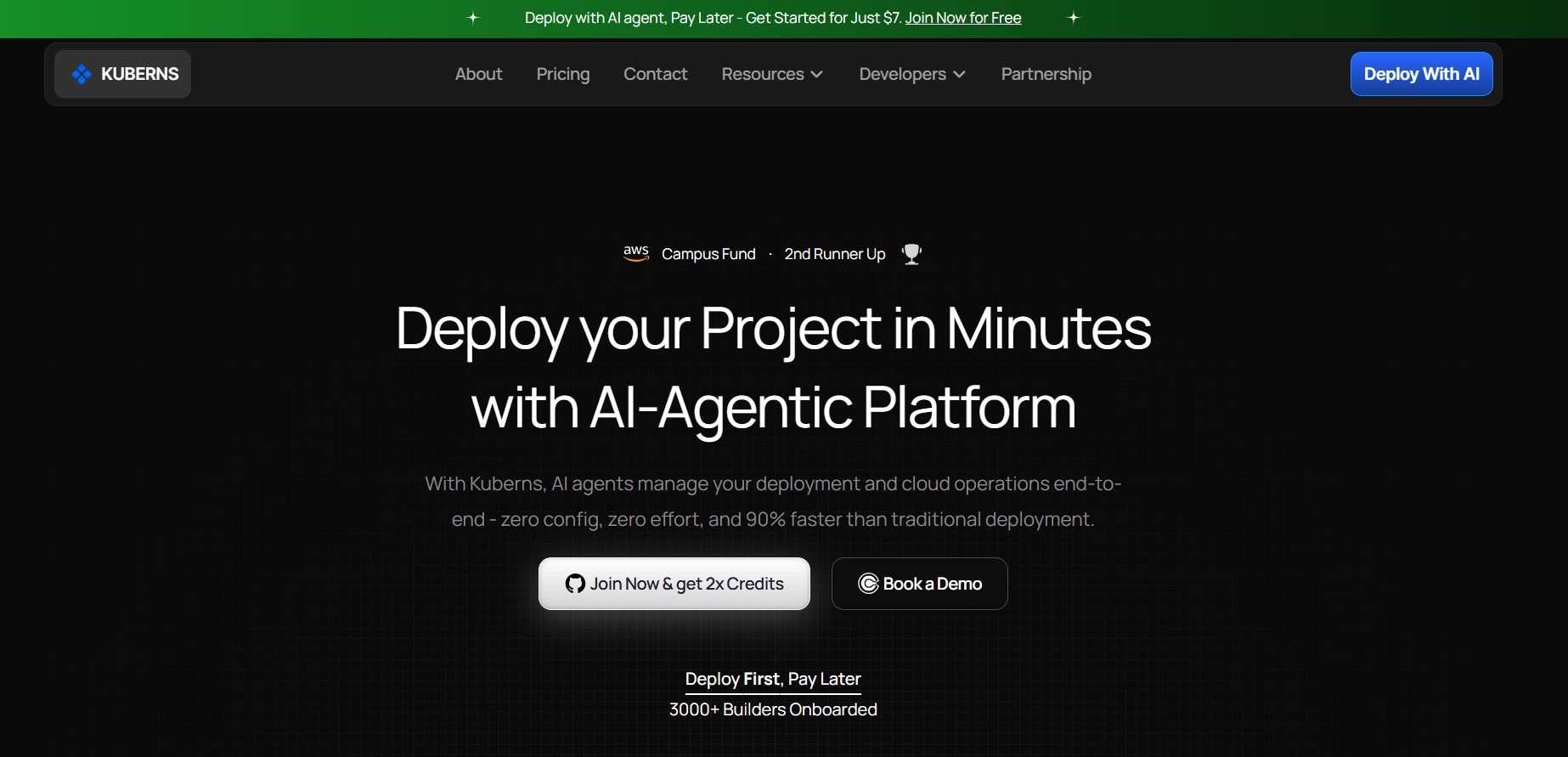
Kuberns understands Python's production requirements deeply, not in a generic way, but specifically:
Framework detection: Kuberns reads your requirements.txt and main.py / app.py / manage.py and identifies your framework automatically:
* Flask: starts with gunicorn app\:app --bind 0.0.0.0:$PORT
* Django: runs python manage.py migrate + collectstatic + starts Gunicorn
* FastAPI: starts with uvicorn main\:app --host 0.0.0.0 --port $PORT
Python version management: Reads your .python-version or pyproject.toml and installs the correct runtime, Python 3.10, 3.11, 3.12, or whatever your app requires. Critical for ML apps where library compatibility depends on exact Python versions.
Dependency installation: Runs pip install -r requirements.txt on a clean environment. Handles heavy ML dependencies (PyTorch, TensorFlow, scikit-learn) without timeout issues.
The critical production issues Kuberns prevents automatically:
* Flask/Django dev server deployed in production (a security and performance disaster), Kuberns always uses Gunicorn
* DEBUG=True in production (exposes your source code), NODE\_ENV=production and DEBUG=False enforced
* Port hardcoding, Kuberns injects PORT, and your app reads it correctly
* Missing environment variables causing silent startup crashes, detected before deployment completes
**[Launch your Python project with Kuberns](https://dashboard.kuberns.com)**
## Conclusion
Python is the go-to choice for AI development, web backends, data science, and automation. The AI tools available for Python in 2026 are genuinely powerful, but only if you pick the right one for how you actually use Python.
Cursor for complex projects. Copilot for flexibility. PyCharm AI for the IDE you already love. Claude Code for scripts and terminal work. Windsurf when you need a free option that doesn't compromise. And Kuberns when the code is done and needs to be live.
Write Python faster with AI. Launch Python faster with Kuberns. That's the 2026 workflow.
[Deploy your Python app on Kuberns](https://dashboard.kuberns.com)
 ## Frequently Asked Questions
### What is the best AI for Python coding in 2026?
The best AI for Python coding depends on your workflow. Cursor is best for complex Django, Flask, and FastAPI projects with multi-file editing and agent mode. GitHub Copilot is best for developers who want AI inside their existing editor without switching IDEs. PyCharm AI (Junie) is best for dedicated PyCharm users and data scientists. Claude Code is best for Python scripts and terminal-first automation. Windsurf is the best free option. Kuberns is the best tool for deploying Python applications to production.
### What is the best AI coding assistant for PyCharm in 2026?
Two strong options: PyCharm AI (Junie), which is built directly into PyCharm Professional and requires no additional setup, and GitHub Copilot, which integrates into PyCharm as a plugin and works seamlessly alongside your existing IDE configuration. Cursor also added PyCharm support via the Agent Client Protocol in March 2026, though this integration is newer and still maturing. For data science work in PyCharm specifically, Junie has the edge due to its deep integration with PyCharm's project model and Jupyter support.
### What is the best AI for writing Python scripts?
Claude Code is the strongest option for Python scripting in 2026. It runs in your terminal, understands Python packaging (writes requirements.txt, installs missing packages), generates complete scripts from descriptions, and iterates autonomously on errors. For shorter scripts or those who prefer staying in an editor, GitHub Copilot Chat is excellent, describe what you need, get working Python. Windsurf is also solid for scripts with a free tier that requires no API key.
### Which AI is best for Python data science and machine learning?
PyCharm AI (Junie) is strong for Python data science work with full Jupyter notebook integration inside PyCharm. Gemini Code Assist is excellent if you're working in BigQuery, Vertex AI, or other Google Cloud data services. Cursor has a meaningful edge for complex multi-file ML pipelines where context spans training scripts, data loaders, and inference services. For deploying ML models as APIs, Kuberns handles the FastAPI + heavy Python dependency stack (PyTorch, scikit-learn) automatically, see our [FastAPI deployment guide](https://kuberns.com/blogs/fastapi-deployment-guide/).
### Is Python still the best language for AI and data science in 2026?
Yes. Python holds the #1 position on the TIOBE Index with 21.25% in March 2026 and overtook JavaScript as the most used language on GitHub in 2025. Its ecosystem (TensorFlow, PyTorch, scikit-learn, Pandas, NumPy) has no serious competitor for AI/ML work. The same Stack Overflow 2025 survey that recorded Python's largest ever single-year jump noted that this growth is driven almost entirely by AI development and data science.
### Can I use any AI coding tool with Kuberns to deploy Python?
Yes. Kuberns deploys Python applications from GitHub regardless of which AI tool wrote the code, Cursor, Claude Code, Copilot, Windsurf, or written by hand. As long as your project has a requirements.txt and a recognisable entry point (app.py, main.py, manage.py), Kuberns detects your Python framework, installs dependencies, starts the correct production server, and deploys to AWS with SSL, CI/CD, and autoscaling.
### What is the difference between Cursor and GitHub Copilot for Python?
Cursor is an AI-native IDE that understands your entire Python project structure, better for large Django/FastAPI codebases, multi-file refactoring, and agentic tasks. GitHub Copilot is an extension that works inside your existing editor, better for developers who want AI without switching IDEs. For pure Python productivity: Cursor for complex projects ($20/month), Copilot for flexibility and value ($10/month). Most Python developers who try both settle on one as their primary and use the other for specific tasks.
### Can AI write Python code completely?
AI can write most Python boilerplate, helper functions, API endpoints, tests, and even full features, but it should not replace human review. The best workflow is to use AI for speed, then review logic, security, performance, dependency choices, and edge cases before using the code in production.
### Is AI good for Python beginners?
Yes, AI tools are useful for Python beginners because they explain syntax, generate examples, and help debug simple errors. Replit is strong for zero-setup learning, while ChatGPT and Copilot are useful for explanations. Beginners should still learn core Python concepts instead of copying generated code blindly.
### Can AI help with Python debugging?
Yes. AI tools can explain Python tracebacks, identify common package or syntax issues, suggest fixes, and help write test cases. Cursor, Claude Code, GitHub Copilot Chat, and PyCharm AI are especially useful when they can see enough project context.
### Is AI-generated Python code safe to use in production?
AI-generated Python code can be safe for production only after review and testing. Developers should check authentication logic, input validation, dependency security, database queries, secrets handling, performance, and error handling before shipping AI-written code.
### What is the best AI workflow for Python development?
A strong AI workflow for Python uses Cursor or GitHub Copilot for day-to-day coding, Claude Code for scripts and automation, PyCharm AI or Gemini Code Assist for data-heavy work, and Kuberns when the project is ready to launch from GitHub to production.
### Can AI deploy Python applications automatically?
Yes, but coding assistants and deployment platforms solve different parts of the workflow. Coding tools help write the Python app, while Kuberns is an agentic AI platform for deployment that helps launch Python projects from GitHub with framework detection, dependency installation, runtime setup, SSL, CI/CD, and scaling.
---
- [More AI & DevOps articles](https://kuberns.com/blogs/category/ai-devops/1/)
- [All articles](https://kuberns.com/blogs/)
## Frequently Asked Questions
### What is the best AI for Python coding in 2026?
The best AI for Python coding depends on your workflow. Cursor is best for complex Django, Flask, and FastAPI projects with multi-file editing and agent mode. GitHub Copilot is best for developers who want AI inside their existing editor without switching IDEs. PyCharm AI (Junie) is best for dedicated PyCharm users and data scientists. Claude Code is best for Python scripts and terminal-first automation. Windsurf is the best free option. Kuberns is the best tool for deploying Python applications to production.
### What is the best AI coding assistant for PyCharm in 2026?
Two strong options: PyCharm AI (Junie), which is built directly into PyCharm Professional and requires no additional setup, and GitHub Copilot, which integrates into PyCharm as a plugin and works seamlessly alongside your existing IDE configuration. Cursor also added PyCharm support via the Agent Client Protocol in March 2026, though this integration is newer and still maturing. For data science work in PyCharm specifically, Junie has the edge due to its deep integration with PyCharm's project model and Jupyter support.
### What is the best AI for writing Python scripts?
Claude Code is the strongest option for Python scripting in 2026. It runs in your terminal, understands Python packaging (writes requirements.txt, installs missing packages), generates complete scripts from descriptions, and iterates autonomously on errors. For shorter scripts or those who prefer staying in an editor, GitHub Copilot Chat is excellent, describe what you need, get working Python. Windsurf is also solid for scripts with a free tier that requires no API key.
### Which AI is best for Python data science and machine learning?
PyCharm AI (Junie) is strong for Python data science work with full Jupyter notebook integration inside PyCharm. Gemini Code Assist is excellent if you're working in BigQuery, Vertex AI, or other Google Cloud data services. Cursor has a meaningful edge for complex multi-file ML pipelines where context spans training scripts, data loaders, and inference services. For deploying ML models as APIs, Kuberns handles the FastAPI + heavy Python dependency stack (PyTorch, scikit-learn) automatically, see our [FastAPI deployment guide](https://kuberns.com/blogs/fastapi-deployment-guide/).
### Is Python still the best language for AI and data science in 2026?
Yes. Python holds the #1 position on the TIOBE Index with 21.25% in March 2026 and overtook JavaScript as the most used language on GitHub in 2025. Its ecosystem (TensorFlow, PyTorch, scikit-learn, Pandas, NumPy) has no serious competitor for AI/ML work. The same Stack Overflow 2025 survey that recorded Python's largest ever single-year jump noted that this growth is driven almost entirely by AI development and data science.
### Can I use any AI coding tool with Kuberns to deploy Python?
Yes. Kuberns deploys Python applications from GitHub regardless of which AI tool wrote the code, Cursor, Claude Code, Copilot, Windsurf, or written by hand. As long as your project has a requirements.txt and a recognisable entry point (app.py, main.py, manage.py), Kuberns detects your Python framework, installs dependencies, starts the correct production server, and deploys to AWS with SSL, CI/CD, and autoscaling.
### What is the difference between Cursor and GitHub Copilot for Python?
Cursor is an AI-native IDE that understands your entire Python project structure, better for large Django/FastAPI codebases, multi-file refactoring, and agentic tasks. GitHub Copilot is an extension that works inside your existing editor, better for developers who want AI without switching IDEs. For pure Python productivity: Cursor for complex projects ($20/month), Copilot for flexibility and value ($10/month). Most Python developers who try both settle on one as their primary and use the other for specific tasks.
### Can AI write Python code completely?
AI can write most Python boilerplate, helper functions, API endpoints, tests, and even full features, but it should not replace human review. The best workflow is to use AI for speed, then review logic, security, performance, dependency choices, and edge cases before using the code in production.
### Is AI good for Python beginners?
Yes, AI tools are useful for Python beginners because they explain syntax, generate examples, and help debug simple errors. Replit is strong for zero-setup learning, while ChatGPT and Copilot are useful for explanations. Beginners should still learn core Python concepts instead of copying generated code blindly.
### Can AI help with Python debugging?
Yes. AI tools can explain Python tracebacks, identify common package or syntax issues, suggest fixes, and help write test cases. Cursor, Claude Code, GitHub Copilot Chat, and PyCharm AI are especially useful when they can see enough project context.
### Is AI-generated Python code safe to use in production?
AI-generated Python code can be safe for production only after review and testing. Developers should check authentication logic, input validation, dependency security, database queries, secrets handling, performance, and error handling before shipping AI-written code.
### What is the best AI workflow for Python development?
A strong AI workflow for Python uses Cursor or GitHub Copilot for day-to-day coding, Claude Code for scripts and automation, PyCharm AI or Gemini Code Assist for data-heavy work, and Kuberns when the project is ready to launch from GitHub to production.
### Can AI deploy Python applications automatically?
Yes, but coding assistants and deployment platforms solve different parts of the workflow. Coding tools help write the Python app, while Kuberns is an agentic AI platform for deployment that helps launch Python projects from GitHub with framework detection, dependency installation, runtime setup, SSL, CI/CD, and scaling.
---
- [More AI & DevOps articles](https://kuberns.com/blogs/category/ai-devops/1/)
- [All articles](https://kuberns.com/blogs/)