# 10 Best AWS Alternatives for Cloud Hosting in 2026
> Explore 10 AWS alternatives for cloud hosting and app deployment. Compare pricing, databases, scaling, global regions, support, and infrastructure control.
- **Author**: manav-dobariya
- **Published**: 2025-09-17
- **Modified**: 2026-07-16
- **Category**: Alternatives
- **URL**: https://kuberns.com/blogs/best-aws-alternatives-for-cheaper-cloud-hosting/
---
The best AWS alternative for teams that want simpler full-stack deployment is **Kuberns**, which provides a managed application workflow on AWS-backed infrastructure. **DigitalOcean, Hetzner Cloud, Vultr, and Akamai Cloud** offer more approachable cloud-compute options. **Google Cloud, Microsoft Azure, and Oracle Cloud** provide broad hyperscaler ecosystems, **OVHcloud** is suited to teams prioritizing European infrastructure, and **Cloudflare Workers and R2** can replace specific edge-compute and object-storage workloads.
AWS remains a strong choice when a team needs its service breadth, global footprint, compliance portfolio, or deep infrastructure control. Teams usually evaluate alternatives because they want simpler billing, lower-cost compute, less server administration, different regional coverage, or a service designed around a narrower application workflow.
This guide compares ten AWS alternatives by the services they replace, setup effort, databases, scaling model, support, pricing risks, and infrastructure control. Because these products range from managed deployment platforms to full public clouds, compare the complete production architecture rather than one entry-level server price. For background on these service models, see our [IaaS vs PaaS vs SaaS guide](https://kuberns.com/blogs/iaas-vs-paas-vs-saas/).
## TL;DR: Best AWS Alternatives by Use Case
* **Kuberns:** best for supported full-stack repositories that need a managed deployment workflow.
* **DigitalOcean:** best for developer-friendly compute plus App Platform and managed data services.
* **Hetzner Cloud:** best for cost-conscious VPS workloads where its regions fit.
* **Vultr and Akamai Cloud:** best for teams wanting direct VM, Kubernetes, storage, and networking alternatives.
* **Google Cloud, Azure, and Oracle Cloud:** best when replacing a broad AWS estate or using their specialized ecosystems.
* **OVHcloud:** best for European infrastructure and sovereignty requirements that match its product and contractual terms.
* **Cloudflare Workers and R2:** best for edge functions and egress-sensitive object storage, not as a complete AWS replacement.
## 10 AWS Alternatives at a Glance (2026)
| Alternative | Best for | AWS services replaced | Setup effort | Managed databases | Scaling model | Support model | Main tradeoff |
| --- | --- | --- | --- | --- | --- | --- | --- |
| **Kuberns** | Managed full-stack deployment | Application deployment on AWS infrastructure | Low | Depends on application architecture | Platform-managed application scaling | Platform support | Less direct infrastructure control |
| **DigitalOcean** | Developer-friendly cloud and app hosting | EC2, Lightsail, App Runner, EKS, RDS-style workloads | Low to moderate | PostgreSQL, MySQL, MongoDB, Kafka, OpenSearch, and Valkey options | Product-specific manual or managed scaling | Documentation and plan-based support | Smaller service catalog than AWS |
| **Hetzner Cloud** | Cost-conscious VPS workloads | EC2 and Lightsail-style compute | Moderate | More limited managed-data portfolio | Team-managed servers and load balancing | Documentation and ticket support | Smaller regional and managed-service footprint |
| **Vultr** | Global compute, Kubernetes, bare metal, and GPUs | EC2, Lightsail, EKS, and selected database workloads | Moderate | Managed database options | Instance and Kubernetes configuration | Documentation and support plans | More infrastructure ownership than a PaaS |
| **Akamai Cloud** | Developer-focused compute and distributed infrastructure | EC2, Lightsail, EKS, S3-style storage | Moderate | Managed databases | Compute, Kubernetes, and regional configuration | Documentation and support plans | Deployment workflow requires assembly |
| **Google Cloud** | Data, AI, Kubernetes, and broad cloud workloads | Broad AWS estate | High | Extensive managed database portfolio | Service-specific autoscaling | Tiered support | Hyperscaler complexity and workload-dependent costs |
| **Microsoft Azure** | Microsoft ecosystem and hybrid cloud | Broad AWS estate | High | Extensive managed database portfolio | Service-specific autoscaling | Tiered support | Complex pricing and configuration |
| **Oracle Cloud** | Oracle workloads and eligible free resources | EC2, RDS, EKS, storage, and enterprise services | High | Oracle and open-source database services | Service-specific autoscaling | Tiered support | Capacity and ecosystem fit vary by region |
| **OVHcloud** | European public cloud and bare metal | EC2, EKS, RDS, S3, and dedicated servers | Moderate to high | Managed database options | Product-specific scaling | Documentation and support plans | Smaller global ecosystem than hyperscalers |
| **Cloudflare Workers and R2** | Edge compute and object storage | Lambda@Edge, CloudFront, and selected S3 workloads | Low to moderate | D1, KV, Durable Objects, and integrations | Serverless platform scaling | Documentation and plan-based support | Does not replace general-purpose VMs or a broad cloud estate |
*Capabilities and pricing models were reviewed against official vendor information in July 2026. Verify current regional availability, limits, support terms, and workload-specific pricing before migrating.*
## Best AWS Alternatives in 2026
If you're comparing AWS competitors or searching for affordable cloud hosting alternatives, the options in 2026 are plentiful. But which ones give you the best balance of cost, reliability, and performance?
Let's break down the top choices, starting with the next-generation option.
### 1. Kuberns: Best AWS Alternative With Agentic AI
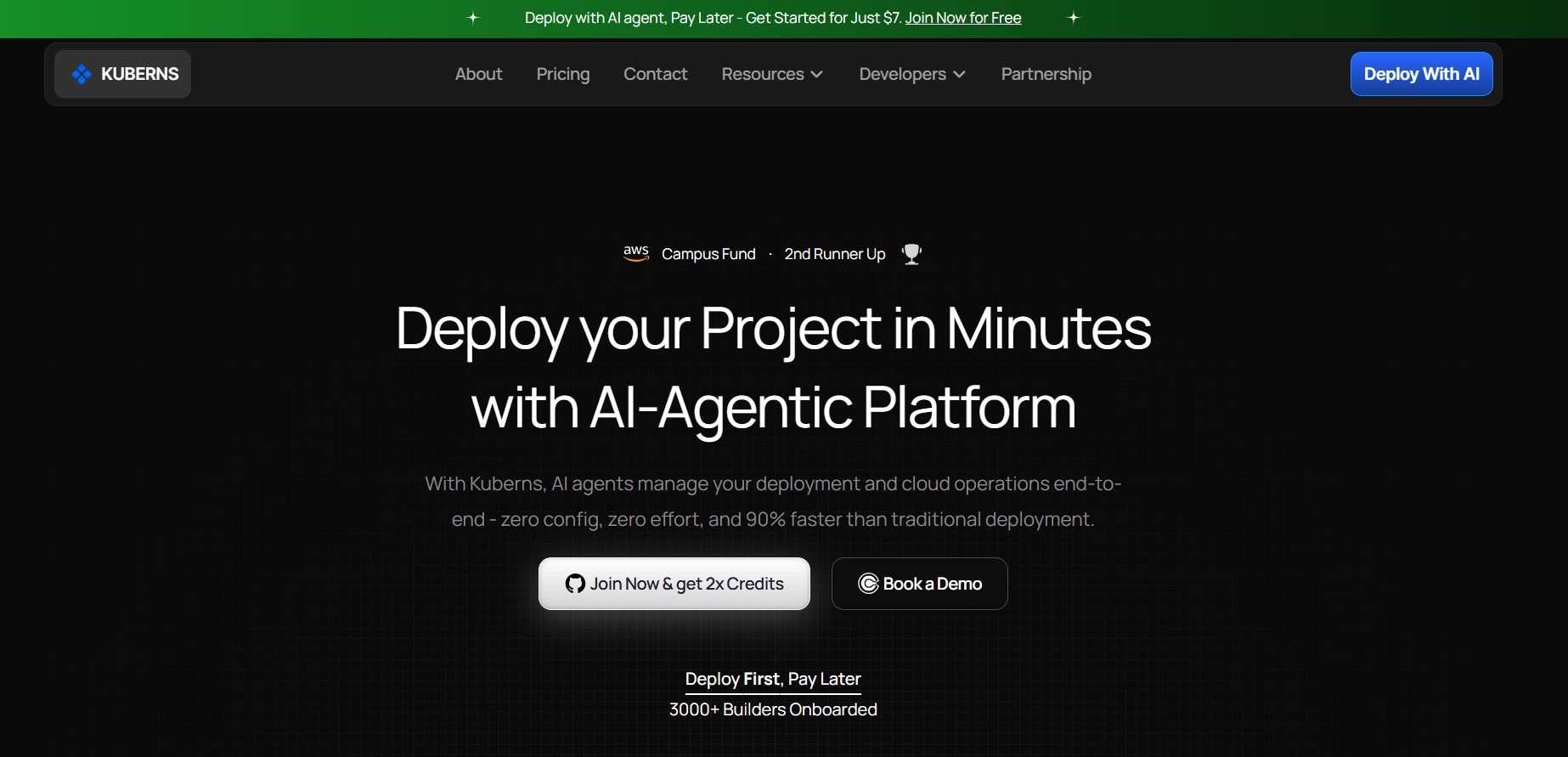
[Kuberns](https://kuberns.com/) is an agent-assisted application deployment platform using AWS-backed infrastructure. Developers connect a supported GitHub repository, add required environment variables, and let the platform identify the stack and prepare the deployment workflow.
**Best for:** Developers and startups that want a managed full-stack deployment workflow without configuring individual AWS services.
**Pricing:** Usage depends on application resources. Use the [Kuberns pricing calculator](https://kuberns.com/pricing) for a workload estimate.
**How it works:** Connect GitHub → add required environment variables → let the agent detect the supported stack and configure deployment → validate the application before production traffic.
**Pros:**
* Repository and stack detection for supported applications
* Integrated build and deployment workflow on repository updates
* HTTPS, logs, deployment history, and application monitoring
* Less infrastructure configuration than assembling EC2, networking, deployment, and monitoring separately
**Choose Kuberns if:** the application uses a supported stack and your team values a consistent repository-to-deployment workflow over direct control of AWS infrastructure. Learn more in [What is Kuberns?](https://kuberns.com/blogs/what-is-kuberns-the-simplest-way-to-build-deploy-and-scale-full-stack-apps/).
### 2. DigitalOcean: Developer-Friendly AWS Alternative

What it is: DigitalOcean has been the default AWS alternative for developers and startups for over a decade. Where AWS overwhelms with 240+ services and an IAM system that requires a dedicated handbook, DigitalOcean gives you clean infrastructure with documentation that actually makes sense. As one developer put it in a cloud provider tier list widely shared on Reddit: "You are the mini CEO of your server. You want a VM for $6/month, and you want it to work. No hidden VPC peering costs. You get a simple bill: $6."
**Best for:** Startups, solo developers, small-to-medium apps, teams who want AWS-grade reliability without AWS-grade complexity
Entry price: [$6/month](https://www.digitalocean.com/pricing/) Droplet (1 vCPU, 1GB RAM, 25GB SSD, 1TB transfer)
**Pros:**
* Predictable flat-rate pricing, no surprise bills from NAT gateways or VPC peering like AWS generates
* Managed databases (PostgreSQL, MySQL, Redis, MongoDB) from $15/month
* App Platform with built-in CI/CD from $5/month, closest thing to Heroku-style deployment on DigitalOcean
* Bangalore data centre for Indian users, good APAC coverage
* Best developer documentation in the cloud industry, DigitalOcean tutorials are so good that AWS developers use them to learn Linux
**Cons:**
* No auto-scaling on Droplets, traffic spikes require manual resize or Kubernetes setup
* Smaller managed service catalogue than AWS, no native equivalent to Lambda, DynamoDB, SQS
* Data transfer overage at $0.01/GB after the included allowance
DigitalOcean combines Droplets with App Platform, Managed Kubernetes, managed data services, storage, and networking. Pricing varies by product and region, so use [DigitalOcean pricing](https://www.digitalocean.com/pricing/) and our [DigitalOcean alternatives guide](https://kuberns.com/blogs/digitalocean-alternatives/) for a current comparison.
### 3. Hetzner Cloud: Best for Budget-Conscious and EU Developers

What it is: Hetzner is the name that comes up every time the discussion on Hacker News or Reddit turns to "how do I cut my cloud bill by 70%?" The German provider has been delivering exceptional price-performance for years, and the developer community has noticed. One Hacker News commenter described it plainly: "For the price of a tiny virtual CPU on AWS, Hetzner gives you an entire physical machine with 64GB of RAM."
**Best for:** Budget-conscious developers, EU-based workloads where GDPR data residency matters, staging and development environments, and teams comfortable managing their own infrastructure
Entry price: CX22 from [€3.79/month](https://www.hetzner.com/cloud/) (2 vCPU, 4GB RAM, 40GB SSD, 20TB traffic)
**Pros:**
* Best price-performance of any major cloud, 4 vCPU, 8GB RAM at €14.39/month vs \~$120/month on AWS EC2
* 20TB included traffic on EU/US servers, compared to AWS, where outbound transfer costs $0.09/GB after a small free allowance
* Managed databases from €4.90/month, load balancers from €5.83/month
* GDPR-compliant by default, German and Finnish data centres
* Servers in Germany, Finland, the USA (Virginia/Oregon), and Singapore
**Cons:**
* No native auto-scaling, you manage horizontal scaling with Terraform or custom scripts
* Managed Kubernetes is available (HCloud K8s), but the ecosystem is thinner than AWS EKS or GKE
* Support quality is community-reported as inconsistent for non-standard issues
* 5 regions vs AWS's 33, not the right choice for global-first apps
Verify current server families, regions, included traffic, and pricing on [Hetzner Cloud](https://www.hetzner.com/cloud/). For more options, see our [Hetzner alternatives guide](https://kuberns.com/blogs/discover-the-best-hetzner-alternative-options-today/).
### 4. Vultr: Best for Global Reach at Low Cost

What it is: Vultr competes on two things: price and global coverage. With 32 data centre locations across North America, Europe, Asia, and Australia, it's the choice for apps that need low latency across multiple regions without the AWS price tag. Benchmarks from independent comparisons (SpinupWP, 2024) put Vultr consistently in the top three for average response time across all tested providers - ahead of DigitalOcean and Linode.
**Best for:** Global apps requiring low latency across multiple regions, developers running multiple small sites or APIs, high-frequency compute workloads
Entry price: From [$2.50/month](https://www.vultr.com/pricing/) (IPv6-only, 1 vCPU, 0.5GB RAM) or $6/month with IPv4 (1 vCPU, 1GB RAM, 25GB SSD, 2TB transfer)
**Pros:**
* 32 regions globally, more than DigitalOcean (15) or Linode (11), approaching AWS's global coverage
* High-frequency compute instances with 3GHz+ CPUs for latency-sensitive apps
* Bare metal from $120/month for dedicated hardware without a hypervisor layer
* $250 credit gives meaningful time to evaluate real production workloads
**Cons:**
* Thinner managed service offering, PostgreSQL and MySQL managed databases, but no MongoDB or managed Redis
* Documentation and support quality lag behind DigitalOcean
* No built-in CI/CD or monitoring, requires third-party tooling
Verify current regions, compute families, databases, Kubernetes, transfer, and support on [Vultr pricing](https://www.vultr.com/pricing/). See [Vultr vs AWS vs Kuberns](https://kuberns.com/blogs/vultr-vs-aws-vs-kuberns-ai/) for a focused comparison.
### 5. Linode / Akamai Cloud: Best for Predictable Pricing and Solid Community

What it is: Previously just Linode, now rebranded as Akamai Cloud following its 2022 acquisition. The result is Linode's developer-friendly compute combined with Akamai's global CDN and DDoS infrastructure. A strong mid-tier option with transparent pricing, good documentation, and a loyal developer community built over many years.
**Best for:** Developers wanting predictable flat-rate pricing with a proven track record, teams wanting managed Kubernetes or GPU instances without enterprise pricing
Entry price: Nanode from [$5/month](https://www.linode.com/pricing/) (1 vCPU, 1GB RAM, 25GB SSD, 1TB transfer)
**Pros:**
* Consistent, transparent pricing with no surprise charges, similar philosophy to DigitalOcean
* GPU instances from $350/month (NVIDIA RTX 4000 Ada), one of the more affordable managed GPU options
* Managed Kubernetes (LKE), Object Storage (S3-compatible API), and managed databases
* Data centres in Mumbai and Singapore for APAC coverage
* Akamai network backing means DDoS protection and CDN capabilities at the infrastructure level
**Cons:**
* Higher per-unit cost than Hetzner for equivalent specs
* Post-acquisition product roadmap is less clear than DigitalOcean's
* No built-in CI/CD, still requires external tooling for deployment automation
Akamai Cloud offers core and distributed compute with different plan availability and transfer terms. Verify these in the [official plan documentation](https://techdocs.akamai.com/cloud-computing/docs/plans-distributed) and compare [Linode vs DigitalOcean](https://kuberns.com/blogs/linode-vs-digitalocean/).
### 6. Google Cloud Platform: Best for AI/ML and Data Workloads

What it is: Google Cloud is a broad hyperscaler alternative with strong data, AI, Kubernetes, serverless, compute, storage, and managed-database services. Its Free Program includes time-limited credits and selected no-cost usage limits; eligibility and regional restrictions should be checked on the [official Google Cloud Free Program page](https://cloud.google.com/free).
**Best for:** AI/ML engineering teams, data analytics workloads (BigQuery), companies already in the Google Workspace ecosystem
**Pricing:** Workload costs depend on service, region, commitments, storage, and network traffic. Use the [Google Cloud pricing calculator](https://cloud.google.com/products/calculator) instead of assuming it is universally cheaper than AWS.
**Pros:**
* Best AI/ML services of any cloud, Vertex AI, TPU access, AutoML, Gemini API integration
* BigQuery is widely considered superior to Amazon Redshift for data warehousing use cases
* Sustained use discounts apply automatically; no Reserved Instance planning is needed
* Generous always-free tier: e2-micro forever, 5GB Cloud Storage, 1M Cloud Functions/month
**Cons:**
* Steeper learning curve than AWS for teams unfamiliar with Google's infrastructure model
* Egress fees comparable to AWS ($0.08-0.12/GB), "GCP is cheaper than AWS" is workload-dependent
* The developer community periodically concerns itself with Google deprecating products, a legitimate long-term worry
Choose Google Cloud when its data, AI, Kubernetes, or Workspace integrations materially fit the workload. See our [Google Cloud alternatives](https://kuberns.com/blogs/google-cloud-alternatives/) for other options.
### 7. Microsoft Azure: Best for Microsoft-Stack Enterprises

What it is: Azure is AWS's closest enterprise-level competitor. For teams already running Microsoft infrastructure, Active Directory, M365, Teams, SharePoint, and SQL Server, Azure is frequently the path of least resistance. Windows Server licenses cost significantly less on Azure than on AWS, which is a concrete financial driver for Windows-first organisations.
**Best for:** Enterprises on Microsoft's ecosystem, hybrid cloud deployments bridging on-premises to cloud, Windows-first development teams
**Pricing:** Azure pricing varies by service, region, operating system, agreement, reservations, and support. Estimate the complete workload with the [Azure pricing calculator](https://azure.microsoft.com/pricing/calculator/).
**Pros:**
* Deep Active Directory and Microsoft 365 integration, SSO and identity management are seamless
* Windows Server licensing is significantly cheaper than AWS, a key driver for Windows workloads
* Azure Arc for hybrid cloud, best option if you have an on-premises infrastructure to bridge
* 60+ regions globally, including Pune and Chennai in India
**Cons:**
* Pricing transparency is worse than AWS, which is itself famously opaque
* Comparable complexity to AWS for non-Microsoft workloads, not a "simpler AWS"
* Less community and third-party tooling support for open-source stacks vs AWS
Choose Azure when Microsoft identity, Windows, SQL Server, development tooling, or hybrid-cloud integration provide a concrete advantage. See our [Azure alternatives guide](https://kuberns.com/blogs/azure-alternatives/).
### 8. Oracle Cloud: Best for Oracle Workloads and Eligible Free Resources

What it is: Oracle Cloud Infrastructure provides compute, Kubernetes, networking, storage, and managed databases, with particular strength for Oracle workloads. OCI documents a time-limited trial and selected Always Free resources, but eligibility, capacity, and regional availability can vary. Verify the current [OCI Free Tier documentation](https://docs.oracle.com/iaas/Content/FreeTier/freetier.htm).
**Best for:** Prototyping, side projects, students, developers testing ideas at zero cost, Oracle database workloads
**Pricing:** Always Free limits and paid OCI resources are service- and region-specific. Do not treat free capacity as guaranteed production capacity.
**Pros:**
* 4 ARM cores + 24GB RAM permanently free, more powerful than any always-free tier on AWS, GCP, or Azure
* 10TB monthly outbound transfer is free, compared to AWS charging $0.09/GB after a small allowance
* Oracle Autonomous Database is included free, an enterprise-grade managed database at zero cost
**Cons:**
* ARM instance availability is unreliable, community reports across GitHub and developer forums document needing days to weeks of daily attempts to provision ARM instances due to capacity constraints, particularly outside the US
* The sign-up process is complex and has rejected legitimate users; multiple community threads report the process taking a week or more, even in US regions
* No enterprise support on Always Free accounts; you're relying on community forums
* For Indian users specifically, card verification issues at sign-up have been widely reported in 2026 developer communities
> Treat Oracle's Always Free tier as a bonus resource rather than a reliable primary infrastructure. For serious production workloads, see our [best Oracle Cloud alternatives](https://kuberns.com/blogs/best-oracle-cloud-alternatives/).
### 9. OVHcloud: Best for EU/GDPR Compliance

What it is: OVHcloud provides public cloud, private cloud, bare metal, Kubernetes, databases, storage, and networking with a strong European footprint. European hosting can support sovereignty and residency goals, but GDPR compliance still depends on configuration, contracts, data flows, and organizational controls.
**Best for:** EU companies with GDPR data residency requirements, European startups wanting competitive EU pricing
**Pricing:** Public-cloud pricing varies by region and product. Verify current compute, Kubernetes, database, storage, and transfer rates on [OVHcloud public-cloud pricing](https://www.ovhcloud.com/en/public-cloud/prices/).
**Pros:**
* Data stored exclusively in the EU meets GDPR data residency requirements without legal complexity
* DDoS protection is built into all plans by default
* Competitive pricing comparable to Hetzner for EU workloads
* OVHcloud has the largest owned data centre footprint in Europe
**Cons:**
* Primarily EU-focused, not suitable for global-audience applications
* Developer experience and documentation quality lag behind DigitalOcean significantly
* Smaller community and fewer third-party integrations
> 💡 Comparing OVHcloud against alternatives? See our [best OVHcloud alternatives](https://kuberns.com/blogs/best-ovh-alternatives/) and [Scaleway alternatives](https://kuberns.com/blogs/scaleway-alternatives/) for a full picture of EU cloud options.
### 10. Cloudflare Workers & R2: Best for Edge Computing and S3 Cost Reduction

What it is: Cloudflare isn't a general-purpose AWS replacement, it's a specialist for two specific use cases: replacing AWS Lambda\@Edge with Workers, and replacing AWS S3 with R2. The financial case for R2 is simple: Cloudflare charges zero egress fees for R2 storage. AWS S3 charges $0.09/GB for outbound data. For high-traffic apps serving large assets from storage, this difference alone can save hundreds of dollars per month.
**Best for:** Replacing AWS Lambda\@Edge with serverless edge functions, reducing S3 egress costs with R2, globally distributed static asset serving, DDoS protection and WAF
**Pricing:** Workers and R2 have separate request, compute, storage, and operation meters. Cloudflare does not charge internet egress fees for R2, but storage and operations remain billable. Verify current limits on [Workers pricing](https://developers.cloudflare.com/workers/platform/pricing/) and [R2 pricing](https://developers.cloudflare.com/r2/pricing/).
**Pros:**
* R2 has zero egress fees vs S3's $0.09/GB for high-volume apps; this is a major cost saving
* Workers run in 300+ edge locations, with the lowest latency possible for distributed compute
* DDoS protection, WAF, and CDN are included at every tier
* D1 (SQLite at the edge), KV store, and Durable Objects for stateful edge applications
**Cons:**
* Not a general-purpose cloud, can't replace EC2, RDS, or the broader AWS compute/database stack
* Workers has CPU time and memory limits, not suitable for long-running tasks
* Best used as a complementary layer on top of another infrastructure provider, not standalone
 ## Who Should Choose Kuberns Over AWS?

When businesses look for AWS alternatives, the question isn't just about price. It's about fit.
AWS is appropriate for many complex and highly controlled workloads. Kuberns is a better fit when a supported application needs a simpler deployment workflow and the team does not require direct control of every AWS resource.
Here's who benefits the most from choosing Kuberns over AWS:
**1. Startups- Lower Burn, Faster Iteration**
Startups live and die by speed and cost efficiency. AWS often forces young teams to overpay for infrastructure they don't fully use.
* Repository detection reduces initial deployment configuration.
* Integrated deployment, logs, and monitoring reduce the number of separate tools to assemble.
* Usage estimates should be based on the actual application workload.
**2. SMBs- Predictable Monthly Costs**
Small and mid-sized businesses don't have the luxury of massive budgets or DevOps teams. AWS billing complexity makes planning hard.
* Kuberns provides all-in-one hosting with no surprise charges.
* Built-in CI/CD and monitoring save SMBs the hassle of buying and maintaining extra tools.
* This means IT budgets can finally be spent on growth instead of overhead.
**3. Agencies- Manage Multiple Projects Without Overhead**
Agencies often juggle multiple client projects and can't afford to spend hours setting up AWS environments for each one.
* With Kuberns, agencies can deploy client projects in minutes.
* Scaling and monitoring are handled automatically, so teams don't need to babysit infrastructure.
* The result: more time spent delivering client value, less time fighting cloud bills.
**4. Freelancers & Independent Developers- Focus on Code, Not Infrastructure**
Freelancers need to impress clients with working apps, not complex AWS setups.
* Kuberns lets them launch projects quickly, without learning the ins and outs of AWS.
* Predictable costs mean freelancers can quote clients confidently without unexpected hosting fees.
* It's the simplest way to run production-ready apps without heavy DevOps knowledge.
> Kuberns is best evaluated as a managed application-deployment layer, not as a replacement for every AWS service or architecture.
## The Bottom Line: Which AWS Alternative Should You Choose?
The right AWS alternative depends on what you are replacing. DigitalOcean, Hetzner, Vultr, and Akamai Cloud simplify or reduce the cost of infrastructure but still leave VM operations with your team. Google Cloud, Azure, Oracle Cloud, and OVHcloud can replace broader cloud estates but retain hyperscaler or infrastructure complexity. Cloudflare Workers and R2 replace specific edge and storage services.
Configuring scale rules. Wiring CI/CD. Installing monitoring. Managing SSL renewals. Debugging deployments. Planning migrations when you outgrow a tier. Every dollar saved in compute can be offset by the engineering time spent managing the infrastructure. A developer spending 8 hours per week on infrastructure at a standard rate spends more in salary than any server bill on this list.
The real question isn't just "which provider is cheaper than AWS?" It's "what is my team's total cost of running infrastructure - compute plus time?"
For supported full-stack repositories, Kuberns is the strongest recommendation when reducing deployment configuration matters more than direct infrastructure control. Connect GitHub, add required environment variables, and validate the agent-configured deployment before moving production traffic.
[Start Saving on Cloud Hosting with Kuberns Agentic AI](https://kuberns.com/)
Connect GitHub. Click deploy. Your app is live on AWS in minutes.
## FAQs on AWS Alternatives
### What is the best AWS alternative in 2026?
Kuberns is the best option in this comparison for supported full-stack repositories that need a managed deployment workflow. DigitalOcean offers approachable cloud infrastructure and App Platform, Hetzner emphasizes low-cost VPS compute, and Google Cloud or Azure are better suited to teams replacing a broad AWS estate.
### What is the cheapest alternative to AWS EC2?
Hetzner Cloud is often among the lowest-cost direct EC2 alternatives when its regions fit the workload. Vultr and Akamai Cloud provide other VM choices. Compare equivalent CPU, memory, storage, transfer, backups, support, availability, and engineering effort rather than relying on the lowest advertised instance.
### Is DigitalOcean a good AWS alternative?
Yes. DigitalOcean combines Droplets, App Platform, Managed Kubernetes, managed databases, storage, networking, and monitoring in a smaller product catalog than AWS. Droplets require server administration, while App Platform removes more deployment work. See our [DigitalOcean alternatives guide](https://kuberns.com/blogs/digitalocean-alternatives/).
### Is Hetzner better than AWS?
Hetzner can be cheaper for comparable virtual-server resources, but AWS offers a broader regional footprint, managed-service catalog, ecosystem, and compliance portfolio. Hetzner is a better fit when its regions satisfy the workload and the team can operate the servers. See [Hetzner vs AWS vs Kuberns](https://kuberns.com/blogs/hetzner-vs-aws-vs-kuberns-ai/).
### What is the best AWS alternative for startups?
Kuberns fits startups that want to connect a supported GitHub repository, add environment variables, and deploy without assembling individual AWS services. DigitalOcean and Akamai Cloud suit teams that still want infrastructure control, while Google Cloud and Azure fit startups that need their specialized ecosystems.
### What is the best AWS alternative with no server management?
Kuberns requires the least server management in this list for supported full-stack repositories because developers work through a managed application platform instead of administering VMs. Cloudflare Workers also removes server management for workloads that fit its edge runtime, but it does not replace a general-purpose AWS environment.
### Is Google Cloud or Azure better than AWS?
Google Cloud is often preferred for data, AI, and Kubernetes workloads, while Azure is frequently selected for Microsoft identity, Windows, SQL Server, and hybrid-cloud integration. AWS has the broadest service ecosystem. The best choice depends on architecture, regional availability, commercial agreements, support, and team expertise.
### What is the best AWS alternative in India?
Choose a provider with an Indian region or acceptable nearby latency, the required managed services, appropriate data-residency terms, and reliable support. DigitalOcean, Akamai Cloud, Vultr, Google Cloud, Azure, Oracle Cloud, and Kuberns may fit different Indian workloads; verify current regional product availability before deciding.
### Can Cloudflare R2 replace Amazon S3?
R2 can replace S3 for many S3-compatible object-storage workloads, especially when internet egress charges are a concern. Migration suitability depends on API compatibility, lifecycle features, integrations, consistency requirements, operations pricing, data location, and existing AWS dependencies.
### What should a team compare before leaving AWS?
Compare compute, databases, storage, network transfer, backups, scaling, regions, compliance, support, migration effort, service compatibility, observability, and engineering time. Run a representative staging workload and test deployment, recovery, performance, and billing before moving production traffic.
---
- [More Alternatives articles](https://kuberns.com/blogs/category/alternatives/1/)
- [All articles](https://kuberns.com/blogs/)
## Who Should Choose Kuberns Over AWS?

When businesses look for AWS alternatives, the question isn't just about price. It's about fit.
AWS is appropriate for many complex and highly controlled workloads. Kuberns is a better fit when a supported application needs a simpler deployment workflow and the team does not require direct control of every AWS resource.
Here's who benefits the most from choosing Kuberns over AWS:
**1. Startups- Lower Burn, Faster Iteration**
Startups live and die by speed and cost efficiency. AWS often forces young teams to overpay for infrastructure they don't fully use.
* Repository detection reduces initial deployment configuration.
* Integrated deployment, logs, and monitoring reduce the number of separate tools to assemble.
* Usage estimates should be based on the actual application workload.
**2. SMBs- Predictable Monthly Costs**
Small and mid-sized businesses don't have the luxury of massive budgets or DevOps teams. AWS billing complexity makes planning hard.
* Kuberns provides all-in-one hosting with no surprise charges.
* Built-in CI/CD and monitoring save SMBs the hassle of buying and maintaining extra tools.
* This means IT budgets can finally be spent on growth instead of overhead.
**3. Agencies- Manage Multiple Projects Without Overhead**
Agencies often juggle multiple client projects and can't afford to spend hours setting up AWS environments for each one.
* With Kuberns, agencies can deploy client projects in minutes.
* Scaling and monitoring are handled automatically, so teams don't need to babysit infrastructure.
* The result: more time spent delivering client value, less time fighting cloud bills.
**4. Freelancers & Independent Developers- Focus on Code, Not Infrastructure**
Freelancers need to impress clients with working apps, not complex AWS setups.
* Kuberns lets them launch projects quickly, without learning the ins and outs of AWS.
* Predictable costs mean freelancers can quote clients confidently without unexpected hosting fees.
* It's the simplest way to run production-ready apps without heavy DevOps knowledge.
> Kuberns is best evaluated as a managed application-deployment layer, not as a replacement for every AWS service or architecture.
## The Bottom Line: Which AWS Alternative Should You Choose?
The right AWS alternative depends on what you are replacing. DigitalOcean, Hetzner, Vultr, and Akamai Cloud simplify or reduce the cost of infrastructure but still leave VM operations with your team. Google Cloud, Azure, Oracle Cloud, and OVHcloud can replace broader cloud estates but retain hyperscaler or infrastructure complexity. Cloudflare Workers and R2 replace specific edge and storage services.
Configuring scale rules. Wiring CI/CD. Installing monitoring. Managing SSL renewals. Debugging deployments. Planning migrations when you outgrow a tier. Every dollar saved in compute can be offset by the engineering time spent managing the infrastructure. A developer spending 8 hours per week on infrastructure at a standard rate spends more in salary than any server bill on this list.
The real question isn't just "which provider is cheaper than AWS?" It's "what is my team's total cost of running infrastructure - compute plus time?"
For supported full-stack repositories, Kuberns is the strongest recommendation when reducing deployment configuration matters more than direct infrastructure control. Connect GitHub, add required environment variables, and validate the agent-configured deployment before moving production traffic.
[Start Saving on Cloud Hosting with Kuberns Agentic AI](https://kuberns.com/)
Connect GitHub. Click deploy. Your app is live on AWS in minutes.
## FAQs on AWS Alternatives
### What is the best AWS alternative in 2026?
Kuberns is the best option in this comparison for supported full-stack repositories that need a managed deployment workflow. DigitalOcean offers approachable cloud infrastructure and App Platform, Hetzner emphasizes low-cost VPS compute, and Google Cloud or Azure are better suited to teams replacing a broad AWS estate.
### What is the cheapest alternative to AWS EC2?
Hetzner Cloud is often among the lowest-cost direct EC2 alternatives when its regions fit the workload. Vultr and Akamai Cloud provide other VM choices. Compare equivalent CPU, memory, storage, transfer, backups, support, availability, and engineering effort rather than relying on the lowest advertised instance.
### Is DigitalOcean a good AWS alternative?
Yes. DigitalOcean combines Droplets, App Platform, Managed Kubernetes, managed databases, storage, networking, and monitoring in a smaller product catalog than AWS. Droplets require server administration, while App Platform removes more deployment work. See our [DigitalOcean alternatives guide](https://kuberns.com/blogs/digitalocean-alternatives/).
### Is Hetzner better than AWS?
Hetzner can be cheaper for comparable virtual-server resources, but AWS offers a broader regional footprint, managed-service catalog, ecosystem, and compliance portfolio. Hetzner is a better fit when its regions satisfy the workload and the team can operate the servers. See [Hetzner vs AWS vs Kuberns](https://kuberns.com/blogs/hetzner-vs-aws-vs-kuberns-ai/).
### What is the best AWS alternative for startups?
Kuberns fits startups that want to connect a supported GitHub repository, add environment variables, and deploy without assembling individual AWS services. DigitalOcean and Akamai Cloud suit teams that still want infrastructure control, while Google Cloud and Azure fit startups that need their specialized ecosystems.
### What is the best AWS alternative with no server management?
Kuberns requires the least server management in this list for supported full-stack repositories because developers work through a managed application platform instead of administering VMs. Cloudflare Workers also removes server management for workloads that fit its edge runtime, but it does not replace a general-purpose AWS environment.
### Is Google Cloud or Azure better than AWS?
Google Cloud is often preferred for data, AI, and Kubernetes workloads, while Azure is frequently selected for Microsoft identity, Windows, SQL Server, and hybrid-cloud integration. AWS has the broadest service ecosystem. The best choice depends on architecture, regional availability, commercial agreements, support, and team expertise.
### What is the best AWS alternative in India?
Choose a provider with an Indian region or acceptable nearby latency, the required managed services, appropriate data-residency terms, and reliable support. DigitalOcean, Akamai Cloud, Vultr, Google Cloud, Azure, Oracle Cloud, and Kuberns may fit different Indian workloads; verify current regional product availability before deciding.
### Can Cloudflare R2 replace Amazon S3?
R2 can replace S3 for many S3-compatible object-storage workloads, especially when internet egress charges are a concern. Migration suitability depends on API compatibility, lifecycle features, integrations, consistency requirements, operations pricing, data location, and existing AWS dependencies.
### What should a team compare before leaving AWS?
Compare compute, databases, storage, network transfer, backups, scaling, regions, compliance, support, migration effort, service compatibility, observability, and engineering time. Run a representative staging workload and test deployment, recovery, performance, and billing before moving production traffic.
---
- [More Alternatives articles](https://kuberns.com/blogs/category/alternatives/1/)
- [All articles](https://kuberns.com/blogs/)