# Best Ecommerce Hosting Platforms in 2026 for Developers
> Compare the best ecommerce hosting platforms in 2026. Find out which platforms are fast, scalable, and developer-friendly for hosting your online store backend.
- **Author**: riddhi-dudhatra
- **Published**: 2026-06-10
- **Modified**: 2026-06-10
- **Category**: Deployment Guides
- **URL**: https://kuberns.com/blogs/best-ecommerce-hosting-platforms/
---
Your ecommerce store is only as reliable as the platform it runs on. A slow checkout page, a downtime during a product launch, or an outage during a flash sale costs real money. Choosing the right hosting platform is one of the most important technical decisions you make for an online store.
In 2026, the options range from managed platforms that handle everything automatically to raw cloud infrastructure that gives you full control but demands a full DevOps team to operate. This guide covers the best ecommerce hosting platforms for developers, what each one is actually good for, and why [Kuberns](https://kuberns.com) is the platform that handles the full stack without the overhead.
## What Ecommerce Hosting Actually Needs
Hosting a blog and hosting an ecommerce store are not the same problem. An ecommerce backend has requirements that generic web hosting does not cover well.
**Uptime that does not negotiate.** A blog going offline for 30 minutes is an inconvenience. An ecommerce store going offline for 30 minutes during a sale is lost revenue and damaged trust. Your hosting platform needs enterprise-grade uptime backed by real infrastructure.
**Autoscaling for traffic spikes.** Ecommerce traffic is not steady. Product launches, flash sales, social media mentions, and seasonal events can multiply your traffic in minutes. A platform that cannot scale automatically fails at the worst possible moment.
**Fast deployment without downtime.** When you push a product update, a pricing change, or a bug fix, your store should stay live. Zero-downtime deployments are not optional for production ecommerce.
**Secure environment variable management.** Stripe API keys, database credentials, payment gateway secrets. These cannot be committed to source control and must be injected securely at runtime.
**Persistent server for dynamic stores.** Serverless platforms with function timeouts are not suitable for full-stack ecommerce applications. Cart sessions, checkout flows, and payment processing require a persistent server that stays alive between requests.
**CI/CD built in.** Every code change should deploy automatically when it hits your main branch. Manual deploys on a production store are a reliability risk.
[Kuberns](https://kuberns.com) covers all of these out of the box with no manual configuration.
## Best Ecommerce Hosting Platforms in 2026
## 1. Kuberns: Best Overall for Ecommerce Hosting

[Kuberns](https://kuberns.com) is an Agentic AI cloud platform built on AWS. It deploys any ecommerce backend from GitHub automatically, no Dockerfiles, no YAML, no infrastructure configuration required.
Whether you are running a Node.js headless ecommerce backend with Medusa, a PHP WooCommerce store, a Python Django shop, or a custom Next.js full-stack application, Kuberns reads your repository and sets up the entire deployment automatically. It detects your stack, installs dependencies, runs your build, and gets your store live with HTTPS and CI/CD in under 5 minutes.
**Why Kuberns is the right choice for ecommerce:**
- Auto-detects and deploys Node.js, PHP, Python, Go, Ruby, Java, and containerized ecommerce stacks
- Agentic AI manages the full deployment lifecycle including builds, restarts, and scaling
- AI-driven autoscaling handles traffic spikes automatically with no manual rules to configure
- Zero-downtime deployments keep your store live during every code update
- Unified monitoring, real-time logs, and AI-driven alerts in one dashboard
- Secure environment variable management for API keys, database URLs, and payment secrets
- Built on AWS, the same infrastructure that powers the world's largest ecommerce stores
- Save up to 40% on infrastructure costs compared to direct AWS or equivalent Heroku setups
- No per-project fees, no per-user fees, no DevOps team required
- Free credits to get started, no credit card required
**Best for:** Developers and teams building custom ecommerce stores, headless commerce backends, and full-stack online stores who want AWS-grade reliability without infrastructure overhead.
 ## 2. AWS

AWS powers a significant portion of the internet, and its reputation for reliability is well earned. Many large ecommerce operations run on it. The challenge for most teams is the gap between the infrastructure and actually having your store running.
Hosting an ecommerce backend directly on AWS means configuring EC2 instances, VPCs, security groups, load balancers, auto-scaling groups, RDS databases, and IAM policies before your first deployment. Each piece requires its own expertise. Without a dedicated DevOps engineer, setup that takes minutes on Kuberns can consume days on raw AWS.
Cost management is an ongoing effort rather than a solved problem. AWS bills grow in ways that are difficult to anticipate without deep experience, and traffic spikes during sales events can result in charges that surprise even experienced teams.
Kuberns is built on AWS infrastructure. Teams that want AWS-grade reliability without the operational burden get both when they deploy on Kuberns.
## 3. DigitalOcean App Platform

DigitalOcean App Platform gives teams a managed deployment layer on top of DigitalOcean infrastructure, which lowers the barrier compared to raw VPS management. It integrates with GitHub and handles auto-deploys across several popular runtimes.
For ecommerce workloads, the platform shows its limits under pressure. Autoscaling is manual and vertical only, meaning you decide when to resize and by how much. There are no rules based on real traffic, which creates risk during unpredictable spikes. Monitoring covers the basics but lacks the intelligent alerting and unified observability that production ecommerce teams depend on when diagnosing checkout failures at speed.
Pricing also tends to grow quietly. Separate charges for managed databases, bandwidth, and additional services stack up in ways that are not immediately obvious, and there is no cost optimization layer built into the platform.
See [best DigitalOcean alternatives](https://kuberns.com/blogs/digitalocean-alternatives/) for more.
## 4. Heroku
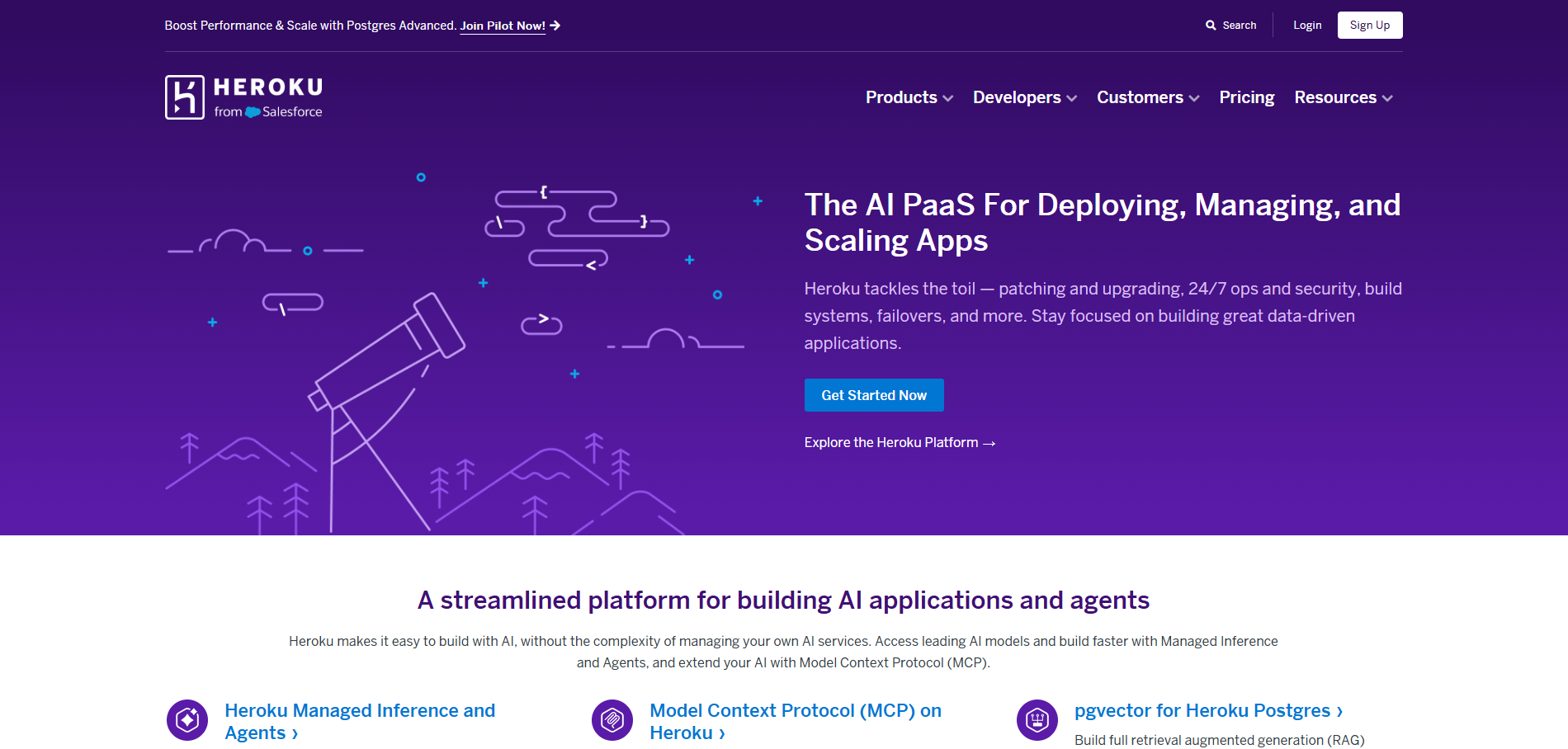
Heroku has a long history in the PaaS space and its Git-based deployment model remains straightforward to use. For teams evaluating it as an ecommerce hosting option in 2026, however, the economics tell a more complicated story.
The costs. Dynos are billed per hour regardless of whether your store is receiving traffic. Add a managed Postgres database, Redis for cart sessions, and any monitoring or logging add-ons and you are paying several hundred dollars a month for a mid-size ecommerce setup before your store has served a single order. Kuberns delivers the same capabilities at up to 40% lower cost.
Autoscaling on Heroku requires manual dyno configuration. There are no automatic scaling rules based on real traffic. For ecommerce stores, that means either over-provisioning at all times or manually scaling up before anticipated spikes, both of which waste money or create downtime risk. Kuberns autoscales automatically with no intervention required.
Heroku has also had documented reliability incidents affecting production apps, with limited mitigation options for standard plan customers. For a store where every minute of downtime is a revenue loss, that track record matters.
For more, see [best Heroku alternatives](https://kuberns.com/blogs/heroku-alternatives/).
## 5. Render
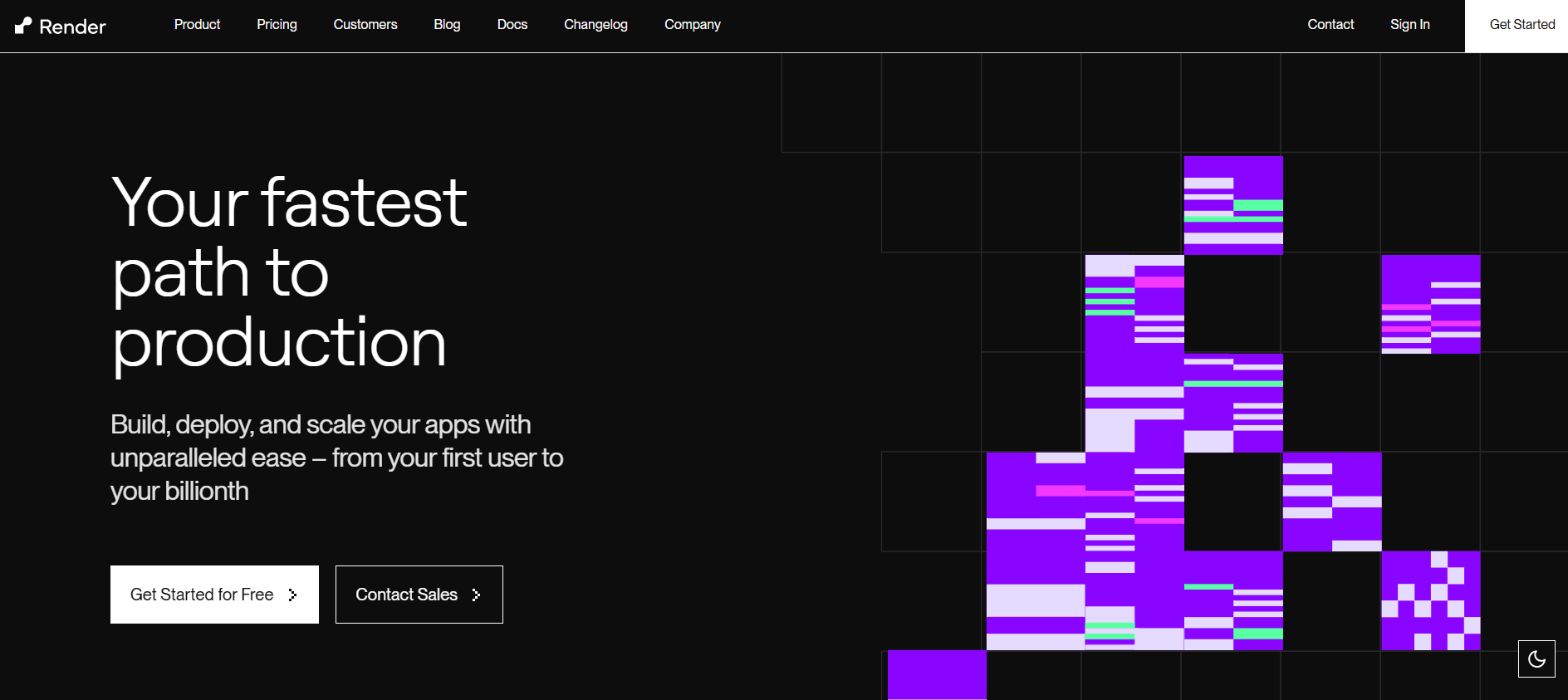
Render is often considered by teams looking for a lower-cost deployment option, and it is straightforward to get a basic app running. However, the gap between getting started and running a reliable production store becomes apparent quickly.
The most significant issue for live ecommerce stores: free tier services spin down after inactivity and take 30 seconds or more to wake up. That means the first visitor after any quiet period waits while your store boots. For a paying customer arriving at checkout, a 30-second blank screen is a conversion killer.
Render's paid tiers remove the spin-down but the pricing stacks up quickly across a full ecommerce stack with web service, database, and any background workers. There is no intelligent autoscaling, no AI-driven monitoring, and no unified dashboard that gives you a complete view of your store's deployment health. When a checkout flow fails or an order processing job stalls, you are piecing together what went wrong from scattered basic logs with no intelligent correlation to speed things up.
For any ecommerce store that takes revenue seriously, the absence of autoscaling and proper observability is a risk that compounds over time. Render works fine for a demo. It is not a platform you want between your customers and their orders in production.
For a detailed comparison, see [Render alternatives](https://kuberns.com/blogs/best-render-alternatives/).
## 6. Railway
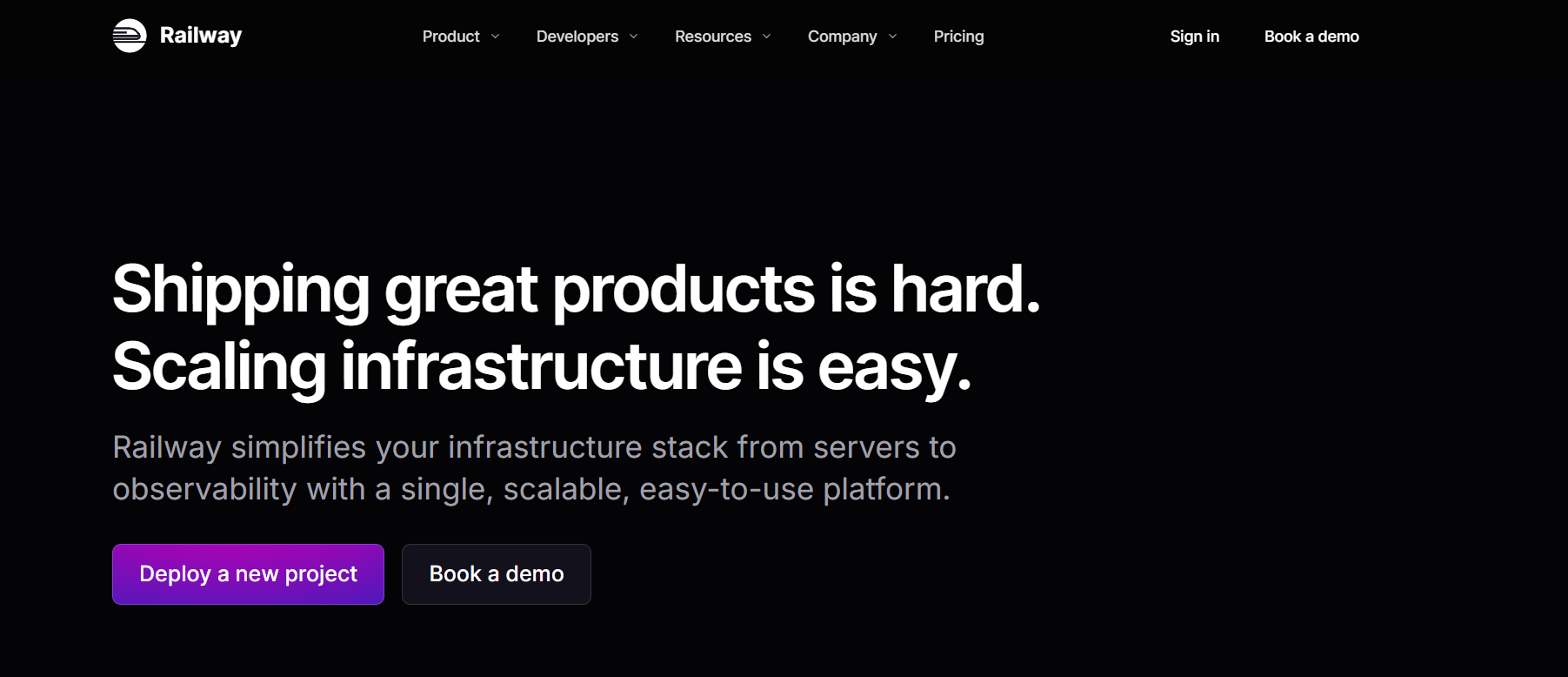
Railway has usage-based pricing that looks attractive on paper, but the platform struggles to hold up once real ecommerce workloads and real customers are involved.
For a production ecommerce store, the platform has gaps that become harder to ignore over time. Railway has had documented platform-wide outages where services went offline for hours with no SLA and no resolution timeline communicated to affected teams. An ecommerce store that goes dark during a product launch or peak sales period is not a recoverable situation on a platform with no uptime guarantees.
Observability is thin across the board. There is no unified metrics dashboard, no intelligent alerting, and no role-based access controls for team environments. When a payment integration fails silently or a checkout flow breaks at 2am, Railway leaves you without the visibility to diagnose it quickly. You are left manually digging through basic logs while your store is losing orders.
Usage-based pricing becomes increasingly unpredictable at any real ecommerce scale. There is no cost protection, no SLA on standard plans, and no AI to optimize your infrastructure spend. What starts as an affordable option for prototyping quietly becomes a reliability and cost problem once real customers are involved. Railway is a tool for building an ecommerce store, not for running one.
For more, see [Railway alternatives](https://kuberns.com/blogs/best-railway-alternatives/).
## How to Deploy Your Ecommerce Store on Kuberns
Getting your ecommerce store live on Kuberns takes under 5 minutes. Here is what the process looks like.
### Prerequisites
Before you start, have these ready:
- Your ecommerce project pushed to a GitHub repository
- Your environment variables: database URL, payment gateway keys, API secrets
- A Kuberns account (free to create, no credit card required)
### Step 1: Sign Up on Kuberns

Go to [kuberns.com](https://kuberns.com) and click **Deploy with AI**. Sign up with Google or GitHub. Your account comes with free credits to deploy immediately.
### Step 2: Connect Your GitHub Repository
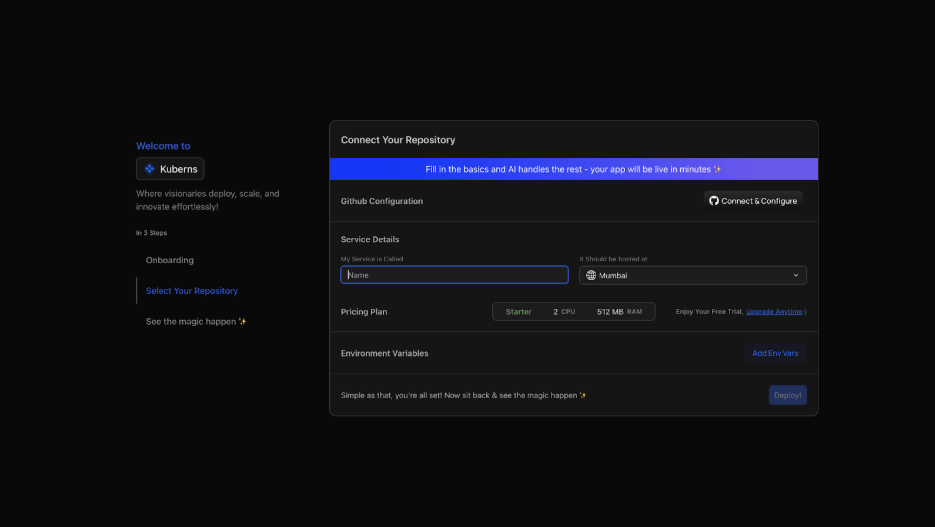
On the **Create Service** page, connect your GitHub account and select your ecommerce repository and branch.
Kuberns AI scans your project and detects your framework, build command, start command, and runtime automatically. Whether it is a Medusa.js backend, a WooCommerce PHP app, a Django store, or a custom Node.js application, no configuration form to fill in.
### Step 3: Add Your Environment Variables

Add your environment variables in the Environment tab. Database URLs, Stripe keys, payment gateway secrets, and any other runtime configuration all go here.
You can add them individually or upload your `.env` file directly. Kuberns encrypts every value and injects them securely at build time and runtime. Nothing gets committed to your repository.
### Step 4: Click Deploy

Click **Deploy**. Kuberns Agentic AI handles the rest:
- Installs all dependencies from your package manifest
- Runs your build command
- Starts your store as a persistent server on AWS
- Issues an SSL certificate and assigns a live HTTPS URL
- Configures CI/CD so every future push to your main branch triggers an automatic zero-downtime redeploy
### Step 5: Your Store is Live

Your ecommerce store is live in under 5 minutes. Connect your custom domain from the dashboard. From this point, every push to your main branch deploys automatically with no downtime and no manual steps.
## 2. AWS

AWS powers a significant portion of the internet, and its reputation for reliability is well earned. Many large ecommerce operations run on it. The challenge for most teams is the gap between the infrastructure and actually having your store running.
Hosting an ecommerce backend directly on AWS means configuring EC2 instances, VPCs, security groups, load balancers, auto-scaling groups, RDS databases, and IAM policies before your first deployment. Each piece requires its own expertise. Without a dedicated DevOps engineer, setup that takes minutes on Kuberns can consume days on raw AWS.
Cost management is an ongoing effort rather than a solved problem. AWS bills grow in ways that are difficult to anticipate without deep experience, and traffic spikes during sales events can result in charges that surprise even experienced teams.
Kuberns is built on AWS infrastructure. Teams that want AWS-grade reliability without the operational burden get both when they deploy on Kuberns.
## 3. DigitalOcean App Platform

DigitalOcean App Platform gives teams a managed deployment layer on top of DigitalOcean infrastructure, which lowers the barrier compared to raw VPS management. It integrates with GitHub and handles auto-deploys across several popular runtimes.
For ecommerce workloads, the platform shows its limits under pressure. Autoscaling is manual and vertical only, meaning you decide when to resize and by how much. There are no rules based on real traffic, which creates risk during unpredictable spikes. Monitoring covers the basics but lacks the intelligent alerting and unified observability that production ecommerce teams depend on when diagnosing checkout failures at speed.
Pricing also tends to grow quietly. Separate charges for managed databases, bandwidth, and additional services stack up in ways that are not immediately obvious, and there is no cost optimization layer built into the platform.
See [best DigitalOcean alternatives](https://kuberns.com/blogs/digitalocean-alternatives/) for more.
## 4. Heroku

Heroku has a long history in the PaaS space and its Git-based deployment model remains straightforward to use. For teams evaluating it as an ecommerce hosting option in 2026, however, the economics tell a more complicated story.
The costs. Dynos are billed per hour regardless of whether your store is receiving traffic. Add a managed Postgres database, Redis for cart sessions, and any monitoring or logging add-ons and you are paying several hundred dollars a month for a mid-size ecommerce setup before your store has served a single order. Kuberns delivers the same capabilities at up to 40% lower cost.
Autoscaling on Heroku requires manual dyno configuration. There are no automatic scaling rules based on real traffic. For ecommerce stores, that means either over-provisioning at all times or manually scaling up before anticipated spikes, both of which waste money or create downtime risk. Kuberns autoscales automatically with no intervention required.
Heroku has also had documented reliability incidents affecting production apps, with limited mitigation options for standard plan customers. For a store where every minute of downtime is a revenue loss, that track record matters.
For more, see [best Heroku alternatives](https://kuberns.com/blogs/heroku-alternatives/).
## 5. Render

Render is often considered by teams looking for a lower-cost deployment option, and it is straightforward to get a basic app running. However, the gap between getting started and running a reliable production store becomes apparent quickly.
The most significant issue for live ecommerce stores: free tier services spin down after inactivity and take 30 seconds or more to wake up. That means the first visitor after any quiet period waits while your store boots. For a paying customer arriving at checkout, a 30-second blank screen is a conversion killer.
Render's paid tiers remove the spin-down but the pricing stacks up quickly across a full ecommerce stack with web service, database, and any background workers. There is no intelligent autoscaling, no AI-driven monitoring, and no unified dashboard that gives you a complete view of your store's deployment health. When a checkout flow fails or an order processing job stalls, you are piecing together what went wrong from scattered basic logs with no intelligent correlation to speed things up.
For any ecommerce store that takes revenue seriously, the absence of autoscaling and proper observability is a risk that compounds over time. Render works fine for a demo. It is not a platform you want between your customers and their orders in production.
For a detailed comparison, see [Render alternatives](https://kuberns.com/blogs/best-render-alternatives/).
## 6. Railway

Railway has usage-based pricing that looks attractive on paper, but the platform struggles to hold up once real ecommerce workloads and real customers are involved.
For a production ecommerce store, the platform has gaps that become harder to ignore over time. Railway has had documented platform-wide outages where services went offline for hours with no SLA and no resolution timeline communicated to affected teams. An ecommerce store that goes dark during a product launch or peak sales period is not a recoverable situation on a platform with no uptime guarantees.
Observability is thin across the board. There is no unified metrics dashboard, no intelligent alerting, and no role-based access controls for team environments. When a payment integration fails silently or a checkout flow breaks at 2am, Railway leaves you without the visibility to diagnose it quickly. You are left manually digging through basic logs while your store is losing orders.
Usage-based pricing becomes increasingly unpredictable at any real ecommerce scale. There is no cost protection, no SLA on standard plans, and no AI to optimize your infrastructure spend. What starts as an affordable option for prototyping quietly becomes a reliability and cost problem once real customers are involved. Railway is a tool for building an ecommerce store, not for running one.
For more, see [Railway alternatives](https://kuberns.com/blogs/best-railway-alternatives/).
## How to Deploy Your Ecommerce Store on Kuberns
Getting your ecommerce store live on Kuberns takes under 5 minutes. Here is what the process looks like.
### Prerequisites
Before you start, have these ready:
- Your ecommerce project pushed to a GitHub repository
- Your environment variables: database URL, payment gateway keys, API secrets
- A Kuberns account (free to create, no credit card required)
### Step 1: Sign Up on Kuberns

Go to [kuberns.com](https://kuberns.com) and click **Deploy with AI**. Sign up with Google or GitHub. Your account comes with free credits to deploy immediately.
### Step 2: Connect Your GitHub Repository

On the **Create Service** page, connect your GitHub account and select your ecommerce repository and branch.
Kuberns AI scans your project and detects your framework, build command, start command, and runtime automatically. Whether it is a Medusa.js backend, a WooCommerce PHP app, a Django store, or a custom Node.js application, no configuration form to fill in.
### Step 3: Add Your Environment Variables

Add your environment variables in the Environment tab. Database URLs, Stripe keys, payment gateway secrets, and any other runtime configuration all go here.
You can add them individually or upload your `.env` file directly. Kuberns encrypts every value and injects them securely at build time and runtime. Nothing gets committed to your repository.
### Step 4: Click Deploy

Click **Deploy**. Kuberns Agentic AI handles the rest:
- Installs all dependencies from your package manifest
- Runs your build command
- Starts your store as a persistent server on AWS
- Issues an SSL certificate and assigns a live HTTPS URL
- Configures CI/CD so every future push to your main branch triggers an automatic zero-downtime redeploy
### Step 5: Your Store is Live

Your ecommerce store is live in under 5 minutes. Connect your custom domain from the dashboard. From this point, every push to your main branch deploys automatically with no downtime and no manual steps.
 ## Comparison Table: Ecommerce Hosting Platforms
| Platform | Autoscaling | Cold Starts | Zero-Downtime Deploy | Monitoring | Pricing |
|---|---|---|---|---|---|
| **Kuberns** | AI-driven, automatic | None | Yes | Unified, built-in | From $7/month, usage-based |
| AWS | Yes, manual config | No | Yes | Separate setup needed | Unpredictable without expertise |
| DigitalOcean | Vertical only, manual | No | Yes | Basic only | Stacks up across services |
| Heroku | Manual, limited | No | Yes | Add-on required | Expensive at scale |
| Render | No | Yes, up to 30s | Yes | Basic only | Per-service charges add up |
| Railway | No | Yes | Yes | Minimal | Unpredictable at scale |
## Why Kuberns is the Right Hosting Platform for Ecommerce
Every platform on this list can technically host an ecommerce store. The question is which one does it without requiring you to become a DevOps engineer to keep it running.
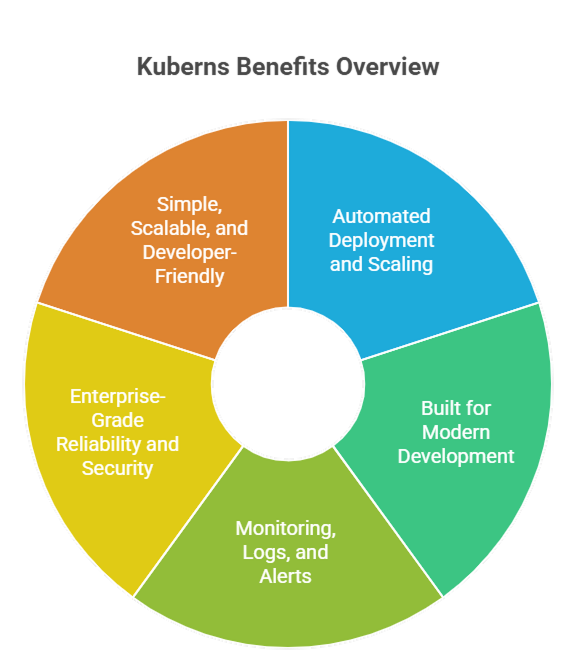
Kuberns is built on AWS, the same infrastructure that powers the world's largest ecommerce operations. It delivers enterprise-grade uptime, automatic scaling, zero-downtime deployments, and built-in monitoring without any of the configuration overhead that raw AWS demands.
You push code. Kuberns deploys it. Your store stays live, scales when traffic spikes, and alerts you when something needs attention. That is what ecommerce hosting should look like.
[Start deploying your ecommerce store on Kuberns for free](https://dashboard.kuberns.com/)
## Conclusion
Choosing the wrong hosting platform for your ecommerce store costs you in uptime, in performance, and in developer time spent managing infrastructure instead of building the store.
In 2026, [Kuberns](https://kuberns.com) is the best ecommerce hosting platform for developers building custom online stores. It combines AWS infrastructure with Agentic AI that handles deployment, scaling, and monitoring automatically. Connect your GitHub repo, add your environment variables, click Deploy, and your store is live in under 5 minutes.
## Frequently Asked Questions
### What is the best hosting platform for an ecommerce store in 2026?
Kuberns is the best hosting platform for ecommerce stores in 2026. It deploys any ecommerce backend directly from GitHub using Agentic AI. No YAML, no Docker, no DevOps team required. Your store is live on AWS infrastructure in under 5 minutes.
### What do I need from a hosting platform for my ecommerce site?
Your ecommerce hosting needs fast uptime, autoscaling for traffic spikes, managed environment variables for API keys, CI/CD for deploying updates without downtime, and built-in monitoring. Kuberns provides all of this with no manual configuration.
### Can I deploy a WooCommerce or WordPress store on Kuberns?
Yes. Kuberns supports PHP applications including WordPress and WooCommerce. Connect your GitHub repository, add your environment variables including your database connection string, and Kuberns deploys your store with HTTPS and CI/CD automatically.
### Can I deploy a Medusa or headless ecommerce backend on Kuberns?
Yes. Kuberns auto-detects Node.js applications including Medusa.js headless ecommerce backends. Connect your repo, add environment variables, and click Deploy. The AI handles the build and deployment in under 5 minutes.
### Does ecommerce hosting need autoscaling?
Yes. Ecommerce traffic is unpredictable. Flash sales, product launches, and seasonal spikes can multiply your traffic in minutes. A platform without autoscaling means your store goes down exactly when it matters most. Kuberns autoscales automatically based on real traffic with no manual rules to configure.
### How much does ecommerce hosting cost on Kuberns?
Kuberns uses usage-based pricing on AWS infrastructure and costs up to 40 percent less than equivalent Heroku setups. New accounts get free credits to start with no credit card required. You pay for what you use with no per-project or per-user fees.
### Is AWS good for ecommerce hosting?
AWS provides excellent infrastructure for large ecommerce operations but requires significant DevOps expertise to configure and manage. For most teams, Kuberns delivers the same AWS-grade reliability with none of the setup overhead.
---
- [More Deployment Guides articles](https://kuberns.com/blogs/category/deployment-guides/1/)
- [All articles](https://kuberns.com/blogs/)
## Comparison Table: Ecommerce Hosting Platforms
| Platform | Autoscaling | Cold Starts | Zero-Downtime Deploy | Monitoring | Pricing |
|---|---|---|---|---|---|
| **Kuberns** | AI-driven, automatic | None | Yes | Unified, built-in | From $7/month, usage-based |
| AWS | Yes, manual config | No | Yes | Separate setup needed | Unpredictable without expertise |
| DigitalOcean | Vertical only, manual | No | Yes | Basic only | Stacks up across services |
| Heroku | Manual, limited | No | Yes | Add-on required | Expensive at scale |
| Render | No | Yes, up to 30s | Yes | Basic only | Per-service charges add up |
| Railway | No | Yes | Yes | Minimal | Unpredictable at scale |
## Why Kuberns is the Right Hosting Platform for Ecommerce

Every platform on this list can technically host an ecommerce store. The question is which one does it without requiring you to become a DevOps engineer to keep it running.
Kuberns is built on AWS, the same infrastructure that powers the world's largest ecommerce operations. It delivers enterprise-grade uptime, automatic scaling, zero-downtime deployments, and built-in monitoring without any of the configuration overhead that raw AWS demands.
You push code. Kuberns deploys it. Your store stays live, scales when traffic spikes, and alerts you when something needs attention. That is what ecommerce hosting should look like.
[Start deploying your ecommerce store on Kuberns for free](https://dashboard.kuberns.com/)
## Conclusion
Choosing the wrong hosting platform for your ecommerce store costs you in uptime, in performance, and in developer time spent managing infrastructure instead of building the store.
In 2026, [Kuberns](https://kuberns.com) is the best ecommerce hosting platform for developers building custom online stores. It combines AWS infrastructure with Agentic AI that handles deployment, scaling, and monitoring automatically. Connect your GitHub repo, add your environment variables, click Deploy, and your store is live in under 5 minutes.
## Frequently Asked Questions
### What is the best hosting platform for an ecommerce store in 2026?
Kuberns is the best hosting platform for ecommerce stores in 2026. It deploys any ecommerce backend directly from GitHub using Agentic AI. No YAML, no Docker, no DevOps team required. Your store is live on AWS infrastructure in under 5 minutes.
### What do I need from a hosting platform for my ecommerce site?
Your ecommerce hosting needs fast uptime, autoscaling for traffic spikes, managed environment variables for API keys, CI/CD for deploying updates without downtime, and built-in monitoring. Kuberns provides all of this with no manual configuration.
### Can I deploy a WooCommerce or WordPress store on Kuberns?
Yes. Kuberns supports PHP applications including WordPress and WooCommerce. Connect your GitHub repository, add your environment variables including your database connection string, and Kuberns deploys your store with HTTPS and CI/CD automatically.
### Can I deploy a Medusa or headless ecommerce backend on Kuberns?
Yes. Kuberns auto-detects Node.js applications including Medusa.js headless ecommerce backends. Connect your repo, add environment variables, and click Deploy. The AI handles the build and deployment in under 5 minutes.
### Does ecommerce hosting need autoscaling?
Yes. Ecommerce traffic is unpredictable. Flash sales, product launches, and seasonal spikes can multiply your traffic in minutes. A platform without autoscaling means your store goes down exactly when it matters most. Kuberns autoscales automatically based on real traffic with no manual rules to configure.
### How much does ecommerce hosting cost on Kuberns?
Kuberns uses usage-based pricing on AWS infrastructure and costs up to 40 percent less than equivalent Heroku setups. New accounts get free credits to start with no credit card required. You pay for what you use with no per-project or per-user fees.
### Is AWS good for ecommerce hosting?
AWS provides excellent infrastructure for large ecommerce operations but requires significant DevOps expertise to configure and manage. For most teams, Kuberns delivers the same AWS-grade reliability with none of the setup overhead.
---
- [More Deployment Guides articles](https://kuberns.com/blogs/category/deployment-guides/1/)
- [All articles](https://kuberns.com/blogs/)