# Best Hosting Platforms for Indian Startups in 2026
> Comparing the best hosting platforms for Indian startups in 2026. Covers pricing, latency, DevOps overhead, and which platform actually fits a startup budget.
- **Author**: aaliya-shaikh
- **Published**: 2026-06-18
- **Modified**: 2026-06-18
- **Category**: AI & DevOps
- **URL**: https://kuberns.com/blogs/best-hosting-platforms-for-indian-startups/
---
Indian startups face a specific version of the hosting decision: you need infrastructure that is reliable enough for paying users, cheap enough to survive pre-revenue, and simple enough that your two-person team is not spending evenings debugging deployment pipelines.
In 2026, the options are better than they have ever been. The challenge is knowing which platforms are actually built for your situation and which are built for enterprise teams with dedicated DevOps engineers.
This guide covers the hosting platforms that make sense for Indian startups, what each one costs in practice, and where each one tends to fall short.
If you want the short answer: [Kuberns](https://kuberns.com) is the platform most Indian startups should start with. It runs on AWS infrastructure with India region support, deploys your app from GitHub in under 5 minutes with no DevOps work, and offers free credits to get started. The rest of this guide explains why, and where other platforms make more sense for specific situations.
## What Indian Startups Actually Need From a Hosting Platform
Before comparing platforms, it helps to be specific about what matters for an early-stage Indian startup.
**Low latency for Indian users.** If your product is built for the Indian market, hosting in a data center near your users matters. A server in Virginia adds 180 to 220ms of latency to every request for someone in Bengaluru. AWS Mumbai and Hyderabad, DigitalOcean Bangalore, and GCP Mumbai are the regions to look at.
**Predictable pricing in USD or INR.** Cloud billing surprises are painful for any team. For a bootstrapped Indian startup managing runway in rupees, a surprise egress fee or an autoscaling charge that was not expected can derail a month. Platforms with transparent, flat pricing are better than those with per-unit compute models that compound in ways that are hard to predict.
**No DevOps overhead.** Most early-stage Indian startups are not staffed with a DevOps engineer. The founding team is usually product and engineering. Any platform that requires significant infrastructure configuration before you can ship your first version is a platform that is working against you.
**Room to grow without a migration.** A platform that works at 10 users should also work at 10,000 without requiring you to replatform, rewrite your deployment setup, or hire additional infrastructure expertise. Pick the platform that grows with you.
**Support for standard stacks.** Indian startup teams predominantly build on Node.js, Python (Django, FastAPI), React, Next.js, and increasingly Go. Any platform worth using should deploy these with minimal setup.
 ## The Best Hosting Platforms for Indian Startups in 2026
### 1. Kuberns

[Kuberns](https://kuberns.com) is an Agentic AI cloud platform built on AWS infrastructure. It is the option on this list that removes the most friction between writing code and having it run in production.
Connect your GitHub repository, add your environment variables, and click Deploy. Kuberns reads your project automatically, detects your stack (Node.js, Python, Go, PHP, full-stack frameworks), installs dependencies, builds your app, and gets it live with HTTPS and CI/CD enabled in under 5 minutes. No Dockerfile, no YAML, no infrastructure decisions.
**What makes it relevant for Indian startups specifically:**
Kuberns deploys on AWS, which means you can target the ap-south-1 (Mumbai) or ap-south-2 (Hyderabad) regions for low-latency serving to Indian users. Every subsequent push to your main branch triggers an automatic redeploy, so your team ships continuously without manual steps.
The Agentic AI layer manages the deployment lifecycle after your app goes live. Autoscaling adjusts capacity based on actual traffic. Monitoring and logs are available in the dashboard. If your app crashes, Kuberns restarts it automatically.
For an Indian startup that does not want to hire a DevOps engineer or spend engineering hours on infrastructure, this is the platform that matches your actual situation.
**Pricing:** Free credits (approximately $14 for 30 days) with no credit card required. Paid plans start from $7 per month. Up to 40 percent cost savings compared to managing AWS directly.
**Best for:** Product teams that want to ship fast without infrastructure overhead. Startups that need AWS-grade reliability without AWS-grade complexity.
---
### 2. DigitalOcean

DigitalOcean sounds appealing at first glance, but for most Indian startups it quickly reveals its gaps. Raw Droplets give you nothing but a Linux box. You are responsible for setting up Nginx, configuring SSL certificates, writing firewall rules, setting up monitoring, and building your own deployment pipeline from scratch. None of that comes with the server.
The App Platform tries to solve this, but it is limited in what it actually handles. You still end up debugging build failures, managing environment variables manually, and dealing with a UI that lacks the intelligence to adapt to your stack. There is no Agentic AI layer managing your deployment lifecycle after you go live.
Bandwidth overages on DigitalOcean are a real cost trap. Once you exceed your included transfer limit, you pay per GB with no warning until the bill arrives. For an Indian startup managing a tight budget in rupees, that kind of unpredictable billing is a genuine risk.
The App Platform also has no autoscaling on lower-tier plans, which means a traffic spike can take your app offline at the worst possible time.
**Bottom line:** Too much manual work for a startup that should be focused on building the product, not maintaining infrastructure.
---
### 3. AWS Lightsail
AWS is notorious for being the most expensive and most complex cloud to manage directly. EC2 instances, IAM roles, VPCs, security groups, load balancers, and RDS configurations all require expertise to set up correctly, and every misconfiguration either breaks your app or inflates your bill.
AWS Lightsail is AWS's attempt at simplicity, but it is still a VPS in disguise. You get a fixed-price server and then figure out the rest yourself. SSL setup, deployment pipelines, monitoring, and autoscaling are all excluded. The moment your app needs to grow beyond the initial bundle, you are forced back into raw AWS complexity anyway.
Billing on AWS is notoriously hard to predict. Data transfer costs, request charges, and resource idle time all accumulate silently. Indian startups have been caught with AWS bills 5 to 10 times what they expected in their first month of real traffic. There is no guardrail unless you set up billing alerts yourself.
With no DevOps background, configuring AWS correctly is weeks of work before you ship a single line of product code.
**Bottom line:** AWS directly is not built for early-stage startups. The infrastructure work alone can consume an entire sprint.
---
### 4. Vercel

Vercel works for one thing: Next.js frontends. The moment your Indian startup has a Python backend, a Node.js API with long-running processes, WebSockets, or any persistent server logic, Vercel cannot host it. You will be running two separate hosting setups and paying for both.
Vercel's serverless model means there are no persistent server connections. Background jobs, cron tasks, and real-time features all require workarounds or separate infrastructure entirely. For a startup trying to ship fast, that complexity defeats the point.
Pricing is another problem. Vercel Pro starts at $20 per seat per month. A three-person team is paying $60 per month before hosting a single backend service. Function invocation limits and bandwidth overages on the free and hobby tiers have caught many Indian startups off guard.
Vercel also has no India region. Every request from an Indian user routes to the nearest available edge node, which adds latency for server-side rendering and API calls that cannot be cached at the edge.
**Bottom line:** Severely limited in scope and expensive at team scale. Not a viable full-stack hosting solution for most Indian startups.
---
### 5. Render
Render has no India region. The closest data center is Singapore, which means every request from an Indian user carries the latency penalty of cross-border routing. For a product targeting Indian users, that is a fundamental problem that no amount of caching fully solves.
The free tier spins services down after 15 minutes of inactivity. The first request after any quiet period takes 30 to 60 seconds to respond as the service cold-starts. If your users hit that window, they see a blank screen or a timeout. For a startup with paying users, that is unacceptable.
Render's autoscaling is limited on lower plans. Their deployment pipeline gives you less visibility than Kuberns when builds fail, and support response times have been a recurring complaint from teams in non-US time zones, including IST.
Build times on Render are also slower than platforms that cache dependencies aggressively. Teams with frequent deploys end up waiting significantly longer per push than they would on a more efficient platform.
**Bottom line:** No India region, cold starts on the free tier, and slow builds make Render a poor fit for Indian startups serving Indian users.
---
### 6. Hetzner

Hetzner gives you a cheap Linux server in Europe and nothing else. There is no India or Asia-Pacific data center, no managed deployment, no autoscaling, no monitoring, no SSL provisioning, and no CI/CD pipeline. You build all of it yourself or you go without.
For an Indian startup, the latency problem alone is disqualifying. Hetzner servers in Germany or Finland add 150 to 200ms of round-trip latency for every user in India. That is a permanent performance tax on your entire product.
The real cost of Hetzner is not on the invoice. It is in engineering hours. Setting up a production-ready server correctly takes a developer with solid Linux and DevOps knowledge anywhere from a few days to a week. Maintaining it, patching it, handling disk failures, and debugging networking issues adds ongoing overhead that compounds over time.
Hetzner's support is primarily in German and English with slow response windows. For an Indian team dealing with a production outage at IST working hours, the lack of responsive support is a serious risk.
**Bottom line:** The cheapest server is not the cheapest option when you factor in engineering time. Hetzner is not built for product teams who want to ship software, not manage servers.
---
## Platform Comparison for Indian Startups
| Platform | India Region | Managed Deployment | Starting Price | DevOps Required | Verdict |
|---|---|---|---|---|---|
| Kuberns | Yes (AWS Mumbai/Hyderabad) | Yes, Agentic AI | Free credits, then $7/mo | No | Best choice for Indian startups |
| DigitalOcean | Yes (Bangalore) | Partial only | $6/month | Yes | Too much manual setup |
| AWS Lightsail | Yes (Mumbai, Hyderabad) | Minimal | $10/month | Yes | Complex billing, steep learning curve |
| Vercel | No India region | Frontend only | Free tier, $20/mo Pro | No | Too limited, expensive at team scale |
| Render | No India region | Yes | Free tier, $7/mo paid | No | Cold starts, no India latency |
| Hetzner | No India region | No | ~$4/month | Yes | Bare server, 200ms India latency |
---
## How to Deploy Your Indian Startup on Kuberns
If you want the fastest path from code to production without touching infrastructure, here is exactly how Kuberns works.
### Prerequisites
Before you start, make sure you have:
- Your app code pushed to a GitHub repository
- Environment variables and API keys listed (you will add them in the dashboard, not in your code)
- A `start` script in `package.json` for Node.js apps, or a `requirements.txt` for Python apps
That is it. No Dockerfile. No cloud account setup. No YAML.
### Step 1: Sign Up on Kuberns

Go to [kuberns.com](https://kuberns.com) and click **Deploy with AI**. Sign up with GitHub or Google. New accounts get free credits with no credit card required.
### Step 2: Connect Your GitHub Repository
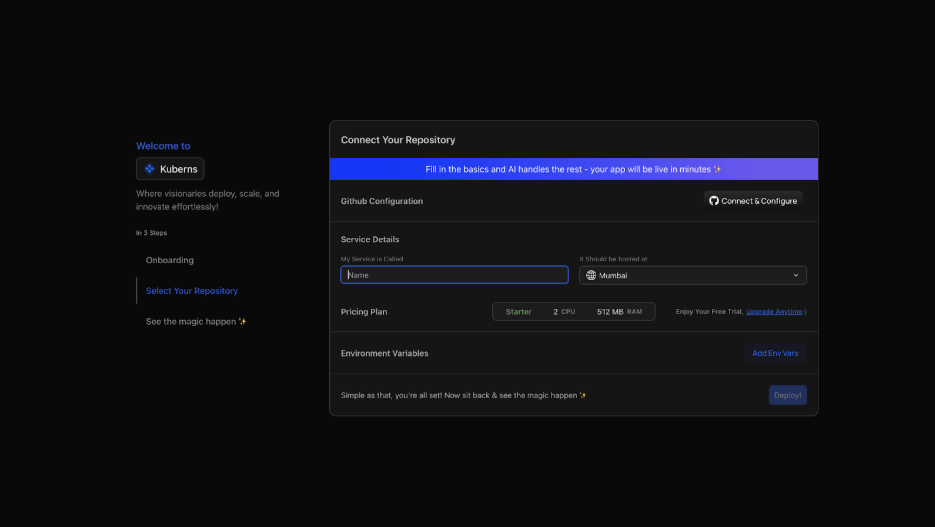
On the **Create Service** page, connect your GitHub account and select your repository and branch. Kuberns scans your project and detects your framework, runtime, build command, and start command automatically.
### Step 3: Add Your Environment Variables

In the Environment tab, add your API keys, database URLs, and any secrets your app needs. These are encrypted and injected securely at runtime. They never touch your git history.
### Step 4: Deploy

Click **Deploy**. Kuberns installs dependencies, runs your build command, starts your app on AWS, issues an SSL certificate, and gives you a live HTTPS URL. The whole process takes under 5 minutes.
### Step 5: Your App is Live

Every future push to your connected branch triggers an automatic redeploy. Autoscaling, uptime monitoring, and logs are all available in the dashboard without any additional configuration.
## The Best Hosting Platforms for Indian Startups in 2026
### 1. Kuberns

[Kuberns](https://kuberns.com) is an Agentic AI cloud platform built on AWS infrastructure. It is the option on this list that removes the most friction between writing code and having it run in production.
Connect your GitHub repository, add your environment variables, and click Deploy. Kuberns reads your project automatically, detects your stack (Node.js, Python, Go, PHP, full-stack frameworks), installs dependencies, builds your app, and gets it live with HTTPS and CI/CD enabled in under 5 minutes. No Dockerfile, no YAML, no infrastructure decisions.
**What makes it relevant for Indian startups specifically:**
Kuberns deploys on AWS, which means you can target the ap-south-1 (Mumbai) or ap-south-2 (Hyderabad) regions for low-latency serving to Indian users. Every subsequent push to your main branch triggers an automatic redeploy, so your team ships continuously without manual steps.
The Agentic AI layer manages the deployment lifecycle after your app goes live. Autoscaling adjusts capacity based on actual traffic. Monitoring and logs are available in the dashboard. If your app crashes, Kuberns restarts it automatically.
For an Indian startup that does not want to hire a DevOps engineer or spend engineering hours on infrastructure, this is the platform that matches your actual situation.
**Pricing:** Free credits (approximately $14 for 30 days) with no credit card required. Paid plans start from $7 per month. Up to 40 percent cost savings compared to managing AWS directly.
**Best for:** Product teams that want to ship fast without infrastructure overhead. Startups that need AWS-grade reliability without AWS-grade complexity.
---
### 2. DigitalOcean

DigitalOcean sounds appealing at first glance, but for most Indian startups it quickly reveals its gaps. Raw Droplets give you nothing but a Linux box. You are responsible for setting up Nginx, configuring SSL certificates, writing firewall rules, setting up monitoring, and building your own deployment pipeline from scratch. None of that comes with the server.
The App Platform tries to solve this, but it is limited in what it actually handles. You still end up debugging build failures, managing environment variables manually, and dealing with a UI that lacks the intelligence to adapt to your stack. There is no Agentic AI layer managing your deployment lifecycle after you go live.
Bandwidth overages on DigitalOcean are a real cost trap. Once you exceed your included transfer limit, you pay per GB with no warning until the bill arrives. For an Indian startup managing a tight budget in rupees, that kind of unpredictable billing is a genuine risk.
The App Platform also has no autoscaling on lower-tier plans, which means a traffic spike can take your app offline at the worst possible time.
**Bottom line:** Too much manual work for a startup that should be focused on building the product, not maintaining infrastructure.
---
### 3. AWS Lightsail

AWS is notorious for being the most expensive and most complex cloud to manage directly. EC2 instances, IAM roles, VPCs, security groups, load balancers, and RDS configurations all require expertise to set up correctly, and every misconfiguration either breaks your app or inflates your bill.
AWS Lightsail is AWS's attempt at simplicity, but it is still a VPS in disguise. You get a fixed-price server and then figure out the rest yourself. SSL setup, deployment pipelines, monitoring, and autoscaling are all excluded. The moment your app needs to grow beyond the initial bundle, you are forced back into raw AWS complexity anyway.
Billing on AWS is notoriously hard to predict. Data transfer costs, request charges, and resource idle time all accumulate silently. Indian startups have been caught with AWS bills 5 to 10 times what they expected in their first month of real traffic. There is no guardrail unless you set up billing alerts yourself.
With no DevOps background, configuring AWS correctly is weeks of work before you ship a single line of product code.
**Bottom line:** AWS directly is not built for early-stage startups. The infrastructure work alone can consume an entire sprint.
---
### 4. Vercel

Vercel works for one thing: Next.js frontends. The moment your Indian startup has a Python backend, a Node.js API with long-running processes, WebSockets, or any persistent server logic, Vercel cannot host it. You will be running two separate hosting setups and paying for both.
Vercel's serverless model means there are no persistent server connections. Background jobs, cron tasks, and real-time features all require workarounds or separate infrastructure entirely. For a startup trying to ship fast, that complexity defeats the point.
Pricing is another problem. Vercel Pro starts at $20 per seat per month. A three-person team is paying $60 per month before hosting a single backend service. Function invocation limits and bandwidth overages on the free and hobby tiers have caught many Indian startups off guard.
Vercel also has no India region. Every request from an Indian user routes to the nearest available edge node, which adds latency for server-side rendering and API calls that cannot be cached at the edge.
**Bottom line:** Severely limited in scope and expensive at team scale. Not a viable full-stack hosting solution for most Indian startups.
---
### 5. Render

Render has no India region. The closest data center is Singapore, which means every request from an Indian user carries the latency penalty of cross-border routing. For a product targeting Indian users, that is a fundamental problem that no amount of caching fully solves.
The free tier spins services down after 15 minutes of inactivity. The first request after any quiet period takes 30 to 60 seconds to respond as the service cold-starts. If your users hit that window, they see a blank screen or a timeout. For a startup with paying users, that is unacceptable.
Render's autoscaling is limited on lower plans. Their deployment pipeline gives you less visibility than Kuberns when builds fail, and support response times have been a recurring complaint from teams in non-US time zones, including IST.
Build times on Render are also slower than platforms that cache dependencies aggressively. Teams with frequent deploys end up waiting significantly longer per push than they would on a more efficient platform.
**Bottom line:** No India region, cold starts on the free tier, and slow builds make Render a poor fit for Indian startups serving Indian users.
---
### 6. Hetzner

Hetzner gives you a cheap Linux server in Europe and nothing else. There is no India or Asia-Pacific data center, no managed deployment, no autoscaling, no monitoring, no SSL provisioning, and no CI/CD pipeline. You build all of it yourself or you go without.
For an Indian startup, the latency problem alone is disqualifying. Hetzner servers in Germany or Finland add 150 to 200ms of round-trip latency for every user in India. That is a permanent performance tax on your entire product.
The real cost of Hetzner is not on the invoice. It is in engineering hours. Setting up a production-ready server correctly takes a developer with solid Linux and DevOps knowledge anywhere from a few days to a week. Maintaining it, patching it, handling disk failures, and debugging networking issues adds ongoing overhead that compounds over time.
Hetzner's support is primarily in German and English with slow response windows. For an Indian team dealing with a production outage at IST working hours, the lack of responsive support is a serious risk.
**Bottom line:** The cheapest server is not the cheapest option when you factor in engineering time. Hetzner is not built for product teams who want to ship software, not manage servers.
---
## Platform Comparison for Indian Startups
| Platform | India Region | Managed Deployment | Starting Price | DevOps Required | Verdict |
|---|---|---|---|---|---|
| Kuberns | Yes (AWS Mumbai/Hyderabad) | Yes, Agentic AI | Free credits, then $7/mo | No | Best choice for Indian startups |
| DigitalOcean | Yes (Bangalore) | Partial only | $6/month | Yes | Too much manual setup |
| AWS Lightsail | Yes (Mumbai, Hyderabad) | Minimal | $10/month | Yes | Complex billing, steep learning curve |
| Vercel | No India region | Frontend only | Free tier, $20/mo Pro | No | Too limited, expensive at team scale |
| Render | No India region | Yes | Free tier, $7/mo paid | No | Cold starts, no India latency |
| Hetzner | No India region | No | ~$4/month | Yes | Bare server, 200ms India latency |
---
## How to Deploy Your Indian Startup on Kuberns
If you want the fastest path from code to production without touching infrastructure, here is exactly how Kuberns works.
### Prerequisites
Before you start, make sure you have:
- Your app code pushed to a GitHub repository
- Environment variables and API keys listed (you will add them in the dashboard, not in your code)
- A `start` script in `package.json` for Node.js apps, or a `requirements.txt` for Python apps
That is it. No Dockerfile. No cloud account setup. No YAML.
### Step 1: Sign Up on Kuberns

Go to [kuberns.com](https://kuberns.com) and click **Deploy with AI**. Sign up with GitHub or Google. New accounts get free credits with no credit card required.
### Step 2: Connect Your GitHub Repository

On the **Create Service** page, connect your GitHub account and select your repository and branch. Kuberns scans your project and detects your framework, runtime, build command, and start command automatically.
### Step 3: Add Your Environment Variables

In the Environment tab, add your API keys, database URLs, and any secrets your app needs. These are encrypted and injected securely at runtime. They never touch your git history.
### Step 4: Deploy

Click **Deploy**. Kuberns installs dependencies, runs your build command, starts your app on AWS, issues an SSL certificate, and gives you a live HTTPS URL. The whole process takes under 5 minutes.
### Step 5: Your App is Live

Every future push to your connected branch triggers an automatic redeploy. Autoscaling, uptime monitoring, and logs are all available in the dashboard without any additional configuration.
 ## What to Look Out For When Choosing a Hosting Platform
**Hidden egress fees.** Some platforms charge for data transferred out of their network. AWS charges $0.09 per GB for egress from ap-south-1. DigitalOcean includes generous bandwidth allowances. Hetzner includes 20TB per month. Always factor in expected bandwidth before committing to a platform.
**Free tier limitations.** Many platforms offer free tiers that are not suitable for production. Render spins down services after inactivity. Railway has credit-based limits that cap at unexpected times. If you have paying users depending on your service, verify that your chosen plan does not impose behavior that affects uptime.
**Lock-in.** Platforms that require proprietary configuration files, custom runtimes, or vendor-specific environment setups make it harder to move later. Kuberns works with standard GitHub repos and no proprietary config, which means migrating away (if you ever need to) is straightforward.
**Support responsiveness.** For Indian startups dealing with IST working hours, support availability matters. AWS and DigitalOcean both have 24/7 support on paid tiers. Kuberns provides responsive support. Hetzner support is primarily in German and English with longer response windows.
## Internal Context: Related Guides
If you are evaluating specific platforms in more depth before making a decision, these guides cover the details:
- [Cloud Hosting for Bootstrapped Startups: What Actually Works](https://kuberns.com/blogs/cloud-hosting-for-bootstrapped-startups/) covers the cost and overhead breakdown for early-stage teams
- [DigitalOcean vs AWS vs Kuberns](https://kuberns.com/blogs/best-cloud-platform-digitalocean-vs-aws/) compares the three most common options directly
- [Best Cloud Platform for Non-Technical Founders](https://kuberns.com/blogs/best-cloud-platform-for-non-technical-founders/) is relevant if your founding team does not have a dedicated engineer
- [The Complete Full-Stack Guide to Deploy App with PostgreSQL](https://kuberns.com/blogs/deploy-app-with-postgresql/) covers database setup for production deployments
## Conclusion
Indian startups have better hosting options in 2026 than at any point before. The question is matching the platform to your actual situation rather than choosing based on brand recognition or what your friends at larger companies use.
If you want AWS-grade reliability, zero infrastructure overhead, an India region, and a deployment experience that gets your app live in under 5 minutes, [Kuberns](https://kuberns.com) is built for exactly that. Connect your GitHub repo, set your environment variables, and ship.
If you have DevOps experience and want the lowest possible raw compute cost, Hetzner or a DigitalOcean Droplet gives you full server control at a fraction of the managed platform price. The trade-off is time.
For most early-stage Indian startups, that trade-off is clear. Your team's time is worth more than the cost difference.
[Deploy your startup on Kuberns for free](https://dashboard.kuberns.com/)
---
## Frequently Asked Questions
### What is the best hosting platform for Indian startups in 2026?
Kuberns is the best hosting platform for Indian startups that want production-grade infrastructure without a DevOps hire. It deploys from GitHub automatically, runs on AWS with an ap-south-1 region option, handles autoscaling, and offers transparent pricing with free credits to start.
### Which cloud provider has data centers in India?
AWS has two Indian regions: ap-south-1 in Mumbai and ap-south-2 in Hyderabad. Google Cloud and Microsoft Azure also have Mumbai regions. DigitalOcean has a Bangalore data center. Kuberns deploys on AWS infrastructure, so Indian startups can target the Mumbai or Hyderabad region.
### Is AWS too expensive for Indian startups?
Managed AWS directly can get expensive if you size instances wrong or leave things running idle. Platforms like Kuberns run on AWS infrastructure but handle resource management efficiently with autoscaling, so you pay for actual usage. Kuberns also delivers up to 40 percent savings compared to configuring AWS directly.
### Do Indian startups need a dedicated DevOps engineer?
Not with the right platform. Kuberns handles deployment, scaling, SSL, monitoring, and CI/CD automatically, so early-stage teams can ship without a dedicated DevOps hire. The need for DevOps expertise increases when you manage raw IaaS infrastructure like EC2 or Droplets directly.
### What hosting platform is best for a startup on a tight budget in India?
For budget-conscious Indian startups, Kuberns offers free credits worth approximately $14 for 30 days with no credit card required. Hetzner is the cheapest raw VPS option but requires self-management. DigitalOcean offers a good balance at $6 to $12 per month.
### How do I reduce latency for Indian users?
Choose a platform that lets you deploy to an India-region data center. AWS Mumbai (ap-south-1), AWS Hyderabad (ap-south-2), and DigitalOcean Bangalore all reduce round-trip latency for Indian users. A CDN layer like Cloudflare can further improve asset delivery regardless of server location.
### Can I deploy a Node.js or Python app on Kuberns?
Yes. Kuberns auto-detects Node.js, Python, Go, PHP, and most modern frameworks from your GitHub repository. You connect your repo, add environment variables, and click Deploy. The platform builds and runs your app with HTTPS and CI/CD enabled in under 5 minutes.
---
- [More AI & DevOps articles](https://kuberns.com/blogs/category/ai-devops/1/)
- [All articles](https://kuberns.com/blogs/)
## What to Look Out For When Choosing a Hosting Platform
**Hidden egress fees.** Some platforms charge for data transferred out of their network. AWS charges $0.09 per GB for egress from ap-south-1. DigitalOcean includes generous bandwidth allowances. Hetzner includes 20TB per month. Always factor in expected bandwidth before committing to a platform.
**Free tier limitations.** Many platforms offer free tiers that are not suitable for production. Render spins down services after inactivity. Railway has credit-based limits that cap at unexpected times. If you have paying users depending on your service, verify that your chosen plan does not impose behavior that affects uptime.
**Lock-in.** Platforms that require proprietary configuration files, custom runtimes, or vendor-specific environment setups make it harder to move later. Kuberns works with standard GitHub repos and no proprietary config, which means migrating away (if you ever need to) is straightforward.
**Support responsiveness.** For Indian startups dealing with IST working hours, support availability matters. AWS and DigitalOcean both have 24/7 support on paid tiers. Kuberns provides responsive support. Hetzner support is primarily in German and English with longer response windows.
## Internal Context: Related Guides
If you are evaluating specific platforms in more depth before making a decision, these guides cover the details:
- [Cloud Hosting for Bootstrapped Startups: What Actually Works](https://kuberns.com/blogs/cloud-hosting-for-bootstrapped-startups/) covers the cost and overhead breakdown for early-stage teams
- [DigitalOcean vs AWS vs Kuberns](https://kuberns.com/blogs/best-cloud-platform-digitalocean-vs-aws/) compares the three most common options directly
- [Best Cloud Platform for Non-Technical Founders](https://kuberns.com/blogs/best-cloud-platform-for-non-technical-founders/) is relevant if your founding team does not have a dedicated engineer
- [The Complete Full-Stack Guide to Deploy App with PostgreSQL](https://kuberns.com/blogs/deploy-app-with-postgresql/) covers database setup for production deployments
## Conclusion
Indian startups have better hosting options in 2026 than at any point before. The question is matching the platform to your actual situation rather than choosing based on brand recognition or what your friends at larger companies use.
If you want AWS-grade reliability, zero infrastructure overhead, an India region, and a deployment experience that gets your app live in under 5 minutes, [Kuberns](https://kuberns.com) is built for exactly that. Connect your GitHub repo, set your environment variables, and ship.
If you have DevOps experience and want the lowest possible raw compute cost, Hetzner or a DigitalOcean Droplet gives you full server control at a fraction of the managed platform price. The trade-off is time.
For most early-stage Indian startups, that trade-off is clear. Your team's time is worth more than the cost difference.
[Deploy your startup on Kuberns for free](https://dashboard.kuberns.com/)
---
## Frequently Asked Questions
### What is the best hosting platform for Indian startups in 2026?
Kuberns is the best hosting platform for Indian startups that want production-grade infrastructure without a DevOps hire. It deploys from GitHub automatically, runs on AWS with an ap-south-1 region option, handles autoscaling, and offers transparent pricing with free credits to start.
### Which cloud provider has data centers in India?
AWS has two Indian regions: ap-south-1 in Mumbai and ap-south-2 in Hyderabad. Google Cloud and Microsoft Azure also have Mumbai regions. DigitalOcean has a Bangalore data center. Kuberns deploys on AWS infrastructure, so Indian startups can target the Mumbai or Hyderabad region.
### Is AWS too expensive for Indian startups?
Managed AWS directly can get expensive if you size instances wrong or leave things running idle. Platforms like Kuberns run on AWS infrastructure but handle resource management efficiently with autoscaling, so you pay for actual usage. Kuberns also delivers up to 40 percent savings compared to configuring AWS directly.
### Do Indian startups need a dedicated DevOps engineer?
Not with the right platform. Kuberns handles deployment, scaling, SSL, monitoring, and CI/CD automatically, so early-stage teams can ship without a dedicated DevOps hire. The need for DevOps expertise increases when you manage raw IaaS infrastructure like EC2 or Droplets directly.
### What hosting platform is best for a startup on a tight budget in India?
For budget-conscious Indian startups, Kuberns offers free credits worth approximately $14 for 30 days with no credit card required. Hetzner is the cheapest raw VPS option but requires self-management. DigitalOcean offers a good balance at $6 to $12 per month.
### How do I reduce latency for Indian users?
Choose a platform that lets you deploy to an India-region data center. AWS Mumbai (ap-south-1), AWS Hyderabad (ap-south-2), and DigitalOcean Bangalore all reduce round-trip latency for Indian users. A CDN layer like Cloudflare can further improve asset delivery regardless of server location.
### Can I deploy a Node.js or Python app on Kuberns?
Yes. Kuberns auto-detects Node.js, Python, Go, PHP, and most modern frameworks from your GitHub repository. You connect your repo, add environment variables, and click Deploy. The platform builds and runs your app with HTTPS and CI/CD enabled in under 5 minutes.
---
- [More AI & DevOps articles](https://kuberns.com/blogs/category/ai-devops/1/)
- [All articles](https://kuberns.com/blogs/)