# 9 Best Rancher Alternatives To Consider For Cloud In 2026
> Looking for a Rancher alternative in 2026? We ranked 9 options on cost, Kubernetes complexity, and developer experience to help you pick the best one for you.
- **Author**: omkar-anbhule
- **Published**: 2025-11-14
- **Modified**: 2026-07-10
- **Category**: Alternatives
- **URL**: https://kuberns.com/blogs/best-rancher-alternative/
---
The best Rancher alternatives in 2026 are Kuberns, Portainer, Red Hat OpenShift, Qovery, Platform9, Spectro Cloud, k0rdent, Azure Arc, and Northflank, and you're here because Rancher is costing you too much, demanding too much, or both.
Maybe it's the [SUSE pricing restructure](https://www.portainer.io/blog/suse-rancher-price-hike-why-enterprises-are-searching-for-alternatives-in-2025), a 16-core VM that cost $2,000/year now costs up to $25,600 under the new CPU-based billing model, a 4-9x increase that has left enterprise teams scrambling.
Maybe it's the performance, Rancher's UI grinding under 20+ clusters, no native cost visibility, and a separate tool required for everything from CI/CD to monitoring. Maybe it's simpler than that: your team is spending more time managing the platform than building the product.
Whatever the reason, this guide gives you the right answer based on your specific situation.
If you need to stay in Kubernetes, because you have enterprise multi-cluster governance requirements, on-prem workloads, or compliance obligations, we cover Portainer, Red Hat OpenShift, Qovery, Platform9, Spectro Cloud, k0rdent, Azure Arc, and Northflank. Each is evaluated on cost, ops complexity, and what it actually solves about Rancher.
If you're done with infrastructure management entirely because Kubernetes was always just the mechanism for running your applications, not the goal, we cover [Kuberns: an all-in-one agentic AI cloud](https://kuberns.com/) that deploys from GitHub, auto-scales on AWS, monitors your app, and optimises your cloud costs automatically.
By the end of this guide, you'll know exactly which path fits your team and what to do next.
## TL;DR
- SUSE Rancher pricing jumped 4-9x under the new CPU/vCPU model; a 16-core VM went from ~$2,000/yr to $25,600/yr
- This guide compares 9 alternatives: Kuberns, Portainer, OpenShift, Qovery, Platform9, Spectro Cloud, k0rdent, Azure Arc, and Northflank
- For teams who want to stop managing Kubernetes entirely: Kuberns automates deployment, scaling, and monitoring via Agentic AI on AWS
- For lightweight open-source management: Portainer (free) and k0rdent (open-source) are the lowest-cost exits from SUSE Rancher
- For enterprise compliance: Red Hat OpenShift is the gold standard; Platform9 for hybrid/on-prem with a managed control plane
- Your choice comes down to one question: do you need a better Kubernetes manager, or do you need to stop managing Kubernetes altogether?
## Why Teams Are Leaving Rancher in 2026
### 1. The SUSE Price Hike (Up to 1,100% More Expensive)
This is the primary driver of Rancher migrations in 2026. SUSE replaced Rancher's simple per-node licensing with a CPU and vCPU-based pricing model. The impact is severe: a single 16-core VM (32 vCPUs) that previously cost around $2,000/year now costs up to $25,600/year for priority support under the new model, an increase of 4-9x for many enterprise teams, and over 1,100% in the worst cases.
[Trustradius pricing data confirms](https://www.trustradius.com/products/suse-rancher/pricing) Rancher Prime editions now range from $7,594.99 to $41,830.99 per licence. For organisations running dozens of nodes, the cumulative impact is significant enough to justify a full platform migration.
### 2. Performance Bottlenecks at Scale
Rancher is powerful, but it struggles under real enterprise load. [G2 reviewers consistently note that for DevOps newcomers](https://www.g2.com/products/rancher-desktop/competitors/alternatives), the sheer amount of options can be overwhelming, and admins managing 20 or more clusters report sluggish UI performance, clunky node operations, and bottlenecks when performing cluster-wide operations. For platform teams that need fast, reliable cluster operations at scale, these performance gaps translate directly into engineering hours lost.
### 3. No Native Kubernetes Cost Visibility
Rancher has no built-in mechanism to track cloud spend by pod, namespace, or team. This is a critical gap: the [Flexera 2026 State of the Cloud Report](https://info.flexera.com/CM-REPORT-State-of-the-Cloud) shows that 29% of all cloud spending is wasted, and 84% of organisations cite managing cloud spend as their top challenge.
Without native cost visibility in Rancher, teams running Kubernetes have no direct line of sight into what their workloads are actually costing until the bill arrives. You have to integrate third-party tools just to get basic attribution, adding yet another layer to an already complex stack.
### 4. The Hidden Ops Tax (Kubernetes Expertise Is Expensive)
Running Rancher requires dedicated Kubernetes expertise. [According to Glassdoor data](https://www.glassdoor.com/Salaries/kubernetes-devops-engineer-salary-SRCH_KO0,26.htm), the average Kubernetes DevOps Engineer in the US earns $136,476/year, with top earners reaching $222,437.
[The kube.careers Q1 2025 State of Kubernetes Jobs](https://kube.careers/state-of-kubernetes-jobs-2025-q1) report puts the global average Kubernetes job salary at $158,450. That's the expertise tax your team pays every year to keep Rancher running, a cost that never appears on the Rancher invoice but is often the largest line item in the total cost of ownership.
### 5. Slower Innovation Since the SUSE Acquisition
The open-source version of Rancher is being maintained, but the community-driven feature velocity that made early Rancher compelling has slowed noticeably since the SUSE acquisition. Enterprise features are concentrated in Rancher Prime, the paid tier, while the roadmap for general-purpose Kubernetes management has stagnated compared to newer platforms shipping faster innovation cycles.
### 6. Not Built for GPU, AI/ML, or Modern Autoscaling
Rancher was not designed for GPU workloads or AI/ML inference pipelines. As more engineering teams run model serving, batch processing, and AI workloads on Kubernetes, Rancher's lack of native GPU scheduling and intelligent autoscaling for these workloads becomes a hard limitation.
### 7. Overkill for Mid-Sized Teams
Rancher was designed for enterprises managing Kubernetes at massive scale across hybrid and multi-cloud environments. For mid-sized organisations that simply want to deploy, scale, and monitor applications reliably, it's a battleship when you needed a speedboat. The operational cost of maintaining Rancher itself, upgrades, security patching, node management, toolchain integrations, often exceeds the value it delivers for teams without dedicated platform engineering resources.
## Full Comparison Table: Rancher vs Alternatives
| Platform | Type | Pricing | K8s Required | Multi-Cloud | Best For |
| ------------- | ------------------------ | ------------------------------ | ------------------------ | -------------- | ---------------------------------------------------- |
| **Kuberns** | **Agentic AI Cloud** | **$7/mo for all-in-one cloud** | **Completely Automated** | **AWS global** | **Full-stack + Agentic AI powered** |
| Portainer | Container/K8s UI | Free / $21/mo/node | Optional | Any cluster | Lightweight K8s management |
| OpenShift | Enterprise K8s PaaS | $10K+/yr | Yes | Yes | Regulated industries, compliance |
| Qovery | BYOC K8s IDP | Free / usage | Yes | AWS/GCP/Azure | Platform engineering, dev UX |
| Platform9 | SaaS K8s Control Plane | Contact | Yes | Yes | Managed control plane, hybrid |
| Spectro Cloud | K8s Fleet Manager | Contact | Yes | Yes | Declarative multi-cloud fleet |
| k0rdent | Open-Source K8s Platform | Free | Yes | Any | Platform engineers, open standards |
| Azure Arc | Azure K8s Extension | Pay-as-go | Yes | Azure-managed | Microsoft-centric hybrid teams |
| Northflank | Dev Platform on K8s | Free sandbox / usage-based | Yes (managed or BYOC) | GKE/EKS/AKS | GPU workloads, dev-first CI/CD |
## These are the Best Rancher Alternatives of 2026
The cloud landscape has evolved far beyond traditional Kubernetes management tools. While Rancher helped teams tame container complexity, modern alternatives now focus on automation, scalability, and developer experience. So you can ship code without needing a DevOps army. Here are the top Rancher alternatives in 2026 that developers actually prefer.
### 1. Kuberns: Best for Teams Who Want to Stop Managing Kubernetes Entirely
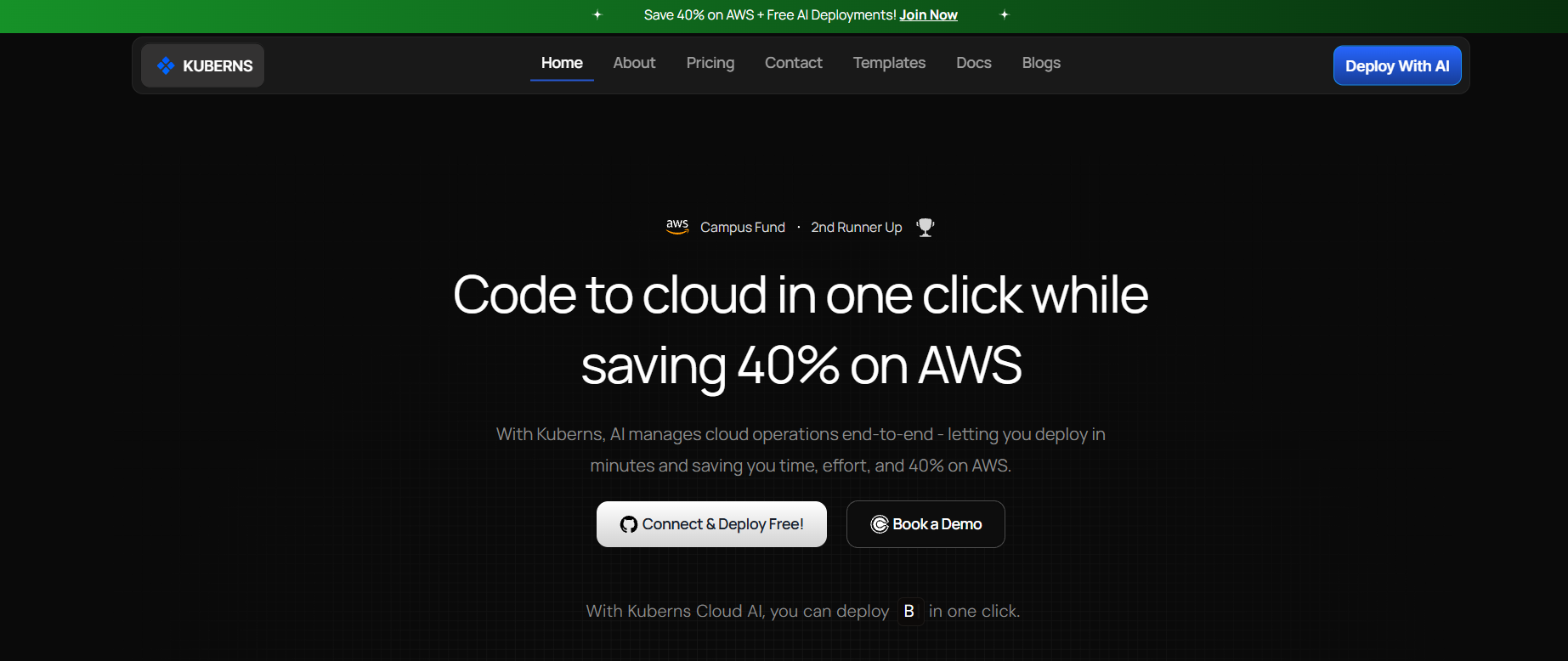Starting price: $7/month (includes $14 in compute credits, ~30 days free) |[ Try the Agentic AI Deployment](https://dashboard.kuberns.com)
**Best for:** Startups, SaaS teams, and engineering organisations using Rancher to run applications, not to manage enterprise multi-cluster governance, who want to eliminate infrastructure management and let Agentic AI handle it.
Kuberns takes a fundamentally different approach to the Rancher problem. Rather than replacing one Kubernetes management tool with another, it removes the need to manage Kubernetes at all.
You connect your GitHub repo, and the agentic AI handles provisioning, deployment, scaling, monitoring, and cost optimisation automatically on AWS infrastructure, without clusters to configure, YAML to write, or nodes to patch.
For teams that landed on Rancher because it was how you managed containers, not because you specifically needed multi-cluster fleet management, Kuberns is the exit path. The AI does what Rancher requires a DevOps team to do, automatically and continuously.
**Rancher vs Kuberns:**
| | Rancher | Kuberns |
| -------------------- | ------------------------------------------------------- | --------------------------------------------- |
| Infrastructure model | Self-managed Kubernetes clusters | Fully managed AWS infrastructure |
| Cluster management | Manual, you provision, configure, and maintain | Zero (Agentic AI handles everything) |
| YAML / configuration | Extensive (cluster configs, RBAC, Helm) | None (Just connect GitHub and deploy) |
| Scaling | Manual rules or Kubernetes HPA | AI-driven automatic scaling |
| Cost visibility | No native cost tracking | Built-in cost optimisation, up to 40% savings |
| Pricing | SUSE Rancher Prime, up to $25,600/year per 16-core node | From $7/month, one flat compute bill |
| CI/CD | Separate tooling required | Infinite CI/CD included, zero setup |
| Monitoring | Requires third-party integration | Real-time logs, alerts, insights built in |
**Pros:**
* Eliminates cluster management, YAML, and DevOps overhead entirely
* Agentic AI automatically scales based on real traffic, no manual rules
* Built-in monitoring, logs, alerts, no third-party tools needed
* Infinite CI/CD pipelines are included at no extra cost
* No per-user pricing, one flat compute bill
* AWS-backed infrastructure, enterprise SLA, global regions
* Up to 40% lower cost than running equivalent workloads directly on AWS
**Bottom line:** If your team's complaint about Rancher is the cost, the complexity, or the maintenance burden, not that you specifically need a better Kubernetes cluster manager, Kuberns removes those problems entirely by removing the infrastructure layer from your team's responsibilities.
[Check out the one-click Agentic AI Deployment](https://kuberns.com/)
### 2. Portainer: Best Lightweight Open-Source K8s and Container Management UI

Starting price: Free (Community Edition); Business Edition from $21/month per node
**Best for:** Small to mid-sized teams that need a simple, lightweight UI for managing Docker and Kubernetes environments without Rancher's heavy operational footprint or SUSE's pricing model.
[Portainer](https://www.portainer.io/) is the most direct open-source alternative to Rancher for teams that want container and cluster management without the enterprise complexity. It installs in seconds, supports Docker, Kubernetes, Docker Swarm, and Podman from a single interface, and gives teams RBAC, access management, and GitOps automation without the infrastructure overhead Rancher demands.
Critically, Portainer's pricing is transparent and predictable, a stark contrast to SUSE Rancher Prime's per-node pricing that has shocked enterprise teams. For teams feeling burned by the SUSE pricing change, Portainer is the most immediate, lowest-risk migration path.
**Pros:**
* Lightweight, installs in seconds, minimal resource requirements
* Supports Docker, Kubernetes, Swarm, and Podman in one UI
* Transparent, predictable pricing, no per-node pricing surprises
* Strong RBAC and access management for team governance
* Free Community Edition for small teams and testing
**Cons:**
* Lacks deep Platform Engineering features, no native ephemeral environments, and advanced GitOps
* Not designed for managing 50+ clusters at enterprise scale
* Less automation depth than Qovery or Platform9 for complex workloads
### 3. Red Hat OpenShift: Best for Regulated Industries Requiring Enterprise Compliance

Starting price: Self-managed ~$10,000+/year per 16-core socket; ROSA/ARO from ~$0.03-$0.06 per vCPU-hour
**Best for:** Large enterprises in regulated industries, healthcare, finance, and government that need stringent security, built-in compliance certifications, and vendor accountability for their Kubernetes platform.
[OpenShift](https://www.redhat.com/en/technologies/cloud-computing/openshift) is the enterprise alternative to Rancher for organisations that need security-first Kubernetes. Its SELinux integration, strict security defaults, built-in compliance certifications, and Red Hat's extensive partner ecosystem make it the platform of choice for teams where regulatory requirements are non-negotiable. It also provides a complete stack: CI/CD, monitoring, logging, service mesh, and an operator framework, all in one opinionated platform.
**The tradeoff:** OpenShift is expensive, requires significant expertise to operate, and creates meaningful Red Hat vendor dependency. [As Mirantis notes](https://www.mirantis.com/blog/rancher-alternatives/), it "locks users into specific infrastructure." Teams moving from Rancher to OpenShift for compliance often find they've traded one complexity for another.
**Pros:**
* Gold standard for security and compliance, SELinux, strict defaults, certifications
* Complete enterprise stack: CI/CD, monitoring, service mesh, operator framework
* Strong Red Hat partner ecosystem and vendor accountability
* Supports hybrid and on-prem workloads with enterprise SLAs
**Cons:**
* Very expensive, $10,000+/year self-managed per 16-core socket
* Steep learning curve, requires Red Hat training to use effectively
* Heavy vendor lock-in, many components are Red Hat-specific
* Significant infrastructure requirements and operational overhead
### 4. Qovery: Best for Platform Engineering Teams Wanting Kubernetes Without the Ops

**Starting price:** Free tier (up to 100 deployments/month); paid plans scale with usage
**Best for:** DevOps and platform engineering teams that want Kubernetes-native deployments running in their own cloud accounts, full infrastructure ownership with a developer-friendly Internal Developer Platform (IDP) layered on top.
[Qovery](https://www.qovery.com/) occupies the space between Rancher's raw cluster management and fully managed PaaS. It runs Kubernetes in your own AWS, GCP, or Azure account while providing developers with a clean UI for deploying, scaling, and managing applications without needing to understand the underlying Kubernetes abstractions. It supports multi-cluster management, GitOps workflows, ephemeral environments, and SOC 2/HIPAA compliance.
For teams leaving Rancher specifically because of its lack of developer experience tooling, not because they want to leave Kubernetes, Qovery is the most direct upgrade path.
**Pros:**
* BYOC, Kubernetes runs in your own AWS, GCP, or Azure account
* Developer-friendly UI, developers deploy without touching Kubernetes
* Multi-cluster management and GitOps workflows
* SOC 2 and HIPAA compliance
* Strong ephemeral environment support
**Cons:**
* Still requires Kubernetes knowledge at the platform team level
* Configuration complexity for non-DevOps users
* Pricing at scale with additional deployment minutes can be expensive
Is Qovery's Kubernetes complexity pushing your team toward simpler options? [See the best Qovery alternatives](https://kuberns.com/blogs/qovery-alternatives/).
 ### 5. Platform9: Best SaaS-Managed Kubernetes for Teams Who Want Zero Control Plane Ops

Starting price: Contact for pricing; free tier available for evaluation
**Best for:** Engineering teams that need enterprise Kubernetes across public cloud, on-prem, and edge but want the control plane fully managed as a SaaS service rather than self-hosted.
[Platform9](https://platform9.com/) offers a managed Kubernetes control plane that eliminates the operational burden of managing Rancher's self-hosted architecture. You connect your infrastructure, cloud VMs, bare metal, edge nodes and Platform9 manages the Kubernetes control plane, upgrades, security patching, and multi-cluster operations as a SaaS service. Your team retains full infrastructure ownership while removing the control plane maintenance burden that makes Rancher expensive to operate at scale.
**Pros:**
* SaaS-managed control plane, no self-hosting required
* Works across public cloud, on-prem, and edge infrastructure
* Automated upgrades and security patching
* Supports multi-cloud and hybrid environments
* Strong enterprise support and SLAs
**Cons:**
* Pricing not publicly listed, requires engagement with sales
* Less developer-facing tooling than Qovery or Kuberns
* Still requires infrastructure provisioning by your team
> Platform9 works well for hybrid or enterprise setups. But if you're looking for a developer-first experience with full automation and lower costs, this [platform replaces the need for both Kubernetes and cluster managers entirely](https://kuberns.com/blogs/what-is-kuberns-the-simplest-way-to-build-deploy-and-scale-full-stack-apps/).
### 6. Spectro Cloud Palette: Best for Multi-Cloud Fleet Management With Automated Stacks

Starting price: Contact for pricing
**Best for:** Platform engineering teams managing complex multi-cloud Kubernetes deployments who want pre-packaged, declarative infrastructure stacks with automated lifecycle management, less customisation than Rancher, and more automation.
[Spectro Cloud Palette](https://www.spectrocloud.com/platform/palette) takes a declarative approach to Kubernetes fleet management. Instead of Rancher's imperative cluster configuration, Palette uses pre-packaged infrastructure stacks that define everything from the OS to the Kubernetes distribution to the add-ons. Upgrades, security patching, and configuration changes propagate through the fleet via these stacks, reducing the manual operational work that Rancher requires for multi-cluster consistency.
**Pros:**
* Declarative infrastructure stacks, consistent fleet management at scale
* Automated upgrades and security patching fleet-wide
* Strong edge and hybrid Kubernetes support
* Reduces the Rancher's manual Day 2 operations significantly
**Cons:**
* Less customisation than Rancher for teams with bespoke cluster requirements
* Pricing requires direct engagement
* Smaller community than Rancher or OpenShift
### 7. k0rdent by Mirantis: Best Open-Source Alternative for Platform Engineers Who Want Full Flexibility

Starting price: Free and open-source
**Best for:** Platform engineers who want complete flexibility, open standards (ClusterAPI, Helm), and multi-cloud portability without Rancher's proprietary management interfaces or SUSE's pricing model.
[k0rdent](https://k0rdent.io/) is Mirantis's open-source Kubernetes management project built on ClusterAPI and Helm. It lets platform engineering teams define their own Kubernetes platforms using open standards, ensuring that clusters can be deployed on any cloud or bare metal without vendor lock-in. Unlike Rancher, which has its own proprietary management layer, k0rdent is designed around the principle that everything should be portable and extensible using community standards.
**Pros:**
* Fully open-source, no licensing costs
* Built on open standards: ClusterAPI, Helm, GitOps
* No vendor lock-in, deploy anywhere
* Actively developed by Mirantis engineering team
* Ideal for platform engineers who want to define their own architecture
**Cons:**
* Requires significant platform engineering expertise to set up
* Less opinionated than Rancher, more assembly required
* Smaller community and ecosystem than Rancher or OpenShift
### 8. Azure Arc: Best for Microsoft-Heavy Teams Managing Hybrid and Multi-Cloud Clusters

Starting price: Pay-per-use; some features included with Azure subscriptions
**Best for:** Organisations already invested in the Microsoft/Azure ecosystem who want Kubernetes management integrated with Azure governance, policy, and security tooling across hybrid and multi-cloud environments.
[Azure Arc](https://azure.microsoft.com/en-us/products/azure-arc) extends Azure's management and policy controls to any Kubernetes cluster, whether running on AWS, GCP, on-premises, or at the edge. For teams that use Azure Active Directory, Azure Policy, Azure Monitor, and Azure Security Center, Arc provides a consistent management layer across hybrid environments without adopting a separate Kubernetes management platform. It's a natural Rancher replacement for Microsoft-centric organisations.
**Pros:**
* Native integration with Azure's full governance, security, and policy stack
* Works with any Kubernetes cluster, cloud, on-prem, or edge
* Azure Active Directory integration for identity and access management
* Familiar tools for teams already in the Azure ecosystem
**Cons:**
* Azure vendor lock-in
* Limited value for teams not already invested in Azure tooling
* Pricing can be unpredictable for large fleets without careful cost management
### 9. Northflank: Best Dev-First Platform for GPU Workloads and BYOC Kubernetes

Starting price: Free sandbox (2 services, 1 database, 2 cron jobs); usage-based pricing beyond that, from $0.01667/vCPU-hour and $0.00833/GB-hour of memory
**Best for:** Development teams that want a Kubernetes-native platform with built-in CI/CD and GPU support, either on Northflank's managed cloud or connected to their own GKE, EKS, AKS, or bare-metal cluster.
[Northflank](https://northflank.com/) treats Kubernetes as infrastructure rather than something your team configures directly. It handles pod scheduling, horizontal scaling, load balancing, health checks, and rolling deployments automatically, while developers deploy any Docker container through built-in CI/CD pipelines or an external registry. Unlike Rancher's cluster-management focus, Northflank is built around the developer workflow: deploy, preview environments, databases, and GPU workloads all live in the same platform.
Its bring-your-own-cloud model is the most direct fit for teams that already run GKE, EKS, or AKS and want a managed developer layer on top, without handing infrastructure ownership to a third party the way a fully managed PaaS would.
**Pros:**
* No seat-based pricing, pay only for CPU, memory, storage, network, and GPU consumption
* Deploy to Northflank's own cloud or BYOC to GKE, EKS, AKS, or bare metal
* Built-in CI/CD, preview environments, and database provisioning
* Native GPU support for AI/ML workloads, from $0.80/hour (L4) up to H100 instances
* Free sandbox tier for evaluation before committing to usage-based billing
**Cons:**
* Usage-based billing can be harder to forecast than flat-rate pricing at unpredictable traffic volumes
* Still Kubernetes-native under the hood, teams avoiding K8s concepts entirely may prefer a fully abstracted platform
* Smaller ecosystem and community than Rancher or OpenShift
## The Agentic AI Shift: Beyond Kubernetes Management
Rancher was built for a world where running Kubernetes was the hard problem. The platform's value was making cluster management possible for teams that wouldn't otherwise have been able to do it.
**In 2026, that world has changed.** The hard problem isn't managing Kubernetes; it's the cost of maintaining the DevOps expertise, tooling sprawl, and operational overhead that Kubernetes still requires, even with a management layer like Rancher on top.
[Agentic AI cloud platforms like Kuberns](https://kuberns.com/) have made a different kind of progress. Instead of making Kubernetes easier to manage, they've removed the need to manage it at all. The AI observes your application, provisions the right resources, scales automatically based on real traffic, monitors for anomalies, and optimises your cloud spend continuously. Your engineering team doesn't configure any of this. It just happens.
For teams that built their Kubernetes strategy around Rancher because they needed to deploy and scale applications, not because they specifically needed multi-cluster fleet governance, the migration path to Kuberns is the cleanest exit from the cycle of cluster maintenance, SUSE pricing surprises, and DevOps overhead that defines life with Rancher in 2026.
***Related Read: [Kubernetes Alternatives: When You Don't Need K8s at All](https://kuberns.com/blogs/kubernetes-alternatives-you-need/)***
***Also Read: [Best PaaS Providers in 2026 Compared](https://kuberns.com/blogs/best-paas-providers/)***
## Ready to Move Beyond Rancher?
The teams moving fastest in 2026 aren't the ones who found a cheaper Kubernetes manager. They're the ones who stopped managing Kubernetes altogether.
Every hour your team spends on cluster upgrades, YAML configurations, security patching, scaling rules, and incident response is an hour not spent shipping the product. Rancher made that trade-off visible, but it never eliminated it. Neither will Portainer, OpenShift, or Qovery. They're all still Kubernetes management tools. They still require your team to own the infrastructure layer.
Agentic AI cloud is a fundamentally different model. Instead of your team managing infrastructure, the AI manages it, continuously, automatically, and intelligently. It doesn't wait for you to notice a traffic spike before scaling. It doesn't wait for you to review a cost report before optimising. It doesn't need a runbook, a Helm chart, or a dedicated DevOps engineer to keep it running. It observes, decides, and acts on its own, so your team never has to.
Kuberns is built on this model. Connect your GitHub repo, and the agentic AI takes over the entire infrastructure lifecycle:
* Deployment: detects your stack, builds, and deploys automatically. No Dockerfiles. No YAML. No pipeline configuration.
* Scaling: monitors real traffic patterns and adjusts resources before performance degrades. Not reactive. Predictive.
* Monitoring: real-time logs, alerts, and performance insights built in. No Prometheus. No Grafana. No third-party observability stack.
* Cost optimisation: continuously right-sizes your infrastructure and eliminates idle resource waste. Up to 40% lower than AWS, automatically, without a FinOps team.
* CI/CD: infinite pipelines included. Every push triggers a build, test, and deploy cycle without you configuring a single step.
This is what replaces Rancher for teams that want to ship faster, spend less, and never think about infrastructure again.
**[Switch to an agentic AI cloud](https://dashboard.kuberns.com)**
## Frequently Asked Questions on Rancher Alternatives
### What is the best Rancher alternative in 2026?
It depends on why you're leaving. For teams wh
---
- [More Alternatives articles](https://kuberns.com/blogs/category/alternatives/1/)
- [All articles](https://kuberns.com/blogs/)
### 5. Platform9: Best SaaS-Managed Kubernetes for Teams Who Want Zero Control Plane Ops

Starting price: Contact for pricing; free tier available for evaluation
**Best for:** Engineering teams that need enterprise Kubernetes across public cloud, on-prem, and edge but want the control plane fully managed as a SaaS service rather than self-hosted.
[Platform9](https://platform9.com/) offers a managed Kubernetes control plane that eliminates the operational burden of managing Rancher's self-hosted architecture. You connect your infrastructure, cloud VMs, bare metal, edge nodes and Platform9 manages the Kubernetes control plane, upgrades, security patching, and multi-cluster operations as a SaaS service. Your team retains full infrastructure ownership while removing the control plane maintenance burden that makes Rancher expensive to operate at scale.
**Pros:**
* SaaS-managed control plane, no self-hosting required
* Works across public cloud, on-prem, and edge infrastructure
* Automated upgrades and security patching
* Supports multi-cloud and hybrid environments
* Strong enterprise support and SLAs
**Cons:**
* Pricing not publicly listed, requires engagement with sales
* Less developer-facing tooling than Qovery or Kuberns
* Still requires infrastructure provisioning by your team
> Platform9 works well for hybrid or enterprise setups. But if you're looking for a developer-first experience with full automation and lower costs, this [platform replaces the need for both Kubernetes and cluster managers entirely](https://kuberns.com/blogs/what-is-kuberns-the-simplest-way-to-build-deploy-and-scale-full-stack-apps/).
### 6. Spectro Cloud Palette: Best for Multi-Cloud Fleet Management With Automated Stacks

Starting price: Contact for pricing
**Best for:** Platform engineering teams managing complex multi-cloud Kubernetes deployments who want pre-packaged, declarative infrastructure stacks with automated lifecycle management, less customisation than Rancher, and more automation.
[Spectro Cloud Palette](https://www.spectrocloud.com/platform/palette) takes a declarative approach to Kubernetes fleet management. Instead of Rancher's imperative cluster configuration, Palette uses pre-packaged infrastructure stacks that define everything from the OS to the Kubernetes distribution to the add-ons. Upgrades, security patching, and configuration changes propagate through the fleet via these stacks, reducing the manual operational work that Rancher requires for multi-cluster consistency.
**Pros:**
* Declarative infrastructure stacks, consistent fleet management at scale
* Automated upgrades and security patching fleet-wide
* Strong edge and hybrid Kubernetes support
* Reduces the Rancher's manual Day 2 operations significantly
**Cons:**
* Less customisation than Rancher for teams with bespoke cluster requirements
* Pricing requires direct engagement
* Smaller community than Rancher or OpenShift
### 7. k0rdent by Mirantis: Best Open-Source Alternative for Platform Engineers Who Want Full Flexibility

Starting price: Free and open-source
**Best for:** Platform engineers who want complete flexibility, open standards (ClusterAPI, Helm), and multi-cloud portability without Rancher's proprietary management interfaces or SUSE's pricing model.
[k0rdent](https://k0rdent.io/) is Mirantis's open-source Kubernetes management project built on ClusterAPI and Helm. It lets platform engineering teams define their own Kubernetes platforms using open standards, ensuring that clusters can be deployed on any cloud or bare metal without vendor lock-in. Unlike Rancher, which has its own proprietary management layer, k0rdent is designed around the principle that everything should be portable and extensible using community standards.
**Pros:**
* Fully open-source, no licensing costs
* Built on open standards: ClusterAPI, Helm, GitOps
* No vendor lock-in, deploy anywhere
* Actively developed by Mirantis engineering team
* Ideal for platform engineers who want to define their own architecture
**Cons:**
* Requires significant platform engineering expertise to set up
* Less opinionated than Rancher, more assembly required
* Smaller community and ecosystem than Rancher or OpenShift
### 8. Azure Arc: Best for Microsoft-Heavy Teams Managing Hybrid and Multi-Cloud Clusters

Starting price: Pay-per-use; some features included with Azure subscriptions
**Best for:** Organisations already invested in the Microsoft/Azure ecosystem who want Kubernetes management integrated with Azure governance, policy, and security tooling across hybrid and multi-cloud environments.
[Azure Arc](https://azure.microsoft.com/en-us/products/azure-arc) extends Azure's management and policy controls to any Kubernetes cluster, whether running on AWS, GCP, on-premises, or at the edge. For teams that use Azure Active Directory, Azure Policy, Azure Monitor, and Azure Security Center, Arc provides a consistent management layer across hybrid environments without adopting a separate Kubernetes management platform. It's a natural Rancher replacement for Microsoft-centric organisations.
**Pros:**
* Native integration with Azure's full governance, security, and policy stack
* Works with any Kubernetes cluster, cloud, on-prem, or edge
* Azure Active Directory integration for identity and access management
* Familiar tools for teams already in the Azure ecosystem
**Cons:**
* Azure vendor lock-in
* Limited value for teams not already invested in Azure tooling
* Pricing can be unpredictable for large fleets without careful cost management
### 9. Northflank: Best Dev-First Platform for GPU Workloads and BYOC Kubernetes

Starting price: Free sandbox (2 services, 1 database, 2 cron jobs); usage-based pricing beyond that, from $0.01667/vCPU-hour and $0.00833/GB-hour of memory
**Best for:** Development teams that want a Kubernetes-native platform with built-in CI/CD and GPU support, either on Northflank's managed cloud or connected to their own GKE, EKS, AKS, or bare-metal cluster.
[Northflank](https://northflank.com/) treats Kubernetes as infrastructure rather than something your team configures directly. It handles pod scheduling, horizontal scaling, load balancing, health checks, and rolling deployments automatically, while developers deploy any Docker container through built-in CI/CD pipelines or an external registry. Unlike Rancher's cluster-management focus, Northflank is built around the developer workflow: deploy, preview environments, databases, and GPU workloads all live in the same platform.
Its bring-your-own-cloud model is the most direct fit for teams that already run GKE, EKS, or AKS and want a managed developer layer on top, without handing infrastructure ownership to a third party the way a fully managed PaaS would.
**Pros:**
* No seat-based pricing, pay only for CPU, memory, storage, network, and GPU consumption
* Deploy to Northflank's own cloud or BYOC to GKE, EKS, AKS, or bare metal
* Built-in CI/CD, preview environments, and database provisioning
* Native GPU support for AI/ML workloads, from $0.80/hour (L4) up to H100 instances
* Free sandbox tier for evaluation before committing to usage-based billing
**Cons:**
* Usage-based billing can be harder to forecast than flat-rate pricing at unpredictable traffic volumes
* Still Kubernetes-native under the hood, teams avoiding K8s concepts entirely may prefer a fully abstracted platform
* Smaller ecosystem and community than Rancher or OpenShift
## The Agentic AI Shift: Beyond Kubernetes Management
Rancher was built for a world where running Kubernetes was the hard problem. The platform's value was making cluster management possible for teams that wouldn't otherwise have been able to do it.
**In 2026, that world has changed.** The hard problem isn't managing Kubernetes; it's the cost of maintaining the DevOps expertise, tooling sprawl, and operational overhead that Kubernetes still requires, even with a management layer like Rancher on top.
[Agentic AI cloud platforms like Kuberns](https://kuberns.com/) have made a different kind of progress. Instead of making Kubernetes easier to manage, they've removed the need to manage it at all. The AI observes your application, provisions the right resources, scales automatically based on real traffic, monitors for anomalies, and optimises your cloud spend continuously. Your engineering team doesn't configure any of this. It just happens.
For teams that built their Kubernetes strategy around Rancher because they needed to deploy and scale applications, not because they specifically needed multi-cluster fleet governance, the migration path to Kuberns is the cleanest exit from the cycle of cluster maintenance, SUSE pricing surprises, and DevOps overhead that defines life with Rancher in 2026.
***Related Read: [Kubernetes Alternatives: When You Don't Need K8s at All](https://kuberns.com/blogs/kubernetes-alternatives-you-need/)***
***Also Read: [Best PaaS Providers in 2026 Compared](https://kuberns.com/blogs/best-paas-providers/)***
## Ready to Move Beyond Rancher?
The teams moving fastest in 2026 aren't the ones who found a cheaper Kubernetes manager. They're the ones who stopped managing Kubernetes altogether.
Every hour your team spends on cluster upgrades, YAML configurations, security patching, scaling rules, and incident response is an hour not spent shipping the product. Rancher made that trade-off visible, but it never eliminated it. Neither will Portainer, OpenShift, or Qovery. They're all still Kubernetes management tools. They still require your team to own the infrastructure layer.
Agentic AI cloud is a fundamentally different model. Instead of your team managing infrastructure, the AI manages it, continuously, automatically, and intelligently. It doesn't wait for you to notice a traffic spike before scaling. It doesn't wait for you to review a cost report before optimising. It doesn't need a runbook, a Helm chart, or a dedicated DevOps engineer to keep it running. It observes, decides, and acts on its own, so your team never has to.
Kuberns is built on this model. Connect your GitHub repo, and the agentic AI takes over the entire infrastructure lifecycle:
* Deployment: detects your stack, builds, and deploys automatically. No Dockerfiles. No YAML. No pipeline configuration.
* Scaling: monitors real traffic patterns and adjusts resources before performance degrades. Not reactive. Predictive.
* Monitoring: real-time logs, alerts, and performance insights built in. No Prometheus. No Grafana. No third-party observability stack.
* Cost optimisation: continuously right-sizes your infrastructure and eliminates idle resource waste. Up to 40% lower than AWS, automatically, without a FinOps team.
* CI/CD: infinite pipelines included. Every push triggers a build, test, and deploy cycle without you configuring a single step.
This is what replaces Rancher for teams that want to ship faster, spend less, and never think about infrastructure again.
**[Switch to an agentic AI cloud](https://dashboard.kuberns.com)**
## Frequently Asked Questions on Rancher Alternatives
### What is the best Rancher alternative in 2026?
It depends on why you're leaving. For teams wh
---
- [More Alternatives articles](https://kuberns.com/blogs/category/alternatives/1/)
- [All articles](https://kuberns.com/blogs/)