# Cloud Deployment Models: Types, Examples and How to Choose
> Learn the 5 cloud deployment models: public, private, hybrid, multi-cloud, and community. Includes real examples, pros and cons, and a decision framework.
- **Author**: harsh-kanani
- **Published**: 2026-05-07
- **Modified**: 2026-09-14
- **Category**: AI & DevOps
- **URL**: https://kuberns.com/blogs/cloud-deployment-models/
---
Cloud deployment models describe how cloud infrastructure is provisioned, who can use it, and who controls it. The four models defined by NIST are **public, private, community, and hybrid cloud**. Multi-cloud is a modern strategy that uses services from two or more cloud providers and is often discussed alongside these four models.
For most startups and new web applications without dedicated-infrastructure requirements, public cloud is the practical starting point. The other approaches become relevant when an organization has specific requirements for control, existing systems, shared governance, provider diversification, or data location.
This guide compares each approach with practical examples and gives you a framework for choosing the model that fits your application. It also explains where a deployment platform such as [Kuberns](https://kuberns.com/) fits after you have chosen a cloud model.
## What Is a Cloud Deployment Model?

A cloud deployment model is a framework for deciding how cloud infrastructure is made available. It defines whether resources are shared or dedicated, who owns or operates the environment, and whether it serves the public, one organization, or a defined community.
The NIST definition of cloud computing identifies public, private, community, and hybrid cloud as the four deployment models. It also describes cloud characteristics such as on-demand self-service, resource pooling, rapid elasticity, and measured service. Therefore, a privately owned server is not automatically a private cloud.
A deployment model affects:
- **Ownership and access:** who owns the environment and who may consume it
- **Control:** how much influence the organization has over infrastructure and configuration
- **Operations:** which responsibilities belong to the provider and customer
- **Cost:** whether spending is usage-based, capital-intensive, shared, or mixed
- **Data location:** where data and workloads may be stored or processed
- **Integration:** whether the application must connect cloud and private systems
A deployment model does not make an application compliant by itself. Compliance depends on the application, data flows, contracts, access controls, configuration, monitoring, and operating processes.
## What Are the Four Main Cloud Deployment Models?

### Public Cloud
Public cloud infrastructure is provisioned for open use and operated by a cloud provider. Customers rent compute, storage, databases, networking, and other services while the provider operates the underlying facilities and hardware. AWS, Microsoft Azure, and Google Cloud are familiar examples.
Public cloud does not mean customer data is publicly visible. Multiple customers can use a provider's infrastructure while accounts, networks, permissions, and service controls separate their workloads. The customer still remains responsible for correctly configuring the application and the cloud services it consumes.
**Advantages:**
- No physical hardware procurement for the customer
- Capacity can be added or removed through provider services
- Access to multiple regions and managed services
- Suitable for testing, production applications, SaaS products, and variable workloads
**Tradeoffs:**
- Less physical-infrastructure control than a private environment
- Usage-based charges require monitoring and cost controls
- Provider quotas, service availability, and regional options affect architecture
- Security follows a shared-responsibility model
Public cloud is usually a strong starting point for startups and development teams that want to focus on the application instead of owning hardware. Teams should still assess data residency, customer contracts, service limits, and operational responsibilities.
> Ready to turn a public-cloud decision into a production release? [See how teams deploy without a dedicated DevOps engineer](https://kuberns.com/blogs/deploy-without-devops/).
### Private Cloud
A private cloud is provisioned for the exclusive use of one organization. It may run in the organization's facilities or be hosted and operated by another party. What makes it a cloud is not simply private ownership, but cloud capabilities such as pooled resources, self-service provisioning, automation, and elastic allocation.
**Advantages:**
- Dedicated organizational use
- Greater control over infrastructure design and governance
- Close integration with established internal systems
- A possible fit when contracts or policies require dedicated environments
**Tradeoffs:**
- Higher setup and operating responsibility
- Capacity planning remains the organization's concern
- Skilled infrastructure and security teams may be required
- Geographic expansion can require additional investment
A bank, hospital, manufacturer, or government body may consider private cloud when it needs dedicated control. However, regulated organizations can also use public cloud when the selected services, agreements, configuration, and application controls satisfy their requirements. Private cloud is not automatic proof of compliance.
### Hybrid Cloud
Hybrid cloud combines distinct private or on-premises infrastructure with public cloud resources and enables data or applications to work across those environments. For example, an organization might retain an established internal system while running a customer portal or analytics workload in public cloud.
The environments do not become hybrid merely because both exist. They need integration, management, networking, identity, or workload coordination. The Microsoft overview of public, private, and hybrid cloud explains the distinction.
**Advantages:**
- A gradual path for modernizing existing systems
- Workload placement according to technical or organizational needs
- Continued use of private investments where replacement is impractical
**Tradeoffs:**
- More networking, identity, security, and observability work
- Failures can occur at the boundaries between environments
- Cost and ownership become harder to understand
- Moving workloads requires deliberate architecture and testing
Hybrid cloud is most useful when there is a concrete reason to keep part of the workload private. It should not be selected only because it appears to offer the best of both worlds.
### Community Cloud
Community cloud is provisioned for exclusive use by organizations with shared concerns, such as a mission, policy, security requirement, or regulatory context. It may be owned and managed by community members, a third party, or both.
**Advantages:**
- Infrastructure and governance can address common requirements
- Costs and specialist capabilities may be shared
- Policies can reflect the needs of a defined group
**Tradeoffs:**
- A smaller user and provider ecosystem
- Governance can be slower when multiple organizations are involved
- Less flexibility outside the community's agreed requirements
- Eligibility and available services may be restricted
Community cloud does not make every participating workload compliant. Each organization must still evaluate its application, configuration, data handling, and responsibilities.
## Is Multi-Cloud a Cloud Deployment Model?
Multi-cloud means using cloud services from two or more cloud providers. It is often described informally as a fifth deployment model, but it is more precise to call it a **cloud strategy** because the environments can still use the public, private, community, or hybrid models defined by NIST.
For example, a team might run its application in one public cloud, use a specialist data service from another, and deliver static assets through an edge network. The Google Cloud explanation of multi-cloud distinguishes multiple providers from a hybrid combination of public and private environments.
**Potential advantages:**
- Access to provider-specific services or regions
- Reduced dependence on one provider for selected workloads
- Alignment with customer or organizational requirements
**Tradeoffs:**
- Multiple identity, networking, billing, and monitoring systems
- Data-transfer costs and cross-provider latency
- More expertise and operational tooling to maintain
- Resilience improves only when the application is designed and tested for provider failure
Multi-cloud should solve a measurable constraint. Adding a second provider without a clear workload, resilience, regulatory, or commercial reason usually adds operational work rather than removing risk.
## Cloud Deployment Models Compared
| Approach | Infrastructure access | Operational responsibility | Cost pattern | Typical use case | Main tradeoff |
|---|---|---|---|---|---|
| Public cloud | Available to many customers through a provider | Shared between provider and customer | Usage-based or reserved plans | Startups, SaaS, web apps | Provider dependence and cost governance |
| Private cloud | Exclusive to one organization | Primarily the organization or operator | Capital, hosting, licensing, and operations | Dedicated organizational infrastructure | Higher ownership and capacity burden |
| Hybrid cloud | Connected private and public environments | Split across organization and provider | Mixed | Extending established private systems | Integration complexity |
| Community cloud | Exclusive to a defined group | Shared or delegated governance | Shared or contracted | Common policies or missions | Limited flexibility and availability |
| Multi-cloud strategy | Services from two or more providers | Distributed across providers and customer | Multiple bills and transfer charges | Provider-specific capabilities | Cross-provider complexity |
This comparison is a starting point, not a compliance verdict. The UK National Cyber Security Centre guidance recommends understanding both the model and the division of security responsibilities before adopting a cloud service.
## How Do You Choose the Right Cloud Deployment Model?

Start with constraints rather than provider names.
**1. Do you require infrastructure dedicated to one organization?**
Confirm whether this is a contractual or architectural requirement, not an assumption. If dedicated use is essential, evaluate private cloud or an appropriate dedicated public-cloud service. Otherwise, public cloud may remove significant ownership work.
**2. Must the workload connect to an existing private environment?**
If an application depends on internal systems that cannot move, a hybrid design may fit. Document identity, networking, data flow, latency, monitoring, and failure behavior first.
**3. Is there an established community with shared governance?**
Community cloud is relevant only when a suitable environment and governance structure exist. It is not a general substitute for public or private cloud.
**4. Is there a measurable reason to use more than one provider?**
Choose multi-cloud when a required service, region, customer commitment, acquisition, or tested resilience objective justifies the complexity. Avoid it when the only goal is theoretical protection from lock-in.
**5. What can your team operate reliably?**
Include deployment, identity, networking, backups, monitoring, incident response, and cost control. The technically possible model is not necessarily the model your current team can manage safely.
> Compare operational effort with your real workload before committing production traffic. [Use this framework to compare and choose a deployment platform](https://kuberns.com/blogs/compare-and-choose-deployment-platform/).
## Which Cloud Deployment Model Is Best for Startups?
Public cloud is usually the best starting model for a startup or web application that does not require dedicated infrastructure. It avoids hardware purchasing, supports flexible capacity, and provides access to managed infrastructure services. It does not eliminate engineering responsibility, but it normally provides a faster route to production than building a private cloud.
The next decision is how the team will deploy and operate its application within public cloud. Direct infrastructure management provides granular control but requires more configuration. A managed deployment platform can reduce the work around builds, environment variables, services, releases, logs, and routine application operations.
AWS, Azure, and Google Cloud are public-cloud providers. IaaS, PaaS, and SaaS are service models. Kuberns is an Agentic AI platform for deployment. It is not another cloud deployment model.
## How Does Kuberns Simplify Public-Cloud Deployment?
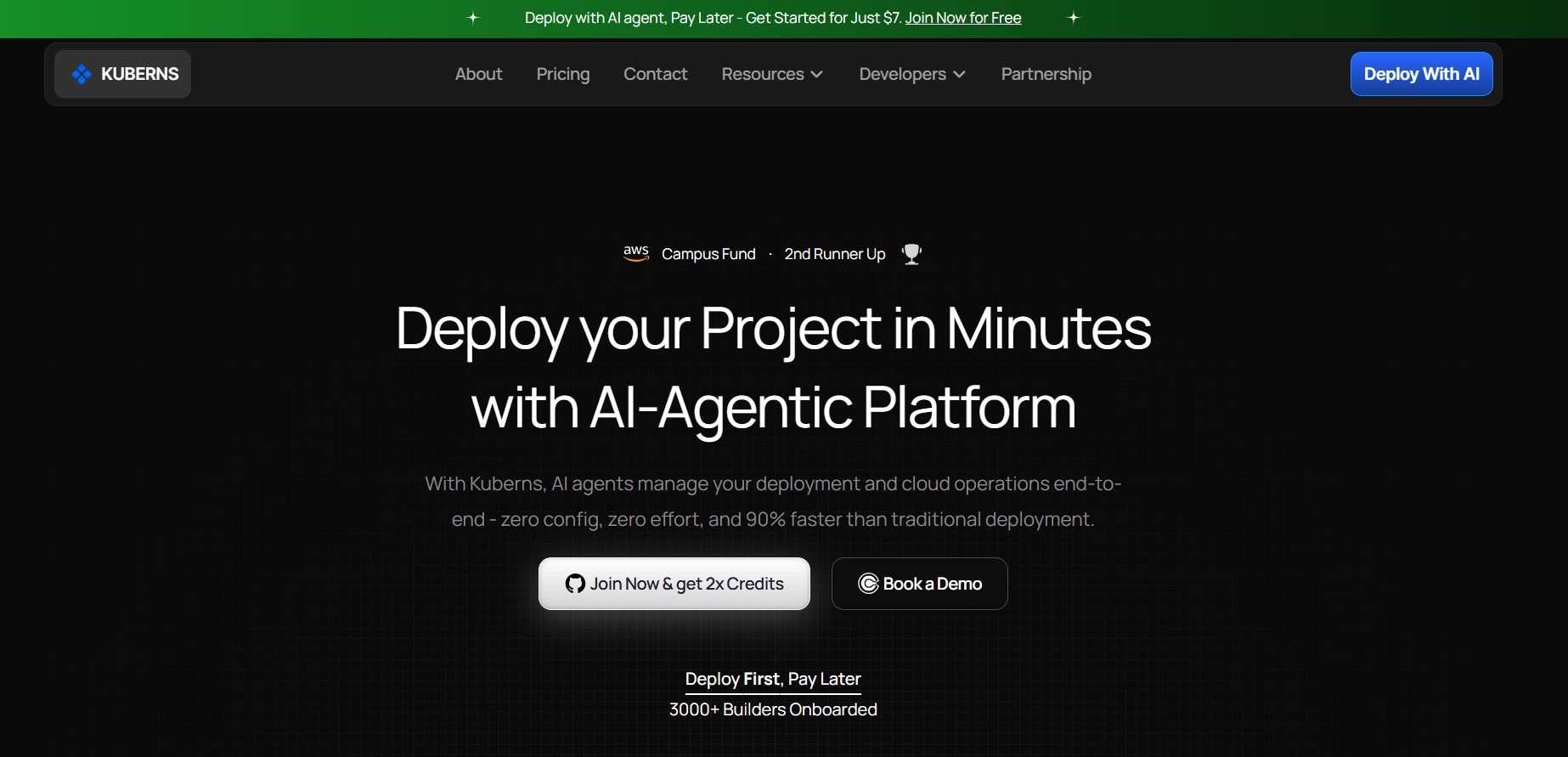
After a team chooses a suitable public-cloud approach, [Kuberns](https://kuberns.com/) provides a managed workflow for taking an application from its GitHub repository to a deployed environment. The detected application configuration remains visible so the developer can review what will be deployed instead of treating automation as a hidden process.
The core workflow is straightforward:
1. **Connect the GitHub repository.** Select the application repository.
2. **Add environment variables and resources.** Provide the production secrets and resources the project requires.
3. **Review and deploy.** Check the detected stack and visible service configuration, then deploy.
This reduces the setup between a working repository and a repeatable deployment workflow. The application team still owns its code, data model, security decisions, capacity requirements, and production verification. Kuberns helps centralize deployment rather than changing the cloud model selected by the team.
The [Kuberns getting-started documentation](https://docs.kuberns.com/docs/getting-started) explains the current repository connection and deployment flow.
> Public cloud is easier to adopt when deployment work does not become a second product. [Open the Kuberns dashboard](https://app.kuberns.com/) and evaluate the workflow with your own repository.
## Conclusion
Public, private, community, and hybrid cloud are the four established cloud deployment models. Multi-cloud is a related strategy for using more than one provider. Public cloud is normally the practical starting point for startups and web applications, while the other approaches address specific needs involving dedicated control, existing private systems, shared governance, or multiple providers.
Choose based on real requirements for control, data, integration, cost, and operational ownership. Do not assume a model creates compliance, security, scalability, or resilience automatically. Those outcomes depend on how the application and environment are designed, configured, and operated.
If public cloud fits your project and you want a simpler path from GitHub to deployment, [deploy with Kuberns Agentic AI](https://kuberns.com/deploy) and evaluate the result against your production requirements.
 ## Frequently Asked Questions
### What are the four cloud deployment models?
The four cloud deployment models defined by NIST are public cloud, private cloud, community cloud, and hybrid cloud. Multi-cloud is a modern strategy that uses services from two or more cloud providers and is often discussed alongside the four models.
### What is the most common cloud deployment model?
Public cloud is a common starting point for startups, SaaS products, and web applications because teams can rent provider-managed infrastructure without purchasing physical hardware. The right choice still depends on control, compliance, data location, cost, and operational requirements.
### Which cloud deployment model is best for startups?
Public cloud is usually the practical starting point for a startup that does not require dedicated infrastructure. It offers flexible capacity and avoids hardware procurement, while a managed deployment platform can reduce the application deployment work the team must handle.
### What is the difference between hybrid cloud and multi-cloud?
Hybrid cloud coordinates private or on-premises infrastructure with public cloud resources. Multi-cloud uses services from two or more cloud providers. An organization can use either strategy independently or combine them.
### Is an on-premises server a private cloud?
Not necessarily. A private cloud must provide cloud characteristics such as pooled resources, self-service provisioning, and elastic capacity for one organization. A conventional server hosted on-premises does not become a private cloud only because it is privately owned.
### Does a private cloud automatically make an application compliant?
No. A private cloud may provide additional control or dedicated infrastructure, but compliance also depends on application design, access controls, data handling, contracts, configuration, monitoring, and operational processes.
### What is the difference between a cloud deployment model and a cloud service model?
A cloud deployment model describes how and for whom cloud infrastructure is provisioned, such as public or private cloud. A cloud service model describes the layer consumed by the customer, such as IaaS, PaaS, or SaaS.
---
- [More AI & DevOps articles](https://kuberns.com/blogs/category/ai-devops/1/)
- [All articles](https://kuberns.com/blogs/)
## Frequently Asked Questions
### What are the four cloud deployment models?
The four cloud deployment models defined by NIST are public cloud, private cloud, community cloud, and hybrid cloud. Multi-cloud is a modern strategy that uses services from two or more cloud providers and is often discussed alongside the four models.
### What is the most common cloud deployment model?
Public cloud is a common starting point for startups, SaaS products, and web applications because teams can rent provider-managed infrastructure without purchasing physical hardware. The right choice still depends on control, compliance, data location, cost, and operational requirements.
### Which cloud deployment model is best for startups?
Public cloud is usually the practical starting point for a startup that does not require dedicated infrastructure. It offers flexible capacity and avoids hardware procurement, while a managed deployment platform can reduce the application deployment work the team must handle.
### What is the difference between hybrid cloud and multi-cloud?
Hybrid cloud coordinates private or on-premises infrastructure with public cloud resources. Multi-cloud uses services from two or more cloud providers. An organization can use either strategy independently or combine them.
### Is an on-premises server a private cloud?
Not necessarily. A private cloud must provide cloud characteristics such as pooled resources, self-service provisioning, and elastic capacity for one organization. A conventional server hosted on-premises does not become a private cloud only because it is privately owned.
### Does a private cloud automatically make an application compliant?
No. A private cloud may provide additional control or dedicated infrastructure, but compliance also depends on application design, access controls, data handling, contracts, configuration, monitoring, and operational processes.
### What is the difference between a cloud deployment model and a cloud service model?
A cloud deployment model describes how and for whom cloud infrastructure is provisioned, such as public or private cloud. A cloud service model describes the layer consumed by the customer, such as IaaS, PaaS, or SaaS.
---
- [More AI & DevOps articles](https://kuberns.com/blogs/category/ai-devops/1/)
- [All articles](https://kuberns.com/blogs/)