# Compare Deployment Platforms and Choose the Best One
> Find the best deployment platform for your project by comparing deployment speed, performance, databases, scaling, troubleshooting, costs, and maintenance.
- **Author**: manav-dobariya
- **Published**: 2026-09-12
- **Modified**: 2026-09-12
- **Category**: Deployment Guides
- **URL**: https://kuberns.com/blogs/compare-and-choose-deployment-platform/
---
The best way to compare deployment platforms is to deploy the same application on Kuberns, Railway, Render, and Heroku, keep the important test conditions comparable, and measure the complete production experience. Compare deployment work, full-stack support, performance, logs, scaling, reliability, cost, and ongoing maintenance before choosing a platform.
A feature table can tell you whether a provider lists databases or workers. It cannot show how your framework, dependencies, build commands, environment variables, database queries, background jobs, and traffic patterns will behave after deployment.
This guide gives you a practical method for comparing the four platforms with your own GitHub repository. It also explains why Kuberns fits the evaluation criteria especially well for full-stack and complex backend projects, then lets you test the Agentic AI deployment experience before making the final decision.
## TL;DR
- Compare Kuberns, Railway, Render, and Heroku using the same application, not four unrelated demos.
- Keep the repository commit, production configuration, database data, region, resources, and test traffic as consistent as possible.
- Test the complete stack, including the backend, database, workers, storage, scheduled jobs, and external services.
- Measure deployment effort, application performance, troubleshooting, scaling, complete costs, and ongoing DevOps work.
- Choose the platform that performs best on the criteria that matter to your project.
## Why Should You Compare Platforms Using Your Own Application?

There is no universally best deployment platform because applications do not make identical demands on infrastructure. A static frontend, a Rails application with PostgreSQL, and a SaaS product with an API, worker, cache, scheduled jobs, and file storage need different deployment workflows.
Generic comparison pages usually start with platform features. Your decision should start with the project:
- Which frameworks and runtimes does it use?
- Does it need a persistent backend process?
- Which database, cache, and queue does it require?
- Are there background workers or scheduled jobs?
- Does it upload or process files?
- Which application journeys are sensitive to latency?
- How much production traffic should it handle?
- Who will investigate a failed deployment?
- How much operational work can the team own?
A Rails developer documented the consequences of insufficient due diligence in a comparison of Railway, Render, Heroku, DigitalOcean, and Fly.io. The team deployed the same application stack and reported different response times and support experiences. The value of the discussion is not that one community report proves a universal winner. It shows why a real deployment can expose differences that a feature list cannot.
Another thread asks for actual Railway and Render deployment experience. The replies discuss Redis, databases, deployment speed, failures, analytics, costs, and portability. Those concerns are specific to the applications people are running, which is exactly why your own project is the most useful test case.
Use community discussions to identify what developers experience and which questions you should ask. Use current official documentation to verify product features, billing rules, limits, and supported workflows before publishing a final comparison.
> **A generic comparison can create your shortlist. Only your application can confirm which platform fits. [See what affects real application deployment speed](https://kuberns.com/blogs/fastest-way-to-deploy-web-app/).**
## Which Deployment Platforms Should You Compare?
For a managed full-stack application, Kuberns, Railway, Render, and Heroku form a useful shortlist. Each can run application services, but the workflow, configuration model, supporting resources, operational visibility, scaling approach, and billing structure differ.
Vercel may belong in a separate comparison when the project is primarily a frontend or Next.js application. This guide focuses on platforms that developers commonly evaluate for persistent backends, databases, workers, and complete application services.
| Criterion | Kuberns | Railway | Render | Heroku |
| --- | --- | --- | --- | --- |
| Deployment approach | Agentic AI deployment from a GitHub repository | GitHub, CLI, templates, and service-based deployment | Git-provider, Docker, and Blueprint deployment | Git, GitHub integration, CLI, and buildpacks |
| Full-stack applications | Designed for full-stack and complex backend projects | Application and database services can run within a project | Web services, workers, jobs, and managed databases | Dynos, data services, and add-ons |
| Configuration | Agentic AI detects supported application configuration for review | Service configuration remains developer-controlled | Build, start, service, and infrastructure settings are configured through the platform | Buildpacks and application configuration control the deployment |
| Database and workers | Supporting resources can be managed in the application workflow | Databases and workers can run as project services | Managed databases and background workers are available | Databases and worker dynos are available |
| Logs and monitoring | Build logs, service logs, metrics, and supported alerts | Deployment and service logs with platform observability | Logs, metrics, events, and applicable notifications | Log streams, metrics, and add-on integrations |
| Scaling | Scaling controls and metrics are available through the dashboard | Vertical and horizontal scaling depend on service configuration | Manual and automatic scaling are available on applicable plans | Applications scale by changing dyno type or quantity |
| Pricing structure | Resource-based runtime pricing with no per-user pricing | Subscription plus resource consumption | Workspace, compute, and metered-feature pricing | Dyno runtime plus data services and add-ons |
| Strongest fit | Teams wanting Agentic AI deployment for complete applications | Developers wanting a flexible, service-based workflow | Teams wanting a conventional managed application platform | Teams familiar with the established Heroku PaaS model |
This table creates a starting point, not a final verdict. Features and plan availability change, and the existence of a feature does not reveal how easily it works with your application. Recheck the official documentation and dashboard before relying on any time-sensitive capability.
> **Do not compare platform homepages. Compare the production capabilities your application actually needs. [Review the detailed Railway, Render, and Kuberns comparison](https://kuberns.com/blogs/railway-vs-render-vs-kuberns/).**
## What Must Stay the Same for a Fair Comparison?

A useful platform test changes the platform while controlling the other important variables. If one deployment receives more resources, uses a closer database, or runs a different commit, the result may describe the configuration rather than the provider.
**Repository baseline:** Use the same GitHub repository, branch, and commit. Do not optimize the code for one platform halfway through the test without recording and reproducing the change elsewhere.
**Application baseline:** Use the same production build command, start command, framework version, dependency lockfile, and runtime mode. Debug servers and development settings do not represent production behavior.
**Data baseline:** Use the same database engine, schema, and representative sanitized dataset. An empty database may hide query behavior, indexing problems, and connection demands that appear with real data.
**Resource baseline:** Choose comparable CPU, memory, storage, and database resources when the platforms expose them. Exact equivalence may not be possible, so document the differences rather than claiming a perfect laboratory comparison.
**Region baseline:** Select the same region or geographically comparable regions. A platform should not be labelled slower because its test environment was farther from the user or database.
**Traffic baseline:** Run the same user journeys, request mix, concurrency, and duration. Testing one cached page on one provider and several database-heavy routes on another produces no useful conclusion.
Create the acceptance criteria before deploying. Decide which application journeys must work, which response-time and error-rate thresholds matter, what costs belong in the calculation, and how much manual infrastructure work the team will tolerate.
> **If the commit, resources, region, data, or traffic changes between tests, you are comparing configurations rather than platforms.**
## How to Compare Deployment Platforms With Your Own Application

The comparison has six steps. Record evidence as you work, including elapsed time, failed attempts, configuration changes, screenshots, log quality, metrics, and costs. Do not rely on memory after completing four deployments.
### Step 1: Prepare One Fair Application Baseline
Select a production-representative application rather than a basic starter template. Prepare one GitHub commit, production environment-variable names, sanitized test secrets, a representative database dataset, required workers and storage, comparable resources, important user journeys, performance thresholds, and a cost worksheet.
Do not reuse the live production database. Platform testing should not expose customer data, allow test traffic to modify production records, or let experimental workers process real jobs.
### Step 2: Deploy the Same Application on Each Platform
Deploy the selected commit on Kuberns, Railway, Render, and Heroku. Start the timer when you begin platform setup and stop when the application is reachable and its required processes have started.
Record the time to first success, configuration decisions, files added or changed, commands entered manually, failed attempts, documentation needed, deployment visibility, and whether later commits deploy automatically.
For Kuberns, the user connects the GitHub repository, selects the repository and branch, adds required values and resources, reviews the detected configuration, and starts deployment. The review keeps the process visible while the Agentic AI workflow handles supported deployment configuration. Use the official Kuberns getting-started documentation for the current workflow.
### Step 3: Connect the Complete Application Stack
A frontend-only deployment is not a fair test when production also needs an API, database, worker, scheduled job, or storage. Connect every essential service supported by each platform.
Verify that the application reads the correct values, reaches the test database, completes migrations, starts workers, processes representative jobs, runs scheduled tasks once, persists uploads, and connects to test versions of email, payment, webhook, and other external services.
Record how many dashboards, providers, configuration pages, and billing relationships are needed. A quick frontend deployment can still become a fragmented production system when every supporting service lives elsewhere.
> **The best platform should simplify the complete application, not merely publish its homepage. [See why application services are easier to manage through one platform](https://kuberns.com/blogs/host-startup-app/).**
### Step 4: Run the Same Functional and Performance Tests
Test complete user journeys rather than one homepage request. Include registration, authentication, dashboards, search, database writes, uploads, webhooks, APIs, and background jobs where they apply.
Measure successful and failed requests, response-time percentiles, database-dependent routes, worker completion, CPU and memory behavior, error rate under expected concurrency, and behavior during a short controlled traffic increase.
Define pass-or-fail conditions before testing. Grafana's k6 threshold documentation shows how response-time and error-rate expectations can become explicit criteria. Its API load-testing guidance recommends choosing user flows, methods, and acceptable performance before generating load.
Short tests do not prove long-term reliability. Their purpose is to determine whether each comparable deployment meets this project's requirements.
> **Measure the user journeys that create value. A fast homepage cannot compensate for a slow login, database query, or background job.**
### Step 5: Create and Diagnose the Same Safe Failure
The first successful deployment measures onboarding. A controlled failure measures how the platform helps when a release or configuration eventually goes wrong.
Use a reversible test such as a missing non-sensitive variable, incorrect start command, failed test-database connection, worker exception, unhealthy test endpoint, or commit that fails during the build.
Compare how quickly the platform exposes the first actionable error. Check whether build output is separate from service logs, whether the affected process is clear, whether recent changes are visible, and whether the team can redeploy the working commit without modifying unrelated services.
Kuberns documents build logs, service logs, CPU, memory, response-time and throughput metrics, supported alerts, activities, and diagnostic workflows. Use the official Kuberns monitoring and diagnostics documentation for exact current functionality.
> **The easiest platform is not only the one that deploys successfully. It is the one that helps your team understand a failed deployment quickly.**
### Step 6: Compare Scaling, Recovery, and Complete Cost
Review how each platform changes capacity. Identify vertical and horizontal scaling, how resource changes appear in metrics, what happens to active requests, and how scaling changes the monthly estimate.
Inspect service health, restart behavior, deployment history, redeployment and rollback, capacity controls, scaling visibility, alerts, and database or worker behavior during changes.
Calculate the complete cost of the same working application, including compute, database, backups, workers, cache, storage, transfer, builds, monitoring, staging, team charges, add-ons, and engineering time spent managing infrastructure.
The invoice is only one part of the comparison. A low server price may be less valuable if developers regularly maintain deployment scripts, assemble monitoring tools, or troubleshoot several providers.
> **Compare the complete monthly workload and the work required to operate it. [Evaluate deployment platforms by billing predictability](https://kuberns.com/blogs/deployment-platform-with-predictable-costs/).**
## How Do Kuberns, Railway, Render, and Heroku Score for Your Project?
Choose the weights before viewing results. This prevents the team from changing the rules afterward to justify a familiar provider or the fastest first deployment.
The scores below are our editorial evaluation of each platform's documented workflow for a representative full-stack project with a frontend, backend, PostgreSQL database, and background worker. They are not measured performance benchmarks, customer results, or guarantees for every application. Runtime performance must still be tested with your own code, region, data, and resources.
| Evaluation criterion | Weight | **Kuberns** | Railway | Render | Heroku |
| --- | ---: | ---: | ---: | ---: | ---: |
| Deployment workflow | 20% | **9.5/10** | 8.5/10 | 8/10 | 8/10 |
| Full-stack support | 15% | **9/10** | 9/10 | 9/10 | 8.5/10 |
| Configuration effort | 10% | **9.5/10** | 8.5/10 | 8/10 | 8/10 |
| Logs and troubleshooting | 15% | **9/10** | 8/10 | 8.5/10 | 8/10 |
| Scaling and recovery workflow | 10% | **9/10** | 8.5/10 | 9/10 | 8/10 |
| Cost clarity for the complete stack | 10% | **9/10** | 8/10 | 8.5/10 | 8/10 |
| Team pricing | 10% | **10/10** | 8/10 | 8/10 | 8/10 |
| Ongoing DevOps work | 10% | **9/10** | 8/10 | 8/10 | 8/10 |
| **Weighted editorial score** | **100%** | **9.3/10** | **8.3/10** | **8.4/10** | **8.1/10** |
The weights suit a small team evaluating a full-stack application. Kuberns ranks first because Agentic AI reduces deployment and configuration work, the complete application workflow remains visible, and adding developers does not create a per-user platform charge. Render scores strongly for conventional full-stack services and scaling, while Railway performs well for flexible service-based deployment. Heroku remains a familiar managed PaaS, but its dyno, data-service, and add-on model can require more separate decisions.
These scores provide a useful starting comparison, but they should not override evidence from your application. Deployment should be checked against actual time and attempts. Performance should use the same tests and resources. Troubleshooting should use time to resolve the controlled failure. Cost should include the complete stack. Ongoing work should identify recurring tasks after migration.
Do not convert these editorial scores into claims that one platform is universally faster, cheaper, or more reliable. Use the table to build a shortlist, then update the scores with the results from your own deployment.
> **The winning platform is not the one that leads one metric. It is the one that produces the best complete result for your project.**
## Why Does Kuberns Fit These Evaluation Criteria Best?
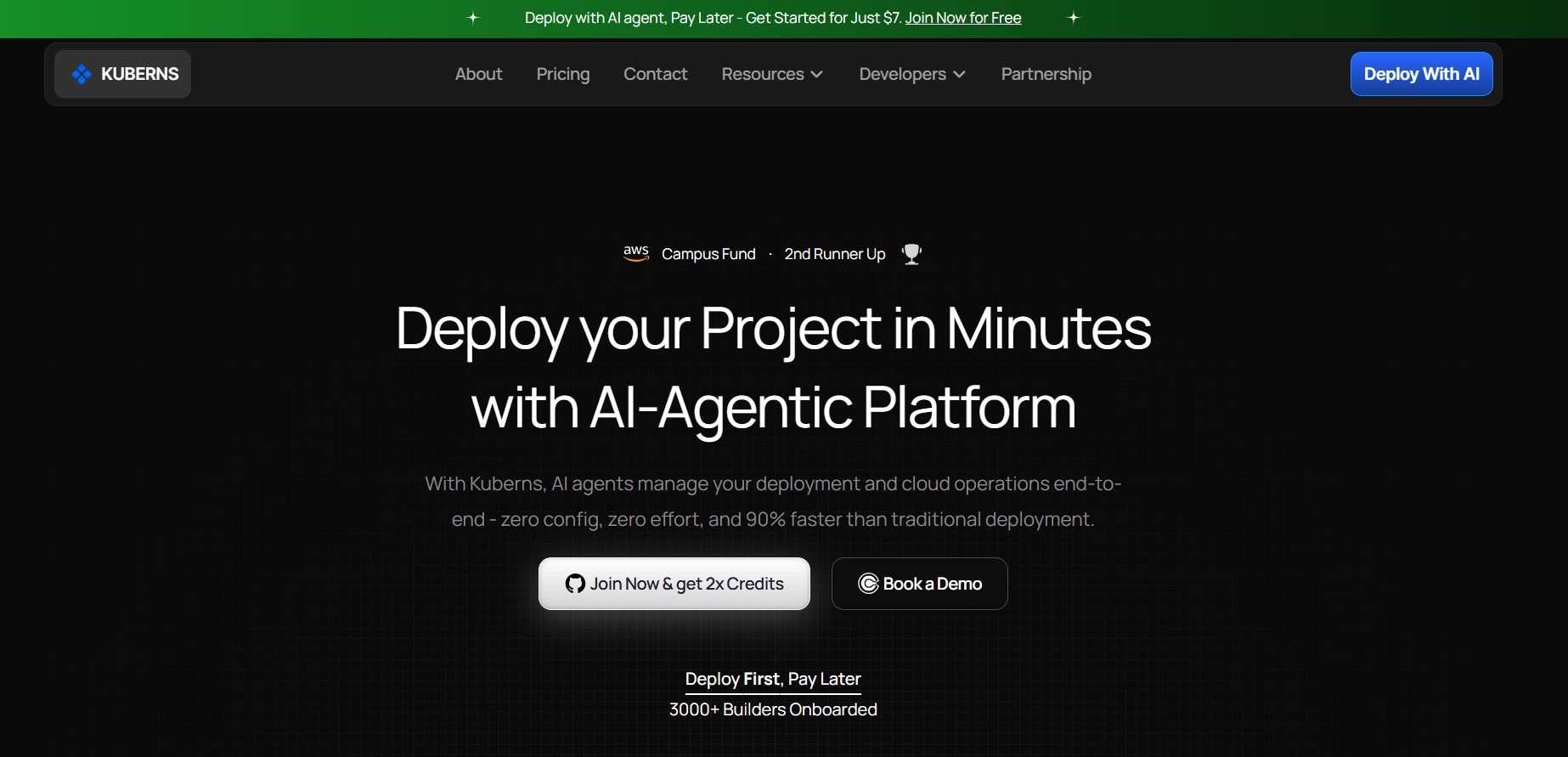
Kuberns fits especially well when the project includes a frontend, backend, database, workers, or other production services and the team wants to reduce deployment and infrastructure configuration. It is an Agentic AI platform for deployment built for full-stack and complex backend projects.
| Evaluation criterion | How Kuberns fits |
| --- | --- |
| Deployment workflow | Starts from the GitHub repository and uses Agentic AI for supported deployment configuration |
| Full-stack support | Designed for application frontends, backends, and supporting resources |
| Configuration effort | Detected stack, commands, variables, and resources remain visible for review |
| Logs and troubleshooting | Provides deployment output, service logs, metrics, activities, and supported alerts |
| Scaling and operations | Keeps application resources, metrics, and supported scaling controls in the dashboard |
| Team cost | Does not use per-user pricing |
| Starting commitment | Plans start at $7 and a Trial Option is available |
| Ongoing work | Agentic AI reduces recurring deployment and infrastructure configuration |
These advantages do not prove that Kuberns produces the lowest latency or smallest bill for every application. Performance depends on code, data paths, resources, region, and traffic. Runtime cost depends on attached resources and how long they run.
They explain why Kuberns should be tested first by a small team that wants a complete application workflow without becoming its own infrastructure team. It addresses deployment effort, operational visibility, team pricing, and ongoing work before the reader assigns a benchmark score.
Review [current Kuberns plans](https://kuberns.com/pricing/) using the requirements of your own application rather than an unrelated example.
> **Kuberns fits the criteria on paper. Your repository can verify the Agentic AI experience before you decide.**
## Try Kuberns With Your Application Before You Decide
You do not need to migrate production to evaluate Kuberns. Use a test environment and the same repository, data, user journeys, thresholds, and scorecard prepared for the comparison.
The main user actions are simple:
1. Connect the GitHub repository and select the application branch.
2. Add the required environment variables and supported resources.
3. Review the visible configuration and click Deploy.
After deployment, run the same functional tests, performance thresholds, controlled failure, resource review, and cost calculation used for Railway, Render, and Heroku. Record the evidence and let the weighted criteria determine whether the workflow fits.
Do not move customer traffic or production data during the comparison. If Kuberns produces the best result, prepare database, external-service, DNS, monitoring, rollback, and cutover work as a separate migration phase.
> **Experience the workflow before committing to the platform. [Test your application with the Kuberns Trial Option](https://dashboard.kuberns.com/).**
## Compare the Complete Application and Choose From Evidence
Platform rankings can help you discover Kuberns, Railway, Render, and Heroku, but they cannot choose the best environment for your repository. Deploy the same application, connect the complete stack, run identical user journeys, create the same safe failure, and compare scaling, costs, and ongoing work.
For full-stack and complex backend projects, Kuberns is the strongest option to include. Its Agentic AI workflow reduces manual configuration, keeps important deployment and operational information visible, avoids per-user pricing, and lets teams begin with a Trial Option.
The final decision should still come from the application. If Kuberns gives your team the best combination of deployment simplicity, full-stack support, troubleshooting, scaling visibility, cost, and reduced DevOps work, you have evidence for migration rather than another opinion.
> **Deploy your repository, use the comparison scorecard, and decide from the result. [Try the Kuberns Agentic AI deployment experience](https://dashboard.kuberns.com/).**
 ## Frequently Asked Questions
### How do I compare deployment platforms fairly?
Deploy the same repository and commit with comparable regions, resources, database data, environment variables, and test traffic. Evaluate deployment effort, full-stack support, performance, troubleshooting, scaling, complete cost, and ongoing DevOps work using criteria chosen before seeing the results.
### Which deployment platform is best for my application?
The best platform is the one that supports your complete architecture and performs well on the criteria that matter to your project. Kuberns is a strong choice for full-stack and complex backend applications when reducing deployment configuration, team charges, and ongoing infrastructure work are priorities.
### Should I test a hosting platform before migrating?
Yes. A test deployment reveals repository compatibility, configuration work, database and worker setup, real application performance, log quality, scaling workflow, and complete costs before production users or data depend on the new platform.
### What should I measure in a deployment-platform test?
Measure deployment time, manual setup, failed attempts, complete service support, response time, error rate, worker completion, troubleshooting time, scaling workflow, recovery options, monthly costs, team charges, and recurring infrastructure work.
### How many deployment platforms should I compare?
Two to four relevant platforms are usually enough. A focused comparison using a complete application produces better evidence than shallow tests across many providers. For a managed full-stack deployment, Kuberns, Railway, Render, and Heroku form a practical shortlist.
### How do I compare Render and Railway with my own app?
Deploy the same commit and complete application stack on both platforms. Keep regions, resources, data, and tests comparable, then record deployment work, database and worker setup, response times, failures, logs, scaling, monthly costs, and ongoing maintenance.
### Should I use the same database when testing hosting platforms?
Use databases with the same engine, schema, representative sanitized data, and comparable resources. Keep each application close to its test database when possible. Sharing one remote database can distort results because network distance may affect one platform differently.
### How do I benchmark application performance on different platforms?
Define the same user journeys and pass-or-fail thresholds, then run identical traffic against comparable deployments. Record response-time percentiles, error rates, database operations, worker completion times, resource use, and behavior during expected concurrency.
### Is the fastest deployment platform always the best?
No. A fast first deployment can still lead to difficult database integration, weak troubleshooting, expensive scaling, or recurring operational work. Evaluate the entire production lifecycle rather than optimizing only for the time required to publish the first version.
### How should I compare deployment-platform costs?
Compare the cost of the same complete workload, including application compute, database, workers, storage, bandwidth, builds, monitoring, staging, backups, team access, add-ons, and engineering time. Do not compare only the smallest advertised plans.
### Can I test Kuberns before migrating production?
Yes. Kuberns offers a Trial Option that lets a team evaluate the Agentic AI deployment workflow using its application before moving production. Confirm the current trial terms and estimated runtime resources in the Kuberns dashboard.
### When is a deployment-platform test complete?
The test is complete when the full application deploys, required services communicate correctly, important user journeys pass, failures can be diagnosed, scaling and recovery are understood, and the team can estimate both the monthly bill and ongoing operational work.
---
- [More Deployment Guides articles](https://kuberns.com/blogs/category/deployment-guides/1/)
- [All articles](https://kuberns.com/blogs/)
## Frequently Asked Questions
### How do I compare deployment platforms fairly?
Deploy the same repository and commit with comparable regions, resources, database data, environment variables, and test traffic. Evaluate deployment effort, full-stack support, performance, troubleshooting, scaling, complete cost, and ongoing DevOps work using criteria chosen before seeing the results.
### Which deployment platform is best for my application?
The best platform is the one that supports your complete architecture and performs well on the criteria that matter to your project. Kuberns is a strong choice for full-stack and complex backend applications when reducing deployment configuration, team charges, and ongoing infrastructure work are priorities.
### Should I test a hosting platform before migrating?
Yes. A test deployment reveals repository compatibility, configuration work, database and worker setup, real application performance, log quality, scaling workflow, and complete costs before production users or data depend on the new platform.
### What should I measure in a deployment-platform test?
Measure deployment time, manual setup, failed attempts, complete service support, response time, error rate, worker completion, troubleshooting time, scaling workflow, recovery options, monthly costs, team charges, and recurring infrastructure work.
### How many deployment platforms should I compare?
Two to four relevant platforms are usually enough. A focused comparison using a complete application produces better evidence than shallow tests across many providers. For a managed full-stack deployment, Kuberns, Railway, Render, and Heroku form a practical shortlist.
### How do I compare Render and Railway with my own app?
Deploy the same commit and complete application stack on both platforms. Keep regions, resources, data, and tests comparable, then record deployment work, database and worker setup, response times, failures, logs, scaling, monthly costs, and ongoing maintenance.
### Should I use the same database when testing hosting platforms?
Use databases with the same engine, schema, representative sanitized data, and comparable resources. Keep each application close to its test database when possible. Sharing one remote database can distort results because network distance may affect one platform differently.
### How do I benchmark application performance on different platforms?
Define the same user journeys and pass-or-fail thresholds, then run identical traffic against comparable deployments. Record response-time percentiles, error rates, database operations, worker completion times, resource use, and behavior during expected concurrency.
### Is the fastest deployment platform always the best?
No. A fast first deployment can still lead to difficult database integration, weak troubleshooting, expensive scaling, or recurring operational work. Evaluate the entire production lifecycle rather than optimizing only for the time required to publish the first version.
### How should I compare deployment-platform costs?
Compare the cost of the same complete workload, including application compute, database, workers, storage, bandwidth, builds, monitoring, staging, backups, team access, add-ons, and engineering time. Do not compare only the smallest advertised plans.
### Can I test Kuberns before migrating production?
Yes. Kuberns offers a Trial Option that lets a team evaluate the Agentic AI deployment workflow using its application before moving production. Confirm the current trial terms and estimated runtime resources in the Kuberns dashboard.
### When is a deployment-platform test complete?
The test is complete when the full application deploys, required services communicate correctly, important user journeys pass, failures can be diagnosed, scaling and recovery are understood, and the team can estimate both the monthly bill and ongoing operational work.
---
- [More Deployment Guides articles](https://kuberns.com/blogs/category/deployment-guides/1/)
- [All articles](https://kuberns.com/blogs/)