# How to Deploy Vibe-Coded Claude Code Apps to Production in Minutes
> Built an app with Claude Code? Deploy your vibe-coded project to production in minutes — no DevOps, no YAML, no infrastructure setup.
- **Author**: charan-achari
- **Published**: 2026-05-18
- **Modified**: 2026-05-18
- **Category**: AI & DevOps
- **URL**: https://kuberns.com/blogs/deploy-claude-code-apps-to-production/
---
You just vibe-coded a full app with Claude Code. It works locally. Now what?
Deploying a Claude Code app to production is where most developers hit a wall: environment variables, Dockerfiles, CI/CD pipelines, SSL certificates. None of that was part of the vibe.
This guide shows you how to take any Claude Code project (Next.js, Express API, FastAPI, Django, whatever) and get it live in production in under 10 minutes. No YAML. No infrastructure knowledge required.
---
## What Claude Code Builds (and Why Deployment Can Catch You Off Guard)

Claude Code is Anthropic's agentic coding tool. You describe what you want in your terminal or IDE, and Claude autonomously writes code, edits files, runs commands, and iterates until it works. It's the fastest way to go from idea to working code in 2026.
The problem is that Claude Code is exceptional at *building*, but it hands you a local project, not a deployed app. That gap between "it works on my machine" and "it's live on the internet" is where most vibe coders get stuck.
Common blockers after vibe coding:
- **No Dockerfile:** the app runs with `npm start` locally but needs containerization for cloud
- **Environment variables:** API keys and secrets need to be set securely in production
- **HTTPS and domain:** getting an SSL cert and routing traffic isn't automatic
- **Build pipeline:** compiling TypeScript, running Next.js builds, installing deps in the right order
The good news: you don't need to solve any of these manually.
---
## The Fastest Way to Deploy a Claude Code App: Use Kuberns
Before walking through manual deployment options, here's the path that actually matches the vibe-coding workflow.
[Kuberns](https://kuberns.com) is an Agentic AI cloud platform that reads your project, detects your stack automatically, installs dependencies, builds your app, and deploys it with HTTPS and CI/CD enabled, all without configuration files.
**Deploy in 3 steps:**
1. Push your Claude Code project to a GitHub repo
2. Connect the repo to Kuberns and set your environment variables
3. Click Deploy and get a live HTTPS URL in under 5 minutes
 Every subsequent push to `main` triggers an automatic redeploy. You stay in the build loop with Claude Code, and Kuberns handles the shipping.
---
## Step-by-Step: Deploying a Claude Code App on Kuberns
### Step 1: Prepare Your Claude Code Project for Deployment
Claude Code projects are usually clean but a few things need to be in place before pushing:
**Check your start command.** Kuberns needs to know how to run your app. Make sure `package.json` has a `start` script (for Node.js apps), or that your `Procfile` / entry point is clear.
```json
// package.json example
{
"scripts": {
"start": "node dist/index.js",
"build": "tsc"
}
}
```
For Python apps, make sure you have a `requirements.txt` or `pyproject.toml` at the root.
**Externalize your secrets.** Any API keys or credentials in your Claude Code project should be in environment variables, not hardcoded. Use `process.env.MY_API_KEY` (Node.js) or `os.environ["MY_API_KEY"]` (Python). You'll inject the actual values in Kuberns.
**Commit and push to GitHub.** Kuberns deploys directly from your repo.
```bash
git init
git add .
git commit -m "initial claude code app"
git remote add origin https://github.com/your-username/your-app.git
git push -u origin main
```
---
### Step 2: Connect Your Repo to Kuberns

1. Go to [dashboard.kuberns.com](https://dashboard.kuberns.com) and sign up (free credits included, no card required)
2. Click **New Project** → **Connect GitHub**
3. Authorize Kuberns to access your repo
4. Select the repo containing your Claude Code app
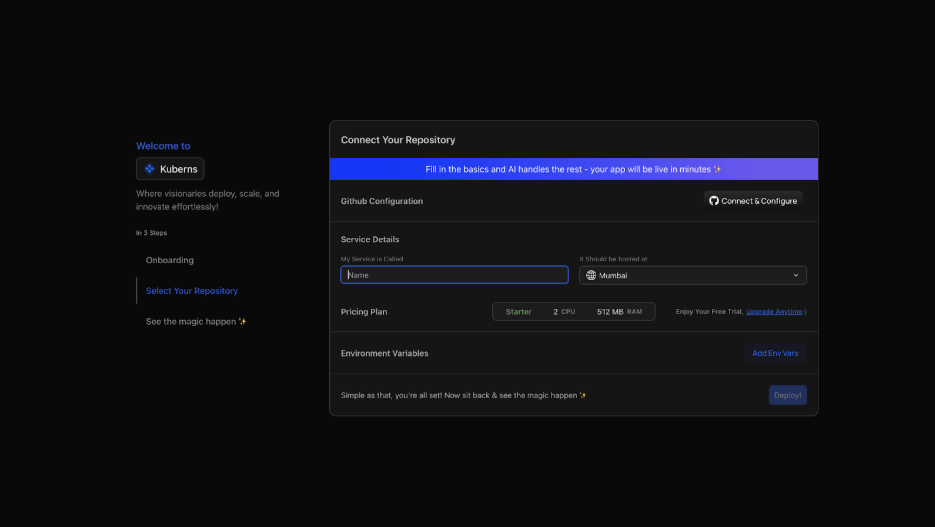
Kuberns scans your project automatically. It detects:
- **Runtime** (Node.js 18/20/22, Python 3.10/3.11/3.12, Go, PHP, etc.)
- **Framework** (Next.js, Express, FastAPI, Django, Flask, NestJS, etc.)
- **Build command** (e.g., `npm run build` for Next.js)
- **Start command** (e.g., `npm start` or `uvicorn main:app`)
No Dockerfile needed. Kuberns builds a container image for you behind the scenes.
---
### Step 3: Set Your Environment Variables

In the Kuberns project settings, go to **Environment Variables** and add each key-value pair your app needs:
- API keys (OpenAI, Stripe, etc.)
- Database URLs
- Auth secrets (JWT secret, OAuth credentials)
- Any feature flags
These are injected securely at build time and runtime. They never touch your git history.
---
### Step 4: Deploy

Click **Deploy**. Kuberns:
1. Pulls your latest code from GitHub
2. Installs dependencies
3. Runs your build command
4. Starts your app in a container on AWS
5. Provisions an HTTPS URL

Your app is live in under 5 minutes. You get a `*.kuberns.app` URL immediately, and you can add a custom domain with a single DNS record.
---
## Deploying Specific Claude Code Stack Types
### Next.js / React Apps
Claude Code frequently builds Next.js apps. Kuberns detects the framework automatically and runs `next build` then serves the output.
If your Claude Code project uses Next.js API routes as a backend (full-stack Next.js), Kuberns handles both the frontend and backend in one deployment with no need to split them.
Internal tip: if you're also [deploying a SaaS app](https://kuberns.com/blogs/how-to-deploy-a-saas-app/), the same workflow applies.
### Node.js / Express APIs
For Express.js or raw Node.js backends, Kuberns detects `package.json` and your `start` script. Make sure your app listens on `process.env.PORT` (Kuberns injects the port):
```javascript
const port = process.env.PORT || 3000;
app.listen(port, () => console.log(`Running on port ${port}`));
```
### Python (FastAPI / Django / Flask)
For Python apps built with Claude Code, Kuberns reads `requirements.txt` and auto-detects the framework.
**FastAPI example:**
```
# requirements.txt
fastapi
uvicorn[standard]
```
Kuberns will run `uvicorn main:app --host 0.0.0.0 --port $PORT` automatically.
**Django:** Ensure `gunicorn` is in your requirements, and Kuberns handles the rest.
---
## What Happens After You Deploy
Once your Claude Code app is live on Kuberns, you get:
- **Auto-deploy on git push:** every `git push` to `main` triggers a new build automatically. You keep iterating with Claude Code; Kuberns keeps shipping.
- **Real-time logs:** view build logs and runtime logs directly in the dashboard
- **Uptime monitoring:** Kuberns restarts your app automatically if it crashes
- **Autoscaling:** traffic spikes are handled without you touching anything
- **Custom domains:** point your domain to your Kuberns app with a single CNAME record
This loop (describe → Claude Code writes → push → Kuberns deploys) is what [vibe deployment](https://kuberns.com/blogs/what-is-vibe-deployment/) actually looks like in practice.
---
## Handling Databases for Claude Code Apps
If your Claude Code project uses a database, you have two options:
**Option 1: Managed database (recommended)**
Use a hosted database service and pass the connection string as an environment variable:
- **Postgres**: Supabase, Neon, Railway Postgres, or AWS RDS
- **MongoDB**: MongoDB Atlas
- **Redis**: Upstash
Set `DATABASE_URL` in Kuberns env vars. Your app connects from day one.
**Option 2: Kuberns persistent storage**
For apps that use SQLite or file-based storage, Kuberns supports persistent volumes so your data survives redeployments.
---
## Claude Code + Kuberns: The Full Vibe Stack

Here's what the end-to-end workflow looks like when you combine these two tools:
| Stage | Tool | What Happens |
|---|---|---|
| Build | Claude Code | Describe features → Claude writes the code |
| Version control | Git + GitHub | Push your changes to a repo |
| Deploy | Kuberns | Auto-detects stack, builds, deploys with HTTPS |
| Scale | Kuberns | Autoscales on traffic without config |
| Iterate | Claude Code + Kuberns | Push new code → auto-redeploy |
No DevOps engineer. No infrastructure YAML. No manual server provisioning.
This is the same pattern used in [Cursor vibe coding workflows](https://kuberns.com/blogs/cursor-vibe-coding/) and [Windsurf-to-production flows](https://kuberns.com/blogs/how-to-deploy-from-windsurf/). Claude Code just gives you a more powerful agentic coding layer underneath.
---
## Why Developers Are Choosing Kuberns for Vibe-Coded Apps
The standard deployment story for solo founders and vibe coders usually ends in one of three frustrations:
1. **Vercel:** perfect for pure frontend, but it breaks when you have a backend or websockets
2. **Heroku:** works but is expensive and slow to scale
3. **AWS/GCP directly:** overwhelming YAML, IAM, and VPC configuration
Kuberns is built for the middle path: the developer who wants production-grade infrastructure without becoming a DevOps engineer.
**What you get with Kuberns:**
- Deploy any stack in under 5 minutes: frontend, backend, and containerized microservices
- Agentic AI that manages the deployment lifecycle (not just automates it)
- Full Kubernetes power under the hood: autoscaling, zero cold starts, and persistent storage
- Save up to 40% on AWS infrastructure costs compared to running it yourself
- No servers to maintain and no DevOps hiring required
For developers who build with [AI productivity tools](https://kuberns.com/blogs/ai-developer-productivity-tools/) like Claude Code, the deployment story should match the build story: fast, zero-config, and smart.
Every subsequent push to `main` triggers an automatic redeploy. You stay in the build loop with Claude Code, and Kuberns handles the shipping.
---
## Step-by-Step: Deploying a Claude Code App on Kuberns
### Step 1: Prepare Your Claude Code Project for Deployment
Claude Code projects are usually clean but a few things need to be in place before pushing:
**Check your start command.** Kuberns needs to know how to run your app. Make sure `package.json` has a `start` script (for Node.js apps), or that your `Procfile` / entry point is clear.
```json
// package.json example
{
"scripts": {
"start": "node dist/index.js",
"build": "tsc"
}
}
```
For Python apps, make sure you have a `requirements.txt` or `pyproject.toml` at the root.
**Externalize your secrets.** Any API keys or credentials in your Claude Code project should be in environment variables, not hardcoded. Use `process.env.MY_API_KEY` (Node.js) or `os.environ["MY_API_KEY"]` (Python). You'll inject the actual values in Kuberns.
**Commit and push to GitHub.** Kuberns deploys directly from your repo.
```bash
git init
git add .
git commit -m "initial claude code app"
git remote add origin https://github.com/your-username/your-app.git
git push -u origin main
```
---
### Step 2: Connect Your Repo to Kuberns

1. Go to [dashboard.kuberns.com](https://dashboard.kuberns.com) and sign up (free credits included, no card required)
2. Click **New Project** → **Connect GitHub**
3. Authorize Kuberns to access your repo
4. Select the repo containing your Claude Code app

Kuberns scans your project automatically. It detects:
- **Runtime** (Node.js 18/20/22, Python 3.10/3.11/3.12, Go, PHP, etc.)
- **Framework** (Next.js, Express, FastAPI, Django, Flask, NestJS, etc.)
- **Build command** (e.g., `npm run build` for Next.js)
- **Start command** (e.g., `npm start` or `uvicorn main:app`)
No Dockerfile needed. Kuberns builds a container image for you behind the scenes.
---
### Step 3: Set Your Environment Variables

In the Kuberns project settings, go to **Environment Variables** and add each key-value pair your app needs:
- API keys (OpenAI, Stripe, etc.)
- Database URLs
- Auth secrets (JWT secret, OAuth credentials)
- Any feature flags
These are injected securely at build time and runtime. They never touch your git history.
---
### Step 4: Deploy

Click **Deploy**. Kuberns:
1. Pulls your latest code from GitHub
2. Installs dependencies
3. Runs your build command
4. Starts your app in a container on AWS
5. Provisions an HTTPS URL

Your app is live in under 5 minutes. You get a `*.kuberns.app` URL immediately, and you can add a custom domain with a single DNS record.
---
## Deploying Specific Claude Code Stack Types
### Next.js / React Apps
Claude Code frequently builds Next.js apps. Kuberns detects the framework automatically and runs `next build` then serves the output.
If your Claude Code project uses Next.js API routes as a backend (full-stack Next.js), Kuberns handles both the frontend and backend in one deployment with no need to split them.
Internal tip: if you're also [deploying a SaaS app](https://kuberns.com/blogs/how-to-deploy-a-saas-app/), the same workflow applies.
### Node.js / Express APIs
For Express.js or raw Node.js backends, Kuberns detects `package.json` and your `start` script. Make sure your app listens on `process.env.PORT` (Kuberns injects the port):
```javascript
const port = process.env.PORT || 3000;
app.listen(port, () => console.log(`Running on port ${port}`));
```
### Python (FastAPI / Django / Flask)
For Python apps built with Claude Code, Kuberns reads `requirements.txt` and auto-detects the framework.
**FastAPI example:**
```
# requirements.txt
fastapi
uvicorn[standard]
```
Kuberns will run `uvicorn main:app --host 0.0.0.0 --port $PORT` automatically.
**Django:** Ensure `gunicorn` is in your requirements, and Kuberns handles the rest.
---
## What Happens After You Deploy
Once your Claude Code app is live on Kuberns, you get:
- **Auto-deploy on git push:** every `git push` to `main` triggers a new build automatically. You keep iterating with Claude Code; Kuberns keeps shipping.
- **Real-time logs:** view build logs and runtime logs directly in the dashboard
- **Uptime monitoring:** Kuberns restarts your app automatically if it crashes
- **Autoscaling:** traffic spikes are handled without you touching anything
- **Custom domains:** point your domain to your Kuberns app with a single CNAME record
This loop (describe → Claude Code writes → push → Kuberns deploys) is what [vibe deployment](https://kuberns.com/blogs/what-is-vibe-deployment/) actually looks like in practice.
---
## Handling Databases for Claude Code Apps
If your Claude Code project uses a database, you have two options:
**Option 1: Managed database (recommended)**
Use a hosted database service and pass the connection string as an environment variable:
- **Postgres**: Supabase, Neon, Railway Postgres, or AWS RDS
- **MongoDB**: MongoDB Atlas
- **Redis**: Upstash
Set `DATABASE_URL` in Kuberns env vars. Your app connects from day one.
**Option 2: Kuberns persistent storage**
For apps that use SQLite or file-based storage, Kuberns supports persistent volumes so your data survives redeployments.
---
## Claude Code + Kuberns: The Full Vibe Stack

Here's what the end-to-end workflow looks like when you combine these two tools:
| Stage | Tool | What Happens |
|---|---|---|
| Build | Claude Code | Describe features → Claude writes the code |
| Version control | Git + GitHub | Push your changes to a repo |
| Deploy | Kuberns | Auto-detects stack, builds, deploys with HTTPS |
| Scale | Kuberns | Autoscales on traffic without config |
| Iterate | Claude Code + Kuberns | Push new code → auto-redeploy |
No DevOps engineer. No infrastructure YAML. No manual server provisioning.
This is the same pattern used in [Cursor vibe coding workflows](https://kuberns.com/blogs/cursor-vibe-coding/) and [Windsurf-to-production flows](https://kuberns.com/blogs/how-to-deploy-from-windsurf/). Claude Code just gives you a more powerful agentic coding layer underneath.
---
## Why Developers Are Choosing Kuberns for Vibe-Coded Apps
The standard deployment story for solo founders and vibe coders usually ends in one of three frustrations:
1. **Vercel:** perfect for pure frontend, but it breaks when you have a backend or websockets
2. **Heroku:** works but is expensive and slow to scale
3. **AWS/GCP directly:** overwhelming YAML, IAM, and VPC configuration
Kuberns is built for the middle path: the developer who wants production-grade infrastructure without becoming a DevOps engineer.
**What you get with Kuberns:**
- Deploy any stack in under 5 minutes: frontend, backend, and containerized microservices
- Agentic AI that manages the deployment lifecycle (not just automates it)
- Full Kubernetes power under the hood: autoscaling, zero cold starts, and persistent storage
- Save up to 40% on AWS infrastructure costs compared to running it yourself
- No servers to maintain and no DevOps hiring required
For developers who build with [AI productivity tools](https://kuberns.com/blogs/ai-developer-productivity-tools/) like Claude Code, the deployment story should match the build story: fast, zero-config, and smart.
 ---
## Common Issues When Deploying Claude Code Apps (and Fixes)
### Build fails: "Cannot find module"
Claude Code sometimes generates imports with path aliases (e.g., `@/components/...`) that require a `tsconfig.json` path mapping. Make sure your `tsconfig.json` is committed and your build command is correct.
### App starts but returns 502
Your app is likely not listening on the correct port. Kuberns injects `PORT` as an environment variable. Update your app to use `process.env.PORT` (Node.js) or `$PORT` (Python).
### Environment variables not loading
Double-check that you've added them in the Kuberns dashboard **before** triggering the deploy. Variables added after deployment won't take effect until you redeploy.
### Static files not found (Express.js)
If Claude Code built a React frontend served by Express, make sure the `build` directory is being served correctly:
```javascript
app.use(express.static(path.join(__dirname, 'build')));
```
---
## Conclusion
Claude Code closes the gap between idea and working software faster than anything else available in 2026. The only part it does not handle is getting that software live. That is where Kuberns comes in.
Connect your GitHub repo, set your environment variables, and click Deploy. [Kuberns](https://kuberns.com) handles the build, the server, the SSL, the scaling, and every redeploy after that. The feedback loop between Claude Code and Kuberns is as tight as the build loop you already have.
[Deploy your Claude Code app on Kuberns for free](https://dashboard.kuberns.com/)
---
## Common Issues When Deploying Claude Code Apps (and Fixes)
### Build fails: "Cannot find module"
Claude Code sometimes generates imports with path aliases (e.g., `@/components/...`) that require a `tsconfig.json` path mapping. Make sure your `tsconfig.json` is committed and your build command is correct.
### App starts but returns 502
Your app is likely not listening on the correct port. Kuberns injects `PORT` as an environment variable. Update your app to use `process.env.PORT` (Node.js) or `$PORT` (Python).
### Environment variables not loading
Double-check that you've added them in the Kuberns dashboard **before** triggering the deploy. Variables added after deployment won't take effect until you redeploy.
### Static files not found (Express.js)
If Claude Code built a React frontend served by Express, make sure the `build` directory is being served correctly:
```javascript
app.use(express.static(path.join(__dirname, 'build')));
```
---
## Conclusion
Claude Code closes the gap between idea and working software faster than anything else available in 2026. The only part it does not handle is getting that software live. That is where Kuberns comes in.
Connect your GitHub repo, set your environment variables, and click Deploy. [Kuberns](https://kuberns.com) handles the build, the server, the SSL, the scaling, and every redeploy after that. The feedback loop between Claude Code and Kuberns is as tight as the build loop you already have.
[Deploy your Claude Code app on Kuberns for free](https://dashboard.kuberns.com/)
 ---
## FAQ
### Q: Can I deploy a Claude Code app without knowing DevOps?
Yes. Kuberns auto-detects your stack, installs dependencies, and deploys with HTTPS and CI/CD. No DevOps knowledge required. You connect your GitHub repo and click Deploy.
### Q: What types of apps can Claude Code build and deploy?
Claude Code can build full-stack apps (Next.js, React + Express, FastAPI, Django, Node.js APIs, and more). All of these stack types are fully supported on Kuberns for one-click deployment.
### Q: Do I need a Dockerfile to deploy a Claude Code app?
Not on Kuberns. The platform auto-detects your runtime and framework from your project files and builds it without requiring a Dockerfile or any infrastructure config.
### Q: How do I handle environment variables for my Claude Code app in production?
On Kuberns, you set environment variables directly in the dashboard before deploying. They are injected securely at build time and runtime, with no `.env` files committed to git.
### Q: Is Kuberns free to get started?
Yes. Kuberns offers free credits (approximately $14 for 30 days) so you can deploy your first Claude Code app and test it in production without a credit card.
### Q: What is vibe coding with Claude Code?
Vibe coding with Claude Code means using the Claude Code CLI or desktop agent to describe features in plain language and have Claude write, refactor, and debug the code for you, often building a full working app in hours instead of days.
### Q: Does Kuberns support auto-deployment on git push?
Yes. Once you connect your GitHub repo to Kuberns, every push to `main` automatically triggers a new build and deploy with zero manual steps after the initial setup.
### Q: What happens if my Claude Code app crashes in production?
Kuberns includes real-time monitoring and automatic restarts. If your app crashes, the platform detects it and restarts the container instantly, and you get logs to diagnose what went wrong.
---
- [More AI & DevOps articles](https://kuberns.com/blogs/category/ai-devops/1/)
- [All articles](https://kuberns.com/blogs/)
---
## FAQ
### Q: Can I deploy a Claude Code app without knowing DevOps?
Yes. Kuberns auto-detects your stack, installs dependencies, and deploys with HTTPS and CI/CD. No DevOps knowledge required. You connect your GitHub repo and click Deploy.
### Q: What types of apps can Claude Code build and deploy?
Claude Code can build full-stack apps (Next.js, React + Express, FastAPI, Django, Node.js APIs, and more). All of these stack types are fully supported on Kuberns for one-click deployment.
### Q: Do I need a Dockerfile to deploy a Claude Code app?
Not on Kuberns. The platform auto-detects your runtime and framework from your project files and builds it without requiring a Dockerfile or any infrastructure config.
### Q: How do I handle environment variables for my Claude Code app in production?
On Kuberns, you set environment variables directly in the dashboard before deploying. They are injected securely at build time and runtime, with no `.env` files committed to git.
### Q: Is Kuberns free to get started?
Yes. Kuberns offers free credits (approximately $14 for 30 days) so you can deploy your first Claude Code app and test it in production without a credit card.
### Q: What is vibe coding with Claude Code?
Vibe coding with Claude Code means using the Claude Code CLI or desktop agent to describe features in plain language and have Claude write, refactor, and debug the code for you, often building a full working app in hours instead of days.
### Q: Does Kuberns support auto-deployment on git push?
Yes. Once you connect your GitHub repo to Kuberns, every push to `main` automatically triggers a new build and deploy with zero manual steps after the initial setup.
### Q: What happens if my Claude Code app crashes in production?
Kuberns includes real-time monitoring and automatic restarts. If your app crashes, the platform detects it and restarts the container instantly, and you get logs to diagnose what went wrong.
---
- [More AI & DevOps articles](https://kuberns.com/blogs/category/ai-devops/1/)
- [All articles](https://kuberns.com/blogs/)