# How to Deploy a GraphQL API in 2026 (Complete Step-by-Step Guide)
> Deploy a GraphQL API to production in 2026 without SSH, Docker, or server config. Step-by-step guide using Kuberns AI with Apollo Server, env vars, and auto-scaling.
- **Author**: omkar-anbhule
- **Published**: 2026-05-02
- **Modified**: 2026-05-02
- **Category**: Deployment Guides
- **URL**: https://kuberns.com/blogs/deploy-graphql-api/
---
GraphQL is how most modern APIs are built in 2026. It gives clients exactly the data they ask for, removes the need for multiple REST endpoints, and ships a self-documenting schema that frontend teams can query without waiting on backend changes.
Building the API is the easy part. Getting it to production is where developers run into problems.
If you have gone through the usual process of provisioning a server, setting up Node.js manually, writing config files, and getting HTTPS to work before a single request can reach your endpoint, you know exactly what we mean.
This guide covers the fastest path from a GraphQL API running on your machine to a live production URL in 2026. No SSH, no server configuration, and no Docker required.
**What this guide covers:**
- What to prepare before deploying a GraphQL API
- Step-by-step deployment on Kuberns
- Platform comparison for GraphQL API hosting in 2026
- Common deployment issues and how to fix them
## Prerequisites: Prepare Your GraphQL API for Production
These three changes take less than five minutes and prevent the most common deployment failures.
### 1. Bind to process.env.PORT
This is the number one reason Node.js APIs fail silently in the cloud. Every platform injects a dynamic port via the `PORT` environment variable. If your Apollo Server listens on a hardcoded port like `4000`, the platform cannot route traffic to it and your deployment will appear to succeed while returning nothing.
Update your entry file to read the port from the environment:
```js
import { ApolloServer } from '@apollo/server';
import { startStandaloneServer } from '@apollo/server/standalone';
const server = new ApolloServer({ typeDefs, resolvers });
const { url } = await startStandaloneServer(server, {
listen: { port: parseInt(process.env.PORT) || 4000 },
});
console.log(`Server ready at ${url}`);
```
If you are using Apollo Server with Express:
```js
const app = express();
const server = new ApolloServer({ typeDefs, resolvers });
await server.start();
app.use('/graphql', expressMiddleware(server));
const port = parseInt(process.env.PORT) || 4000;
app.listen(port, () => console.log(`Server ready on port ${port}`));
```
### 2. Confirm Your package.json Scripts
Kuberns reads your `scripts` block to determine the build and start commands. Your `package.json` needs at minimum a `start` script:
```json
{
"scripts": {
"start": "node index.js",
"dev": "nodemon index.js"
},
"engines": {
"node": ">=20.0.0"
}
}
```
For TypeScript projects, add a `build` script pointing to `tsc` and set `start` to the compiled output:
```json
{
"scripts": {
"build": "tsc",
"start": "node dist/index.js"
}
}
```
No Procfile. No Dockerfile. No additional configuration files. The `build` and `start` scripts are all Kuberns needs.
### 3. Push Your Code to GitHub
Kuberns deploys directly from your repository. If your project is not on GitHub yet:
```bash
git init
git add .
git commit -m "Initial GraphQL API"
git branch -M main
git remote add origin https://github.com/yourusername/your-graphql-api.git
git push -u origin main
```
That is the complete prerequisite list. No Docker image, no YAML config, no CLI tools to install.
> On a VPS, you would also need to provision a server, install Node.js, configure PM2 as a process manager, set up Nginx as a reverse proxy, get SSL from Certbot, write a cron for certificate renewal, and manually restart the process on every code update. On [Kuberns](https://kuberns.com/), none of those steps exist.
 ## How to Deploy a GraphQL API on Kuberns (Step by Step)
[Kuberns](https://kuberns.com/) is an agentic AI deployment platform built on AWS. It detects your Node.js runtime, installs dependencies, starts your server on the correct port, provisions SSL, and manages auto-scaling without any configuration from you.
### Step 1: Create Your Kuberns Account
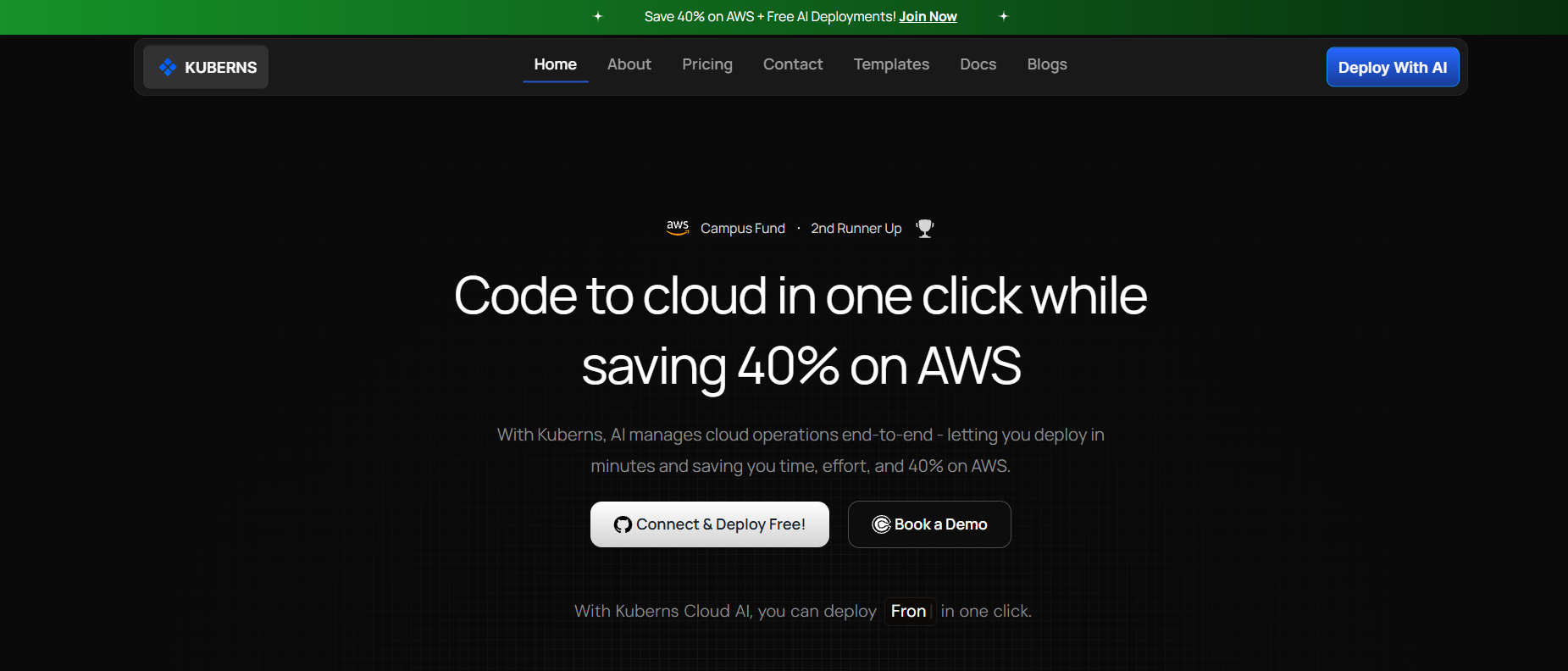
Go to [kuberns.com](https://kuberns.com/) and click **Deploy for Free**. Create your account and verify your phone number.
Kuberns has a free tier to start. After that, $7 gets you $14 in compute credits (2x value). [See all pricing tiers here](https://kuberns.com/pricing/).
### Step 2: Connect Your GitHub Repository
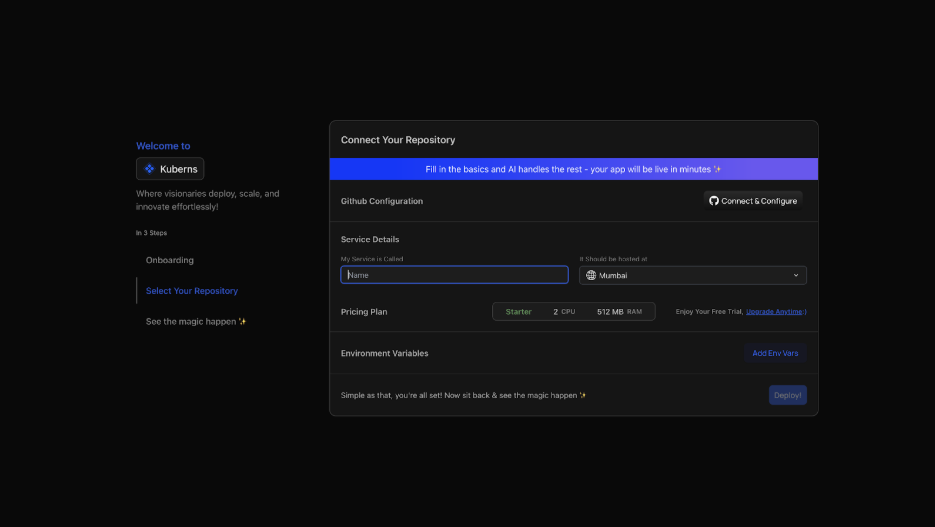
On the **Creating a Service** page, connect your GitHub account and select the repository that contains your GraphQL API.
- Click **Connect and Configure** and authorize Kuberns access to your repositories
- Select your repository and the branch you want to deploy (typically `main`)
- Kuberns AI scans your project, detects Node.js from your `package.json`, and identifies your start script automatically
### Step 3: Add Environment Variables

Before clicking Deploy, navigate to the **Environment** section and add your API secrets.
- Click **Add Env Vars** to add key-value pairs manually, or
- Click **Upload .env file** to import all variables at once
For a typical GraphQL API, add:
| Variable | Description |
|---|---|
| `DATABASE_URL` | Your database connection string |
| `JWT_SECRET` | Your authentication secret |
| `NODE_ENV` | Set to `production` |
Kuberns encrypts all values at rest. They never appear in build logs or deployment output.
### Step 4: Click Deploy
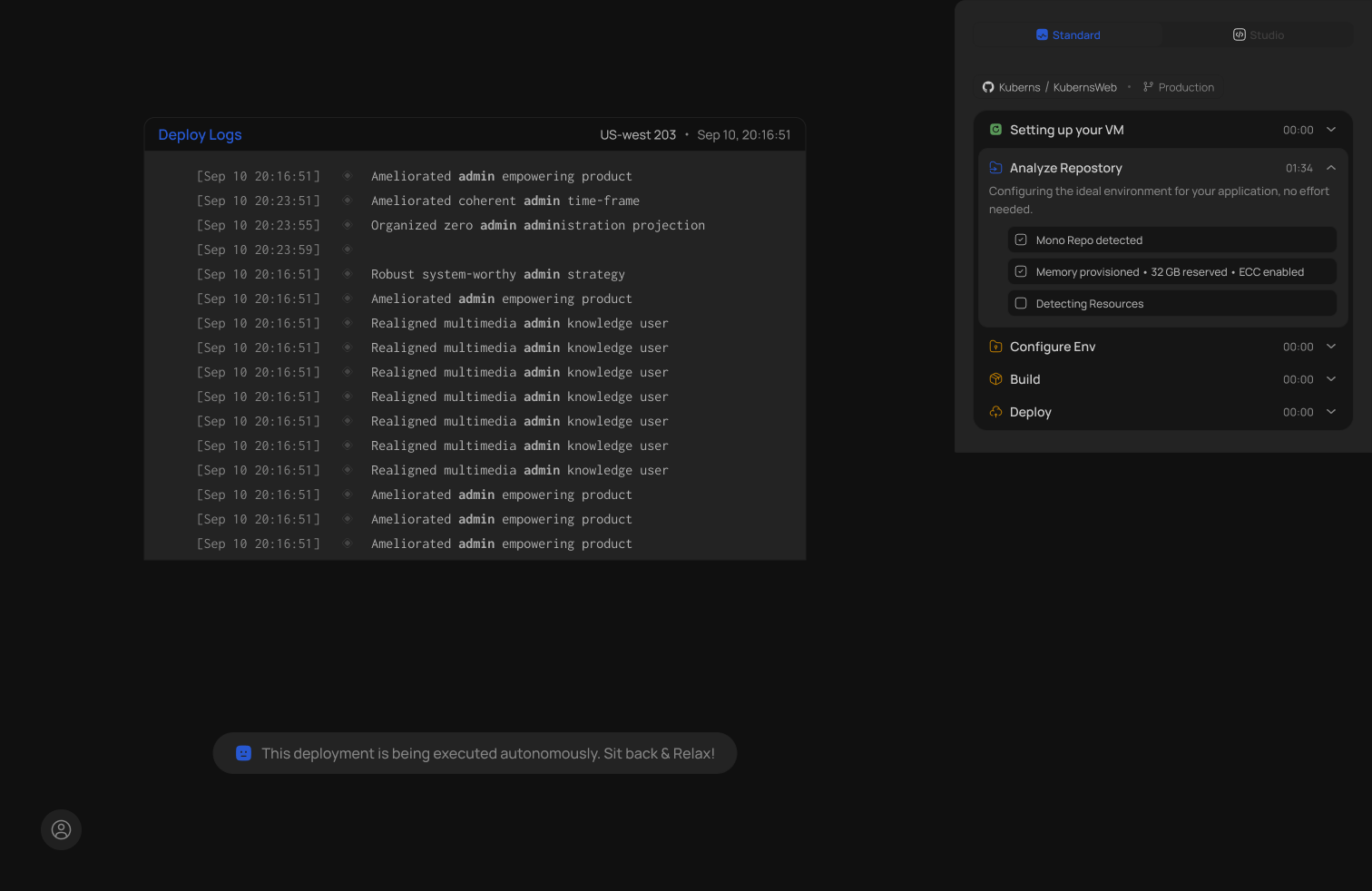
Click **Deploy**. Kuberns agentic AI takes over:
- Clones your repository from GitHub
- Runs `npm install` to install all dependencies
- Runs your build script if one is present (for TypeScript projects)
- Starts your server using the `start` script in your `package.json`
- Provisions AWS compute in your chosen region
- Issues an SSL certificate and assigns a live HTTPS URL
- Enables monitoring, logging, and AI-driven auto-scaling
- Sets up CI/CD so every future push to the connected branch triggers an automatic redeploy
### Step 5: Your GraphQL API is Live
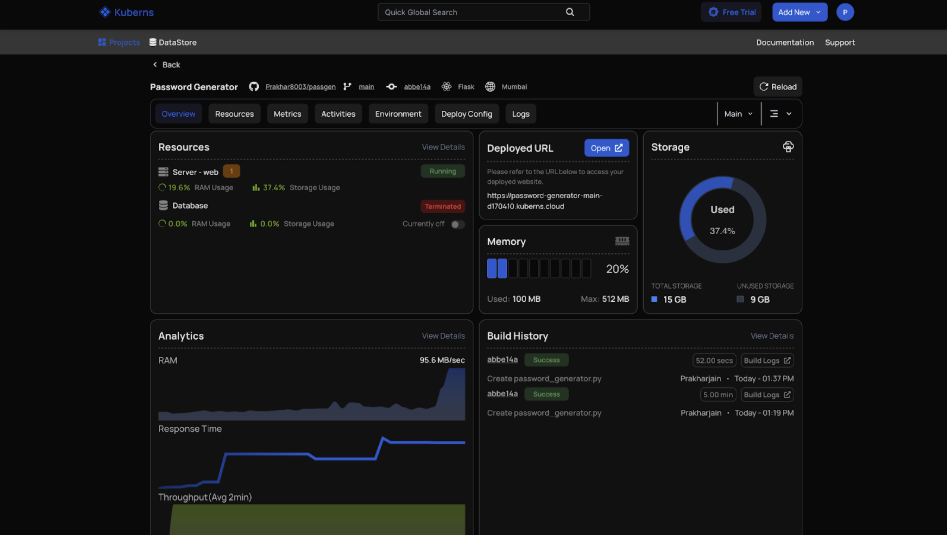
Your `/graphql` endpoint is live in under five minutes. From the Kuberns dashboard you can:
- Open your deployed HTTPS URL and test the endpoint
- View live usage stats and resource consumption
- Check real-time logs and build history
- Update environment variables without redeploying
- Monitor AI-driven auto-scaling metrics
[Deploy your GraphQL API on Kuberns](https://dashboard.kuberns.com)
## Connecting a Database to Your GraphQL Resolvers
Most GraphQL APIs are backed by a database. Pass the connection string as an environment variable in Kuberns and read it in your resolvers via `process.env`.
**PostgreSQL with pg:**
```js
import { Pool } from 'pg';
const pool = new Pool({
connectionString: process.env.DATABASE_URL,
ssl: { rejectUnauthorized: false },
});
const resolvers = {
Query: {
users: async () => {
const result = await pool.query('SELECT * FROM users ORDER BY id');
return result.rows;
},
},
};
```
**MongoDB with Mongoose:**
```js
import mongoose from 'mongoose';
mongoose.connect(process.env.MONGODB_URI);
```
Database options that work well with Kuberns:
- **Supabase** for managed PostgreSQL with a generous free tier
- **PlanetScale** for serverless MySQL via a single `DATABASE_URL`
- **MongoDB Atlas** for managed MongoDB via `MONGODB_URI`
- **Neon** for serverless PostgreSQL with fast cold starts
- **Amazon RDS** for PostgreSQL or MySQL on the same AWS infrastructure
## How to Deploy a GraphQL API on Kuberns (Step by Step)
[Kuberns](https://kuberns.com/) is an agentic AI deployment platform built on AWS. It detects your Node.js runtime, installs dependencies, starts your server on the correct port, provisions SSL, and manages auto-scaling without any configuration from you.
### Step 1: Create Your Kuberns Account

Go to [kuberns.com](https://kuberns.com/) and click **Deploy for Free**. Create your account and verify your phone number.
Kuberns has a free tier to start. After that, $7 gets you $14 in compute credits (2x value). [See all pricing tiers here](https://kuberns.com/pricing/).
### Step 2: Connect Your GitHub Repository

On the **Creating a Service** page, connect your GitHub account and select the repository that contains your GraphQL API.
- Click **Connect and Configure** and authorize Kuberns access to your repositories
- Select your repository and the branch you want to deploy (typically `main`)
- Kuberns AI scans your project, detects Node.js from your `package.json`, and identifies your start script automatically
### Step 3: Add Environment Variables

Before clicking Deploy, navigate to the **Environment** section and add your API secrets.
- Click **Add Env Vars** to add key-value pairs manually, or
- Click **Upload .env file** to import all variables at once
For a typical GraphQL API, add:
| Variable | Description |
|---|---|
| `DATABASE_URL` | Your database connection string |
| `JWT_SECRET` | Your authentication secret |
| `NODE_ENV` | Set to `production` |
Kuberns encrypts all values at rest. They never appear in build logs or deployment output.
### Step 4: Click Deploy

Click **Deploy**. Kuberns agentic AI takes over:
- Clones your repository from GitHub
- Runs `npm install` to install all dependencies
- Runs your build script if one is present (for TypeScript projects)
- Starts your server using the `start` script in your `package.json`
- Provisions AWS compute in your chosen region
- Issues an SSL certificate and assigns a live HTTPS URL
- Enables monitoring, logging, and AI-driven auto-scaling
- Sets up CI/CD so every future push to the connected branch triggers an automatic redeploy
### Step 5: Your GraphQL API is Live

Your `/graphql` endpoint is live in under five minutes. From the Kuberns dashboard you can:
- Open your deployed HTTPS URL and test the endpoint
- View live usage stats and resource consumption
- Check real-time logs and build history
- Update environment variables without redeploying
- Monitor AI-driven auto-scaling metrics
[Deploy your GraphQL API on Kuberns](https://dashboard.kuberns.com)
## Connecting a Database to Your GraphQL Resolvers
Most GraphQL APIs are backed by a database. Pass the connection string as an environment variable in Kuberns and read it in your resolvers via `process.env`.
**PostgreSQL with pg:**
```js
import { Pool } from 'pg';
const pool = new Pool({
connectionString: process.env.DATABASE_URL,
ssl: { rejectUnauthorized: false },
});
const resolvers = {
Query: {
users: async () => {
const result = await pool.query('SELECT * FROM users ORDER BY id');
return result.rows;
},
},
};
```
**MongoDB with Mongoose:**
```js
import mongoose from 'mongoose';
mongoose.connect(process.env.MONGODB_URI);
```
Database options that work well with Kuberns:
- **Supabase** for managed PostgreSQL with a generous free tier
- **PlanetScale** for serverless MySQL via a single `DATABASE_URL`
- **MongoDB Atlas** for managed MongoDB via `MONGODB_URI`
- **Neon** for serverless PostgreSQL with fast cold starts
- **Amazon RDS** for PostgreSQL or MySQL on the same AWS infrastructure
 ## Disabling Introspection in Production
Introspection exposes your full GraphQL schema to anyone who queries it. In development this is useful for tools like Apollo Sandbox. In production, it reveals your entire API surface to the public.
Disable it based on your `NODE_ENV`:
```js
const server = new ApolloServer({
typeDefs,
resolvers,
introspection: process.env.NODE_ENV !== 'production',
});
```
Set `NODE_ENV=production` in the Kuberns environment tab and introspection is disabled on your live endpoint automatically.
## GraphQL API Deployment Platform Comparison (2026)
| Platform | Auto-detects Node.js | Config required | Free tier | Sleeps on idle | Starting price | Best for |
|---|---|---|---|---|---|---|
| **Kuberns** | Yes | None | Yes, free credits | No | $7/mo | GraphQL APIs, zero-ops teams |
| Heroku | Partial, Procfile needed | Procfile required | No | No | $7/mo | Legacy deployments |
| Render | Yes | Build and start commands | Yes, sleeps after 15 min | Yes | $7/mo | Prototypes |
| Railway | Yes | Start command | $5 trial credit | No | Pay per use | Short-lived projects |
| DigitalOcean App Platform | Yes | Build and run config | No | No | $5/mo | Teams with DevOps experience |
| Fly.io | No, Dockerfile required | Dockerfile and fly.toml | Limited | No | Pay per use | Teams comfortable with containers |
Kuberns requires no Procfile, no `fly.toml`, no Dockerfile, and no build configuration files. Connect the repo, add environment variables, deploy.
## Common GraphQL Deployment Issues and Fixes
**The /graphql endpoint returns 404**
Your route path does not match what the platform is routing to. Make sure your GraphQL middleware is mounted at `/graphql` and that no upstream middleware is intercepting the route.
**Port binding error on startup**
Your server is listening on a hardcoded port instead of reading `process.env.PORT`. Change your listen call as shown in the prerequisites section above.
**Build fails for TypeScript projects**
Ensure your `tsconfig.json` has `outDir` set and your start script points to the compiled output in `dist/`. Check that `typescript` is listed in `dependencies` (not just `devDependencies`) if Kuberns needs to compile during build.
**Resolver throws "Cannot read environment variable"**
Your environment variables are not set in the Kuberns dashboard. Go to the Environment tab, add the missing variables, and redeploy. Variables added after the initial deploy take effect on the next deployment.
**Subscriptions not working after deploy**
Make sure your subscription server explicitly handles the WebSocket upgrade. Kuberns supports persistent WebSocket connections. Use `graphql-ws` as the transport layer and verify your server setup handles both HTTP and WebSocket connections at startup.
## Why Developers Deploy GraphQL APIs on Kuberns
The infrastructure work around deploying a GraphQL API, configuring a server, managing environment variables, setting up SSL, and keeping a process running, takes more time than writing the API itself.
Kuberns removes that work entirely. The agentic AI reads your repository, installs dependencies, starts your Apollo Server on the correct port, provisions SSL, and manages auto-scaling on AWS. You push code and the API is live.
For teams building GraphQL APIs for mobile apps, frontend teams, or production SaaS products, Kuberns gives you the deployment infrastructure that used to require a dedicated DevOps setup, without the overhead of maintaining it yourself.
For a full comparison of deployment platforms, see the [best PaaS providers guide](https://kuberns.com/blogs/best-paas-providers-in-2026-compared-found-an-ai-powered-paas/).
## Disabling Introspection in Production
Introspection exposes your full GraphQL schema to anyone who queries it. In development this is useful for tools like Apollo Sandbox. In production, it reveals your entire API surface to the public.
Disable it based on your `NODE_ENV`:
```js
const server = new ApolloServer({
typeDefs,
resolvers,
introspection: process.env.NODE_ENV !== 'production',
});
```
Set `NODE_ENV=production` in the Kuberns environment tab and introspection is disabled on your live endpoint automatically.
## GraphQL API Deployment Platform Comparison (2026)
| Platform | Auto-detects Node.js | Config required | Free tier | Sleeps on idle | Starting price | Best for |
|---|---|---|---|---|---|---|
| **Kuberns** | Yes | None | Yes, free credits | No | $7/mo | GraphQL APIs, zero-ops teams |
| Heroku | Partial, Procfile needed | Procfile required | No | No | $7/mo | Legacy deployments |
| Render | Yes | Build and start commands | Yes, sleeps after 15 min | Yes | $7/mo | Prototypes |
| Railway | Yes | Start command | $5 trial credit | No | Pay per use | Short-lived projects |
| DigitalOcean App Platform | Yes | Build and run config | No | No | $5/mo | Teams with DevOps experience |
| Fly.io | No, Dockerfile required | Dockerfile and fly.toml | Limited | No | Pay per use | Teams comfortable with containers |
Kuberns requires no Procfile, no `fly.toml`, no Dockerfile, and no build configuration files. Connect the repo, add environment variables, deploy.
## Common GraphQL Deployment Issues and Fixes
**The /graphql endpoint returns 404**
Your route path does not match what the platform is routing to. Make sure your GraphQL middleware is mounted at `/graphql` and that no upstream middleware is intercepting the route.
**Port binding error on startup**
Your server is listening on a hardcoded port instead of reading `process.env.PORT`. Change your listen call as shown in the prerequisites section above.
**Build fails for TypeScript projects**
Ensure your `tsconfig.json` has `outDir` set and your start script points to the compiled output in `dist/`. Check that `typescript` is listed in `dependencies` (not just `devDependencies`) if Kuberns needs to compile during build.
**Resolver throws "Cannot read environment variable"**
Your environment variables are not set in the Kuberns dashboard. Go to the Environment tab, add the missing variables, and redeploy. Variables added after the initial deploy take effect on the next deployment.
**Subscriptions not working after deploy**
Make sure your subscription server explicitly handles the WebSocket upgrade. Kuberns supports persistent WebSocket connections. Use `graphql-ws` as the transport layer and verify your server setup handles both HTTP and WebSocket connections at startup.
## Why Developers Deploy GraphQL APIs on Kuberns
The infrastructure work around deploying a GraphQL API, configuring a server, managing environment variables, setting up SSL, and keeping a process running, takes more time than writing the API itself.
Kuberns removes that work entirely. The agentic AI reads your repository, installs dependencies, starts your Apollo Server on the correct port, provisions SSL, and manages auto-scaling on AWS. You push code and the API is live.
For teams building GraphQL APIs for mobile apps, frontend teams, or production SaaS products, Kuberns gives you the deployment infrastructure that used to require a dedicated DevOps setup, without the overhead of maintaining it yourself.
For a full comparison of deployment platforms, see the [best PaaS providers guide](https://kuberns.com/blogs/best-paas-providers-in-2026-compared-found-an-ai-powered-paas/).
 ## Frequently Asked Questions
**Do I need a Procfile to deploy a GraphQL API on Kuberns?**
No. Kuberns detects Node.js automatically and reads your start script from `package.json`. You do not need to create any configuration files.
**Can I deploy GraphQL Yoga or Pothos on Kuberns?**
Yes. Any Node.js-based GraphQL server works on Kuberns. GraphQL Yoga, Pothos, Mercurius, and other libraries all deploy the same way as Apollo Server, as long as your server reads `process.env.PORT` and your start script is in `package.json`.
**How do I add authentication to my GraphQL API?**
Add your `JWT_SECRET` or API key as an environment variable in the Kuberns dashboard and read it in your context function. The secret never appears in your codebase and never shows in build logs.
**Can I use a custom domain for my GraphQL API?**
Yes. In the Kuberns dashboard, go to Domains, add your domain, and update your DNS A record. Kuberns issues and renews the SSL certificate automatically.
**How does Kuberns compare to deploying a GraphQL API on Render or Railway?**
Render and Railway both require you to specify build and start commands manually and deal with sleep behavior on free tiers. Kuberns autodetects your Node.js project, runs your start script, does not sleep on idle, and uses AI-driven auto-scaling built on AWS. See the [Render vs Kuberns comparison](https://kuberns.com/blogs/render-vs-railway-vs-kuberns-ai-which-to-choose-traditional-paas-or-ai/) for a detailed breakdown.
**Can I deploy a GraphQL API without Docker?**
Yes. Kuberns does not require a Dockerfile. The platform handles the runtime environment internally. You push code from GitHub and the API deploys.
---
- [More Deployment Guides articles](https://kuberns.com/blogs/category/deployment-guides/1/)
- [All articles](https://kuberns.com/blogs/)
## Frequently Asked Questions
**Do I need a Procfile to deploy a GraphQL API on Kuberns?**
No. Kuberns detects Node.js automatically and reads your start script from `package.json`. You do not need to create any configuration files.
**Can I deploy GraphQL Yoga or Pothos on Kuberns?**
Yes. Any Node.js-based GraphQL server works on Kuberns. GraphQL Yoga, Pothos, Mercurius, and other libraries all deploy the same way as Apollo Server, as long as your server reads `process.env.PORT` and your start script is in `package.json`.
**How do I add authentication to my GraphQL API?**
Add your `JWT_SECRET` or API key as an environment variable in the Kuberns dashboard and read it in your context function. The secret never appears in your codebase and never shows in build logs.
**Can I use a custom domain for my GraphQL API?**
Yes. In the Kuberns dashboard, go to Domains, add your domain, and update your DNS A record. Kuberns issues and renews the SSL certificate automatically.
**How does Kuberns compare to deploying a GraphQL API on Render or Railway?**
Render and Railway both require you to specify build and start commands manually and deal with sleep behavior on free tiers. Kuberns autodetects your Node.js project, runs your start script, does not sleep on idle, and uses AI-driven auto-scaling built on AWS. See the [Render vs Kuberns comparison](https://kuberns.com/blogs/render-vs-railway-vs-kuberns-ai-which-to-choose-traditional-paas-or-ai/) for a detailed breakdown.
**Can I deploy a GraphQL API without Docker?**
Yes. Kuberns does not require a Dockerfile. The platform handles the runtime environment internally. You push code from GitHub and the API deploys.
---
- [More Deployment Guides articles](https://kuberns.com/blogs/category/deployment-guides/1/)
- [All articles](https://kuberns.com/blogs/)