# How to Deploy a Rust App in 2026 (Complete Step-by-Step Guide)
> Deploy a Rust app to production in 2026 without Docker, SSH, or server config. Step-by-step guide using Kuberns with AI automation, env vars, and auto-scaling.
- **Author**: suyash-tiwari
- **Published**: 2026-04-27
- **Modified**: 2026-04-27
- **Category**: Deployment Guides
- **URL**: https://kuberns.com/blogs/deploy-rust-app/
---
Deploying a Rust application to production is fast once your code is ready. Rust compiles to a single self-contained binary with no runtime, no interpreter, and no dependency manager running at startup. You build it once in release mode and ship it.
The problem is everything that surrounds the binary: provisioning a server, managing the Rust toolchain, setting up a process manager, handling SSL, and wiring up CI/CD. None of that is Rust work. It is pure infrastructure overhead, and it adds hours before your app serves a single request.
This guide walks you through deploying a Rust web app to production in 2026 the fast way, using [Kuberns](https://kuberns.com/) to handle the build pipeline, compute, SSL, and auto-scaling automatically.
## Before You Deploy: Two Things to Check
You only need two things before Kuberns can deploy your Rust app.
**1. Bind to the PORT environment variable**
Kuberns injects a `PORT` variable at runtime. Your app must listen on it, not a hardcoded port. For Axum:
```rust
let port: u16 = std::env::var("PORT")
.unwrap_or_else(|_| "3000".to_string())
.parse()
.expect("PORT must be a number");
let addr = SocketAddr::from(([0, 0, 0, 0], port));
let listener = tokio::net::TcpListener::bind(addr).await.unwrap();
axum::serve(listener, app).await.unwrap();
```
For Actix Web:
```rust
HttpServer::new(|| App::new().service(index))
.bind(("0.0.0.0", port))?
.run()
.await
```
Bind to `0.0.0.0`, not `127.0.0.1`, so the platform can route traffic to your app.
**2. Push your code to GitHub**
Kuberns deploys directly from your repository:
```bash
git add .
git commit -m "Ready for deployment"
git push origin main
```
That is all. No Dockerfile. No build scripts. No configuration files.
 ## Step-by-Step: Deploy a Rust App on Kuberns
[Kuberns](https://kuberns.com/) is an agentic AI cloud platform built on AWS. It detects your Rust project from `Cargo.toml`, runs `cargo build --release`, caches compiled dependencies between deploys, provisions compute, handles SSL, and manages auto-scaling. No configuration required from you.
### Step 1: Sign Up and Create an Account
Go to [kuberns.com](https://kuberns.com/) and sign up with your Google or GitHub account. New accounts get free credits to deploy and test without a credit card.
### Step 2: Connect Your GitHub Repository
On the Create Service page, connect GitHub and select your Rust repository and the branch to deploy.
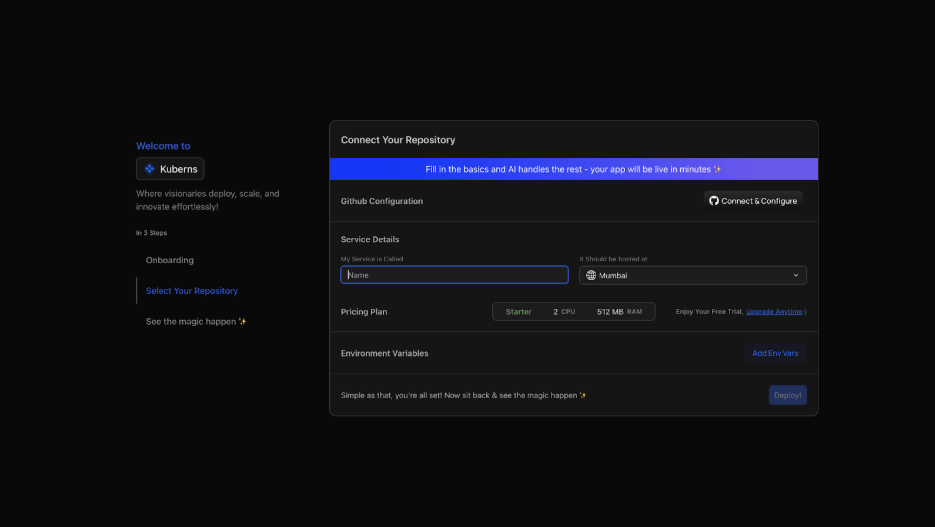
Kuberns AI scans your project and automatically detects:
- Language: Rust (from `Cargo.toml`)
- Build command: `cargo build --release`
- Binary name and start command from your package definition
- Dependency cache to restore on future builds
You do not select runtime versions or write any config files.
> "On a VPS, you configure a CI pipeline to compile the binary, transfer it over SSH, set up systemd, manage SSL with Certbot, and write deployment scripts. On Kuberns, none of those steps exist."
### Step 3: Add Environment Variables
Go to the Environment tab and add your app's configuration.

For a typical Rust web app, add:
- `DATABASE_URL` for your database connection string
- `RUST_LOG` set to `info` for structured logging
- Any API keys or secrets your app reads via `std::env::var`
Variables are encrypted at rest and injected at runtime. Your [web app](https://toxsl.com/service/6/web-development-services) reads them cleanly without any additional libraries.
### Step 4: Click Deploy
Click Deploy and watch the live build logs as Kuberns takes over.

Here is exactly what happens:
- Clones your repository from GitHub
- Restores cached compiled dependencies from previous builds
- Runs `cargo build --release`
- Launches the release binary with your environment variables injected
- Provisions compute on AWS in your chosen region
- Issues an SSL certificate and assigns a live HTTPS URL
- Enables monitoring, logging, and auto-scaling
Your Rust app is live. Every push to the connected branch triggers an automatic redeploy with zero additional setup.

## Deploying Rust with a PostgreSQL Database
Most Rust backends connect to PostgreSQL via `sqlx` or `diesel`. Add `sqlx` to your `Cargo.toml`:
```toml
[dependencies]
sqlx = { version = "0.7", features = ["runtime-tokio-rustls", "postgres"] }
tokio = { version = "1", features = ["full"] }
```
Connect using the `DATABASE_URL` environment variable:
```rust
let database_url = std::env::var("DATABASE_URL")
.expect("DATABASE_URL must be set");
let pool = PgPool::connect(&database_url)
.await
.expect("Failed to connect to database");
```
Add `DATABASE_URL` in the Kuberns environment tab with your full Postgres connection string:
```
postgres://username:password@host:5432/dbname?sslmode=require
```
Kuberns injects it at startup. Your app connects without any extra setup.
### Database options that work well with Kuberns
- **Supabase** for managed PostgreSQL with a generous free tier
- **Neon** for serverless Postgres with connection pooling, ideal for `sqlx`
- **AWS RDS** for PostgreSQL on the same AWS infrastructure as Kuberns with the lowest latency
- **Railway** for quick Postgres provisioning on side projects
## What Kuberns Handles That You Configure Manually on Other Platforms
| What Rust needs in production | Manual / VPS | Kuberns |
|---|---|---|
| Rust toolchain and build environment | Install rustup, set stable version | Configured automatically |
| Release compilation | Run cargo build --release on server or CI | Runs automatically on every deploy |
| Dependency caching | Configure CI cache layers | Built-in, restores between builds |
| Process manager | Set up systemd or Supervisor | Not required |
| SSL certificate | Certbot setup and renewal cron | Automatic |
| Environment variables | .env files on the server | Encrypted in dashboard |
| Auto-scaling | Manual load balancer and instance setup | AI-driven |
| CI/CD pipeline | GitHub Actions or custom webhooks | Built-in, triggers on Git push |
| Custom domain with HTTPS | DNS config and Certbot | One-click in dashboard |
| Crash recovery and restarts | systemd restart policies | Automatic |
## Step-by-Step: Deploy a Rust App on Kuberns
[Kuberns](https://kuberns.com/) is an agentic AI cloud platform built on AWS. It detects your Rust project from `Cargo.toml`, runs `cargo build --release`, caches compiled dependencies between deploys, provisions compute, handles SSL, and manages auto-scaling. No configuration required from you.
### Step 1: Sign Up and Create an Account
Go to [kuberns.com](https://kuberns.com/) and sign up with your Google or GitHub account. New accounts get free credits to deploy and test without a credit card.
### Step 2: Connect Your GitHub Repository
On the Create Service page, connect GitHub and select your Rust repository and the branch to deploy.

Kuberns AI scans your project and automatically detects:
- Language: Rust (from `Cargo.toml`)
- Build command: `cargo build --release`
- Binary name and start command from your package definition
- Dependency cache to restore on future builds
You do not select runtime versions or write any config files.
> "On a VPS, you configure a CI pipeline to compile the binary, transfer it over SSH, set up systemd, manage SSL with Certbot, and write deployment scripts. On Kuberns, none of those steps exist."
### Step 3: Add Environment Variables
Go to the Environment tab and add your app's configuration.

For a typical Rust web app, add:
- `DATABASE_URL` for your database connection string
- `RUST_LOG` set to `info` for structured logging
- Any API keys or secrets your app reads via `std::env::var`
Variables are encrypted at rest and injected at runtime. Your [web app](https://toxsl.com/service/6/web-development-services) reads them cleanly without any additional libraries.
### Step 4: Click Deploy
Click Deploy and watch the live build logs as Kuberns takes over.

Here is exactly what happens:
- Clones your repository from GitHub
- Restores cached compiled dependencies from previous builds
- Runs `cargo build --release`
- Launches the release binary with your environment variables injected
- Provisions compute on AWS in your chosen region
- Issues an SSL certificate and assigns a live HTTPS URL
- Enables monitoring, logging, and auto-scaling
Your Rust app is live. Every push to the connected branch triggers an automatic redeploy with zero additional setup.

## Deploying Rust with a PostgreSQL Database
Most Rust backends connect to PostgreSQL via `sqlx` or `diesel`. Add `sqlx` to your `Cargo.toml`:
```toml
[dependencies]
sqlx = { version = "0.7", features = ["runtime-tokio-rustls", "postgres"] }
tokio = { version = "1", features = ["full"] }
```
Connect using the `DATABASE_URL` environment variable:
```rust
let database_url = std::env::var("DATABASE_URL")
.expect("DATABASE_URL must be set");
let pool = PgPool::connect(&database_url)
.await
.expect("Failed to connect to database");
```
Add `DATABASE_URL` in the Kuberns environment tab with your full Postgres connection string:
```
postgres://username:password@host:5432/dbname?sslmode=require
```
Kuberns injects it at startup. Your app connects without any extra setup.
### Database options that work well with Kuberns
- **Supabase** for managed PostgreSQL with a generous free tier
- **Neon** for serverless Postgres with connection pooling, ideal for `sqlx`
- **AWS RDS** for PostgreSQL on the same AWS infrastructure as Kuberns with the lowest latency
- **Railway** for quick Postgres provisioning on side projects
## What Kuberns Handles That You Configure Manually on Other Platforms
| What Rust needs in production | Manual / VPS | Kuberns |
|---|---|---|
| Rust toolchain and build environment | Install rustup, set stable version | Configured automatically |
| Release compilation | Run cargo build --release on server or CI | Runs automatically on every deploy |
| Dependency caching | Configure CI cache layers | Built-in, restores between builds |
| Process manager | Set up systemd or Supervisor | Not required |
| SSL certificate | Certbot setup and renewal cron | Automatic |
| Environment variables | .env files on the server | Encrypted in dashboard |
| Auto-scaling | Manual load balancer and instance setup | AI-driven |
| CI/CD pipeline | GitHub Actions or custom webhooks | Built-in, triggers on Git push |
| Custom domain with HTTPS | DNS config and Certbot | One-click in dashboard |
| Crash recovery and restarts | systemd restart policies | Automatic |
 ## Rust Deployment Platform Comparison (2026)
| Platform | Auto-detects Rust | Docker required | Free tier | Sleeps on idle | Starting price | Best for |
|---|---|---|---|---|---|---|
| Kuberns | Yes, from Cargo.toml | No | Yes ($14 credits) | No | $7/mo | Full Rust APIs, microservices, zero-ops |
| Heroku | No (needs Buildpack) | No | No (removed 2022) | No | $7/mo | Legacy apps with buildpack setup |
| Render | No (needs Dockerfile) | Recommended | Yes (sleeps) | Yes, 15 min | $7/mo | Prototypes, simple web services |
| Railway | Partial | Optional | $5 trial credit | No | $5/mo + usage | Short-lived projects |
| Fly.io | No (needs Dockerfile) | Yes | Yes (limited) | No | $5/mo + usage | Distributed edge apps |
| DigitalOcean App Platform | No (needs Dockerfile) | Yes | No | No | $5/mo | Teams with DevOps skills |
| VPS (raw server) | Manual | Optional | No | No | ~$5/mo | Full control, experienced DevOps |
Kuberns is the only platform here that auto-detects Rust from `Cargo.toml` without requiring a Dockerfile, a Buildpack config, or manual build commands.
## Common Rust Deployment Issues and Fixes
**Build fails with toolchain errors**
If you need a specific Rust version, add a `rust-toolchain.toml` at the project root:
```toml
[toolchain]
channel = "1.78"
```
Kuberns reads this and uses the specified version automatically.
**App panics on startup with "PORT must be set"**
Your app is not reading `PORT` from the environment. Update your binding code to use `std::env::var("PORT")` with a fallback value as shown in the prerequisites section.
**Slow builds after every code change**
Commit your `Cargo.lock` file to the repository. Without it, Kuberns re-resolves all dependencies on every build. With it, cached dependency layers restore correctly and only changed crates recompile.
**Database connection fails at runtime**
Check that `DATABASE_URL` is set in the Kuberns environment tab and that your connection string includes `?sslmode=require` for managed Postgres providers. For `sqlx`, use the `runtime-tokio-rustls` feature flag.
**App starts but returns connection refused**
Your server is binding to `127.0.0.1` instead of `0.0.0.0`. Update your socket address as shown in the prerequisites section.
## Why Teams Choose Kuberns for Rust in 2026
Rust's performance makes it an excellent choice for production APIs and services that handle high throughput with low resource usage. The bottleneck for Rust deployment is never the language. It is the infrastructure surrounding it.
A raw VPS deployment means managing a build pipeline, maintaining the Rust toolchain, configuring systemd, setting up SSL renewal, and writing scripts to transfer binaries from CI to production. That is a significant amount of work before your first endpoint responds.
Kuberns removes all of it. The agentic AI detects your Rust project, builds the release binary with dependency caching, provisions AWS compute, handles SSL, and manages scaling automatically. You push code. The platform handles the rest.
[Deploy your Rust app on Kuberns](https://dashboard.kuberns.com). Free credits to get started, no credit card required.
## Rust Deployment Platform Comparison (2026)
| Platform | Auto-detects Rust | Docker required | Free tier | Sleeps on idle | Starting price | Best for |
|---|---|---|---|---|---|---|
| Kuberns | Yes, from Cargo.toml | No | Yes ($14 credits) | No | $7/mo | Full Rust APIs, microservices, zero-ops |
| Heroku | No (needs Buildpack) | No | No (removed 2022) | No | $7/mo | Legacy apps with buildpack setup |
| Render | No (needs Dockerfile) | Recommended | Yes (sleeps) | Yes, 15 min | $7/mo | Prototypes, simple web services |
| Railway | Partial | Optional | $5 trial credit | No | $5/mo + usage | Short-lived projects |
| Fly.io | No (needs Dockerfile) | Yes | Yes (limited) | No | $5/mo + usage | Distributed edge apps |
| DigitalOcean App Platform | No (needs Dockerfile) | Yes | No | No | $5/mo | Teams with DevOps skills |
| VPS (raw server) | Manual | Optional | No | No | ~$5/mo | Full control, experienced DevOps |
Kuberns is the only platform here that auto-detects Rust from `Cargo.toml` without requiring a Dockerfile, a Buildpack config, or manual build commands.
## Common Rust Deployment Issues and Fixes
**Build fails with toolchain errors**
If you need a specific Rust version, add a `rust-toolchain.toml` at the project root:
```toml
[toolchain]
channel = "1.78"
```
Kuberns reads this and uses the specified version automatically.
**App panics on startup with "PORT must be set"**
Your app is not reading `PORT` from the environment. Update your binding code to use `std::env::var("PORT")` with a fallback value as shown in the prerequisites section.
**Slow builds after every code change**
Commit your `Cargo.lock` file to the repository. Without it, Kuberns re-resolves all dependencies on every build. With it, cached dependency layers restore correctly and only changed crates recompile.
**Database connection fails at runtime**
Check that `DATABASE_URL` is set in the Kuberns environment tab and that your connection string includes `?sslmode=require` for managed Postgres providers. For `sqlx`, use the `runtime-tokio-rustls` feature flag.
**App starts but returns connection refused**
Your server is binding to `127.0.0.1` instead of `0.0.0.0`. Update your socket address as shown in the prerequisites section.
## Why Teams Choose Kuberns for Rust in 2026
Rust's performance makes it an excellent choice for production APIs and services that handle high throughput with low resource usage. The bottleneck for Rust deployment is never the language. It is the infrastructure surrounding it.
A raw VPS deployment means managing a build pipeline, maintaining the Rust toolchain, configuring systemd, setting up SSL renewal, and writing scripts to transfer binaries from CI to production. That is a significant amount of work before your first endpoint responds.
Kuberns removes all of it. The agentic AI detects your Rust project, builds the release binary with dependency caching, provisions AWS compute, handles SSL, and manages scaling automatically. You push code. The platform handles the rest.
[Deploy your Rust app on Kuberns](https://dashboard.kuberns.com). Free credits to get started, no credit card required.
 ## FAQ
### What is the easiest way to deploy a Rust app in 2026?
The easiest way is [Kuberns](https://kuberns.com/). Push your Rust code to GitHub, connect the repo, add environment variables, and click Deploy. Kuberns AI runs `cargo build --release`, provisions compute on AWS, and issues an HTTPS URL. No Dockerfile, no server config, no DevOps needed.
### Do I need Docker to deploy a Rust app?
Not on Kuberns. The platform detects Rust from your `Cargo.toml`, builds a release binary, and deploys it without requiring any Dockerfile or container configuration.
### Which Rust web frameworks work on Kuberns?
Any framework that binds to the `PORT` environment variable works on Kuberns, including Axum, Actix Web, Warp, Rocket, and Poem. Kuberns detects the project from `Cargo.toml` without framework-specific configuration.
### How do I handle slow Rust compilation?
Commit your `Cargo.lock` to the repository. Kuberns caches compiled Cargo dependencies between deploys, so only changed crates recompile after the first build.
### Can I run Rust background workers alongside my web server?
Yes. Deploy your web server as the primary service and configure background workers as separate services pointing to the same repository. Each service can run a different binary from the same Cargo workspace.
### How does Kuberns compare to Railway or Render for Rust?
Railway and Render both require a Dockerfile or manual build commands for Rust. Kuberns auto-detects Rust from `Cargo.toml` with no configuration. It also runs on AWS with no idle sleep on production tiers. See our [best deployment platforms comparison](https://kuberns.com/blogs/best-deployment-platform-small-dev-teams/) for a full breakdown.
### Can I deploy a Rust app with a custom domain on Kuberns?
Yes. Add your domain in the Kuberns dashboard, update your DNS A record, and Kuberns provisions and auto-renews the SSL certificate. No manual cert management required.
---
- [More Deployment Guides articles](https://kuberns.com/blogs/category/deployment-guides/1/)
- [All articles](https://kuberns.com/blogs/)
## FAQ
### What is the easiest way to deploy a Rust app in 2026?
The easiest way is [Kuberns](https://kuberns.com/). Push your Rust code to GitHub, connect the repo, add environment variables, and click Deploy. Kuberns AI runs `cargo build --release`, provisions compute on AWS, and issues an HTTPS URL. No Dockerfile, no server config, no DevOps needed.
### Do I need Docker to deploy a Rust app?
Not on Kuberns. The platform detects Rust from your `Cargo.toml`, builds a release binary, and deploys it without requiring any Dockerfile or container configuration.
### Which Rust web frameworks work on Kuberns?
Any framework that binds to the `PORT` environment variable works on Kuberns, including Axum, Actix Web, Warp, Rocket, and Poem. Kuberns detects the project from `Cargo.toml` without framework-specific configuration.
### How do I handle slow Rust compilation?
Commit your `Cargo.lock` to the repository. Kuberns caches compiled Cargo dependencies between deploys, so only changed crates recompile after the first build.
### Can I run Rust background workers alongside my web server?
Yes. Deploy your web server as the primary service and configure background workers as separate services pointing to the same repository. Each service can run a different binary from the same Cargo workspace.
### How does Kuberns compare to Railway or Render for Rust?
Railway and Render both require a Dockerfile or manual build commands for Rust. Kuberns auto-detects Rust from `Cargo.toml` with no configuration. It also runs on AWS with no idle sleep on production tiers. See our [best deployment platforms comparison](https://kuberns.com/blogs/best-deployment-platform-small-dev-teams/) for a full breakdown.
### Can I deploy a Rust app with a custom domain on Kuberns?
Yes. Add your domain in the Kuberns dashboard, update your DNS A record, and Kuberns provisions and auto-renews the SSL certificate. No manual cert management required.
---
- [More Deployment Guides articles](https://kuberns.com/blogs/category/deployment-guides/1/)
- [All articles](https://kuberns.com/blogs/)