# Best 6 GitHub Actions Alternatives for Developers in 2026
> Looking for a GitHub Actions alternative? Here are the 6 top tools compared on pricing, runners, and features to find the right fit for your team in 2026.
- **Author**: parth-kanpariya
- **Published**: 2026-07-09
- **Modified**: 2026-07-09
- **Category**: Alternatives
- **URL**: https://kuberns.com/blogs/github-actions-alternatives/
---
The best GitHub Actions alternatives in 2026 are Kuberns, CircleCI, GitLab CI, Buildkite, Travis CI, and Harness, each solving a specific limitation: runner concurrency limits, YAML complexity, or no integrated hosting once a pipeline needs to deploy something.
GitHub Actions works well while your repo, runners, and workflow stay simple. The search for an alternative usually starts once a team hits free-tier concurrency limits, needs infrastructure control beyond GitHub-hosted runners, or gets tired of debugging YAML through a slow commit-push-wait cycle. This guide compares all six on pricing and execution environment.
## Quick Comparison: GitHub Actions Alternatives at a Glance
| Tool | Best For | Execution Environment | Pricing | Hosting Included |
|---|---|---|---|---|
| **Kuberns** | Teams that want CI/CD and deployment on one platform, zero YAML | Managed AWS infrastructure | Starts at $7/mo, compute-only | Yes, full-stack |
| **CircleCI** | Customisable pipelines with Docker, Kubernetes, or VM runners | Cloud or self-hosted | Free tier, usage-based after | No |
| **GitLab CI** | Teams already using GitLab for source control | Cloud or self-hosted runners | Free (400 min/mo), $29/user/mo Premium | No |
| **Buildkite** | Infrastructure control via self-hosted or cloud-hosted agents | Self-hosted agents, managed control plane | Free tier, usage-based after | No |
| **Travis CI** | Straightforward YAML pipelines for smaller projects | Cloud or self-hosted | Usage-based, no free tier for private repos | No |
| **Harness** | Enterprises needing approval gates and compliance tooling | Cloud, self-hosted, or hybrid | Custom, quote-based | No |
Kuberns is the only tool here built to remove the pipeline entirely rather than run it faster. See [one-click automated deployment](https://kuberns.com/blogs/how-to-implement-one-click-automated-software-deployment/) for how it works.
## What Are the Best GitHub Actions Alternatives in 2026?
Each tool below takes a different approach to replacing GitHub Actions. Here's what each one does well, where it falls short, and who it's built for.
### 1. Kuberns
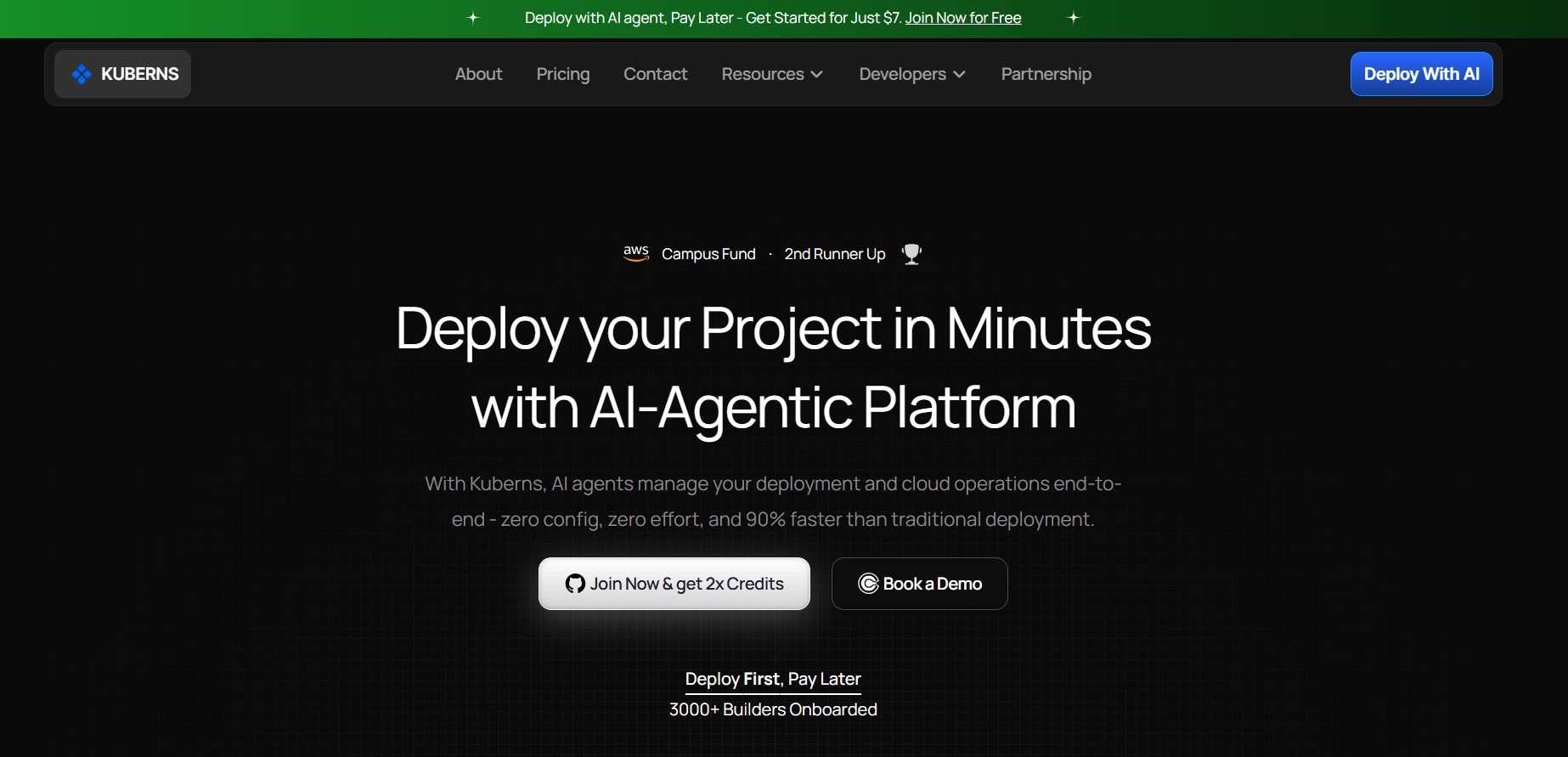
Kuberns is an agentic AI cloud platform built for teams who want CI and CD handled without maintaining a pipeline. Connect a GitHub repository, and it detects your stack, runs the build, provisions AWS infrastructure, issues SSL, and enables CI/CD automatically. Every push triggers a redeploy with zero manual steps and no workflow YAML.
Where GitHub Actions stops at running your pipeline and leaves hosting, scaling, and monitoring to separate tools, Kuberns handles all four in one dashboard. Teams typically see around 40% lower AWS costs from AI-driven resource allocation, not discounts.
**Best for:** Teams that want to [eliminate manual steps in their CI/CD workflow](https://kuberns.com/blogs/how-to-eliminate-manual-steps-in-ci-cd-workflow/) with hosting, scaling, and observability bundled in.
**Honest limit:** Newer than GitHub Actions, and less suited to deep pipeline customisation like test-suite orchestration across dozens of services.
> Still stitching together CI, hosting, and monitoring across five tools? See how [the top CI/CD tools compare against a unified platform](https://kuberns.com/blogs/best-cicd-tools/) built to replace all of them.
### 2. CircleCI

CircleCI is a cloud-native CI/CD service built around speed, using parallelism and caching to cut build times. It supports Docker, Kubernetes, and VM execution environments, plus cloud-hosted and self-hosted runners.
**Best for:** Teams needing customisable pipelines and more runner flexibility than GitHub Actions offers.
**Honest limit:** CircleCI focuses on CI. For deployment, most teams still need a separate CD platform.
### 3. GitLab CI

GitLab CI/CD is natively embedded in GitLab and configured through a `.gitlab-ci.yml` file, with pipelines tied into merge requests and GitLab's own runners.
**Best for:** Teams already on GitLab who want CI/CD in the same platform rather than adding a second tool.
**Honest limit:** Migrating just for CI/CD means moving your source control too, a heavier lift than swapping a pipeline tool.
### 4. Buildkite

Buildkite separates the control plane from the execution layer. Pipelines are defined in your repo, but builds run on agents you host yourself, on your own servers or cloud account.
**Best for:** Teams that need infrastructure control through self-hosted or cloud-hosted agents with a managed control plane.
**Honest limit:** You are still responsible for provisioning, patching, and scaling the agents that run your builds.
### 5. Travis CI

Travis CI configures pipelines through a `.travis.yml` file and keeps setup simple, with cloud and self-hosted runner options.
**Best for:** Teams that want straightforward, readable YAML pipelines without the deeper customisation Jenkins or CircleCI allow.
**Honest limit:** Feature development has slowed compared to newer platforms, and private repo pricing no longer includes a meaningful free tier.
### 6. Harness

Harness is a broad DevOps platform covering CI, CD, feature flags, and cost management, built for enterprises that need approval gates and compliance controls on every deployment.
**Best for:** Enterprises that need pipelines with approval gates, feature flags, and compliance tooling in one platform.
**Honest limit:** Harness covers a lot of surface. Teams that only need basic CI/CD often find it more complex than their use case requires.
[Deploy your app on Kuberns](https://dashboard.kuberns.com)
 ## Choose the Right GitHub Actions Alternative
The right pick depends on what is actually driving you away from GitHub Actions, not tool popularity.
**If cost at scale is the problem:** Buildkite and self-hosted CircleCI runners give more control over compute costs, since you own the infrastructure.
**If you want CI/CD and deployment in one place:** CircleCI, GitLab CI, Buildkite, and Travis CI all stop at running your pipeline. None of them host, scale, or monitor your app. Kuberns closes that gap; the [best AI tools for deployment](https://kuberns.com/blogs/best-ai-tools-for-deployment/) comparison shows how it stacks against Render, Railway, and Fly.io.
**If your team is already on GitLab:** Don't add a second CI/CD tool. GitLab CI keeps everything in one platform.
**If you need approval gates and compliance controls:** Harness is built for this, at the cost of more platform surface than a small team needs.
**If infrastructure control matters more than convenience:** Buildkite's self-hosted agent model gives the most control. [The best auto deployment tools in 2026](https://kuberns.com/blogs/best-auto-deployment-tools/) covers Jenkins, Argo CD, and others alongside Kuberns.
**If you're evaluating whether AI changes this decision entirely:** [Will AI replace DevOps engineers](https://kuberns.com/blogs/will-ai-replace-devops-engineers/) breaks down what's actually automated in 2026.
## Conclusion
GitHub Actions alternatives fall into two groups: tools that run your pipeline better, like CircleCI, GitLab CI, Buildkite, Travis CI, and Harness, and platforms that remove the pipeline entirely, like Kuberns. The choice depends on whether you want more control over CI/CD, or would rather stop configuring it altogether.
For teams that just want code pushed to GitHub and live in production without writing YAML, Kuberns is the most direct path. Our [guide to AI-driven CI/CD automation](https://kuberns.com/blogs/best-ai-solutions-for-automating-code-deployments-and-cicd/) covers the broader ecosystem.
[Connect your GitHub repo and deploy on Kuberns](https://dashboard.kuberns.com)
## Choose the Right GitHub Actions Alternative
The right pick depends on what is actually driving you away from GitHub Actions, not tool popularity.
**If cost at scale is the problem:** Buildkite and self-hosted CircleCI runners give more control over compute costs, since you own the infrastructure.
**If you want CI/CD and deployment in one place:** CircleCI, GitLab CI, Buildkite, and Travis CI all stop at running your pipeline. None of them host, scale, or monitor your app. Kuberns closes that gap; the [best AI tools for deployment](https://kuberns.com/blogs/best-ai-tools-for-deployment/) comparison shows how it stacks against Render, Railway, and Fly.io.
**If your team is already on GitLab:** Don't add a second CI/CD tool. GitLab CI keeps everything in one platform.
**If you need approval gates and compliance controls:** Harness is built for this, at the cost of more platform surface than a small team needs.
**If infrastructure control matters more than convenience:** Buildkite's self-hosted agent model gives the most control. [The best auto deployment tools in 2026](https://kuberns.com/blogs/best-auto-deployment-tools/) covers Jenkins, Argo CD, and others alongside Kuberns.
**If you're evaluating whether AI changes this decision entirely:** [Will AI replace DevOps engineers](https://kuberns.com/blogs/will-ai-replace-devops-engineers/) breaks down what's actually automated in 2026.
## Conclusion
GitHub Actions alternatives fall into two groups: tools that run your pipeline better, like CircleCI, GitLab CI, Buildkite, Travis CI, and Harness, and platforms that remove the pipeline entirely, like Kuberns. The choice depends on whether you want more control over CI/CD, or would rather stop configuring it altogether.
For teams that just want code pushed to GitHub and live in production without writing YAML, Kuberns is the most direct path. Our [guide to AI-driven CI/CD automation](https://kuberns.com/blogs/best-ai-solutions-for-automating-code-deployments-and-cicd/) covers the broader ecosystem.
[Connect your GitHub repo and deploy on Kuberns](https://dashboard.kuberns.com)
 ## FAQs
### What is the best GitHub Actions alternative in 2026?
Kuberns for CI/CD and deployment together with zero YAML, CircleCI for customisable runner environments, GitLab CI for teams on GitLab, and Harness for enterprise compliance.
### Is there a free GitHub Actions alternative?
Yes. GitLab CI includes 400 free minutes per month, and CircleCI and Buildkite offer usage-based free tiers. Kuberns starts at $7/mo.
### Why do teams look for a GitHub Actions alternative?
Free-tier concurrency limits, rising costs at scale, harder-to-debug YAML as workflows grow, and no integrated application hosting.
### Does Kuberns replace GitHub Actions entirely?
Yes. Kuberns connects to your GitHub repository and handles build, deploy, and CI/CD without a separate workflow file.
### Can I use GitHub Actions and Kuberns together?
Yes. Teams that want GitHub Actions for pre-deploy checks like linting can use Kuberns for the build and deployment stage after.
### Is CircleCI better than GitHub Actions?
CircleCI offers more execution flexibility, including Docker, Kubernetes, and VM runners, plus stronger parallelism for large test suites. GitHub Actions is simpler to set up for teams already on GitHub.
### What is the best GitHub Actions alternative for small teams?
Kuberns and Travis CI are the simplest. Kuberns also removes the need for separate hosting.
### What is the best GitHub Actions alternative for enterprises?
Harness, due to its approval gates, feature flags, and compliance tooling built for regulated environments.
### Does GitHub Actions have usage limits?
Yes, 2,000 free minutes per month on private repos, plus concurrent job limits on the free tier.
### Which GitHub Actions alternative requires the least setup?
Kuberns, since it detects your stack automatically from a repository connection with no pipeline configuration file needed.
### Can I migrate from GitHub Actions without rewriting everything?
Most teams run both in parallel for a few weeks to validate the new tool before switching fully.
### Do these alternatives support self-hosted runners?
CircleCI, GitLab CI, Buildkite, Travis CI, and Harness all do. Kuberns runs on managed AWS infrastructure and needs no self-hosted runners.
---
- [More Alternatives articles](https://kuberns.com/blogs/category/alternatives/1/)
- [All articles](https://kuberns.com/blogs/)
## FAQs
### What is the best GitHub Actions alternative in 2026?
Kuberns for CI/CD and deployment together with zero YAML, CircleCI for customisable runner environments, GitLab CI for teams on GitLab, and Harness for enterprise compliance.
### Is there a free GitHub Actions alternative?
Yes. GitLab CI includes 400 free minutes per month, and CircleCI and Buildkite offer usage-based free tiers. Kuberns starts at $7/mo.
### Why do teams look for a GitHub Actions alternative?
Free-tier concurrency limits, rising costs at scale, harder-to-debug YAML as workflows grow, and no integrated application hosting.
### Does Kuberns replace GitHub Actions entirely?
Yes. Kuberns connects to your GitHub repository and handles build, deploy, and CI/CD without a separate workflow file.
### Can I use GitHub Actions and Kuberns together?
Yes. Teams that want GitHub Actions for pre-deploy checks like linting can use Kuberns for the build and deployment stage after.
### Is CircleCI better than GitHub Actions?
CircleCI offers more execution flexibility, including Docker, Kubernetes, and VM runners, plus stronger parallelism for large test suites. GitHub Actions is simpler to set up for teams already on GitHub.
### What is the best GitHub Actions alternative for small teams?
Kuberns and Travis CI are the simplest. Kuberns also removes the need for separate hosting.
### What is the best GitHub Actions alternative for enterprises?
Harness, due to its approval gates, feature flags, and compliance tooling built for regulated environments.
### Does GitHub Actions have usage limits?
Yes, 2,000 free minutes per month on private repos, plus concurrent job limits on the free tier.
### Which GitHub Actions alternative requires the least setup?
Kuberns, since it detects your stack automatically from a repository connection with no pipeline configuration file needed.
### Can I migrate from GitHub Actions without rewriting everything?
Most teams run both in parallel for a few weeks to validate the new tool before switching fully.
### Do these alternatives support self-hosted runners?
CircleCI, GitLab CI, Buildkite, Travis CI, and Harness all do. Kuberns runs on managed AWS infrastructure and needs no self-hosted runners.
---
- [More Alternatives articles](https://kuberns.com/blogs/category/alternatives/1/)
- [All articles](https://kuberns.com/blogs/)