# Hetzner vs Azure: Which Cloud Platform Should You Choose in 2026?
> Hetzner vs Azure compared on pricing, DevOps overhead, and use cases in 2026. Find out which platform fits your team and when Kuberns is the smarter choice.
- **Author**: shreya-menon
- **Published**: 2026-06-20
- **Modified**: 2026-06-20
- **Category**: Alternatives
- **URL**: https://kuberns.com/blogs/hetzner-vs-azure/
---
Hetzner and Azure sit at opposite ends of the cloud market. Hetzner is a lean European provider with some of the lowest compute prices available. Azure is a hyperscale cloud with over 200 services, global regions, and enterprise-grade compliance tools. The two platforms are rarely compared because they serve very different audiences.
But if you are evaluating infrastructure options in 2026, the comparison is worth making directly. Price, region coverage, DevOps overhead, and what each platform actually requires from your team are all different in ways that matter. [Kuberns](https://kuberns.com) sits outside both categories entirely: it removes the IaaS layer so your team never manages a server at all. More on that below.
Here is the direct comparison first.
### TL;DR
- **Hetzner:** Cheapest compute available from an established provider, strong for European workloads, but pure IaaS with no managed deployment, no India or Asia-Pacific region, and full server management on you
- **Azure:** Hyperscale cloud with global regions including India, 200-plus managed services, and enterprise compliance, but expensive, deeply complex, and requires significant cloud engineering expertise
- **[Kuberns](https://kuberns.com):** Agentic AI deployment platform that deploys any stack from GitHub to enterprise-grade cloud infrastructure in under 5 minutes. No server management. No YAML. Up to 40% lower infrastructure costs.
> If your team wants to ship product instead of manage infrastructure, [Kuberns](https://kuberns.com) removes the server layer entirely.
---
## Hetzner Cloud in 2026

Hetzner is a German infrastructure provider with a strong reputation for affordable, reliable compute. Its VPS and dedicated server pricing is among the lowest you will find from any established cloud provider, and its network performance within Europe is solid.
Hetzner offers shared vCPU (CX series), dedicated vCPU (CCX series), and Arm64 (CAX series) compute. For European workloads where raw cost is the primary concern, Hetzner is genuinely hard to beat.
**Where Hetzner falls short:**
- Pure IaaS: you get a Linux server and nothing else. SSL, deployment pipelines, monitoring, and autoscaling are entirely your responsibility
- No India or Asia-Pacific data center. Its only non-European location is Ashburn, Virginia, making it a poor choice for teams serving South Asian or East Asian users
- No managed deployment, no stack auto-detection, no git-push CI/CD out of the box
- Support response times for non-critical tickets are slow, which is painful during production incidents
- No managed Kubernetes, no serverless, no AI services
The gap between provisioning a Hetzner server and having a production-ready app running on it is measured in hours or days for teams without dedicated DevOps experience.

---
## Microsoft Azure in 2026

Azure is Microsoft's hyperscale cloud platform with data centers in over 60 regions globally, including Mumbai, Pune, and Hyderabad in India. It offers compute, managed databases, Kubernetes (AKS), AI services, DevOps pipelines, and an extensive enterprise compliance portfolio.
Azure is the dominant choice for large enterprises with Microsoft ecosystem dependencies (Active Directory, Office 365, Teams) and for regulated industries that require specific compliance certifications.
**Where Azure falls short:**
- Steep learning curve: navigating IAM, VNets, resource groups, subscriptions, and 200-plus services requires dedicated cloud engineering expertise
- Expensive: Azure VMs start at $70 to $140 per month for specs comparable to a $15 Hetzner instance, and egress costs add up quickly
- Billing is complex and hard to predict: costs compound across compute, storage, bandwidth, managed services, and support tiers
- Massive over-engineering for most app deployments: the majority of web apps and APIs do not need Azure's complexity
- Long provisioning and configuration times: getting a production-ready environment on Azure from scratch takes days for teams unfamiliar with the platform
- Not built for individual developers or small teams: the tooling, documentation, and pricing model assume enterprise-scale operations

---
## Hetzner vs Azure: Head-to-Head
| Category | Hetzner | Microsoft Azure |
|---|---|---|
| Entry compute price | ~3.79 EUR/month (2 vCPU, 4GB) | ~$70/month (2 vCPU, 8GB B-series VM) |
| Dedicated compute entry | ~12.49 EUR/month (CCX13) | ~$140/month (D2s v5) |
| India region | No | Yes (Mumbai, Pune, Hyderabad) |
| Asia-Pacific region | No | Yes (Singapore, Tokyo, Seoul, Sydney) |
| Managed Kubernetes | No | Yes (AKS) |
| Managed databases | Yes (PostgreSQL, MySQL) | Yes (Azure SQL, Cosmos DB, PostgreSQL) |
| AI and ML services | No | Yes (Azure OpenAI, Cognitive Services) |
| Deployment tooling | None | Azure DevOps, pipelines (complex setup) |
| DevOps required | Yes | Yes (significant expertise) |
| Free credits | No | $200 for 30 days (new accounts) |
| Pricing complexity | Simple | Very complex |
| Egress costs | Included up to 20TB | Billed per GB beyond free tier |
---
## Pricing: What You Actually Pay
### Hetzner
A realistic production setup for a web app on Hetzner:
| Resource | Plan | Monthly Cost |
|---|---|---|
| App server | CCX23 (4 vCPU, 16GB) | ~24.49 EUR |
| Managed database | DB 2 vCPU, 4GB | ~28 EUR |
| Load balancer | LB11 | ~5.39 EUR |
| Backups | 20% of server cost | ~4.90 EUR |
| Floating IP | 1 IP | ~2 EUR |
| **Infrastructure total** | | **~64.78 EUR/month** |
That figure does not include the engineering time to configure Nginx, set up your deployment pipeline, manage SSL, handle monitoring, and patch the server. For teams without a dedicated DevOps engineer, these invisible hours are the real cost.
### Azure
An equivalent Azure setup costs significantly more:
| Resource | Plan | Monthly Cost |
|---|---|---|
| App VM | D2s v5 (2 vCPU, 8GB) | ~$140 |
| Azure Database | PostgreSQL Flexible, 2 vCPU | ~$50 |
| Load balancer | Standard tier | ~$18 |
| Storage | 128GB premium SSD | ~$20 |
| Egress | 10GB/month beyond free | ~$8 |
| **Infrastructure total** | | **~$236/month** |
Azure is three to four times the cost of Hetzner for comparable raw specs, and the engineering overhead of configuring and maintaining Azure services is substantially higher.
---
## Where Both Platforms Leave You on Your Own
Hetzner and Azure are both IaaS platforms at their core. The moment you provision infrastructure on either, the following becomes your team's responsibility:
- Web server setup and configuration
- SSL certificate provisioning and renewal
- Deployment pipeline creation (GitHub Actions, Azure DevOps, shell scripts)
- Runtime installation and version management
- Environment variable and secrets management
- Monitoring, alerting, and log aggregation
- Database backups and connection pooling
- Security patching and OS updates
- Scaling decisions when traffic increases
For Azure specifically, add IAM policy configuration, VNet setup, resource group management, and navigating billing across dozens of connected services.
For Hetzner, the overhead is smaller but still significant: you are handed a blank Linux server and expected to do the rest yourself.
Neither platform is designed to make deployment fast for teams building product.
 ---
## Kuberns: Deploy Without the Infrastructure Overhead

[Kuberns](https://kuberns.com) is an Agentic AI cloud deployment platform that removes the IaaS layer entirely. Connect your GitHub repository, add your environment variables, and click Deploy. Kuberns reads your project, detects your stack automatically, builds your app, provisions infrastructure on enterprise-grade cloud, issues SSL, and delivers a live HTTPS URL in under 5 minutes.
No server to configure. No Nginx to set up. No deployment pipeline to write. No IAM policies to manage.
**Here is how Kuberns compares to running infrastructure on Hetzner or Azure:**
| What Hetzner and Azure require | What Kuberns does instead |
|---|---|
| Provision a server and SSH in | Connect your GitHub repo |
| Install runtime and web server | Auto-detected from your project |
| Configure SSL manually | Automatic HTTPS on every deployment |
| Write a CI/CD pipeline | Auto-deploy on every git push |
| Set up monitoring and alerts | Built-in logs and metrics dashboard |
| Manually decide when to scale | Autoscaling based on real traffic |
| Patch OS and handle security updates | Fully managed, zero maintenance |
| Navigate billing across dozens of services | Transparent pay-as-you-go from $7/month |
Teams that move from Azure or Hetzner to Kuberns typically save up to 40% on infrastructure costs and eliminate the DevOps overhead that was pulling engineering time away from building product.
---
## How to Deploy on Kuberns
### Prerequisites
Before you start, have the following ready:
- Your app code pushed to a GitHub repository
- A list of environment variables your app needs (API keys, database URLs, secrets)
- For Node.js apps: a `start` script in `package.json`. For Python apps: a `requirements.txt` at the project root
No Dockerfile needed. No YAML. No cloud account or credit card required to start.
---
### Step 1: Sign Up on Kuberns

Go to [kuberns.com](https://kuberns.com) and click **Deploy with AI**. Sign up with your GitHub or Google account. Free credits worth approximately $14 are included for 30 days with no credit card required.
---
### Step 2: Connect Your GitHub Repository
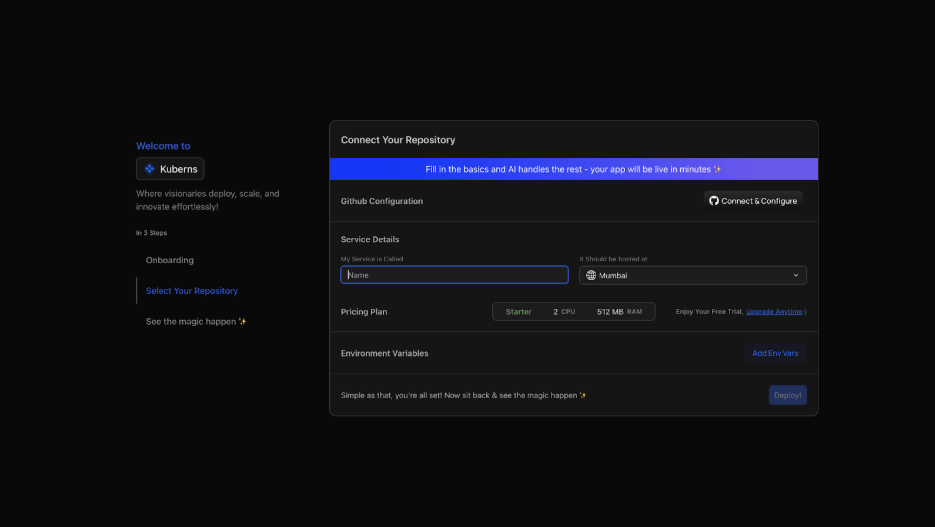
On the **Create Service** page, connect your GitHub account and select your repository and branch. Kuberns scans your project and automatically detects your runtime (Node.js, Python, Go, PHP), framework, build command, and start command. There is nothing to fill in manually.
---
### Step 3: Add Your Environment Variables

Add your API keys, database connection strings, and any secrets in the Environment Variables tab. Every value is encrypted and injected securely at runtime. They never appear in your git history or build logs.
---
### Step 4: Deploy

Click **Deploy**. Kuberns installs dependencies, runs your build command, starts your app on enterprise-grade cloud infrastructure, provisions a live HTTPS URL, and configures CI/CD so every future push to your branch triggers an automatic redeploy. The whole process takes under 5 minutes.
---
### Step 5: Your App is Live

Your app is live with a `*.kuberns.app` URL. Add a custom domain with a single DNS record. Real-time logs, deployment history, autoscaling, and uptime monitoring are all available in the dashboard with no additional configuration.
---
## Kuberns: Deploy Without the Infrastructure Overhead

[Kuberns](https://kuberns.com) is an Agentic AI cloud deployment platform that removes the IaaS layer entirely. Connect your GitHub repository, add your environment variables, and click Deploy. Kuberns reads your project, detects your stack automatically, builds your app, provisions infrastructure on enterprise-grade cloud, issues SSL, and delivers a live HTTPS URL in under 5 minutes.
No server to configure. No Nginx to set up. No deployment pipeline to write. No IAM policies to manage.
**Here is how Kuberns compares to running infrastructure on Hetzner or Azure:**
| What Hetzner and Azure require | What Kuberns does instead |
|---|---|
| Provision a server and SSH in | Connect your GitHub repo |
| Install runtime and web server | Auto-detected from your project |
| Configure SSL manually | Automatic HTTPS on every deployment |
| Write a CI/CD pipeline | Auto-deploy on every git push |
| Set up monitoring and alerts | Built-in logs and metrics dashboard |
| Manually decide when to scale | Autoscaling based on real traffic |
| Patch OS and handle security updates | Fully managed, zero maintenance |
| Navigate billing across dozens of services | Transparent pay-as-you-go from $7/month |
Teams that move from Azure or Hetzner to Kuberns typically save up to 40% on infrastructure costs and eliminate the DevOps overhead that was pulling engineering time away from building product.
---
## How to Deploy on Kuberns
### Prerequisites
Before you start, have the following ready:
- Your app code pushed to a GitHub repository
- A list of environment variables your app needs (API keys, database URLs, secrets)
- For Node.js apps: a `start` script in `package.json`. For Python apps: a `requirements.txt` at the project root
No Dockerfile needed. No YAML. No cloud account or credit card required to start.
---
### Step 1: Sign Up on Kuberns

Go to [kuberns.com](https://kuberns.com) and click **Deploy with AI**. Sign up with your GitHub or Google account. Free credits worth approximately $14 are included for 30 days with no credit card required.
---
### Step 2: Connect Your GitHub Repository

On the **Create Service** page, connect your GitHub account and select your repository and branch. Kuberns scans your project and automatically detects your runtime (Node.js, Python, Go, PHP), framework, build command, and start command. There is nothing to fill in manually.
---
### Step 3: Add Your Environment Variables

Add your API keys, database connection strings, and any secrets in the Environment Variables tab. Every value is encrypted and injected securely at runtime. They never appear in your git history or build logs.
---
### Step 4: Deploy

Click **Deploy**. Kuberns installs dependencies, runs your build command, starts your app on enterprise-grade cloud infrastructure, provisions a live HTTPS URL, and configures CI/CD so every future push to your branch triggers an automatic redeploy. The whole process takes under 5 minutes.
---
### Step 5: Your App is Live

Your app is live with a `*.kuberns.app` URL. Add a custom domain with a single DNS record. Real-time logs, deployment history, autoscaling, and uptime monitoring are all available in the dashboard with no additional configuration.
 ---
## Hetzner vs Azure vs Kuberns: Full Comparison
| Feature | Hetzner | Azure | Kuberns |
|---|---|---|---|
| Starting price | ~3.79 EUR/month | ~$70/month | $7/month |
| India region | No | Yes | Yes (via AWS) |
| Stack auto-detection | No | No | Yes, AI-driven |
| Git-push deployment | Manual setup | Manual setup | Built-in |
| Managed SSL | No | Yes (complex) | Automatic |
| Autoscaling | No | Yes (complex config) | Automatic, AI-driven |
| DevOps required | Yes | Yes (significant) | No |
| Monitoring and logs | Manual setup | Yes (complex) | Built-in dashboard |
| Dockerfile required | No (bare server) | No (bare server) | No |
| Setup time to production | Hours to days | Days to weeks | Under 5 minutes |
| Free credits | No | $200 for 30 days | ~$14 for 30 days |
---
## Which Platform Should You Choose?
**Choose Hetzner if** you have a dedicated DevOps engineer, your workload is European, and raw compute cost is the primary constraint. It is genuinely the cheapest IaaS option for European infrastructure-savvy teams.
**Choose Azure if** you are a large enterprise with existing Microsoft licensing, regulated industry compliance requirements, or specific Azure-native service dependencies like Azure OpenAI or AKS at scale. The complexity and cost are justified only in those contexts.
**Choose Kuberns if** your goal is to ship product. If your team does not have a dedicated cloud engineer, if you want deployment to be a git push rather than a DevOps project, or if you want enterprise-grade infrastructure without an enterprise-scale bill, Kuberns is the right call. It gives you what Hetzner and Azure both lack: a deployment experience that matches the speed of modern development.
[Start deploying on Kuberns for free](https://dashboard.kuberns.com/)
---
## Hetzner vs Azure vs Kuberns: Full Comparison
| Feature | Hetzner | Azure | Kuberns |
|---|---|---|---|
| Starting price | ~3.79 EUR/month | ~$70/month | $7/month |
| India region | No | Yes | Yes (via AWS) |
| Stack auto-detection | No | No | Yes, AI-driven |
| Git-push deployment | Manual setup | Manual setup | Built-in |
| Managed SSL | No | Yes (complex) | Automatic |
| Autoscaling | No | Yes (complex config) | Automatic, AI-driven |
| DevOps required | Yes | Yes (significant) | No |
| Monitoring and logs | Manual setup | Yes (complex) | Built-in dashboard |
| Dockerfile required | No (bare server) | No (bare server) | No |
| Setup time to production | Hours to days | Days to weeks | Under 5 minutes |
| Free credits | No | $200 for 30 days | ~$14 for 30 days |
---
## Which Platform Should You Choose?
**Choose Hetzner if** you have a dedicated DevOps engineer, your workload is European, and raw compute cost is the primary constraint. It is genuinely the cheapest IaaS option for European infrastructure-savvy teams.
**Choose Azure if** you are a large enterprise with existing Microsoft licensing, regulated industry compliance requirements, or specific Azure-native service dependencies like Azure OpenAI or AKS at scale. The complexity and cost are justified only in those contexts.
**Choose Kuberns if** your goal is to ship product. If your team does not have a dedicated cloud engineer, if you want deployment to be a git push rather than a DevOps project, or if you want enterprise-grade infrastructure without an enterprise-scale bill, Kuberns is the right call. It gives you what Hetzner and Azure both lack: a deployment experience that matches the speed of modern development.
[Start deploying on Kuberns for free](https://dashboard.kuberns.com/)
 ---
## Frequently Asked Questions
### Is Hetzner better than Azure for small teams?
Hetzner is significantly cheaper for raw compute, making it attractive for cost-conscious small teams. However, both are IaaS platforms that require full server management. For small teams that want to ship quickly without a DevOps engineer, [Kuberns](https://kuberns.com) is a better choice: it deploys from GitHub automatically with no server configuration required and offers free credits to get started.
### Is Azure cheaper than Hetzner?
No. Hetzner is significantly cheaper on raw compute. An equivalent 4 vCPU, 8GB server on Hetzner costs around 12 to 15 EUR per month, while Azure VMs at comparable specs start at $70 to $140 per month. Azure's pricing complexity also means unexpected costs from egress, storage, and service add-ons.
### What are the main differences between Hetzner and Azure?
Hetzner is an affordable European IaaS provider with simple compute and storage products. Azure is a hyperscale cloud with 200-plus services, global regions including India, managed Kubernetes, AI services, and enterprise compliance tools. Hetzner wins on price and simplicity. Azure wins on global reach and managed services. Both require significant DevOps expertise to use in production.
### Can I deploy a web app on Hetzner or Azure without DevOps experience?
Not easily. Both give you raw infrastructure that you have to configure yourself. For developers without DevOps experience, [Kuberns](https://kuberns.com) is the better option: it auto-detects your stack, deploys with HTTPS, and sets up CI/CD from a GitHub push in under 5 minutes with no server knowledge required.
### Does Hetzner have a data center in India?
No. Hetzner does not have any data center in India or the Asia-Pacific region. Its locations are limited to Germany, Finland, and the US (Ashburn, Virginia). Azure has multiple India regions including Mumbai, Pune, and Hyderabad, making it the clear choice for teams targeting Indian users from a region perspective. Kuberns deploys on AWS infrastructure and also supports India region deployments.
### What is the best alternative to both Hetzner and Azure?
[Kuberns](https://kuberns.com) is the best alternative for teams who want production-grade infrastructure without the management overhead. It runs on enterprise-grade cloud infrastructure, deploys any stack from GitHub automatically, handles scaling and monitoring without configuration, and costs up to 40 percent less than managing equivalent cloud infrastructure directly.
### Is Azure too complex for startups?
For most startups, yes. Azure's 200-plus services, IAM policies, VNet configuration, and billing complexity require dedicated cloud engineering expertise. Most early-stage teams are better served by a managed platform like [Kuberns](https://kuberns.com) that handles infrastructure automatically while they focus on building product.
### How does Kuberns compare to Hetzner and Azure?
Kuberns is an Agentic AI deployment platform built on enterprise-grade cloud infrastructure. Unlike Hetzner and Azure, which both require you to provision and manage servers yourself, Kuberns auto-detects your stack, deploys from GitHub in under 5 minutes, handles autoscaling, SSL, and monitoring automatically, and saves teams up to 40 percent on cloud costs compared to managing raw cloud infrastructure.
---
- [More Alternatives articles](https://kuberns.com/blogs/category/alternatives/1/)
- [All articles](https://kuberns.com/blogs/)
---
## Frequently Asked Questions
### Is Hetzner better than Azure for small teams?
Hetzner is significantly cheaper for raw compute, making it attractive for cost-conscious small teams. However, both are IaaS platforms that require full server management. For small teams that want to ship quickly without a DevOps engineer, [Kuberns](https://kuberns.com) is a better choice: it deploys from GitHub automatically with no server configuration required and offers free credits to get started.
### Is Azure cheaper than Hetzner?
No. Hetzner is significantly cheaper on raw compute. An equivalent 4 vCPU, 8GB server on Hetzner costs around 12 to 15 EUR per month, while Azure VMs at comparable specs start at $70 to $140 per month. Azure's pricing complexity also means unexpected costs from egress, storage, and service add-ons.
### What are the main differences between Hetzner and Azure?
Hetzner is an affordable European IaaS provider with simple compute and storage products. Azure is a hyperscale cloud with 200-plus services, global regions including India, managed Kubernetes, AI services, and enterprise compliance tools. Hetzner wins on price and simplicity. Azure wins on global reach and managed services. Both require significant DevOps expertise to use in production.
### Can I deploy a web app on Hetzner or Azure without DevOps experience?
Not easily. Both give you raw infrastructure that you have to configure yourself. For developers without DevOps experience, [Kuberns](https://kuberns.com) is the better option: it auto-detects your stack, deploys with HTTPS, and sets up CI/CD from a GitHub push in under 5 minutes with no server knowledge required.
### Does Hetzner have a data center in India?
No. Hetzner does not have any data center in India or the Asia-Pacific region. Its locations are limited to Germany, Finland, and the US (Ashburn, Virginia). Azure has multiple India regions including Mumbai, Pune, and Hyderabad, making it the clear choice for teams targeting Indian users from a region perspective. Kuberns deploys on AWS infrastructure and also supports India region deployments.
### What is the best alternative to both Hetzner and Azure?
[Kuberns](https://kuberns.com) is the best alternative for teams who want production-grade infrastructure without the management overhead. It runs on enterprise-grade cloud infrastructure, deploys any stack from GitHub automatically, handles scaling and monitoring without configuration, and costs up to 40 percent less than managing equivalent cloud infrastructure directly.
### Is Azure too complex for startups?
For most startups, yes. Azure's 200-plus services, IAM policies, VNet configuration, and billing complexity require dedicated cloud engineering expertise. Most early-stage teams are better served by a managed platform like [Kuberns](https://kuberns.com) that handles infrastructure automatically while they focus on building product.
### How does Kuberns compare to Hetzner and Azure?
Kuberns is an Agentic AI deployment platform built on enterprise-grade cloud infrastructure. Unlike Hetzner and Azure, which both require you to provision and manage servers yourself, Kuberns auto-detects your stack, deploys from GitHub in under 5 minutes, handles autoscaling, SSL, and monitoring automatically, and saves teams up to 40 percent on cloud costs compared to managing raw cloud infrastructure.
---
- [More Alternatives articles](https://kuberns.com/blogs/category/alternatives/1/)
- [All articles](https://kuberns.com/blogs/)