# Hetzner vs Linode: Which VPS Should You Choose in 2026?
> Hetzner vs Linode compared on pricing, performance, regions, and DevOps overhead. See which VPS fits your needs in 2026 and when to skip both entirely.
- **Author**: rohan-kulkarni
- **Published**: 2026-06-18
- **Modified**: 2026-06-18
- **Category**: Alternatives
- **URL**: https://kuberns.com/blogs/hetzner-vs-linode/
---
If you are comparing Hetzner vs Linode, you are looking at two of the most popular independent VPS providers available in 2026. Hetzner wins on raw compute price. Linode (now Akamai Cloud) wins on global region coverage. Both give you a Linux server and leave everything else to you.
The real question is not which VPS is technically better. It is whether running a VPS is the right model for your team at all.
Before we get to that, here is the direct comparison you came for.
### TL;DR
- **Hetzner:** Significantly cheaper compute, strong European regions, dedicated vCPU and Arm64 options, but no India or Asia-Pacific data center and zero managed deployment
- **Linode (Akamai Cloud):** More global regions including Mumbai, Tokyo, and Singapore, managed Kubernetes and GPU options, but substantially more expensive per spec
- **[Kuberns](https://kuberns.com):** Agentic AI deployment platform with enterprise-grade cloud infrastructure. No server to manage. Deploys any stack from GitHub in under 5 minutes. Up to 40 percent lower costs than direct cloud.
> If your team wants to ship product instead of manage servers, [Kuberns](https://kuberns.com) removes the infrastructure layer entirely.
## Hetzner Cloud in 2026

Hetzner is a German cloud provider that has built a strong reputation as one of the most affordable VPS options on the market. Its compute pricing is the lowest you will find from any established provider, and it has expanded from purely European data centers to include a US location in Ashburn, Virginia.
Hetzner offers three compute tiers: shared vCPU (CX series), dedicated vCPU (CCX series), and Arm64 (CAX series). The CCX dedicated plans are the standout for production workloads where consistent CPU performance matters.
**What Hetzner is good at:**
- Very low compute prices. A CCX13 dedicated instance with 2 vCPUs and 8GB RAM costs around 12.49 EUR per month.
- Generous traffic allowances. Each server includes 20TB outbound per month.
- Simple billing with no surprise egress fees beyond the included allowance.
- Solid network performance within Europe.
**Where Hetzner falls short:**
- No India or Asia-Pacific data center. The US location is in Virginia only. Latency to South Asian or East Asian users is high.
- Pure IaaS. You get a Linux server and nothing else. SSL, deployment pipelines, monitoring, and scaling are entirely your responsibility.
- Support is primarily in German and English. Response times for non-critical tickets are slow, which is a real problem during a production incident.
- No managed Kubernetes, no GPU compute, no serverless options.
For European workloads with a team that has DevOps capability, Hetzner is hard to beat on cost. For everyone else, the gap between the server price and the production-ready state of your app is significant.
## Linode (Akamai Cloud) in 2026

Linode was acquired by Akamai in 2022 and rebranded to Akamai Cloud. The underlying product is similar to what Linode always offered: reliable VPS compute across a global network of data centers, now with updated hardware generations (G6, G7, G8) and expanded services including managed Kubernetes (LKE) and GPU compute.
The key advantage Linode holds over Hetzner is geographic reach. Linode has data centers across the US, Europe, Asia Pacific (Singapore, Tokyo, Osaka), and India (Mumbai). For teams serving users outside Europe, the region options are meaningfully better.
**What Linode is good at:**
- Strong global region coverage including India, which Hetzner lacks entirely.
- G8 generation hardware (5th Gen AMD EPYC) is modern and competitive.
- Managed Kubernetes via LKE for teams that need container orchestration.
- GPU plans for ML and compute-intensive workloads.
- $100 in free credits for new accounts.
**Where Linode falls short:**
- Significantly more expensive than Hetzner per spec. A 4GB dedicated instance on Linode costs $43 to $50 per month compared to Hetzner's 12.49 EUR.
- Still pure IaaS. Like Hetzner, Linode gives you a server. Deployment, SSL, monitoring, and scaling are all manual.
- The Akamai rebrand has been disorienting for existing users. Pricing pages moved, plan names changed, and some documentation is outdated.
- G8 plans do not include a fixed transfer allowance, meaning bandwidth is billed separately unlike most Linode legacy plans.
Linode suits teams that need global region reach and are comfortable with IaaS complexity. It is not a simpler or cheaper path than Hetzner for most use cases.
## Hetzner vs Linode: Head-to-Head
| Category | Hetzner | Linode (Akamai Cloud) |
|---|---|---|
| Entry compute price | ~3.79 EUR/month (CX22, 2 vCPU, 4GB) | $24/month (4GB shared) |
| Dedicated vCPU entry | ~12.49 EUR/month (CCX13) | $43 to $50/month (G7/G8) |
| Regions | Germany, Finland, US (Virginia) | US, Europe, India, Singapore, Tokyo |
| India region | No | Yes (Mumbai) |
| Managed databases | Yes (PostgreSQL, MySQL) | Yes (PostgreSQL, MySQL, Redis) |
| Managed Kubernetes | No | Yes (LKE) |
| GPU compute | No | Yes (RTX 4000 Ada, RTX PRO 6000) |
| Traffic included | 20TB per server | Pooled by plan, varies |
| Free credits | No free tier | $100 for 60 days |
| Support quality | Slow for non-critical tickets | Better response times |
| Deployment tooling | None (bare server) | None (bare server) |
| DevOps required | Yes | Yes |
## Pricing: What You Actually Pay
The headline compute prices look attractive on both platforms. The real cost picture is more complicated.
### Hetzner
A realistic production setup on Hetzner for a web application might look like this:
| Resource | Hetzner Plan | Monthly Cost |
|---|---|---|
| App server | CCX23 (4 vCPU, 16GB) | ~24.49 EUR |
| Managed database | DB 2 vCPU, 4GB | ~28 EUR |
| Load balancer | LB11 | ~5.39 EUR |
| Backups | 20% of server cost | ~4.90 EUR |
| Floating IP | 1 IP | ~2 EUR |
| **Total infrastructure** | | **~64.78 EUR/month** |
That does not include the engineering hours required to configure Nginx, set up your deployment pipeline, manage SSL certificates, write monitoring alerts, and handle server patching. For a team without a dedicated DevOps engineer, those hours are the invisible cost that makes Hetzner's invoice look misleadingly cheap.
### Linode
An equivalent Linode setup costs substantially more:
| Resource | Linode Plan | Monthly Cost |
|---|---|---|
| App server | G7 Dedicated 8GB | ~$86 |
| Managed database | Postgres 4GB | ~$30 |
| Load balancer | NodeBalancer | ~$10 |
| Backups | 20% of server cost | ~$17.20 |
| **Total infrastructure** | | **~$143.20/month** |
Linode is roughly double the cost of Hetzner for comparable specs. The trade-off is better region coverage and managed Kubernetes if you need it. The engineering overhead is identical.
## Where Both Platforms Leave You on Your Own
Both Hetzner and Linode are IaaS platforms. The moment you provision a server, you own everything that runs on it.
**What you manage yourself on both platforms:**
- Web server configuration (Nginx, Caddy, or Apache)
- SSL certificate provisioning and renewal
- Deployment pipeline setup (GitHub Actions, shell scripts, or similar)
- Runtime installation and version management
- Environment variable handling
- Monitoring and alerting configuration
- Database connection pooling and backups
- Security patching and OS updates
- Scaling decisions when traffic increases
For experienced backend engineers, this is familiar territory. For product teams and early-stage startups that need to ship fast, this list represents days of setup work before a single user can reach your app.
This is not a flaw in Hetzner or Linode specifically. It is the nature of IaaS. The question for your team is whether this overhead is worth carrying.
 ## Kuberns: What Deployment Looks Like Without the Server Management

[Kuberns](https://kuberns.com) is an Agentic AI cloud platform that removes the IaaS layer entirely. You connect your GitHub repository, add your environment variables, and click Deploy. Kuberns reads your project, detects your stack automatically, builds your app, provisions infrastructure on AWS, issues SSL, and gives you a live HTTPS URL in under 5 minutes.
There is no server to configure. No Nginx to set up. No deployment pipeline to write.
**Here is how Kuberns compares to running a VPS on Hetzner or Linode:**
| What a VPS requires | What Kuberns does instead |
|---|---|
| Provision a server and SSH in | Connect your GitHub repo |
| Install runtime (Node.js, Python, etc.) | Auto-detected from your project |
| Configure Nginx and SSL | Automatic HTTPS provisioning |
| Write a deployment pipeline | Auto-deploy on every git push |
| Set up monitoring and alerts | Built-in dashboard with logs and metrics |
| Decide when to scale up | Autoscaling based on real traffic |
| Patch the OS and runtime | Fully managed, no maintenance required |
You also get AWS-grade infrastructure under the hood, which means reliability and region coverage that neither Hetzner nor Linode can match. And because Kuberns manages resource allocation efficiently with autoscaling, teams typically save up to 40 percent compared to provisioning equivalent AWS infrastructure directly.
### How to Deploy on Kuberns
#### Prerequisites
Before you start, make sure you have:
- Your app code pushed to a GitHub repository
- Environment variables and API keys listed (you will add them in the dashboard, not in your code)
- A `start` script in `package.json` for Node.js apps, or a `requirements.txt` for Python apps
No Dockerfile needed. No YAML. No cloud account setup.
#### Step 1: Sign Up on Kuberns

Go to [kuberns.com](https://kuberns.com) and click **Deploy with AI**. Sign up with GitHub or Google. Free credits are included with no credit card required.
#### Step 2: Connect Your GitHub Repository
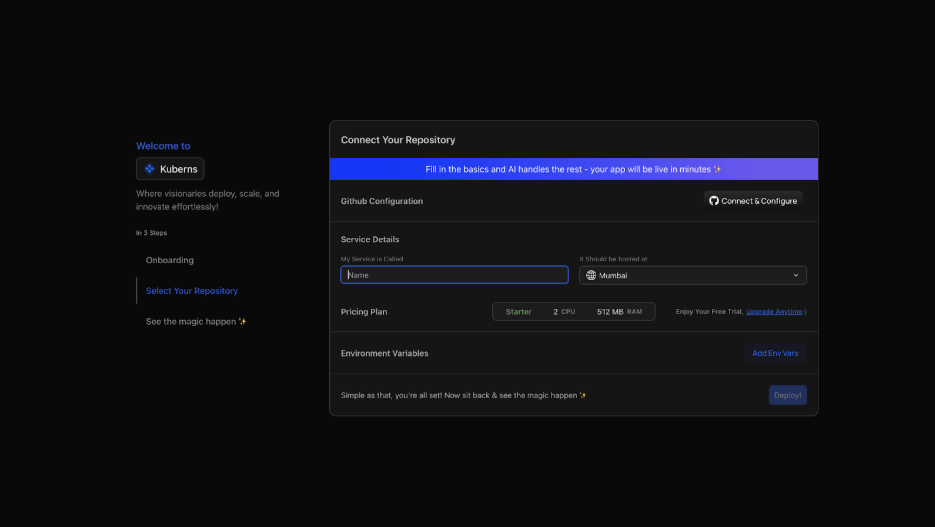
On the **Create Service** page, connect your GitHub account and select your repository and branch. Kuberns scans your project and detects your framework, runtime, build command, and start command automatically. Nothing to configure manually.
#### Step 3: Add Your Environment Variables

In the Environment tab, add your API keys, database URLs, and any other secrets your app needs. These are encrypted and injected securely at runtime. They never appear in your git history.
#### Step 4: Deploy

Click **Deploy**. Kuberns installs dependencies, runs your build command, starts your app on AWS, and provisions a live HTTPS URL. The whole process takes under 5 minutes.
#### Step 5: Your App is Live

Every future push to your connected branch triggers an automatic redeploy. Autoscaling, uptime monitoring, and real-time logs are all available in the dashboard without any additional setup.
## Kuberns: What Deployment Looks Like Without the Server Management

[Kuberns](https://kuberns.com) is an Agentic AI cloud platform that removes the IaaS layer entirely. You connect your GitHub repository, add your environment variables, and click Deploy. Kuberns reads your project, detects your stack automatically, builds your app, provisions infrastructure on AWS, issues SSL, and gives you a live HTTPS URL in under 5 minutes.
There is no server to configure. No Nginx to set up. No deployment pipeline to write.
**Here is how Kuberns compares to running a VPS on Hetzner or Linode:**
| What a VPS requires | What Kuberns does instead |
|---|---|
| Provision a server and SSH in | Connect your GitHub repo |
| Install runtime (Node.js, Python, etc.) | Auto-detected from your project |
| Configure Nginx and SSL | Automatic HTTPS provisioning |
| Write a deployment pipeline | Auto-deploy on every git push |
| Set up monitoring and alerts | Built-in dashboard with logs and metrics |
| Decide when to scale up | Autoscaling based on real traffic |
| Patch the OS and runtime | Fully managed, no maintenance required |
You also get AWS-grade infrastructure under the hood, which means reliability and region coverage that neither Hetzner nor Linode can match. And because Kuberns manages resource allocation efficiently with autoscaling, teams typically save up to 40 percent compared to provisioning equivalent AWS infrastructure directly.
### How to Deploy on Kuberns
#### Prerequisites
Before you start, make sure you have:
- Your app code pushed to a GitHub repository
- Environment variables and API keys listed (you will add them in the dashboard, not in your code)
- A `start` script in `package.json` for Node.js apps, or a `requirements.txt` for Python apps
No Dockerfile needed. No YAML. No cloud account setup.
#### Step 1: Sign Up on Kuberns

Go to [kuberns.com](https://kuberns.com) and click **Deploy with AI**. Sign up with GitHub or Google. Free credits are included with no credit card required.
#### Step 2: Connect Your GitHub Repository

On the **Create Service** page, connect your GitHub account and select your repository and branch. Kuberns scans your project and detects your framework, runtime, build command, and start command automatically. Nothing to configure manually.
#### Step 3: Add Your Environment Variables

In the Environment tab, add your API keys, database URLs, and any other secrets your app needs. These are encrypted and injected securely at runtime. They never appear in your git history.
#### Step 4: Deploy

Click **Deploy**. Kuberns installs dependencies, runs your build command, starts your app on AWS, and provisions a live HTTPS URL. The whole process takes under 5 minutes.
#### Step 5: Your App is Live

Every future push to your connected branch triggers an automatic redeploy. Autoscaling, uptime monitoring, and real-time logs are all available in the dashboard without any additional setup.
 ## Hetzner vs Linode vs Kuberns: Full Comparison
| Category | Kuberns | Hetzner | Linode (Akamai) |
|---|---|---|---|
| Deployment model | Agentic AI, fully automated | Bare IaaS VPS | Bare IaaS VPS |
| Setup time | Under 5 minutes | Hours to days | Hours to days |
| Server management | None required | Full ownership | Full ownership |
| SSL provisioning | Automatic | Manual | Manual |
| CI/CD | Built-in on every push | You build it | You build it |
| Autoscaling | Automatic | Manual | Manual |
| Monitoring | Built-in dashboard | Manual setup | Manual setup |
| India region | Yes (AWS Mumbai/Hyderabad) | No | Yes (Mumbai) |
| Starting price | Free credits, then $7/mo | ~3.79 EUR/mo | $5/mo (shared) |
| DevOps required | No | Yes | Yes |
| Best for | Teams that want to ship without managing infra | Budget compute with DevOps expertise | Global reach with DevOps expertise |
## Which Should You Choose?
**Choose Hetzner if** you have solid DevOps experience on your team, your workload is primarily in Europe, and getting the lowest possible raw compute cost is more important than deployment convenience. The savings are real. The overhead is real too.
**Choose Linode if** you need global data center coverage, particularly in Asia Pacific or India, and your team can handle IaaS complexity. The G8 hardware is solid and LKE is a good managed Kubernetes option if you need it.
**Choose Kuberns if** your team wants to focus on building the product rather than managing infrastructure. If you have ever spent an evening debugging a server configuration instead of shipping a feature, Kuberns is the platform that removes that problem permanently. You get AWS-grade infrastructure, zero-config deployment, and autoscaling, at lower cost than either VPS option once you factor in engineering time.
For most product teams and startups, the right answer is not Hetzner or Linode. It is stopping the IaaS conversation entirely and deploying with [Kuberns](https://kuberns.com).
[Deploy your first app on Kuberns for free](https://dashboard.kuberns.com/)
---
## Frequently Asked Questions
### Is Hetzner better than Linode in 2026?
Hetzner offers cheaper raw compute and more RAM per euro. Linode has better global region coverage, especially in North America and Asia Pacific. For European workloads on a tight budget, Hetzner wins on price. For global apps needing regions close to US or Asian users, Linode has the advantage. For teams who want to skip VPS management entirely, Kuberns deploys on enterprise-grade cloud infrastructure automatically with no server setup required.
### Is Hetzner cheaper than Linode?
Yes. Hetzner is significantly cheaper per equivalent spec. A Hetzner CX22 with 2 vCPUs and 4GB RAM costs around 3.79 EUR per month. Linode's closest shared plan at 4GB RAM costs $24 per month. For raw compute cost, Hetzner wins by a wide margin. However, both are IaaS platforms with full server management overhead.
### Does Hetzner have a US or India region?
Hetzner has a US data center in Ashburn, Virginia. It does not have an India or Asia-Pacific data center. Linode has data centers in India (Mumbai), Singapore, and Tokyo. For teams serving Indian or Asian users, Linode has a clear geographic advantage.
### Can I deploy a Node.js or Python app without DevOps experience?
Not easily on either platform. Both give you a bare Linux server. You handle the runtime, web server, SSL, and deployment pipeline yourself. For teams without DevOps experience, Kuberns is the better path. It detects your stack automatically and deploys in under 5 minutes with no server configuration required.
### What is a good alternative to both Hetzner and Linode?
Kuberns is the best alternative for teams who want production-grade infrastructure without managing it. It runs on enterprise-grade cloud infrastructure, deploys from GitHub automatically, handles scaling and monitoring, and costs up to 40 percent less than managing equivalent AWS infrastructure directly. No server to provision, no Dockerfile required, no deployment pipeline to maintain.
### Does Linode or Hetzner include managed databases?
Linode offers managed PostgreSQL, MySQL, and Redis starting at around $15 per month. Hetzner also offers managed PostgreSQL and MySQL. Both charge separately for databases on top of compute costs. With Kuberns, you connect an external managed database provider via environment variables and Kuberns handles the rest of the deployment automatically.
---
- [More Alternatives articles](https://kuberns.com/blogs/category/alternatives/1/)
- [All articles](https://kuberns.com/blogs/)
## Hetzner vs Linode vs Kuberns: Full Comparison
| Category | Kuberns | Hetzner | Linode (Akamai) |
|---|---|---|---|
| Deployment model | Agentic AI, fully automated | Bare IaaS VPS | Bare IaaS VPS |
| Setup time | Under 5 minutes | Hours to days | Hours to days |
| Server management | None required | Full ownership | Full ownership |
| SSL provisioning | Automatic | Manual | Manual |
| CI/CD | Built-in on every push | You build it | You build it |
| Autoscaling | Automatic | Manual | Manual |
| Monitoring | Built-in dashboard | Manual setup | Manual setup |
| India region | Yes (AWS Mumbai/Hyderabad) | No | Yes (Mumbai) |
| Starting price | Free credits, then $7/mo | ~3.79 EUR/mo | $5/mo (shared) |
| DevOps required | No | Yes | Yes |
| Best for | Teams that want to ship without managing infra | Budget compute with DevOps expertise | Global reach with DevOps expertise |
## Which Should You Choose?
**Choose Hetzner if** you have solid DevOps experience on your team, your workload is primarily in Europe, and getting the lowest possible raw compute cost is more important than deployment convenience. The savings are real. The overhead is real too.
**Choose Linode if** you need global data center coverage, particularly in Asia Pacific or India, and your team can handle IaaS complexity. The G8 hardware is solid and LKE is a good managed Kubernetes option if you need it.
**Choose Kuberns if** your team wants to focus on building the product rather than managing infrastructure. If you have ever spent an evening debugging a server configuration instead of shipping a feature, Kuberns is the platform that removes that problem permanently. You get AWS-grade infrastructure, zero-config deployment, and autoscaling, at lower cost than either VPS option once you factor in engineering time.
For most product teams and startups, the right answer is not Hetzner or Linode. It is stopping the IaaS conversation entirely and deploying with [Kuberns](https://kuberns.com).
[Deploy your first app on Kuberns for free](https://dashboard.kuberns.com/)
---
## Frequently Asked Questions
### Is Hetzner better than Linode in 2026?
Hetzner offers cheaper raw compute and more RAM per euro. Linode has better global region coverage, especially in North America and Asia Pacific. For European workloads on a tight budget, Hetzner wins on price. For global apps needing regions close to US or Asian users, Linode has the advantage. For teams who want to skip VPS management entirely, Kuberns deploys on enterprise-grade cloud infrastructure automatically with no server setup required.
### Is Hetzner cheaper than Linode?
Yes. Hetzner is significantly cheaper per equivalent spec. A Hetzner CX22 with 2 vCPUs and 4GB RAM costs around 3.79 EUR per month. Linode's closest shared plan at 4GB RAM costs $24 per month. For raw compute cost, Hetzner wins by a wide margin. However, both are IaaS platforms with full server management overhead.
### Does Hetzner have a US or India region?
Hetzner has a US data center in Ashburn, Virginia. It does not have an India or Asia-Pacific data center. Linode has data centers in India (Mumbai), Singapore, and Tokyo. For teams serving Indian or Asian users, Linode has a clear geographic advantage.
### Can I deploy a Node.js or Python app without DevOps experience?
Not easily on either platform. Both give you a bare Linux server. You handle the runtime, web server, SSL, and deployment pipeline yourself. For teams without DevOps experience, Kuberns is the better path. It detects your stack automatically and deploys in under 5 minutes with no server configuration required.
### What is a good alternative to both Hetzner and Linode?
Kuberns is the best alternative for teams who want production-grade infrastructure without managing it. It runs on enterprise-grade cloud infrastructure, deploys from GitHub automatically, handles scaling and monitoring, and costs up to 40 percent less than managing equivalent AWS infrastructure directly. No server to provision, no Dockerfile required, no deployment pipeline to maintain.
### Does Linode or Hetzner include managed databases?
Linode offers managed PostgreSQL, MySQL, and Redis starting at around $15 per month. Hetzner also offers managed PostgreSQL and MySQL. Both charge separately for databases on top of compute costs. With Kuberns, you connect an external managed database provider via environment variables and Kuberns handles the rest of the deployment automatically.
---
- [More Alternatives articles](https://kuberns.com/blogs/category/alternatives/1/)
- [All articles](https://kuberns.com/blogs/)