# Why Should Your Startup Host Its Entire App in One Place?
> Host your startup app on one platform and simplify deployments, logs, environment variables, costs, and service management using Kuberns for deployment.
- **Author**: harsh-kanani
- **Published**: 2026-08-24
- **Modified**: 2026-08-24
- **Category**: Deployment Guides
- **URL**: https://kuberns.com/blogs/host-startup-app/
---
Your startup should **host its application through one platform** when separate deployment workflows, dashboards, logs, environment variables, and bills are consuming time that should go into the product. The practical goal is one operational place for the application, not one physical server for every component.
[Hosting your startup app through Kuberns](https://kuberns.com/) gives your team one managed place to connect application repositories, review the detected stack and services, add production variables, and deploy. Its agentic AI for deployment reduces the manual configuration between your code and a production release. The frontend, backend, and workers can be operated together while databases, storage, email, payments, and AI APIs remain external when their specialist capabilities are useful.
## TL;DR
- Use one platform to coordinate application deployments, configuration, logs, domains, and releases.
- Do not interpret “one place” as putting the frontend, backend, database, files, and workers into one unmanaged server.
- Keep services independently deployable when they have different runtimes, scaling patterns, or reliability requirements.
- Add specialist providers when they deliver a necessary capability, not simply because splitting the stack appears more advanced.
- Kuberns gives startups one Git-based workflow for deploying supported application services without maintaining a VPS deployment toolchain.
## What Does Hosting Your Entire App in One Place Mean?

Hosting an entire app in one place means giving the team one operational platform for deploying and observing the application. It does not require every process and every byte of data to run on the same machine.
This distinction creates three common hosting models:
1. **One server:** The frontend, backend, database, files, and workers run on one VPS. The setup can be inexpensive and understandable at first, but the team owns server updates, networking, certificates, deployments, backups, monitoring, and recovery.
2. **A provider for every layer:** The frontend, API, database, files, email, and monitoring each use a separate platform. Every service may be well managed individually, but the startup becomes responsible for coordinating the complete system.
3. **One application platform:** The frontend, backend, and workers remain logically separate services but share a deployment and operational workflow. External managed services connect where the application needs them.
For most early-stage startups, the third model provides the clearest balance. It reduces day-to-day coordination without pretending that a database, payment processor, object store, and AI model all have identical operational needs.
This is also different from a monorepo. A monorepo defines how code is organized, while a deployment platform defines how running services reach production. If the code is already organized together, see the [guide to deploying a frontend and backend from a monorepo](https://kuberns.com/blogs/deploy-monorepo-to-production/).
## Why Do Startups Use Separate Hosting Providers?

Fragmented hosting rarely begins as an intentional architecture. It usually grows one convenient decision at a time. A founder selects a frontend platform because deployment takes a few clicks, adds a managed database recommended by a framework template, places the backend somewhere else, and later connects storage, email, payments, authentication, analytics, and an AI API.
A startup team raised exactly this problem while looking for hosting for a landing page, domain, database, backend, and AI model. The replies in the startup hosting discussion recommend different combinations of services, including a PaaS to reduce DevOps work, PostgreSQL, a frontend and database starter, and specialist AI infrastructure. The discussion shows why the decision is larger than choosing a single host.

Separate services are not inherently wrong. A managed PostgreSQL provider may offer the durability and database operations the team needs. An object store is designed for user uploads, and a transactional email provider protects deliverability. A payment processor or hosted AI model solves a specialized problem that an application host should not reproduce.
The difficulty appears when the team chooses a separate deployment platform for every application process without gaining a material advantage. The frontend may contain one backend URL, the backend another database connection, the worker a separate queue configuration, and every provider its own variables, permissions, logs, limits, and billing rules.
> **A service should earn its place in the stack by solving a specific requirement. Convenience at signup is not enough if the team must maintain another production workflow indefinitely.**
For teams already feeling this fragmentation, the [full-stack application deployment guide](https://kuberns.com/blogs/deploy-full-stack-app-with-ai/) explains how to prepare the complete application rather than treating the frontend as the entire product.
## Why Should Your Startup Consolidate App Hosting?
Your startup should consolidate application hosting when coordination work is growing faster than the technical value of keeping providers separate. The strongest benefit is not a smaller list of logos on an architecture diagram. It is a shorter and more repeatable path from a code change to a verified production release.
**One deployment workflow:** A feature can change the frontend, backend, and worker at the same time. When those services use unrelated release processes, the team must remember the correct order, verify compatible versions, and investigate different systems when one deployment fails. One application platform makes the release easier to follow even when the services remain independent.
**Consistent environment configuration:** Production applications depend on API addresses, database connections, authentication secrets, callback URLs, storage credentials, and third-party keys. Scattering these settings across providers increases the chance that one environment receives an old value or that a credential is updated in one service but not another.
**Connected troubleshooting:** A user may report a broken page, but the cause could be an expired credential, an unreachable backend, a failed database connection, or a worker that stopped processing jobs. When application deployment and logs are easier to inspect together, developers spend less time locating the system that contains the first useful clue.
**Simpler access and billing:** Every additional platform introduces accounts, permissions, invoices, usage models, renewal decisions, and support channels. These tasks are easy to ignore while the product is small, but they become recurring operational work when a teammate joins or an incident crosses service boundaries.
**More engineering time for customers:** Infrastructure still needs ownership. Consolidation reduces duplicated mechanics so the startup can focus that ownership on secure releases, useful monitoring, backups, recovery, and product behavior rather than maintaining several similar hosting workflows.
> **If deploying one customer-facing change requires coordinating several dashboards, [use Kuberns to bring the application workflow together](https://kuberns.com/) before that fragmentation becomes the team’s default architecture.**
## One Platform vs Separate Hosting Providers
The better setup depends on what is being separated and why. One application platform usually reduces operational work for a small team. Separate providers remain valuable when they supply specialized infrastructure or an isolation boundary that the application genuinely requires.
| Decision factor | One application platform | Separate hosting providers |
|---|---|---|
| Deployment workflow | Related services follow one managed workflow | Each provider can require a different release process |
| Environment variables | Easier to coordinate across application services | Values may be repeated across dashboards |
| Logs and troubleshooting | Application activity is easier to correlate | Investigation often crosses several systems |
| Billing and access | Fewer accounts and permission models | Multiple invoices, limits, roles, and support channels |
| Service specialization | A more consistent operating model | Greater freedom to select a specialist for every layer |
| Failure isolation | Depends on how services and data are designed | Can be stronger when separation is deliberate |
| Scaling | Services can still scale according to their role | Scaling is configured and reviewed provider by provider |
| Operational work | Usually lower for founders and small teams | Usually higher because the team owns integration |
Using several providers does not automatically make an application more reliable. It can reduce one shared failure domain, but it also introduces more network paths, credentials, dashboards, and vendor dependencies. Reliability comes from intentional boundaries, durable data, tested recovery, observable services, and controlled releases.
Cost needs the same complete view. A cheap or free service can lower the first bill while adding engineering work, data-transfer charges, or another paid tool for logs. Compare compute, storage, transfer, observability, maintenance, and recovery rather than adding only the advertised entry prices.
> **The cheapest component list is not always the lowest-cost system. [See when a startup should replace VPS operations with a managed PaaS](https://kuberns.com/blogs/move-from-vps-to-paas/) before comparing infrastructure prices alone.**
## Should the Frontend, Backend, and Database All Run Together?
The frontend and backend can be deployed through the same platform, but they do not need to run as one service. Separate deployable services are useful when the frontend and backend have different runtimes, release schedules, traffic patterns, or scaling requirements.
The database requires a stricter decision. It stores durable business and customer data, so production readiness depends on persistent storage, restricted access, tested backups, monitoring, and a recovery procedure. Those requirements apply whether the database is connected through the application platform or supplied by an external managed provider.
A developer building a React, Django, PostgreSQL, and image-heavy SaaS asked whether to put everything on a VPS or split the frontend, backend, database, and files among several providers. The full-stack hosting strategy discussion captures the real tradeoff: one server appears simpler, while service separation introduces more deployment decisions. A managed application platform offers a third path by unifying operations without forcing every component into one process.

For a prototype with low-risk data, one VPS may be an acceptable temporary decision when the team understands and owns the server. For a production SaaS, do not make the database share the application server merely to achieve a one-provider architecture. Preserve data durability and recovery first.
If the application needs PostgreSQL, the [application and database deployment guide](https://kuberns.com/blogs/deploy-app-with-postgresql/) covers connection variables, production configuration, migrations, and verification in more detail.
## How to Host Your Startup App Through One Platform
To host a startup app through one platform, first map the complete production system. Then connect the application repositories, confirm each deployable service, configure production variables, deploy, and verify every path that crosses the frontend, backend, database, workers, and external integrations.
The following workflow uses Kuberns to reduce manual infrastructure configuration while keeping application and data decisions with the team.
### 1. Map the application services
List the frontend, backend, workers, scheduled jobs, database, object storage, email, payment, authentication, analytics, and AI integrations. Mark which components contain durable data and which must run continuously or process work outside a web request.
This map prevents a common deployment failure: publishing the visible frontend while overlooking the process that sends emails, receives webhooks, generates files, or completes background work.
### 2. Prepare the repositories
Confirm that each repository contains the correct dependency files, runtime version, build command, start command, and references to environment variables. Do not commit production passwords, tokens, private keys, or connection strings.
If the frontend and backend share one repository, identify their application directories and shared packages. If they use separate repositories, document which production variables and public endpoints connect them.
### 3. Connect the repository to Kuberns
Create a project, connect GitHub, select the required repository, and choose the branch used for production. Repeat this for the application repositories that belong in the same operating workflow.
### 4. Review the detected stack and services
Kuberns reviews the repository so the team can confirm the detected runtime, framework, service type, and commands before deployment. Check these values against the way the application runs locally and against any production-specific requirements.
Stack detection reduces repetitive configuration, but the team should still verify what it is approving. A custom build script, system dependency, worker command, or unusual repository structure may need attention.
### 5. Add production environment variables
Add database connections, authentication secrets, API addresses, storage credentials, email settings, payment keys, AI provider credentials, and the public application URL. Keep public frontend variables separate from secrets that must only reach backend or worker processes.
Review callback URLs for authentication and payments before release. A service can deploy successfully and still fail for users because a provider is pointing to a local or preview address.
### 6. Deploy the application services
Deploy the frontend, backend, workers, and other supported services. Review build output and runtime logs instead of treating a successful build as proof that the complete system works.
Confirm that every long-running process starts correctly and that a failed process is visible. A background worker that never starts may not affect the homepage, but it can silently prevent emails, imports, notifications, or AI jobs from completing.
### 7. Configure the production domain
Connect the production domain and verify HTTPS. Then confirm API base URLs, CORS rules, cookies, authentication callbacks, payment webhooks, and any allowlists that depend on the final domain.
### 8. Verify the complete application
Test the application as a real user would. Create an account, authenticate, submit and retrieve data, upload a file, trigger an email, complete a test payment, and run an AI or background task where applicable. Inspect the relevant logs while testing.
Also verify what happens when a release fails and how the team will recover data. Hosting becomes simpler through one platform, but rollback and data recovery still need explicit ownership.
> **A production deployment is complete only when the full user journey works. [Open the Kuberns dashboard](https://dashboard.kuberns.com/) to connect the repositories and bring those application services into one deployment workflow.**
## Why Kuberns Is the Best Choice to Host Your Startup Application
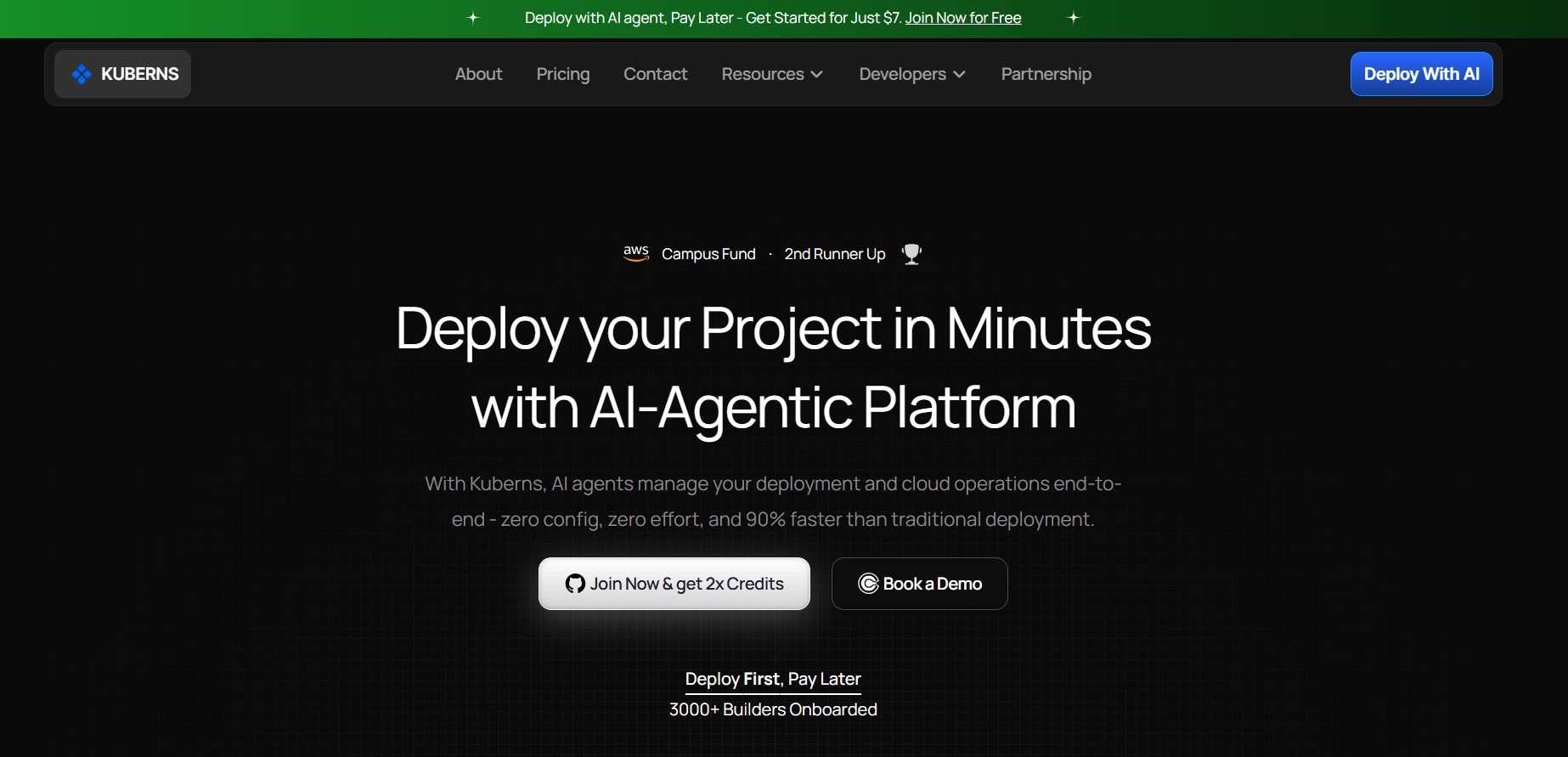
Kuberns is the best choice for a startup that wants one managed deployment workflow without taking on routine VPS administration or stitching together a different hosting process for every application service. It is an agentic AI platform for deployment, designed to move supported applications from GitHub repositories to production with less manual configuration.
A VPS can place many components on one machine, but the startup remains responsible for the operating system, reverse proxy, certificates, deployment scripts, process management, logging, updates, and recovery. A fragmented PaaS setup removes some server work, but the team can still end up coordinating separate frontend, backend, and worker platforms.
Kuberns provides a more direct path:
- Connect the application repository from GitHub.
- Review the stack and service configuration detected from the codebase.
- Add the required production environment variables.
- Deploy supported frontend, backend, and worker services.
- Inspect deployment activity and logs through one operating workflow.
- Continue using external databases, storage, email, payment, authentication, or AI services when the application needs them.
The value is operational consolidation without pretending every dependency is the same kind of workload. Kuberns manages the application-deployment path, while the startup retains responsibility for secure code, database design, credentials, migrations, backups, testing, and recovery.
For a small team without a dedicated infrastructure specialist, this also avoids turning a founder into the permanent integration layer between hosting providers. The [guide to deploying without a DevOps engineer](https://kuberns.com/blogs/deploy-without-devops/) explains which responsibilities a managed platform simplifies and which responsibilities remain with the application team.
> **Kuberns gives your startup one place to deploy the application without forcing your team to become the hosting integration layer.**
## Common App Hosting Mistakes

Hosting mistakes usually come from optimizing one component without considering the complete production workflow.
**Treating one platform as one physical server:** A unified dashboard does not require all services to share one process, disk, or failure domain. Keep service and data boundaries appropriate to the application.
**Running the only database copy beside the app:** If the server fails, an application restart is inconvenient; lost customer data can be irreversible. Protect persistent data with access controls, backups, monitoring, and tested recovery.
**Adding providers before there is a requirement:** A separate service should solve a measurable need such as durable storage, email deliverability, payment compliance, GPU access, or a scaling boundary. Otherwise, it may only add another deployment and support surface.
**Copying environment variables without ownership:** Duplicated settings drift. Document which service owns each value, which services receive it, and how credential rotation will be completed.
**Releasing incompatible application versions:** Frontend and backend changes can depend on each other. Define compatible API changes and a release order rather than assuming separate deployments will remain synchronized.
**Choosing entirely by free tiers:** Free allowances can be useful during validation, but they do not describe engineering time, data transfer, production limits, or the cost of moving later. Evaluate the operating model the startup can sustain.
**Ignoring recovery until after an incident:** A platform can make deployment repeatable, but it cannot invent the startup’s acceptable data-loss window or recovery procedure. Test application rollback and data restoration before customers depend on them.
## What Is the Best Hosting Structure for an Early-Stage Startup?
For most early-stage startups, the best hosting structure is one managed platform for deploying and operating application services, combined with specialist managed services only where they provide a necessary capability. This keeps the frontend, backend, and workers operationally connected without forcing the database, storage, payments, email, and AI infrastructure into one server.
A recent founder asked whether a new SaaS should keep its frontend, backend, and database together or host them separately while balancing simplicity, cost, and scalability. The SaaS hosting discussion illustrates why first-time founders struggle with this decision: infrastructure price is visible, but the cost of coordinating the stack is harder to estimate.

Start with the fewest operational systems that satisfy the application’s real requirements. Separate a component when durability, compliance, performance, hardware, or failure isolation justifies the additional work. Do not split the stack merely to imitate the architecture of a much larger company.
## Conclusion
Your startup should host its application through one platform when separate deployment workflows are creating more work than value. Keep the frontend, backend, and workers logically separated where appropriate, protect the database independently, and use specialist services when they solve a genuine requirement.
The goal is one operational home for the application, not one physical server for every component. Kuberns provides that home through a managed, Git-based workflow with agentic AI for deployment, helping the team move from repositories to production without maintaining a VPS toolchain or coordinating several application hosts.
 ## Frequently Asked Questions
### Should a startup host its entire app on one platform?
Most early-stage startups benefit from using one managed platform for application deployment, configuration, logs, and releases. The frontend, backend, and workers can remain separate services, while databases, storage, payments, email, and AI APIs can stay with specialist providers when needed.
### Can the frontend, backend, and database be hosted together?
Yes, but hosting them through one platform should not mean placing them all in one process or on one unmanaged server. Keep the application services independently deployable when appropriate, and give the production database protected persistence, backups, restricted access, and a recovery plan.
### Is it better to use one hosting provider or several providers?
One managed application platform is usually simpler for a small team because it centralizes deployments and operational visibility. Add another provider when it supplies a necessary capability, such as managed data storage, payment processing, transactional email, or specialized AI infrastructure.
### Is it safe to host a database on the same server as the backend?
It can work for development or a low-risk prototype, but it creates shared resource and failure concerns. A production database needs durable storage, tested backups, access controls, monitoring, and recovery procedures regardless of where it runs.
### What is the easiest way to host a full-stack startup app?
Use a managed platform that can deploy the frontend, backend, and workers from Git repositories while centralizing environment variables, domains, logs, and releases. Kuberns provides this workflow for supported application stacks without requiring the startup to maintain a VPS deployment toolchain.
### Can an app use external services while being deployed on one platform?
Yes. An application deployed through one platform can connect to an external database, object storage, email service, payment processor, authentication provider, or AI API through securely configured credentials and network endpoints.
### Should a startup use a VPS or a managed application platform?
Use a VPS when the team needs server-level control and can own operating-system maintenance, networking, deployments, monitoring, backups, and incident response. Use a managed application platform when reducing infrastructure work matters more than direct server control.
### Does consolidating application hosting reduce costs?
It can reduce operational costs by removing duplicated tooling, accounts, and engineering work, but it does not guarantee the lowest infrastructure bill. Compare the complete cost of compute, data transfer, managed services, monitoring, and maintenance rather than only the entry price.
---
- [More Deployment Guides articles](https://kuberns.com/blogs/category/deployment-guides/1/)
- [All articles](https://kuberns.com/blogs/)
## Frequently Asked Questions
### Should a startup host its entire app on one platform?
Most early-stage startups benefit from using one managed platform for application deployment, configuration, logs, and releases. The frontend, backend, and workers can remain separate services, while databases, storage, payments, email, and AI APIs can stay with specialist providers when needed.
### Can the frontend, backend, and database be hosted together?
Yes, but hosting them through one platform should not mean placing them all in one process or on one unmanaged server. Keep the application services independently deployable when appropriate, and give the production database protected persistence, backups, restricted access, and a recovery plan.
### Is it better to use one hosting provider or several providers?
One managed application platform is usually simpler for a small team because it centralizes deployments and operational visibility. Add another provider when it supplies a necessary capability, such as managed data storage, payment processing, transactional email, or specialized AI infrastructure.
### Is it safe to host a database on the same server as the backend?
It can work for development or a low-risk prototype, but it creates shared resource and failure concerns. A production database needs durable storage, tested backups, access controls, monitoring, and recovery procedures regardless of where it runs.
### What is the easiest way to host a full-stack startup app?
Use a managed platform that can deploy the frontend, backend, and workers from Git repositories while centralizing environment variables, domains, logs, and releases. Kuberns provides this workflow for supported application stacks without requiring the startup to maintain a VPS deployment toolchain.
### Can an app use external services while being deployed on one platform?
Yes. An application deployed through one platform can connect to an external database, object storage, email service, payment processor, authentication provider, or AI API through securely configured credentials and network endpoints.
### Should a startup use a VPS or a managed application platform?
Use a VPS when the team needs server-level control and can own operating-system maintenance, networking, deployments, monitoring, backups, and incident response. Use a managed application platform when reducing infrastructure work matters more than direct server control.
### Does consolidating application hosting reduce costs?
It can reduce operational costs by removing duplicated tooling, accounts, and engineering work, but it does not guarantee the lowest infrastructure bill. Compare the complete cost of compute, data transfer, managed services, monitoring, and maintenance rather than only the entry price.
---
- [More Deployment Guides articles](https://kuberns.com/blogs/category/deployment-guides/1/)
- [All articles](https://kuberns.com/blogs/)