# How DevOps Teams Can Take Advantage of Artificial Intelligence in 2026
> Learn how a DevOps team can take advantage of artificial intelligence to automate workflows, scale smarter, and deploy faster with Kuberns.
- **Author**: jaikishan-singh-rajawat
- **Published**: 2025-10-09
- **Modified**: 2026-03-25
- **Category**: AI & DevOps
- **URL**: https://kuberns.com/blogs/how-can-devops-team-take-advantage-of-artificial-intelligence/
---
TL;DR
* DevOps teams are under more pressure than ever. More services to manage, more deployments to run, more alerts to deal with, and never enough people to handle all of it.
* AI is not here to replace DevOps engineers. It simply takes care of the repetitive work like configuring pipelines, monitoring deployments, and scaling infrastructure so teams can focus on building and improving their applications.
* The teams getting the most value from AI are not trying to automate everything overnight. They start small, automate one part of the workflow, and expand from there.
* [Kuberns](https://kuberns.com/) is an Agentic AI deployment and management platform where you connect your repository and deploy your application in minutes, while you manage scaling, monitoring, domains, and environments from a single dashboard.
* In this guide, we will walk through how AI fits into each stage of the DevOps workflow and what it looks like when an agentic platform like [Kuberns](https://kuberns.com/) powers the deployment process.
## The Real Problem DevOps Teams Face Today
DevOps teams today have access to more tools and technologies. CI/CD pipelines, cloud platforms, monitoring systems, and automation frameworks are already part of most workflows. Many teams have also started exploring artificial intelligence to improve efficiency and reliability.
Yet, despite all this, daily DevOps work still feels heavy. Releases often require manual intervention. Infrastructure changes demand careful coordination. Scaling decisions are not always automatic. Monitoring generates alerts that still need human attention. Even when AI is introduced, it is usually added as another tool rather than a way to simplify the workflow.
The issue is not a lack of AI capabilities. It is how AI is applied.
When artificial intelligence is layered on top of fragmented workflows, it can only offer incremental improvements. The core processes remain complex and manual. As a result, DevOps teams do not fully experience the benefits AI promises.
This is why teams are now shifting their focus away from adding more complex tools and toward simplifying production workflow with an [all-in-one AI Platform](https://dashboard.kuberns.com/).
> [Kuberns AI](https://kuberns.com/) reflect this shift. Instead of applying AI to individual DevOps tasks, they apply it to the entire production workflow, reducing the need for manual intervention, multiple tool and operational decision-making.
This approach highlights an important point. DevOps teams benefit most from artificial intelligence when it removes friction from core workflows, not when it adds more complexity. Understanding this problem sets the foundation for how DevOps teams are actually using AI today.
 ## Why Should DevOps Teams Start Adopting AI Now?

Modern software systems have reached a scale where traditional DevOps practices alone can’t keep up. Applications run across multi-cloud environments, containers spin up and down by the minute, and microservices communicate through hundreds of moving parts.
In this chaos, teams spend more time managing complexity than delivering value.
That’s where artificial intelligence steps in, not as a futuristic add-on, but as a necessary evolution for DevOps.
AI helps DevOps teams handle scale, speed, and uncertainty in ways humans simply can’t. It learns from continuous streams of metrics, logs, and deployment patterns to spot inefficiencies before they hurt performance.
Instead of manually sifting through dashboards, engineers gain instant insights that tell them what to fix and why. Documentation-heavy DevOps workflows can become easier to maintain when teams convert, turning long README files or deployment notes into structured visual overviews that simplify onboarding and cross-team collaboration.
Here’s why adopting AI now makes sense:
* Faster Recovery and Reliability: AI systems detect anomalies in real time and trigger automatic rollbacks or fixes before users are impacted.
* Reduced Cognitive Load: Teams no longer need to track thousands of metrics; AI surfaces what truly matters.
* Better Resource Optimisation: Cloud spending becomes predictable as AI continuously right-sizes resources based on live usage.
* Shorter Release Cycles: Smarter automation reduces wait time between build, test, and deploy.
The result isn’t just efficiency. It’s a more confident DevOps culture that can operate at startup speed even in enterprise-scale environments.
As one of our earlier insights in [AI for DevOps: The Secret to Faster, Smarter Software Delivery](https://kuberns.com/blogs/ai-for-devops-the-secret-to-faster-smarter-software-delivery/) explains, the future of DevOps is about combining human intuition with machine precision.
> Teams that start adopting AI today will set new benchmarks for stability, speed, and cost efficiency tomorrow: [CEO, Kuberns](https://kuberns.com/)
> What DevOps Teams Are Actually Using AI For in 2026
Before getting into the steps, it helps to know what AI is genuinely good at in a DevOps context today. Not what is theoretically possible, but what teams are actually using it for right now.
Catching configuration errors before deployment. AI scans the codebase before a release runs and flags mismatches between environments. Version differences, missing variables, service dependencies that are not defined. Things that would have caused a failure in production get caught before the deployment even starts.
Monitoring without the noise. Traditional monitoring fires an alert every time a metric crosses a threshold. AI learns what normal looks like for your specific system and only flags deviations that actually matter. The result is fewer alerts and more signal.
Managing rollouts automatically. Instead of someone watching a dashboard for 30 minutes after every release, AI monitors the rollout in real time and pauses or rolls back automatically if something looks wrong.
Scaling based on what is actually happening. Instead of static scaling rules that react after performance has already degraded, AI forecasts demand and scales infrastructure before users notice anything.
Keeping cloud costs in check. AI right-sizes infrastructure continuously based on actual usage, scaling down idle resources during off-peak hours without anyone having to manage it manually.
## AI-Managed DevOps: From Manual Pipelines to an AI Dashboard
As DevOps teams adopt artificial intelligence more seriously, the focus is shifting away from optimising individual pipelines and toward simplifying the entire production workflow.
Traditional DevOps pipelines were built to automate steps, not decisions. They still require teams to configure infrastructure, manage scaling rules, connect monitoring tools, and intervene when something goes wrong. AI can assist these steps, but the responsibility stays with the team.
> [Kuberns AI, the AI-Powered platform, takes a different approach.](https://kuberns.com/)
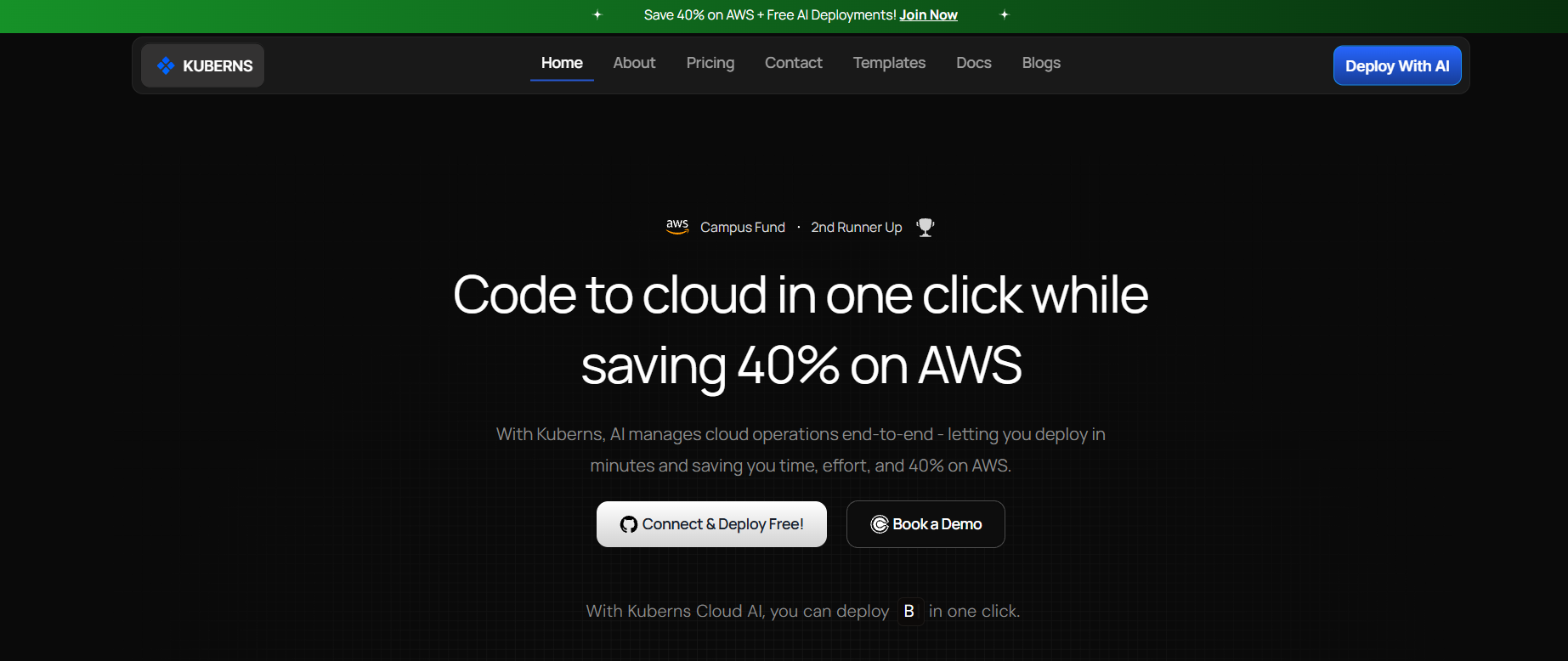
Instead of asking DevOps teams to stitch together pipelines, tools, and scripts, kuberns treat deployment, scaling, and monitoring as a single system. AI is responsible for handling routine operational decisions based on real usage and system behaviour.
For DevOps teams, this shift does not mean losing control. It means spending less time managing infrastructure and more time focusing on reliability, performance, and business outcomes.
Moving from pipeline-centric DevOps to platform-centric DevOps is how teams fully take advantage of artificial intelligence. AI takes responsibility for the operational layer, while DevOps teams focus on guiding and improving the system, rather than maintaining it.
### How Can a DevOps Team Use Kuberns to Unlock AI Benefits Instantly?

Everything we’ve covered so far, smarter monitoring, predictive scaling, and automated deployments, can transform how DevOps teams work. But building and managing all of it on your own takes serious effort. Setting up integrations, maintaining scripts, and fine-tuning infrastructure can easily turn into another full-time job.
That’s why many teams now prefer using [AI-powered platforms](https://kuberns.com) that already have these capabilities built in.
Kuberns brings all the advantages of AI-driven DevOps into one place, without the endless setup. It’s designed for teams that want to spend time shipping code, not managing cloud infrastructure.
Here’s how Kuberns helps DevOps teams take advantage of AI right away:
#### One-click deployment from code to cloud
You don’t have to piece together different tools for building, deploying, and monitoring. With Kuberns, your Git repository connects directly to the platform. AI handles the build, deployment, scaling, and monitoring automatically. That means no manual pipelines, no guesswork, and no delays.
#### Smart scaling that cuts cloud costs
Kuberns runs on [AWS](https://aws.amazon.com/) infrastructure but uses its own AI-driven engine to optimise resource usage. It automatically scales your app up or down based on demand, saving AWS costs while maintaining reliability and performance. Your team doesn’t have to worry about wasted capacity or unexpected billing spikes again.
#### All-in-one observability and automation
Instead of juggling multiple dashboards, Kuberns gives you everything in one interface: logs, metrics, health checks, and alerts, powered by AI. It tells you why something happened, not just that it did. This helps teams respond faster, collaborate better, and learn continuously.
#### Seamless collaboration for modern DevOps teams
Kuberns isn’t just built for automation. It’s built for teams. It gives every team member visibility into deployments, errors, and performance, creating transparency across Dev, Ops, and QA. The result is fewer blockers, fewer silos, and a shared understanding of what’s happening in real time.
#### Built-in intelligence, zero setup
What takes months to build manually, connecting CI/CD tools, setting up scaling rules, and configuring alerts, is already part of Kuberns by default. You just connect your code, and the AI engine handles the rest. It’s DevOps without the overhead, a system that learns, adapts, and keeps improving with every deployment.
> ***It’s the fastest way to see everything we’ve discussed in action, from automated deployments to intelligent scaling, in a single, simple platform. If your team is ready to see what AI can do for DevOps, try deploying your next project on [Kuberns](https://kuberns.com/) and experience how easy intelligent automation can actually be***.
## Why Should DevOps Teams Start Adopting AI Now?

Modern software systems have reached a scale where traditional DevOps practices alone can’t keep up. Applications run across multi-cloud environments, containers spin up and down by the minute, and microservices communicate through hundreds of moving parts.
In this chaos, teams spend more time managing complexity than delivering value.
That’s where artificial intelligence steps in, not as a futuristic add-on, but as a necessary evolution for DevOps.
AI helps DevOps teams handle scale, speed, and uncertainty in ways humans simply can’t. It learns from continuous streams of metrics, logs, and deployment patterns to spot inefficiencies before they hurt performance.
Instead of manually sifting through dashboards, engineers gain instant insights that tell them what to fix and why. Documentation-heavy DevOps workflows can become easier to maintain when teams convert, turning long README files or deployment notes into structured visual overviews that simplify onboarding and cross-team collaboration.
Here’s why adopting AI now makes sense:
* Faster Recovery and Reliability: AI systems detect anomalies in real time and trigger automatic rollbacks or fixes before users are impacted.
* Reduced Cognitive Load: Teams no longer need to track thousands of metrics; AI surfaces what truly matters.
* Better Resource Optimisation: Cloud spending becomes predictable as AI continuously right-sizes resources based on live usage.
* Shorter Release Cycles: Smarter automation reduces wait time between build, test, and deploy.
The result isn’t just efficiency. It’s a more confident DevOps culture that can operate at startup speed even in enterprise-scale environments.
As one of our earlier insights in [AI for DevOps: The Secret to Faster, Smarter Software Delivery](https://kuberns.com/blogs/ai-for-devops-the-secret-to-faster-smarter-software-delivery/) explains, the future of DevOps is about combining human intuition with machine precision.
> Teams that start adopting AI today will set new benchmarks for stability, speed, and cost efficiency tomorrow: [CEO, Kuberns](https://kuberns.com/)
> What DevOps Teams Are Actually Using AI For in 2026
Before getting into the steps, it helps to know what AI is genuinely good at in a DevOps context today. Not what is theoretically possible, but what teams are actually using it for right now.
Catching configuration errors before deployment. AI scans the codebase before a release runs and flags mismatches between environments. Version differences, missing variables, service dependencies that are not defined. Things that would have caused a failure in production get caught before the deployment even starts.
Monitoring without the noise. Traditional monitoring fires an alert every time a metric crosses a threshold. AI learns what normal looks like for your specific system and only flags deviations that actually matter. The result is fewer alerts and more signal.
Managing rollouts automatically. Instead of someone watching a dashboard for 30 minutes after every release, AI monitors the rollout in real time and pauses or rolls back automatically if something looks wrong.
Scaling based on what is actually happening. Instead of static scaling rules that react after performance has already degraded, AI forecasts demand and scales infrastructure before users notice anything.
Keeping cloud costs in check. AI right-sizes infrastructure continuously based on actual usage, scaling down idle resources during off-peak hours without anyone having to manage it manually.
## AI-Managed DevOps: From Manual Pipelines to an AI Dashboard
As DevOps teams adopt artificial intelligence more seriously, the focus is shifting away from optimising individual pipelines and toward simplifying the entire production workflow.
Traditional DevOps pipelines were built to automate steps, not decisions. They still require teams to configure infrastructure, manage scaling rules, connect monitoring tools, and intervene when something goes wrong. AI can assist these steps, but the responsibility stays with the team.
> [Kuberns AI, the AI-Powered platform, takes a different approach.](https://kuberns.com/)

Instead of asking DevOps teams to stitch together pipelines, tools, and scripts, kuberns treat deployment, scaling, and monitoring as a single system. AI is responsible for handling routine operational decisions based on real usage and system behaviour.
For DevOps teams, this shift does not mean losing control. It means spending less time managing infrastructure and more time focusing on reliability, performance, and business outcomes.
Moving from pipeline-centric DevOps to platform-centric DevOps is how teams fully take advantage of artificial intelligence. AI takes responsibility for the operational layer, while DevOps teams focus on guiding and improving the system, rather than maintaining it.
### How Can a DevOps Team Use Kuberns to Unlock AI Benefits Instantly?

Everything we’ve covered so far, smarter monitoring, predictive scaling, and automated deployments, can transform how DevOps teams work. But building and managing all of it on your own takes serious effort. Setting up integrations, maintaining scripts, and fine-tuning infrastructure can easily turn into another full-time job.
That’s why many teams now prefer using [AI-powered platforms](https://kuberns.com) that already have these capabilities built in.
Kuberns brings all the advantages of AI-driven DevOps into one place, without the endless setup. It’s designed for teams that want to spend time shipping code, not managing cloud infrastructure.
Here’s how Kuberns helps DevOps teams take advantage of AI right away:
#### One-click deployment from code to cloud
You don’t have to piece together different tools for building, deploying, and monitoring. With Kuberns, your Git repository connects directly to the platform. AI handles the build, deployment, scaling, and monitoring automatically. That means no manual pipelines, no guesswork, and no delays.
#### Smart scaling that cuts cloud costs
Kuberns runs on [AWS](https://aws.amazon.com/) infrastructure but uses its own AI-driven engine to optimise resource usage. It automatically scales your app up or down based on demand, saving AWS costs while maintaining reliability and performance. Your team doesn’t have to worry about wasted capacity or unexpected billing spikes again.
#### All-in-one observability and automation
Instead of juggling multiple dashboards, Kuberns gives you everything in one interface: logs, metrics, health checks, and alerts, powered by AI. It tells you why something happened, not just that it did. This helps teams respond faster, collaborate better, and learn continuously.
#### Seamless collaboration for modern DevOps teams
Kuberns isn’t just built for automation. It’s built for teams. It gives every team member visibility into deployments, errors, and performance, creating transparency across Dev, Ops, and QA. The result is fewer blockers, fewer silos, and a shared understanding of what’s happening in real time.
#### Built-in intelligence, zero setup
What takes months to build manually, connecting CI/CD tools, setting up scaling rules, and configuring alerts, is already part of Kuberns by default. You just connect your code, and the AI engine handles the rest. It’s DevOps without the overhead, a system that learns, adapts, and keeps improving with every deployment.
> ***It’s the fastest way to see everything we’ve discussed in action, from automated deployments to intelligent scaling, in a single, simple platform. If your team is ready to see what AI can do for DevOps, try deploying your next project on [Kuberns](https://kuberns.com/) and experience how easy intelligent automation can actually be***.
 ## What Are the Key Challenges DevOps Teams Face Without AI?

Even with great tools and talented engineers, DevOps teams often struggle to keep up with the growing scale of modern systems. As applications become more complex and workloads spread across multiple clouds, managing performance, uptime, and costs manually becomes almost impossible.
Without artificial intelligence, DevOps turns into a constant cycle of monitoring, fixing, and optimising, usually after something has already gone wrong. Here are some of the biggest challenges teams face today:
### Manual intervention in pipelines
Every time a deployment fails or a test breaks, someone has to dig through logs, re-run builds, or patch scripts by hand. This slows down delivery and breaks the “continuous” part of continuous delivery. Instead of focusing on improving code or infrastructure, engineers spend hours dealing with repetitive fixes that could easily be automated. Over time, this creates friction between development and operations teams, leading to slower releases and frustrated engineers.
### Slower incident response and longer downtime
Traditional monitoring systems send hundreds of alerts, most of which are noise. When an actual issue appears, it can take hours to trace the root cause. Teams manually compare logs, graphs, and error messages to figure out what went wrong. During that time, performance drops, users face delays, and service reliability takes a hit. AI can help here by identifying real anomalies, linking them to specific services, and even suggesting the most likely fix, but without AI, teams remain stuck in reactive mode.
### Uncontrolled cloud costs and inefficient scaling
Most DevOps teams still rely on manual scaling rules or guesswork when managing cloud resources. Without predictive analysis, it’s easy to over-provision servers “just to be safe,” which drives up monthly bills. On the other hand, under-provisioning leads to slowdowns and downtime during peak usage. This balance is difficult to manage without intelligent automation, especially when workloads change every hour.
### Fragmented visibility across multiple tools
A typical DevOps setup includes separate tools for CI/CD, monitoring, logging, and cloud management. Each has its own dashboard, metrics, and alerts. When something breaks, engineers jump between platforms trying to piece together what happened. This lack of a unified view wastes time and makes collaboration harder. AI systems, by contrast, can pull all this data together, connect the dots, and show what actually matters.
### Human fatigue and burnout
DevOps is a 24/7 operation. Teams deal with overnight alerts, weekend deployments, and endless task switching. Manually tracking systems at scale is mentally draining, and constant firefighting leaves little time for learning or building new features. AI takes over repetitive and high-volume tasks, log analysis, pattern detection, and scaling, freeing humans to focus on meaningful work.
Without AI, DevOps becomes a never-ending loop of firefighting instead of continuous improvement. And as infrastructure scales, these small inefficiencies multiply into lost productivity and mounting costs.
That’s why the next step, understanding how artificial intelligence can help improve DevOps workflows, becomes so critical.
## How Can Artificial Intelligence Help Improve DevOps Workflows?

If you’ve ever worked on a DevOps team, you know how chaotic things can get. One small code change triggers dozens of builds, hundreds of logs start pouring in, and someone is always on call waiting for the next alert. Now imagine if some of those things could just… handle themselves.
That’s exactly where artificial intelligence fits in. AI doesn’t replace the team. It helps the team breathe. It learns from every deployment, every failure, and every success, then uses that data to make better decisions the next time.
Here’s what that looks like in real DevOps workflows:
### Catching problems before they explode
In most setups, you only know something went wrong after it breaks. AI changes that. By analysing thousands of logs and metrics in real time, AI spots subtle signs of trouble, maybe a slow database query or an unusual CPU spike and alerts the team before users even notice. Some systems can even fix the issue automatically or roll back a bad deployment. That means fewer late-night calls and a lot more sleep for your on-call engineers.
### Taking the repetitive work off your plate
DevOps teams spend hours doing the same tasks over and over: checking build results, cleaning up resources, or restarting containers. AI can take over these repetitive jobs. It learns what usually causes failures, handles quick fixes, and keeps pipelines running without waiting for manual approval. This gives engineers more time to focus on code, architecture, and optimisation, the parts that actually matter.
### Making scaling smart and automatic
Scaling infrastructure manually is like guessing the weather. Sometimes you overestimate, sometimes you fall short. AI looks at usage patterns, predicts traffic surges, and automatically scales resources to match demand. When traffic slows down, it scales back to save costs. It’s like having an intelligent autopilot for your cloud environment, performance stays consistent, and budgets stay under control.
### Helping teams work better together
When an incident happens, everyone scrambles to figure out what went wrong. Logs, graphs, and dashboards tell different stories. AI simplifies that chaos. It can summarise incidents in plain language, highlight the root cause, and even suggest next steps. Instead of spending hours interpreting data, teams can act immediately and learn faster from every issue.
### Learning and improving with every release
AI in DevOps isn’t static. It keeps getting better. Every build, deployment, and rollback adds to its understanding of your system. Over time, it learns which changes cause problems, how traffic behaves during peak hours, and what “normal” looks like for your application. The result? A pipeline that doesn’t just run tasks but adapts to your team’s habits and goals.
> If you want to see what this looks like in practice, check out [How to Use AI in DevOps and Developer Workflow to Automate Deployments](https://kuberns.com/blogs/how-to-use-ai-in-devops-and-developer-workflow-to-automate-deployments/). It shows how real teams are already using AI to take the “ops” out of DevOps.
## Conclusion
Most DevOps teams are not short on tools. They are short on time. Time spent on alerts that do not matter, deployments that broke because of a configuration mismatch, and infrastructure that should be managing itself.
AI gives that time back.
The teams using it well did not change everything at once. They started with monitoring, got comfortable, moved to deployments, then let AI handle scaling and cost. Each step builds on the last and the results compound over time.
[Kuberns](https://kuberns.com/) brings all of it into one Agentic AI platform. Connect your repo, click deploy, and manage everything from a single dashboard.
[Get started with Kuberns Agentic AI](https://kuberns.com/)
## What Are the Key Challenges DevOps Teams Face Without AI?

Even with great tools and talented engineers, DevOps teams often struggle to keep up with the growing scale of modern systems. As applications become more complex and workloads spread across multiple clouds, managing performance, uptime, and costs manually becomes almost impossible.
Without artificial intelligence, DevOps turns into a constant cycle of monitoring, fixing, and optimising, usually after something has already gone wrong. Here are some of the biggest challenges teams face today:
### Manual intervention in pipelines
Every time a deployment fails or a test breaks, someone has to dig through logs, re-run builds, or patch scripts by hand. This slows down delivery and breaks the “continuous” part of continuous delivery. Instead of focusing on improving code or infrastructure, engineers spend hours dealing with repetitive fixes that could easily be automated. Over time, this creates friction between development and operations teams, leading to slower releases and frustrated engineers.
### Slower incident response and longer downtime
Traditional monitoring systems send hundreds of alerts, most of which are noise. When an actual issue appears, it can take hours to trace the root cause. Teams manually compare logs, graphs, and error messages to figure out what went wrong. During that time, performance drops, users face delays, and service reliability takes a hit. AI can help here by identifying real anomalies, linking them to specific services, and even suggesting the most likely fix, but without AI, teams remain stuck in reactive mode.
### Uncontrolled cloud costs and inefficient scaling
Most DevOps teams still rely on manual scaling rules or guesswork when managing cloud resources. Without predictive analysis, it’s easy to over-provision servers “just to be safe,” which drives up monthly bills. On the other hand, under-provisioning leads to slowdowns and downtime during peak usage. This balance is difficult to manage without intelligent automation, especially when workloads change every hour.
### Fragmented visibility across multiple tools
A typical DevOps setup includes separate tools for CI/CD, monitoring, logging, and cloud management. Each has its own dashboard, metrics, and alerts. When something breaks, engineers jump between platforms trying to piece together what happened. This lack of a unified view wastes time and makes collaboration harder. AI systems, by contrast, can pull all this data together, connect the dots, and show what actually matters.
### Human fatigue and burnout
DevOps is a 24/7 operation. Teams deal with overnight alerts, weekend deployments, and endless task switching. Manually tracking systems at scale is mentally draining, and constant firefighting leaves little time for learning or building new features. AI takes over repetitive and high-volume tasks, log analysis, pattern detection, and scaling, freeing humans to focus on meaningful work.
Without AI, DevOps becomes a never-ending loop of firefighting instead of continuous improvement. And as infrastructure scales, these small inefficiencies multiply into lost productivity and mounting costs.
That’s why the next step, understanding how artificial intelligence can help improve DevOps workflows, becomes so critical.
## How Can Artificial Intelligence Help Improve DevOps Workflows?

If you’ve ever worked on a DevOps team, you know how chaotic things can get. One small code change triggers dozens of builds, hundreds of logs start pouring in, and someone is always on call waiting for the next alert. Now imagine if some of those things could just… handle themselves.
That’s exactly where artificial intelligence fits in. AI doesn’t replace the team. It helps the team breathe. It learns from every deployment, every failure, and every success, then uses that data to make better decisions the next time.
Here’s what that looks like in real DevOps workflows:
### Catching problems before they explode
In most setups, you only know something went wrong after it breaks. AI changes that. By analysing thousands of logs and metrics in real time, AI spots subtle signs of trouble, maybe a slow database query or an unusual CPU spike and alerts the team before users even notice. Some systems can even fix the issue automatically or roll back a bad deployment. That means fewer late-night calls and a lot more sleep for your on-call engineers.
### Taking the repetitive work off your plate
DevOps teams spend hours doing the same tasks over and over: checking build results, cleaning up resources, or restarting containers. AI can take over these repetitive jobs. It learns what usually causes failures, handles quick fixes, and keeps pipelines running without waiting for manual approval. This gives engineers more time to focus on code, architecture, and optimisation, the parts that actually matter.
### Making scaling smart and automatic
Scaling infrastructure manually is like guessing the weather. Sometimes you overestimate, sometimes you fall short. AI looks at usage patterns, predicts traffic surges, and automatically scales resources to match demand. When traffic slows down, it scales back to save costs. It’s like having an intelligent autopilot for your cloud environment, performance stays consistent, and budgets stay under control.
### Helping teams work better together
When an incident happens, everyone scrambles to figure out what went wrong. Logs, graphs, and dashboards tell different stories. AI simplifies that chaos. It can summarise incidents in plain language, highlight the root cause, and even suggest next steps. Instead of spending hours interpreting data, teams can act immediately and learn faster from every issue.
### Learning and improving with every release
AI in DevOps isn’t static. It keeps getting better. Every build, deployment, and rollback adds to its understanding of your system. Over time, it learns which changes cause problems, how traffic behaves during peak hours, and what “normal” looks like for your application. The result? A pipeline that doesn’t just run tasks but adapts to your team’s habits and goals.
> If you want to see what this looks like in practice, check out [How to Use AI in DevOps and Developer Workflow to Automate Deployments](https://kuberns.com/blogs/how-to-use-ai-in-devops-and-developer-workflow-to-automate-deployments/). It shows how real teams are already using AI to take the “ops” out of DevOps.
## Conclusion
Most DevOps teams are not short on tools. They are short on time. Time spent on alerts that do not matter, deployments that broke because of a configuration mismatch, and infrastructure that should be managing itself.
AI gives that time back.
The teams using it well did not change everything at once. They started with monitoring, got comfortable, moved to deployments, then let AI handle scaling and cost. Each step builds on the last and the results compound over time.
[Kuberns](https://kuberns.com/) brings all of it into one Agentic AI platform. Connect your repo, click deploy, and manage everything from a single dashboard.
[Get started with Kuberns Agentic AI](https://kuberns.com/)
 ## Frequently Asked Questions
### How can artificial intelligence be applied to DevOps?
AI can automate repetitive DevOps tasks like testing, deployment, scaling, and monitoring. It learns from system data, detects issues early, and helps teams make faster, data-driven decisions that improve reliability and performance.
### What are the first steps for a DevOps team to integrate AI?
Start small. Use AI-powered tools for log analysis, alert management, and performance monitoring. Once that’s stable, move into AI-assisted testing, predictive scaling, and resource optimisation to build efficiency over time.
### How does AI improve CI/CD and monitoring?
AI analyses build patterns, prioritise tests, and predict potential failures before deployment. For monitoring, it detects anomalies, summarises incidents in plain language, and can trigger automated rollbacks or fixes to minimise downtime.
### Can AI tools reduce cloud costs for DevOps teams?
Yes. AI continuously tracks infrastructure usage and automatically scales resources based on real-time demand. This eliminates waste and can reduce cloud spending, as seen with AI-powered platforms like Kuberns.
### How does Kuberns use AI to automate deployment and scaling?
Kuberns connects directly to your code repository and uses AI to manage build, deployment, and scaling automatically. It runs on optimised AWS infrastructure, helping teams deploy faster, maintain uptime, and cut costs without managing multiple tools.
---
- [More AI & DevOps articles](https://kuberns.com/blogs/category/ai-devops/1/)
- [All articles](https://kuberns.com/blogs/)
## Frequently Asked Questions
### How can artificial intelligence be applied to DevOps?
AI can automate repetitive DevOps tasks like testing, deployment, scaling, and monitoring. It learns from system data, detects issues early, and helps teams make faster, data-driven decisions that improve reliability and performance.
### What are the first steps for a DevOps team to integrate AI?
Start small. Use AI-powered tools for log analysis, alert management, and performance monitoring. Once that’s stable, move into AI-assisted testing, predictive scaling, and resource optimisation to build efficiency over time.
### How does AI improve CI/CD and monitoring?
AI analyses build patterns, prioritise tests, and predict potential failures before deployment. For monitoring, it detects anomalies, summarises incidents in plain language, and can trigger automated rollbacks or fixes to minimise downtime.
### Can AI tools reduce cloud costs for DevOps teams?
Yes. AI continuously tracks infrastructure usage and automatically scales resources based on real-time demand. This eliminates waste and can reduce cloud spending, as seen with AI-powered platforms like Kuberns.
### How does Kuberns use AI to automate deployment and scaling?
Kuberns connects directly to your code repository and uses AI to manage build, deployment, and scaling automatically. It runs on optimised AWS infrastructure, helping teams deploy faster, maintain uptime, and cut costs without managing multiple tools.
---
- [More AI & DevOps articles](https://kuberns.com/blogs/category/ai-devops/1/)
- [All articles](https://kuberns.com/blogs/)