# How to Deploy a Java App in 2026 (Complete Step-by-Step Guide)
> Deploy a Java app to production in 2026 without SSH, Docker, or server setup. Step-by-step guide using Kuberns with AI automation, env vars, and auto-scaling.
- **Author**: parth-kanpariya
- **Published**: 2026-04-25
- **Modified**: 2026-04-25
- **Category**: Deployment Guides
- **URL**: https://kuberns.com/blogs/how-to-deploy-a-java-app/
---
You have a Java app. It builds cleanly. You want it live in production with HTTPS, auto-scaling, and deployments that trigger on every Git push. And you do not want to spend a day on infrastructure to get there.
That is exactly what [Kuberns](https://kuberns.com/) is built for.
Kuberns is an Agentic AI cloud platform that reads your Maven or Gradle project, builds the JAR, configures the JVM automatically, and deploys your Java app on AWS in under five minutes. No Dockerfile. No server setup. No JVM tuning.
> "Push your code to GitHub, connect the repo on Kuberns, and click Deploy. The AI handles everything else."
## Before You Deploy: Two Things to Confirm
You do not need to change your code or restructure your project. Kuberns works with standard Maven and Gradle projects as they are. There are just two things to confirm before you hit deploy.
**1. Your app reads PORT from the environment.**
Kuberns injects the port your app should listen on via a `PORT` environment variable. Your app must bind to it. If your app hardcodes a port, the platform health check will fail. This is the one thing most apps need to check before deploying to any managed platform.
**2. Your project is on GitHub.**
Kuberns deploys directly from your repository. If it is already on GitHub, you are ready to go. That is it. No Dockerfile, no Procfile, no YAML.
## Deploy Your Java App on Kuberns: Step by Step
### Step 1: Create Your Account
Go to [kuberns.com](https://kuberns.com/) and sign up with Google or GitHub.

New accounts get free credits to deploy and test your first app. After that, $7 gets you $14 in compute credits. [See pricing](https://kuberns.com/pricing).
### Step 2: Connect Your GitHub Repository
On the "Create Service" page, connect your GitHub account and select your Java repository.
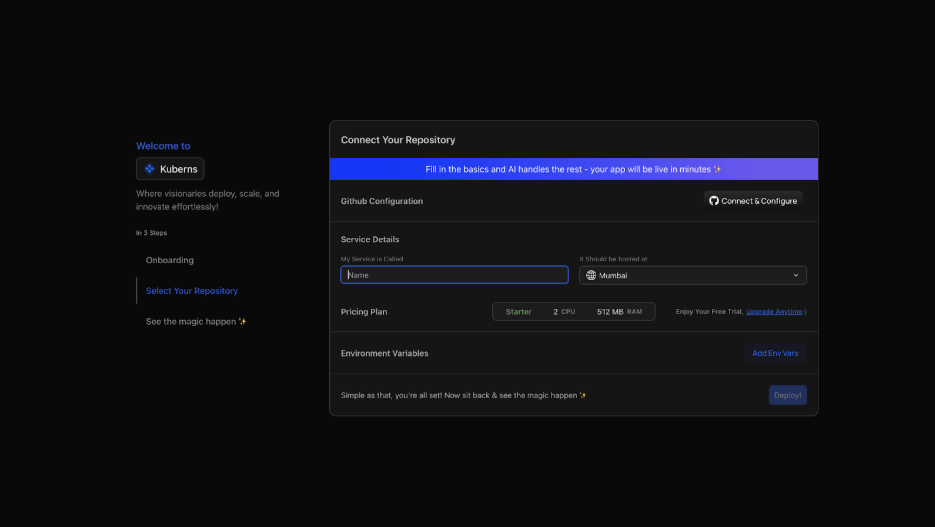
Kuberns AI scans your project automatically and detects:
- Build tool: Maven or Gradle
- Java version from your `pom.xml` or `build.gradle`
- JAR output path in `target/` or `build/libs/`
- Whether it is a Spring Boot app or a plain Java app
You configure nothing. The Agentic AI reads your project and sets the build pipeline up for you.
### Step 3: Add Environment Variables
Navigate to the Environment tab and add your production configuration.

Add anything your app reads via `System.getenv()`: database URLs, API keys, third-party service credentials. You can paste them one by one or upload your `.env` file directly.

Kuberns encrypts all values at rest. They never appear in build logs or output.
### Step 4: Click Deploy
Click the Deploy button and watch the real-time logs.

The Agentic AI takes over completely:
- Runs `mvn clean package -DskipTests` or `./gradlew build` based on your build system
- Locates the output JAR and starts it with production-grade JVM flags configured for your instance size
- Provisions AWS compute in your chosen region
- Issues an SSL certificate so your app is on HTTPS from the very first request
- Enables CI/CD so every future push to your branch triggers an automatic redeploy

Your Java app is live in under five minutes. No SSH. No server terminal. No JVM flags to look up.
 ## What Kuberns Handles That You Would Otherwise Do Yourself
| Java production requirement | Without Kuberns | With Kuberns |
|---|---|---|
| Maven or Gradle build | Run manually on the server | Agentic AI detects and runs automatically |
| JVM heap sizing (-Xms, -Xmx) | Research, configure, retune on every resize | AI sets automatically per instance size |
| GC configuration | Manual flags per deployment | Automated |
| Process management | systemd unit file | Built-in, automatic restart |
| Nginx reverse proxy | Install and configure | Not needed |
| SSL certificate | Certbot setup and renewal | Automatic |
| CI/CD pipeline | GitHub Actions YAML | Built-in on every Git push |
| Crash recovery | systemd restart policy | Automatic |
| Monitoring and logs | Third-party tools | Built into the dashboard |
> "The JVM heap and GC settings are configured automatically based on your chosen instance size. This is the Java-specific detail that every other platform still leaves to you."
## Deploying a Java App with a Database
Most Java apps connect to a database. The setup on Kuberns is straightforward.
Add your database credentials as environment variables in the Kuberns dashboard before you deploy. Your app reads them at runtime via `System.getenv()`. Kuberns injects them securely at runtime. They never touch your codebase.
## Common Deployment Failures and How to Avoid Them
**App marked unhealthy immediately after deploy**
Your app is binding to a hardcoded port instead of reading `PORT` from `System.getenv()`. Fix the port binding and redeploy.
**UnsupportedClassVersionError on startup**
The JAR was compiled with a newer Java version than what is on the server. On Kuberns this never happens because the AI reads your build file and matches the JDK version automatically.
**ClassNotFoundException at runtime**
Your build is producing a thin JAR without bundled dependencies. Switch to a fat JAR using the Maven Shade plugin or Gradle Shadow plugin.
**App works locally but crashes in production**
A required environment variable is missing. Check the Kuberns logs tab, identify which `System.getenv()` call returned null, and add that variable in the Environment tab.
## Java Deployment Platform Comparison (2026)
| Platform | Auto-detects Java build | JVM auto-config | Setup required | Free tier | Auto-scaling |
|---|---|---|---|---|---|
| **Kuberns** | Yes | Yes, automatic | None | Yes, free credits | AI-driven |
| Heroku | Partial, needs Procfile | No | Procfile required | No | Manual dynos |
| Render | Yes | No | Build and start commands | Yes, sleeps on idle | Rules-based |
| Railway | Yes | No | Start command | Trial credits only | Limited |
| AWS Elastic Beanstalk | Yes | Partial | ebextensions config files | No | Rules-based |
| VPS with systemd | Manual | Manual JVM flags | Full server setup | No | Manual |
Kuberns is the only platform in this table where JVM heap sizing and GC configuration are handled automatically. On every other option, you are setting `-Xmx` manually and retuning it every time you change instance size.
## Deploy Your Java App Now
Your Java app is already production-ready. The JAR is built. The code works. The only thing between you and a live URL is the infrastructure layer, and Kuberns removes it entirely.
Connect your GitHub repo. Add your environment variables. Click Deploy.
If you are also using Spring Boot, the [Spring Boot deployment guide](https://kuberns.com/blogs/deploy-springboot-application/) covers the framework-specific setup including Actuator health checks. For teams running multiple services, the [Node.js deployment guide](https://kuberns.com/blogs/how-to-deploy-nodejs-app/) and [Python deployment guide](https://kuberns.com/blogs/how-to-deploy-python-app-with-ai/) cover how to run other services alongside your Java backend on Kuberns.
[Deploy your Java app on Kuberns. Your first deployment is free.](https://dashboard.kuberns.com/)
## What Kuberns Handles That You Would Otherwise Do Yourself
| Java production requirement | Without Kuberns | With Kuberns |
|---|---|---|
| Maven or Gradle build | Run manually on the server | Agentic AI detects and runs automatically |
| JVM heap sizing (-Xms, -Xmx) | Research, configure, retune on every resize | AI sets automatically per instance size |
| GC configuration | Manual flags per deployment | Automated |
| Process management | systemd unit file | Built-in, automatic restart |
| Nginx reverse proxy | Install and configure | Not needed |
| SSL certificate | Certbot setup and renewal | Automatic |
| CI/CD pipeline | GitHub Actions YAML | Built-in on every Git push |
| Crash recovery | systemd restart policy | Automatic |
| Monitoring and logs | Third-party tools | Built into the dashboard |
> "The JVM heap and GC settings are configured automatically based on your chosen instance size. This is the Java-specific detail that every other platform still leaves to you."
## Deploying a Java App with a Database
Most Java apps connect to a database. The setup on Kuberns is straightforward.
Add your database credentials as environment variables in the Kuberns dashboard before you deploy. Your app reads them at runtime via `System.getenv()`. Kuberns injects them securely at runtime. They never touch your codebase.
## Common Deployment Failures and How to Avoid Them
**App marked unhealthy immediately after deploy**
Your app is binding to a hardcoded port instead of reading `PORT` from `System.getenv()`. Fix the port binding and redeploy.
**UnsupportedClassVersionError on startup**
The JAR was compiled with a newer Java version than what is on the server. On Kuberns this never happens because the AI reads your build file and matches the JDK version automatically.
**ClassNotFoundException at runtime**
Your build is producing a thin JAR without bundled dependencies. Switch to a fat JAR using the Maven Shade plugin or Gradle Shadow plugin.
**App works locally but crashes in production**
A required environment variable is missing. Check the Kuberns logs tab, identify which `System.getenv()` call returned null, and add that variable in the Environment tab.
## Java Deployment Platform Comparison (2026)
| Platform | Auto-detects Java build | JVM auto-config | Setup required | Free tier | Auto-scaling |
|---|---|---|---|---|---|
| **Kuberns** | Yes | Yes, automatic | None | Yes, free credits | AI-driven |
| Heroku | Partial, needs Procfile | No | Procfile required | No | Manual dynos |
| Render | Yes | No | Build and start commands | Yes, sleeps on idle | Rules-based |
| Railway | Yes | No | Start command | Trial credits only | Limited |
| AWS Elastic Beanstalk | Yes | Partial | ebextensions config files | No | Rules-based |
| VPS with systemd | Manual | Manual JVM flags | Full server setup | No | Manual |
Kuberns is the only platform in this table where JVM heap sizing and GC configuration are handled automatically. On every other option, you are setting `-Xmx` manually and retuning it every time you change instance size.
## Deploy Your Java App Now
Your Java app is already production-ready. The JAR is built. The code works. The only thing between you and a live URL is the infrastructure layer, and Kuberns removes it entirely.
Connect your GitHub repo. Add your environment variables. Click Deploy.
If you are also using Spring Boot, the [Spring Boot deployment guide](https://kuberns.com/blogs/deploy-springboot-application/) covers the framework-specific setup including Actuator health checks. For teams running multiple services, the [Node.js deployment guide](https://kuberns.com/blogs/how-to-deploy-nodejs-app/) and [Python deployment guide](https://kuberns.com/blogs/how-to-deploy-python-app-with-ai/) cover how to run other services alongside your Java backend on Kuberns.
[Deploy your Java app on Kuberns. Your first deployment is free.](https://dashboard.kuberns.com/)
 ## Frequently Asked Questions
### What is the easiest way to deploy a Java app in 2026?
The easiest way is using Kuberns. Connect your GitHub repo, add environment variables, and click deploy. The Agentic AI builds your JAR, configures the JVM, handles SSL, and sets up auto-scaling without any server configuration needed from you.
### Do I need Docker to deploy a Java application?
No. Kuberns detects your Java project from `pom.xml` or `build.gradle`, runs the build, and deploys the JAR directly. No Dockerfile required.
### How do I deploy a Java app to AWS without managing servers?
Kuberns runs on AWS infrastructure and handles everything automatically. Push your project to GitHub, connect it on Kuberns, add environment variables, and click Deploy. No AWS console, no EC2 setup, no VPC configuration needed.
### What Java version does Kuberns support?
Kuberns supports Java 11, 17, 21, and later LTS versions. The Agentic AI reads your `pom.xml` or `build.gradle` to detect the correct version and configures the runtime automatically.
### How long does it take to deploy a Java app on Kuberns?
Under 5 minutes for the first deployment. Subsequent auto-deployments on Git push take around 60 to 90 seconds depending on your build size.
### Can I deploy a Java app with a database on Kuberns?
Yes. Add your `DATABASE_URL` and any other credentials as environment variables in the Kuberns dashboard. Your app reads them at runtime via `System.getenv()` and connects to PostgreSQL, MySQL, or any JDBC-compatible database.
### Does Kuberns handle JVM configuration automatically?
Yes. Kuberns sets JVM heap size, GC flags, and runtime options automatically based on your instance size. You do not need to pass `-Xms` or `-Xmx` flags manually.
### Can I migrate my existing Java app from Heroku or Render to Kuberns?
Yes. Connect your existing GitHub repo to Kuberns, copy your environment variables into the dashboard, and click Deploy. No changes to your code or build files needed.
---
- [More Deployment Guides articles](https://kuberns.com/blogs/category/deployment-guides/1/)
- [All articles](https://kuberns.com/blogs/)
## Frequently Asked Questions
### What is the easiest way to deploy a Java app in 2026?
The easiest way is using Kuberns. Connect your GitHub repo, add environment variables, and click deploy. The Agentic AI builds your JAR, configures the JVM, handles SSL, and sets up auto-scaling without any server configuration needed from you.
### Do I need Docker to deploy a Java application?
No. Kuberns detects your Java project from `pom.xml` or `build.gradle`, runs the build, and deploys the JAR directly. No Dockerfile required.
### How do I deploy a Java app to AWS without managing servers?
Kuberns runs on AWS infrastructure and handles everything automatically. Push your project to GitHub, connect it on Kuberns, add environment variables, and click Deploy. No AWS console, no EC2 setup, no VPC configuration needed.
### What Java version does Kuberns support?
Kuberns supports Java 11, 17, 21, and later LTS versions. The Agentic AI reads your `pom.xml` or `build.gradle` to detect the correct version and configures the runtime automatically.
### How long does it take to deploy a Java app on Kuberns?
Under 5 minutes for the first deployment. Subsequent auto-deployments on Git push take around 60 to 90 seconds depending on your build size.
### Can I deploy a Java app with a database on Kuberns?
Yes. Add your `DATABASE_URL` and any other credentials as environment variables in the Kuberns dashboard. Your app reads them at runtime via `System.getenv()` and connects to PostgreSQL, MySQL, or any JDBC-compatible database.
### Does Kuberns handle JVM configuration automatically?
Yes. Kuberns sets JVM heap size, GC flags, and runtime options automatically based on your instance size. You do not need to pass `-Xms` or `-Xmx` flags manually.
### Can I migrate my existing Java app from Heroku or Render to Kuberns?
Yes. Connect your existing GitHub repo to Kuberns, copy your environment variables into the dashboard, and click Deploy. No changes to your code or build files needed.
---
- [More Deployment Guides articles](https://kuberns.com/blogs/category/deployment-guides/1/)
- [All articles](https://kuberns.com/blogs/)