# How to Use AI in DevOps: 6 Step-by-Step Guide for 2026
> See how developers can add AI to DevOps for reviewed configuration, testing, deployment, monitoring, and incident analysis without losing production control.
- **Author**: manav-dobariya
- **Published**: 2025-08-08
- **Modified**: 2026-10-09
- **Category**: AI & DevOps
- **URL**: https://kuberns.com/blogs/how-to-use-ai-in-devops-and-developer-workflow-to-automate-deployments/
---
To use AI in DevOps, start with one measurable bottleneck, give the AI limited context and permissions, review its output, and expand automation only after the result is reliable. Teams commonly begin with deployment configuration, CI failure analysis, test prioritization, release verification, or incident triage.
If slow and error-prone deployments are the main bottleneck, the deployment and release phase is the most direct place to apply AI. An Agentic AI platform for deployment such as Kuberns can analyze a repository and prepare the deployment workflow, while developers retain responsibility for secrets, migrations, application behavior, and production verification.
This guide shows where AI fits in a DevOps workflow, how to introduce it in six controlled steps, which tool categories support each stage, and how Kuberns applies agentic AI to application deployment.
### TL;DR
- Start with one frequent, measurable DevOps problem instead of automating the entire lifecycle at once.
- Keep generated configuration and infrastructure changes in version control and require review.
- Use existing tests, security checks, health checks, and deployment policies as authoritative controls.
- Give AI read-only access first, then approve narrowly scoped actions only after measuring results.
- For deployment, Kuberns analyzes a GitHub repository, proposes configuration, and runs the managed build and deployment workflow.
## What Can AI Automate in a DevOps Workflow?
AI can assist with repetitive analysis and configuration across the software delivery lifecycle. It is most useful when it has reliable context from the repository, pipeline history, deployment state, logs, metrics, and documented runbooks. It should not be treated as a replacement for tests, access controls, change review, or operational ownership.
| DevOps stage | Appropriate AI use | Control that should remain |
| --- | --- | --- |
| Planning and design | Summarize requirements, identify dependencies, draft implementation tasks | Architecture review and acceptance criteria |
| Build and configuration | Draft Dockerfiles, pipeline files, infrastructure code, and runbooks | Version control, pull-request review, and validation tools |
| Testing and security | Suggest relevant tests, explain failures, prioritize findings, and review configuration changes | Deterministic CI checks and security policies |
| Deployment and release | Analyze application requirements, prepare deployment settings, explain build failures, and review health signals | Approval rules, migration ownership, release policy, and rollback plan |
| Observability and incidents | Correlate logs, metrics, traces, changes, and runbooks to propose likely causes | Access restrictions and human approval for production actions |
When a team's primary bottleneck is slow and error-prone deployment, AI offers the most direct solution in the **deployment and release phase**. This is where build configuration, environment differences, process commands, health checks, migrations, and release decisions meet.
Teams that need a broader explanation of the technology at every lifecycle stage can first read how [AI fits into DevOps and the developer workflow](https://kuberns.com/blogs/ai-in-devops-and-developer-workflow/). The rest of this guide focuses on implementation.

## How to Use AI in DevOps: A Six-Step Workflow
The safest adoption path moves from reviewable assistance to narrowly approved actions. Each step should have an owner, a measurable outcome, and a way to return to the previous workflow if the result is unreliable.
### Step 1: Identify One Bottleneck and Record a Baseline
Choose one recurring DevOps bottleneck and record its current deployment time, failure rate, recovery time, or manual effort before introducing an AI tool.
Map the work from commit to production and identify where engineers wait, repeat the same diagnosis, copy configuration, or manually collect context. Useful baseline measures include deployment duration, change failure rate, mean time to recovery, repeated pipeline failures, and engineering time spent on release work.
Avoid arbitrary thresholds. A 20-minute deployment may be acceptable for one system and unacceptable for another. The right target is the recurring problem that materially slows your own team.
### Step 2: Use AI for Reviewed Configuration Changes
Let AI draft deployment configuration, infrastructure code, pipeline files, and runbooks, but keep the generated changes in version control and require review before merging them.
Coding assistants can help create a starting Dockerfile, GitHub Actions workflow, Terraform module, Kubernetes manifest, or deployment runbook. The output should enter the same pull-request process as human-written configuration. Review image versions, permissions, network exposure, secret handling, health checks, resource limits, and rollback behavior.
This stage improves consistency only when design requirements, generated configuration, and validation remain connected. Describe the desired behavior in the pull request, store the generated change in Git, and let CI test the result against the same acceptance criteria.
The guide to [automated software deployment](https://kuberns.com/blogs/how-to-implement-one-click-automated-software-deployment/) explains the underlying Git and deployment workflow that AI-assisted configuration should support.
### Step 3: Add AI-Assisted Testing and Security Checks
Use repository and change context to suggest relevant tests, explain failures, identify suspicious configuration changes, and prioritize findings while existing CI checks remain authoritative.
AI is useful for explaining a failing test, identifying which services a change may affect, drafting missing test cases, and summarizing security findings. It should not silently remove failing tests, dismiss security controls, or decide that an unverified change is safe.
Keep deterministic tools responsible for pass or fail decisions. Unit tests, integration tests, policy checks, dependency scans, static analysis, and infrastructure validation should continue running even when an AI assistant predicts that a change is low risk.
### Step 4: Apply AI at the Deployment and Release Stage
Use AI to analyze application requirements, prepare deployment configuration, summarize build failures, and review health checks and logs during a controlled release.
This is the highest-value stage when the team struggles with inconsistent environments or manual deployment setup. A repository-aware system can identify the framework, dependency files, likely build command, start command, port, environment-variable names, and supporting services. The team must still confirm production secrets, database migrations, stateful storage, background workers, domains, and application-specific health behavior.
After deployment begins, AI can help summarize build logs and organize diagnostic evidence. Release policy should still define what constitutes success, when traffic can move, who approves a rollback, and how data changes are handled.
For a focused comparison of tools at this stage, see the guide to [AI tools for application deployment](https://kuberns.com/blogs/best-ai-tools-for-deployment/).
### Step 5: Use AI for Observability and Incident Triage
Give the AI read-only access to approved logs, metrics, traces, deployment history, and runbooks so it can correlate evidence and propose the next diagnostic step.
Read-only access is the safest starting point because the system can reduce investigation time without changing production. Ask it to summarize what changed before an incident, identify correlated errors, compare healthy and unhealthy periods, or assemble a timeline for the responder.
Do not send unrestricted secrets or customer data to a model. Define which telemetry sources are available, how long context is retained, and which users may request it. A proposed remediation should cite the supporting logs, metrics, or change history so an engineer can verify the reasoning.
### Step 6: Expand Only After Measuring Results and Setting Controls
Compare results with the baseline, define permissions and approval boundaries, preserve audit logs and rollback procedures, and automate additional actions only after the earlier stage is reliable.
Document which actions the AI may take, which actions require approval, and which actions are prohibited. Production infrastructure changes, secret access, destructive commands, database migrations, permission changes, traffic shifts, and data-sensitive rollbacks should remain explicitly controlled.
Measure the same values captured in Step 1. If deployment duration improves but failure rate rises, the workflow is not successful. If incident summaries are faster but frequently omit important evidence, keep the tool in an assistive role until the gaps are resolved.

## Which AI Tools Fit Each DevOps Stage?
No single tool needs to control the entire lifecycle. Select tools according to the stage, the context they can access, and the actions they are allowed to perform.
| Need | Tool category | Examples | Evaluation question |
| --- | --- | --- | --- |
| Draft configuration and infrastructure code | Coding assistant | GitHub Copilot, Cursor, Amazon Q Developer | Does every generated change remain reviewable in Git? |
| Explain pipelines and test failures | CI/CD assistant | GitHub Actions with Copilot, CircleCI, Harness | Does the tool show the evidence behind its recommendation? |
| Review code and configuration risks | Code and security review | CodeRabbit, Qodo, Snyk | Does it complement rather than bypass required checks? |
| Correlate operational telemetry | Observability assistant | Datadog Watchdog, Dynatrace Davis AI, New Relic AI | Can it begin with narrowly scoped, read-only access? |
| Analyze and deploy an application repository | Agentic deployment platform | Kuberns | Can the team review configuration, logs, resources, and deployment state? |
Tool selection should follow the bottleneck identified in Step 1. A team with slow incident diagnosis does not need to begin by replacing its deployment platform. A team losing days to application deployment configuration may get more value from repository-aware deployment automation than from another observability product.
For a broader product comparison, use the dedicated guide to the [best AI tools for DevOps](https://kuberns.com/blogs/best-ai-tools-for-devops/) rather than expanding this implementation guide into a long tools list.
## How Does Kuberns Use Agentic AI for Deployment?
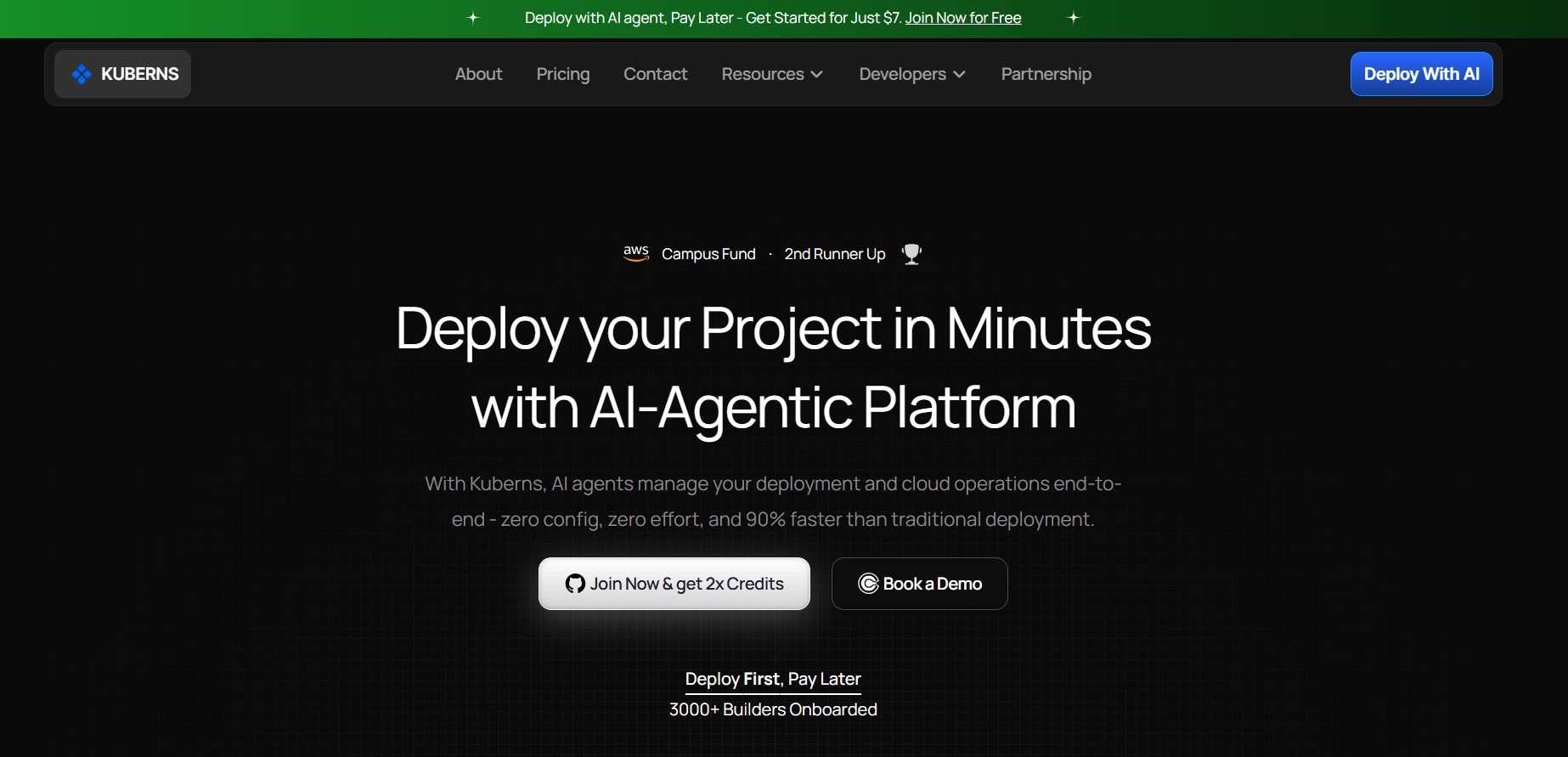
Kuberns is an **Agentic AI platform for deployment** that moves a GitHub repository into a managed build and deployment workflow. It is relevant at Step 4 when application teams want to reduce deployment configuration work without giving a general-purpose agent unrestricted access to production infrastructure.
The documented workflow is:
1. **Connect a GitHub repository.** Select the repository, branch, region, and available project options.
2. **Let the temporary agent analyze the source.** The agent can identify the framework, root directory, dependency files, ports, build commands, process commands, Dockerfiles, environment-variable names, and supporting resources.
3. **Review the application requirements.** Confirm the detected configuration and provide required secrets or external-service credentials. The agent does not remove the need to understand application-specific migrations, storage, workers, and production behavior.
4. **Run the managed build and deployment.** Kuberns creates the project, service, environment, resources, build, and deployment using the proposed configuration.
5. **Verify the running application.** Review build and runtime logs, deployment activity, resources, metrics, environment variables, HTTPS, and domain status from the dashboard.
6. **Deploy later repository changes.** Pushes to the connected branch can trigger another deployment through the GitHub integration.
These capabilities align with the [Kuberns platform overview](https://docs.kuberns.com/docs/overview) and [getting-started workflow](https://docs.kuberns.com/docs/getting-started). Scaling, lifecycle operations, migrations, secrets, backups, and application correctness still require deliberate configuration and ownership.
The [DevOps AI agent guide](https://kuberns.com/blogs/understanding-devops-ai-agent-the-future-of-ai-in-devops/) explains how observation, reasoning, permissions, approval, and action fit together when teams want to understand the agent model in more detail.
## Conclusion
The safest way to use AI in DevOps is to begin with one measurable problem, keep early usage assistive and reviewable, and expand permissions only after the workflow proves reliable. AI can draft configuration, explain pipeline failures, prioritize tests, organize deployment evidence, and accelerate incident triage, but established engineering controls remain necessary.
When slow and error-prone application deployment is the main bottleneck, Kuberns provides a direct implementation path. Connect a GitHub repository, review the deployment requirements identified by the temporary agent, follow the managed build, and verify the application through logs, resources, metrics, HTTPS, and domains.
[Start an agentic deployment with Kuberns](https://dashboard.kuberns.com)
## Frequently Asked Questions
### How do you use AI in DevOps?
Use AI in DevOps by choosing one measurable bottleneck, giving the tool only the context and permissions it needs, reviewing its output, and comparing the result with a baseline. Common starting points include configuration drafting, test selection, deployment diagnostics, and incident triage.
### Where should a team start if deployments are slow and error-prone?
Start at the deployment and release stage. Use AI to analyze application requirements, review configuration, explain build failures, and assess health checks and logs. Keep production changes behind CI checks and human approval until the workflow is proven.
### Can AI automate software deployment?
AI can help analyze a repository, propose build and runtime configuration, start a managed deployment, and explain failures. Production secrets, migrations, permissions, rollout policy, application behavior, and final verification still require explicit ownership and controls.
### Which DevOps actions should require human approval?
Require approval for production infrastructure changes, secret access, database migrations, destructive commands, permission changes, traffic shifts, rollbacks that can affect data, and any action whose impact the system cannot safely reverse.
### How does Kuberns use agentic AI for deployment?
Kuberns uses a temporary AI agent to analyze a connected GitHub repository and propose settings such as the framework, root directory, ports, commands, environment-variable names, Dockerfiles, and supporting resources. Kuberns then runs the managed build and deployment workflow, while the developer reviews the application through configuration, logs, metrics, resources, and domains.
---
- [More AI & DevOps articles](https://kuberns.com/blogs/category/ai-devops/1/)
- [All articles](https://kuberns.com/blogs/)