Published
- 17 min read
UpCloud Alternatives That Save You Time and Scale Better

Why Developers Are Searching for UpCloud Alternatives?
UpCloud alternatives are becoming a popular search among developers and teams who want more automation, global scalability, and predictable pricing in their cloud infrastructure.
UpCloud has built a strong reputation for speed and reliability, especially with its MaxIOPS storage and European data centres.
For many developers, it’s a dependable choice, straightforward to use, fast to provision, and backed by solid uptime.
But as applications grow, teams begin to need more than just raw performance. They need automation, monitoring, and scalability without having to handle everything manually.
While UpCloud performs well as an infrastructure provider, it doesn’t offer the same managed experience that modern developers expect today.
That’s where the shift is happening.
More startups, agencies, and SaaS teams are looking for UpCloud alternatives that combine performance with automation, platforms that handle deployment, scaling, and monitoring automatically, freeing teams from repetitive operational work.
In this guide, we’ll explore the top 10 UpCloud alternatives to consider, comparing performance, cost, and usability.
You’ll see how platforms like DigitalOcean, Vultr, Linode, and Kuberns differ and which one might be the best fit depending on your stage, team size, and infrastructure needs.
Understanding UpCloud: What It Does Well and Where It Falls Short
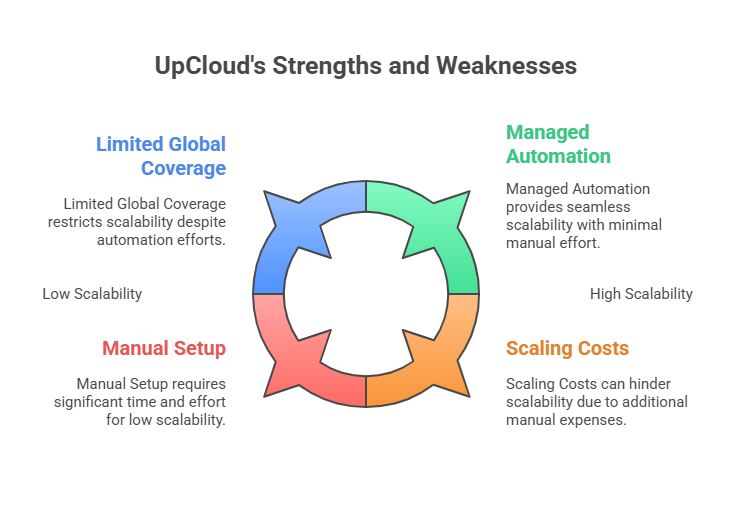 Before exploring the best UpCloud alternatives, it’s worth understanding what makes UpCloud stand out and where it tends to fall behind for modern teams.
UpCloud has positioned itself as a developer-friendly cloud hosting provider known for its performance, reliability, and data security.
Its biggest advantage is speed, powered by MaxIOPS block storage technology that delivers faster disk performance compared to traditional SSDs.
Developers also appreciate its clean dashboard, strong uptime, and focus on privacy through European data centres.
For startups or individuals running smaller workloads, these advantages make UpCloud an appealing choice. It offers a balance between control and simplicity, especially for those who prefer managing infrastructure directly.
However, as development teams grow and projects scale, UpCloud’s limitations become clearer:
- Limited global coverage: UpCloud’s data centres are concentrated in Europe and select regions, which can affect performance for globally distributed users.
- Lack of managed automation: Unlike newer managed platforms, UpCloud still requires manual setup for scaling, monitoring, and CI/CD pipelines.
- No built-in application management: You get servers, not a full platform. Everything beyond provisioning, like deployment, observability, and autoscaling, needs to be configured separately.
- Scaling costs and resource management: While base pricing is transparent, scaling larger workloads or managing multiple servers often requires additional manual effort and spending.
- Learning curve for teams: For developers without infrastructure experience, setting up and maintaining servers on UpCloud can be time-consuming.
In short, UpCloud is an excellent infrastructure provider but not a complete deployment platform.
As more companies shift toward automation and developer productivity, the demand for managed alternatives to UpCloud has grown rapidly.
Top 10 UpCloud Alternatives to Consider in 2025
Cloud infrastructure has evolved rapidly in the past few years.
Developers no longer want to spend time configuring servers or patching environments. They want platforms that deploy, monitor, and scale applications automatically.
Here are the top 10 UpCloud alternatives that stand out in 2025, covering everything from developer-friendly clouds to fully managed AI-powered platforms.
Kuberns: AI-Powered Cloud Hosting with Built-in Automation
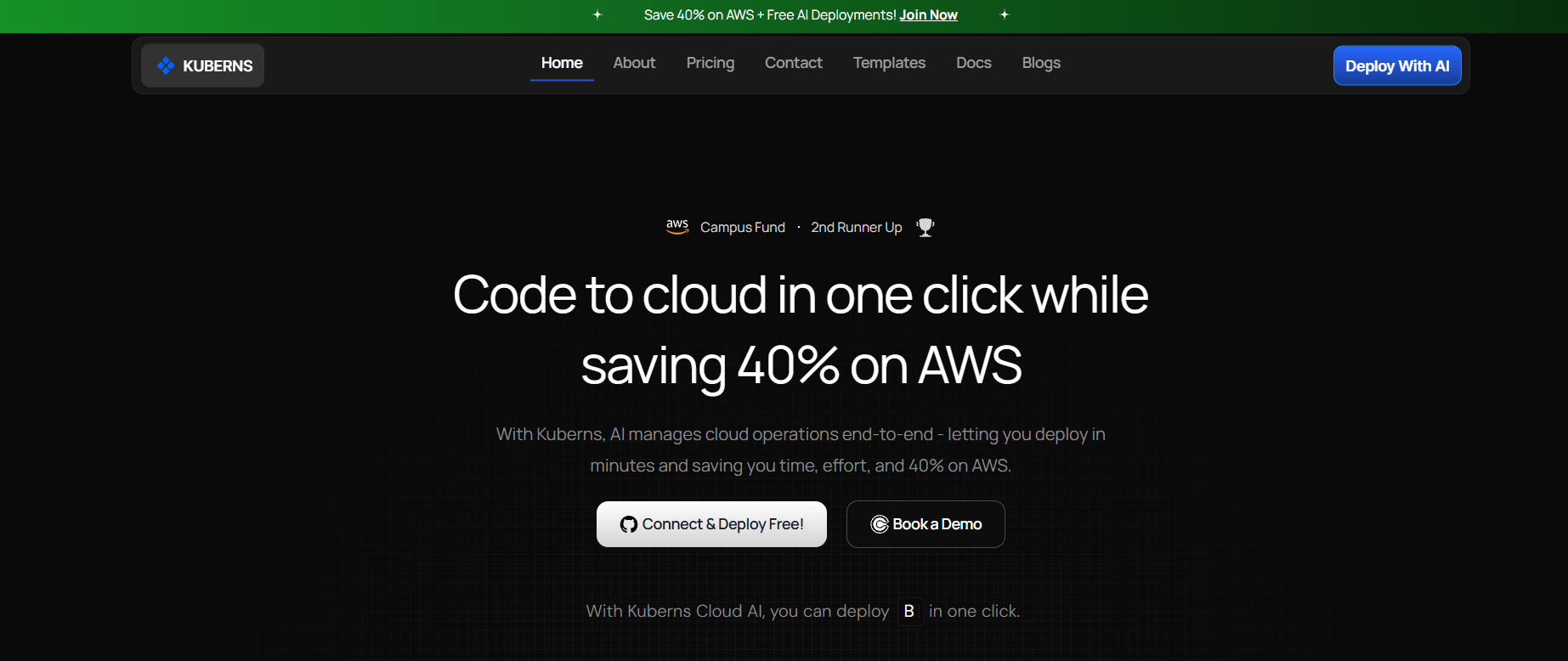 Kuberns simplifies everything that makes traditional infrastructure time-consuming. Built on top of AWS, it automates the entire deployment process, from code to container to live environment, without requiring any DevOps setup.
Key Highlights:
- One-click GitHub deployment with automatic build and scaling
- Built-in CI/CD, SSL, monitoring, and logs
- Intelligent resource optimisation that cuts AWS costs by up to 40%
- Secure, AWS-backed hosting with transparent pricing
Ideal For:
Startups, development teams, and agencies that want a fully managed experience without managing servers.
DigitalOcean: Simple Cloud Hosting for Developers
 DigitalOcean remains one of the strongest alternatives to UpCloud because of its simplicity, clean UI, and active developer community.
It offers Droplets for compute, Spaces for storage, and App Platform for managed deployments.
Key Highlights:
- Predictable pricing and clear documentation
- Quick instance provisioning and managed databases
- Growing set of developer tools and APIs
Limitations:
Manual scaling and a lack of integrated automation for larger workloads.
Ideal For:
Developers and small businesses who want a reliable and cost-friendly alternative to UpCloud.
Check our detailed guide on DigitalOcean Alternatives in 2025
Vultr: Affordable and Global Cloud Infrastructure
 Vultr offers competitive pricing and one of the broadest global region coverages among independent cloud providers.
Its infrastructure performance is strong, and the setup is straightforward for experienced developers.
Key Highlights:
- 30+ global data centre locations
- Straightforward API and automated provisioning
- Affordable hourly or monthly plans
Limitations:
Lacks advanced monitoring, cost optimisation, and team collaboration features.
Ideal For:
Developers who prioritise price and global availability over managed automation.
Explore our comparison of the Best Vultr Alternatives
Linode (Akamai Cloud): Reliable and Developer-Centric
 Now part of Akamai, Linode has earned developer trust for its reliability and customer support. It’s a straightforward alternative to UpCloud with transparent pricing and predictable performance.
Key Highlights:
- Simple pricing with no hidden costs
- Solid performance and global reach through Akamai’s network
- Rich documentation and community tutorials
Limitations:
Still largely infrastructure-focused; lacks managed automation layers found in newer platforms.
Ideal For:
Small to mid-sized teams looking for a reliable VPS alternative with long-term stability.
Scaleway: European Cloud with a Local Focus
 Scaleway is a strong choice for teams that prefer to stay within the EU region. It offers a variety of compute and storage options with a modern interface and GDPR-compliant infrastructure.
Key Highlights:
- EU-based data centres for privacy-focused organisations
- User-friendly dashboard and developer APIs
- Competitive pricing within Europe
Limitations:
Limited global presence and smaller ecosystem compared to larger providers.
Ideal For:
European startups or SaaS companies prioritising compliance and data sovereignty.
OVHcloud: Enterprise-Level Performance, Complex Setup
 OVHcloud is one of Europe’s largest infrastructure providers, offering both dedicated servers and public cloud services.
It’s well known for its affordability and robust hardware configurations, making it a good step up for those who’ve outgrown UpCloud.
Key Highlights:
- Wide range of compute and storage options
- Strong presence in Europe with enterprise-grade data centres
- Competitive pricing compared to hyperscalers
Limitations:
Setup and management can be complex. Developers often report slower support response times and limited developer integrations.
Ideal For:
Enterprises and advanced users who want cost-effective control within Europe.
AWS: Complete Power with Complexity
 Amazon Web Services (AWS) remains the largest and most comprehensive cloud platform globally. It offers every possible service, from compute and storage to analytics, AI, and DevOps tools.
Key Highlights:
- Global infrastructure across 30+ regions
- Full suite of cloud services for any scale
- Proven reliability and performance
Limitations:
Steep learning curve and complex pricing structure. Teams often require dedicated DevOps or cloud architects to manage AWS efficiently.
Ideal For:
Enterprises and SaaS companies need full control and scalability.
Learn how to simplify AWS management to reduce AWS Costs with AI-powered Automation.
Azure: Enterprise Ecosystem Integration
 Microsoft Azure is the preferred choice for organisations that already rely on Microsoft’s ecosystem.
It integrates seamlessly with Office 365, Active Directory, and .NET-based applications.
Key Highlights:
- Deep integration with enterprise tools
- Global data centre network
- Advanced security and compliance support
Limitations:
Complex setup and steep pricing for smaller workloads. Requires technical expertise for efficient resource management.
Ideal For:
Enterprises and large organisations with Microsoft-based infrastructures.
Explore how managed platforms compare in Best Azure Alternatives
Google Cloud Platform: Developer Power, High Learning Curve
 Google Cloud Platform (GCP) has become a leading choice for data-intensive and AI-driven applications. It provides powerful networking, analytics, and Kubernetes integration.
Key Highlights:
- Superior data and AI tools
- Serverless and container-first architecture
- Strong global availability and uptime
Limitations:
Complex IAM and billing systems. Pricing can be unpredictable without active monitoring.
Ideal For:
AI-driven startups and engineering teams are building data-heavy workloads.
Heroku: Simple, but Expensive at Scale
 Heroku remains a favourite among developers for its simplicity. It allows quick deployments without managing servers and is ideal for early-stage startups. However, its ease comes at a cost.
Key Highlights:
- Intuitive “git push to deploy” workflow
- Large add-on ecosystem
- Great for prototypes and small applications
Limitations:
Pricing increases rapidly with scaling. Limited visibility into underlying infrastructure.
Ideal For:
Developers and startups that prioritise simplicity over cost optimisation.
UpCloud vs Other Alternatives: Feature Comparison Overview
When comparing UpCloud alternatives, it helps to see how each platform performs across critical areas such as automation, pricing, global reach, and ease of use.
UpCloud remains a reliable VPS provider, but modern managed platforms have evolved to automate much of the manual infrastructure work that UpCloud still requires.
Here’s a direct comparison that highlights the differences between UpCloud and other leading alternatives:
| Platform | Hosting Type | Global Coverage | Automation | Ease of Use | Cost Transparency | Ideal For |
|---|---|---|---|---|---|---|
| UpCloud | Managed VPS | Limited (Mostly EU) | Partial | Moderate | High | Developers seeking control |
| Kuberns | Managed AI Cloud | Global (AWS-backed) | Full | Very Easy | High | Startups and teams |
| DigitalOcean | Managed Cloud | Global | Partial | Easy | High | Developers and SMBs |
| Vultr | Cloud VPS | Global | Partial | Moderate | High | Cost-conscious users |
| Linode | Managed Cloud (Akamai) | Global | Partial | Easy | High | Growing development teams |
| Scaleway | EU Cloud | Regional (EU) | Partial | Easy | High | EU-based startups |
| OVHcloud | Public/Private Cloud | Europe, NA, APAC | Partial | Moderate | High | Enterprises needing control |
| AWS | Public Cloud | Global | Full | Complex | Medium | Large-scale enterprises |
| GCP | Public Cloud | Global | Full | Moderate | Medium | Data-driven and AI workloads |
| Heroku | Managed PaaS | Global | Full | Very Easy | Low | Startups and small teams |
What This Comparison Shows?
UpCloud offers a great balance of control and speed but remains infrastructure-focused. If you want managed simplicity, automation, and better scalability, platforms like Kuberns, DigitalOcean, and Heroku provide smoother workflows and integrated tools.
Meanwhile, cloud giants like AWS and GCP offer full power but often require dedicated DevOps expertise.
For most startups and mid-sized teams, the best middle ground lies in managed AI-driven platforms that combine speed, automation, and cost transparency, something UpCloud lacks natively.
Why Businesses Move Away from UpCloud?
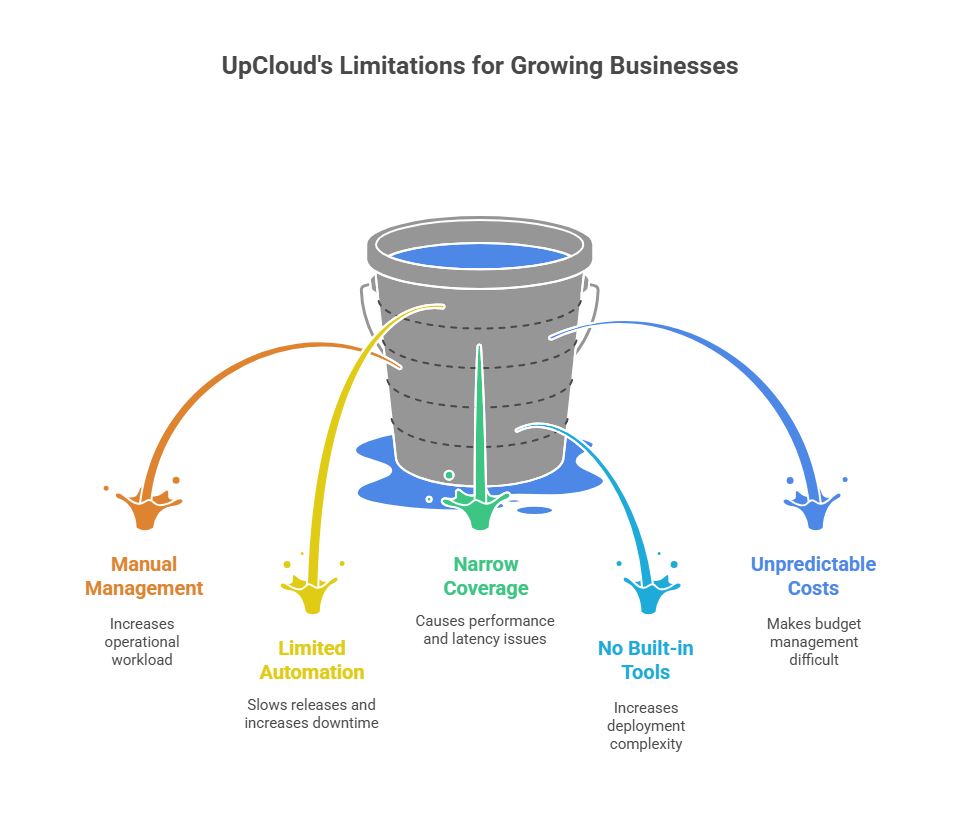 UpCloud has been a solid choice for developers who prefer more control over their servers, but as teams grow, many find themselves hitting the same limitations.
What once worked perfectly for a single app or small team starts to demand more time, manual configuration, and constant maintenance.
That’s why more startups, agencies, and SaaS companies are exploring UpCloud alternatives, not because UpCloud underperforms, but because it doesn’t scale as easily as modern managed platforms.
Manual Management and Maintenance
UpCloud gives full control of the environment, but with that control comes manual responsibility. Developers need to handle updates, security patches, backups, and scaling configurations themselves.
Over time, this adds up, taking focus away from product development and turning simple deployments into ongoing operational work.
Limited Automation and Scaling
UpCloud is infrastructure-focused. It doesn’t offer the kind of auto-scaling or continuous deployment that newer managed platforms provide. For growing teams, this lack of automation means slower releases, higher workload for engineers, and potential downtime during peak usage.
Modern cloud platforms now automate these functions, letting applications adjust resources in real time without manual input.
Narrow Regional Coverage
UpCloud’s data centres are primarily located in Europe and select regions in Asia and North America. For global teams or applications with distributed users, this can lead to performance gaps and latency issues.
By contrast, providers like AWS, GCP, and Kuberns offer near-global coverage with consistent reliability across regions.
No Built-in Developer Tools
Unlike platforms with built-in CI/CD pipelines, integrated monitoring, and logs, UpCloud users must configure these tools separately. This adds more moving parts to the deployment process and increases the learning curve for smaller teams without DevOps expertise.
Cost Management Becomes Unpredictable
While UpCloud’s pricing is clear at the base level, scaling often means adding more servers, monitoring tools, and third-party integrations, each introducing separate costs.
Over time, this makes monthly bills harder to predict and manage.
The Modern Shift Toward Managed Automation
The market is moving away from self-managed infrastructure toward AI-powered, fully managed platforms. Developers now expect their hosting provider to handle scaling, performance tuning, and cost optimisation automatically, freeing them to focus on code, not configuration.
This is where platforms like Kuberns outperform traditional VPS providers such as UpCloud.
They combine the same level of performance with built-in automation, CI/CD, and continuous monitoring, all with no additional setup.
In Short
UpCloud remains a good platform for developers who want control and simplicity. But when speed, automation, and global scalability matter, most teams realise it’s no longer enough. Moving to a managed, intelligent platform ensures faster deployments, fewer operational headaches, and better cost efficiency over time.
How Kuberns Helps Teams Move from UpCloud?
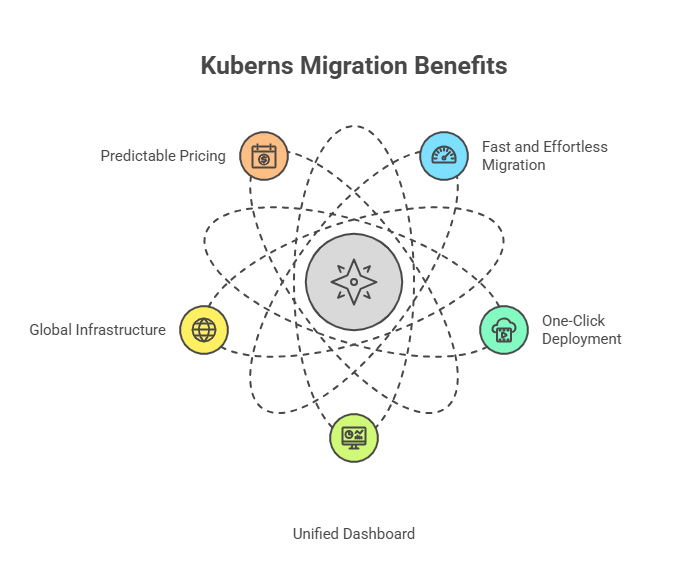 For teams already using UpCloud, migrating to a managed platform might sound like a big step, but it doesn’t have to be. Kuberns was designed precisely for developers who want to move away from manual infrastructure management without giving up performance, control, or transparency.
It delivers the same reliability you’d expect from a traditional cloud provider, but with automation, intelligence, and built-in optimisation layered on top.
Fast and Effortless Migration
Migrating from UpCloud to Kuberns is straightforward. You can connect your existing GitHub repository, import environment variables, and deploy your application directly. Kuberns handles the rest, from containerization to provisioning, monitoring, and scaling. There’s no downtime and no need to rewrite configuration files.
One-Click Deployment with Built-in CI/CD
Unlike UpCloud, which requires manual server setup and pipeline configuration, Kuberns includes a complete CI/CD flow out of the box. Every push to your repository can trigger an automated build, test, and deploy cycle, ensuring consistent updates with minimal effort. Developers spend less time managing infrastructure and more time improving their product.
Unified Dashboard for Visibility and Control
UpCloud users often rely on multiple tools for logging, monitoring, and alerts. Kuberns brings all of this into a single clean dashboard, giving full visibility into performance, error logs, deployments, and costs in one place. It’s designed for teams that value clarity over complexity.
Global Infrastructure, AWS-Backed Reliability
Kuberns runs entirely on AWS infrastructure, giving your applications enterprise-grade reliability and global reach. It’s the same power you’d get from AWS directly, but simplified through Kuberns’ automation layer. no AWS console navigation, IAM setups, or networking complexity.
Predictable Pricing and Simple Scaling
One of the biggest advantages of Kuberns over UpCloud is its transparent, usage-based pricing. There are no surprise charges for bandwidth, add-ons, or user seats. Teams can forecast infrastructure costs accurately while still benefiting from dynamic scaling.
The Result
By shifting from UpCloud to Kuberns, teams don’t just move to a new provider. They move to a smarter system that handles infrastructure automatically. No scripts, no downtime, no manual scaling, just a clear, fast, and optimised way to deploy applications from code to cloud.
The Future Beyond UpCloud
The biggest change in cloud hosting is mindset: from configuring instances to deploying applications in one click. Developers want results faster, without the repetitive complexity that used to define DevOps.
If UpCloud gave developers control, the next generation of platforms gives them freedom. Freedom to scale, innovate, and grow without infrastructure slowing them down.
Startups, SaaS teams, and enterprises alike are realising that moving from manual management to AI-powered automation isn’t just a convenience, it’s now a competitive advantage.
Start deploying on Kuberns and experience cloud hosting designed for speed, efficiency, and complete transparency.

Frequently Asked Questions
1. What are the best UpCloud alternatives in 2025?
The best UpCloud alternatives in 2025 include Kuberns, DigitalOcean, Vultr, Linode (Akamai), Scaleway, AWS, and Heroku. These platforms offer better automation, scalability, and cost management, making them ideal for startups and growing teams.
2. Why do developers move away from UpCloud?
Developers move away from UpCloud because managing scaling, CI/CD, and monitoring manually becomes time-consuming as projects grow. Most teams prefer managed or AI-powered platforms like Kuberns, which handle deployment, scaling, and cost optimisation automatically.
3. Which UpCloud alternative offers the best value for startups?
For early-stage startups, Kuberns provides one of the best value propositions, as it simplifies deployment and automates scaling on AWS infrastructure while keeping costs predictable.
4. Can I migrate my app from UpCloud to Kuberns easily?
Yes. Migrating from UpCloud to Kuberns is simple and does not require manual reconfiguration. You can connect your GitHub or GitLab repository, import environment variables, and deploy instantly. Kuberns takes care of the containerization, scaling, and monitoring automatically.
5. Which UpCloud alternative is best for enterprises?
Enterprises often prefer AWS, GCP, or Kuberns for their automation capabilities and compliance-grade reliability. Kuberns adds the benefit of AI-driven cost control and full-stack visibility, making it ideal for teams managing complex workloads across regions.
6. How does Kuberns differ from UpCloud?
UpCloud is primarily an infrastructure provider that gives developers control over virtual servers. Kuberns, on the other hand, is a fully managed platform that automates everything, from deployment to scaling, while reducing AWS costs by up to 40%. It’s designed to eliminate the operational overhead of managing infrastructure manually.
7. Which UpCloud alternative offers the best global coverage?
Platforms like AWS, GCP, and Kuberns provide the widest global coverage. Since Kuberns runs on AWS infrastructure, it offers worldwide availability and enterprise-grade reliability, making it suitable for apps with users across multiple regions.