# Top Netlify Competitors in 2026 for Production-Ready Applications
> Explore the top Netlify competitors in 2026. Compare platforms, features, and pricing to find the smartest choice for your apps and development needs.
- **Author**: charan-achari
- **Published**: 2025-08-19
- **Modified**: 2026-03-27
- **Category**: Alternatives
- **URL**: https://kuberns.com/blogs/top-netlify-competitors/
---
If you are searching for a [Netlify](https://www.netlify.com/) alternative, it usually means your application has started to move beyond what Netlify is best suited for.
Many teams start with Netlify because it makes deploying static sites and frontend projects easy. But as applications move into real production, common limitations begin to show. Backend requirements, databases, background jobs, and traffic scaling often require additional services and manual setup.
Over time, managing multiple tools, handling scaling during traffic spikes, and keeping cloud costs predictable can start to feel unnecessarily complex. What was once a simple deployment workflow becomes harder to maintain as the application grows.
This is where teams begin looking for a Netlify alternative that simplifies production deployments instead of adding more configuration.
Kuberns automates the entire deployment process. You connect your GitHub repository and deploy in one click, while AI handles build detection, deployment, scaling, monitoring, and cloud management without manual setup.
> You can learn more about how Kuberns works in detail in this guide: [What is Kuberns? The Simplest Way to Build, Deploy, and Scale Full-Stack Apps](https://kuberns.com/blogs/what-is-kuberns-the-simplest-way-to-build-deploy-and-scale-full-stack-apps/).
This blog will break down the top Netlify competitors in 2026, highlight what makes each platform unique, and explain why Kuberns is the first choice for developers and businesses looking to move beyond Netlify.
## TL;DR : Which Netlify Alternative Should You Choose in 2026?
* Choose Netlify if your project is a static website, marketing page, documentation site, or a frontend-only app where speed and simplicity matter more than backend logic or long-term scalability.
* Choose Vercel if you are building a frontend-focused application, especially with React or Next.js, and are comfortable relying on external services for backend and databases.
* Choose Render or Railway if you are okay with manually configuring services, managing scaling limits, and making infrastructure decisions as your application grows.
* Choose Kuberns if you want the entire deployment process automated. You connect your GitHub repository and deploy in one click, while AI handles build detection, deployment, scaling, monitoring, and cloud management without manual setup.
## Why Developers Look Beyond Netlify
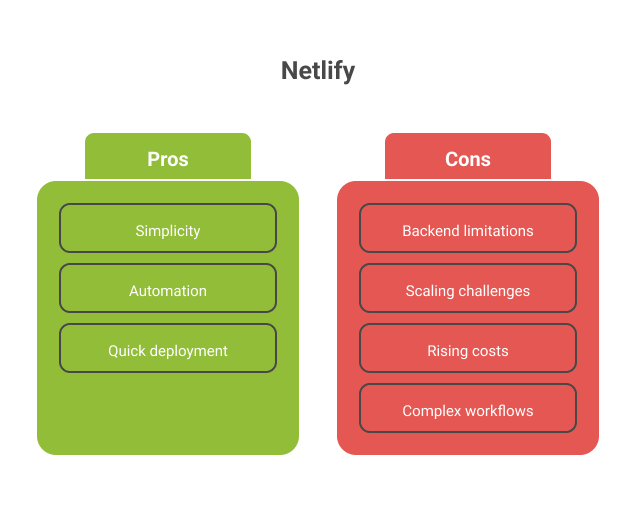
Netlify works well when applications stay simple. For static sites and frontend-focused projects, its workflow is fast and convenient. The challenges usually appear once applications move closer to production use.
As soon as backend APIs, databases, background jobs, or long-running processes are required, teams often need to rely on additional services outside Netlify. This increases setup effort and introduces more moving parts into what was originally a simple deployment flow.
Scaling can also become harder to manage over time. Handling traffic spikes, coordinating multiple services, and maintaining consistent performance often requires manual configuration and ongoing attention. At the same time, costs can become less predictable as usage grows across different tools and providers.
What starts as an easy way to deploy gradually turns into a fragmented setup that demands more maintenance than expected. At this stage, developers are not looking for more flexibility or control, they are looking for fewer decisions and less operational work.
This is why many teams begin exploring Netlify competitors that can handle deployment, scaling, and infrastructure as a single, automated workflow. Platforms like Kuberns are designed for this shift, removing the need to manage multiple services and allowing teams to focus on building and shipping their applications.
> If you want a broader comparison of the options available, check out our detailed blog on the [best Netlify alternatives](https://kuberns.com/blogs/best-netlify-alternatives/).
 ## Key Factors for Choosing a Netlify Competitor
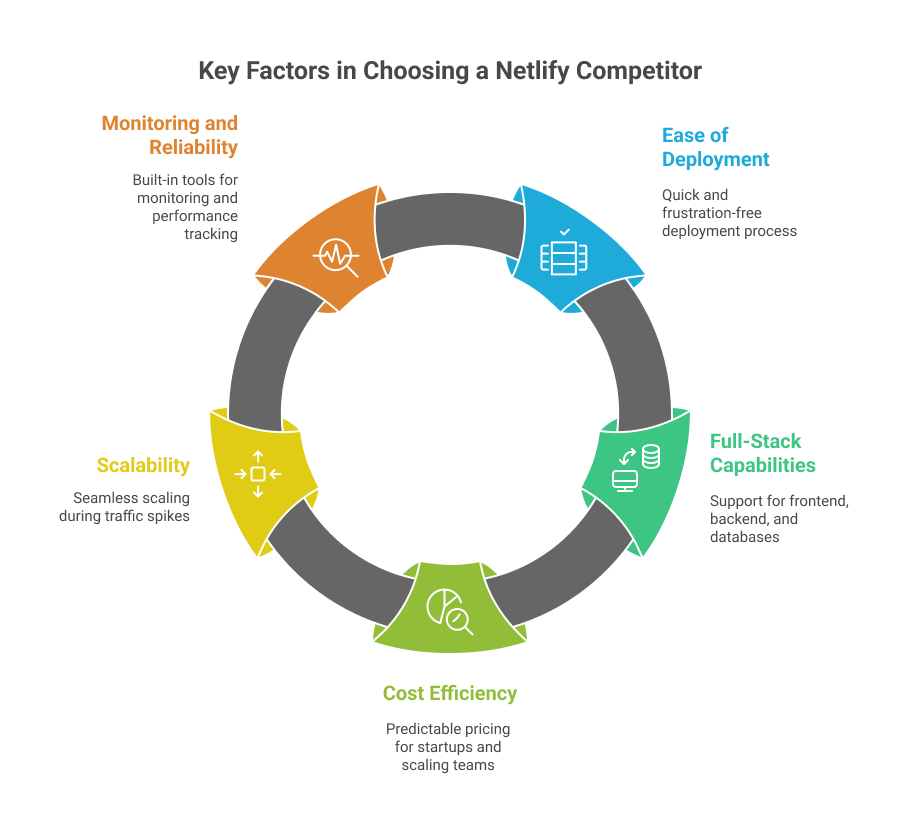
When teams start evaluating alternatives to Netlify, the decision usually comes down to a few core factors. These are not about adding more features, but about reducing long-term complexity as applications move into production.
1\. Ease of deployment
Teams want deployments to stay simple as applications grow. Fewer configuration steps and less manual setup reduce friction and deployment-related errors.
2\. Support for real production workloads
Modern applications often include backend services, background processing, and persistent data. Platforms need to handle these workloads without forcing teams to rely on multiple external services.
3\. Scalability without constant tuning
Handling traffic spikes and growing usage should not require ongoing infrastructure changes. Automatic scaling is increasingly expected, not optional.
4\. Cost predictability
As applications scale, cloud costs should remain understandable and manageable. Platforms that optimize resource usage and avoid hidden pricing complexity are easier to run long term.
5\. Operational visibility
Built-in monitoring and logs help teams understand how applications behave in production without adding separate tools or services.
These criteria define what makes a strong Netlify competitor. If you want to see how different deployment tools stack up beyond Netlify, check out our detailed guide on the [best software deployment tools](https://kuberns.com/blogs/best-software-deployment-tools/).
With these benchmarks in mind, let’s now explore the top Netlify competitors in 2026.
## Netlify vs Top Alternatives: How They Compare in Real-World Usage
This comparison focuses on how Netlify and its alternatives handle deployment, automation, scaling, and cost as applications grow beyond static sites.
| Platform | Deployment Experience | Automation Level | Scaling & Infrastructure Handling | Cost Behaviour | Suitable For |
| ------------------------- | --------------------------------------------------------------- | --------------------------------- | ---------------------------------------------------------------------------- | ------------------------------------------------------ | -------------------------------------------------------------------------- |
| Kuberns | One-click deployment directly from GitHub | AI-powered, end-to-end automation | Fully automated build, deployment, scaling, monitoring, and cloud management | Predictable cloud costs, optimized to reduce AWS spend | Teams outgrowing Netlify, full-stack production apps across any tech stack |
| Vercel | Smooth frontend deployments, configuration required for backend | Partial automation | Backend services and infrastructure handled separately | Costs increase with traffic and usage | Frontend-first applications |
| Netlify | Simple static site deployment, manual work for backend needs | Limited automation | Backend requires external services and integrations | Add-ons and bandwidth usage increase costs | Static sites and JAMstack projects |
| DigitalOcean App Platform | Guided setup with several manual steps | Basic automation | Manual tuning and scaling required at higher loads | Predictable early, more management needed later | Simple applications and small teams |
| Heroku | Git-based deployment with configuration required | Dyno-based automation | Manual scaling and resource decisions | Becomes expensive as usage grows | Small projects and early-stage apps |
| AWS Amplify | Multi-step setup process | Mostly manual automation | Requires AWS configuration and ongoing management | Difficult to estimate long-term costs | AWS-native teams with infrastructure experience |
## Top Netlify Competitors in 2026
### 1. Kuberns
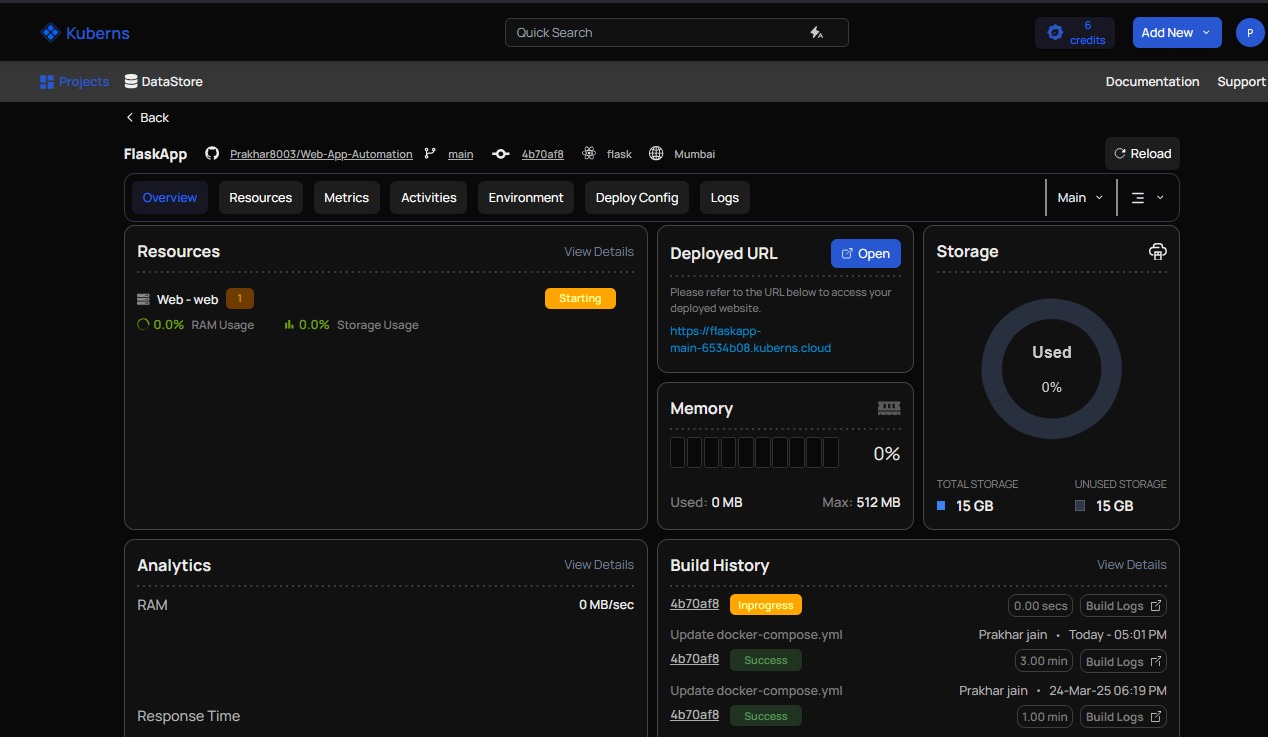
Kuberns is the #1 Netlify competitor in 2026 because it directly addresses the areas where Netlify falls short while remaining simple and developer-friendly.
* AI-Powered Deployments: Kuberns takes care of containerization, scaling, and configuration automatically. Instead of writing complex deployment scripts, developers can rely on AI to handle the heavy lifting, ensuring apps are always optimized.
* One-Click Deploy: With Kuberns, going live is as simple as connecting your Git repository. The platform handles build, deploy, and scale in seconds, which removes the delays and manual steps developers face on Netlify.
* Full-Stack Support: Unlike Netlify, which focuses mainly on static and frontend hosting, Kuberns supports the entire stack. You can host frontend apps, backend APIs, and databases together without patching multiple services.
* 40% AWS Savings: Kuberns runs on AWS infrastructure but intelligently optimizes resource usage with AI. This translates into real savings, cutting cloud costs by up to 40% compared to running workloads directly on AWS or Netlify.
* Zero Platform Fees: Many platforms add hidden charges or per-user costs as teams grow. Kuberns avoids this entirely, charging only for infrastructure usage with transparent pricing.
* Built-In Monitoring: Logs, alerts, and performance insights are built into the platform. Developers and teams get complete visibility into deployments without needing third-party monitoring tools.
While other competitors cover certain gaps, [Kuberns ](https://kuberns.com/)brings all of these advantages together in one platform. For teams that want to move beyond Netlify and adopt a future-ready solution, [Kuberns ](https://kuberns.com/)is the smartest choice in 2026.
## Key Factors for Choosing a Netlify Competitor

When teams start evaluating alternatives to Netlify, the decision usually comes down to a few core factors. These are not about adding more features, but about reducing long-term complexity as applications move into production.
1\. Ease of deployment
Teams want deployments to stay simple as applications grow. Fewer configuration steps and less manual setup reduce friction and deployment-related errors.
2\. Support for real production workloads
Modern applications often include backend services, background processing, and persistent data. Platforms need to handle these workloads without forcing teams to rely on multiple external services.
3\. Scalability without constant tuning
Handling traffic spikes and growing usage should not require ongoing infrastructure changes. Automatic scaling is increasingly expected, not optional.
4\. Cost predictability
As applications scale, cloud costs should remain understandable and manageable. Platforms that optimize resource usage and avoid hidden pricing complexity are easier to run long term.
5\. Operational visibility
Built-in monitoring and logs help teams understand how applications behave in production without adding separate tools or services.
These criteria define what makes a strong Netlify competitor. If you want to see how different deployment tools stack up beyond Netlify, check out our detailed guide on the [best software deployment tools](https://kuberns.com/blogs/best-software-deployment-tools/).
With these benchmarks in mind, let’s now explore the top Netlify competitors in 2026.
## Netlify vs Top Alternatives: How They Compare in Real-World Usage
This comparison focuses on how Netlify and its alternatives handle deployment, automation, scaling, and cost as applications grow beyond static sites.
| Platform | Deployment Experience | Automation Level | Scaling & Infrastructure Handling | Cost Behaviour | Suitable For |
| ------------------------- | --------------------------------------------------------------- | --------------------------------- | ---------------------------------------------------------------------------- | ------------------------------------------------------ | -------------------------------------------------------------------------- |
| Kuberns | One-click deployment directly from GitHub | AI-powered, end-to-end automation | Fully automated build, deployment, scaling, monitoring, and cloud management | Predictable cloud costs, optimized to reduce AWS spend | Teams outgrowing Netlify, full-stack production apps across any tech stack |
| Vercel | Smooth frontend deployments, configuration required for backend | Partial automation | Backend services and infrastructure handled separately | Costs increase with traffic and usage | Frontend-first applications |
| Netlify | Simple static site deployment, manual work for backend needs | Limited automation | Backend requires external services and integrations | Add-ons and bandwidth usage increase costs | Static sites and JAMstack projects |
| DigitalOcean App Platform | Guided setup with several manual steps | Basic automation | Manual tuning and scaling required at higher loads | Predictable early, more management needed later | Simple applications and small teams |
| Heroku | Git-based deployment with configuration required | Dyno-based automation | Manual scaling and resource decisions | Becomes expensive as usage grows | Small projects and early-stage apps |
| AWS Amplify | Multi-step setup process | Mostly manual automation | Requires AWS configuration and ongoing management | Difficult to estimate long-term costs | AWS-native teams with infrastructure experience |
## Top Netlify Competitors in 2026
### 1. Kuberns

Kuberns is the #1 Netlify competitor in 2026 because it directly addresses the areas where Netlify falls short while remaining simple and developer-friendly.
* AI-Powered Deployments: Kuberns takes care of containerization, scaling, and configuration automatically. Instead of writing complex deployment scripts, developers can rely on AI to handle the heavy lifting, ensuring apps are always optimized.
* One-Click Deploy: With Kuberns, going live is as simple as connecting your Git repository. The platform handles build, deploy, and scale in seconds, which removes the delays and manual steps developers face on Netlify.
* Full-Stack Support: Unlike Netlify, which focuses mainly on static and frontend hosting, Kuberns supports the entire stack. You can host frontend apps, backend APIs, and databases together without patching multiple services.
* 40% AWS Savings: Kuberns runs on AWS infrastructure but intelligently optimizes resource usage with AI. This translates into real savings, cutting cloud costs by up to 40% compared to running workloads directly on AWS or Netlify.
* Zero Platform Fees: Many platforms add hidden charges or per-user costs as teams grow. Kuberns avoids this entirely, charging only for infrastructure usage with transparent pricing.
* Built-In Monitoring: Logs, alerts, and performance insights are built into the platform. Developers and teams get complete visibility into deployments without needing third-party monitoring tools.
While other competitors cover certain gaps, [Kuberns ](https://kuberns.com/)brings all of these advantages together in one platform. For teams that want to move beyond Netlify and adopt a future-ready solution, [Kuberns ](https://kuberns.com/)is the smartest choice in 2026.
 ### 2. Vercel
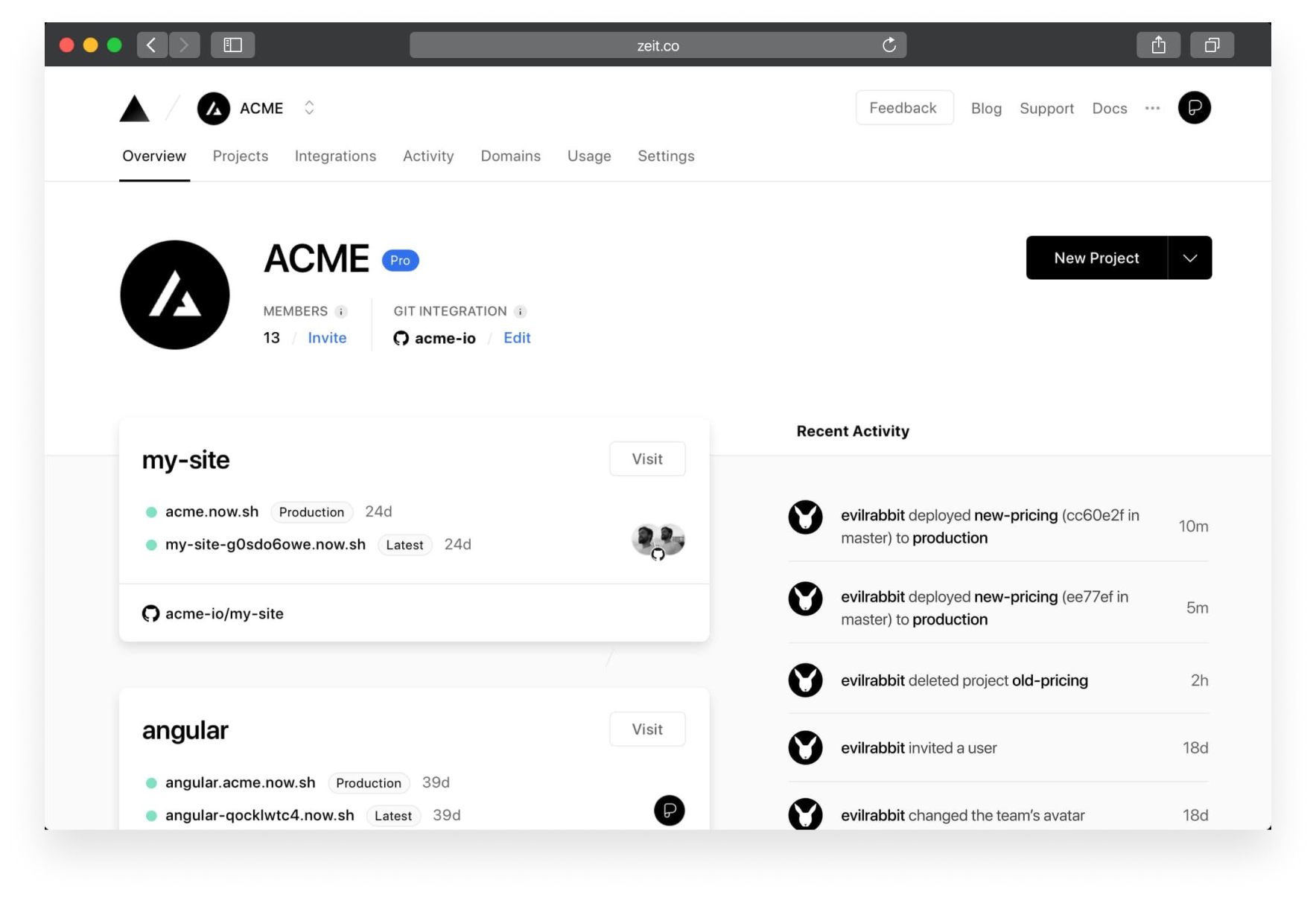
Vercel is often considered one of the strongest competitors to Netlify, especially for developers working with React and Next.js. Its edge network, fast build times, and seamless frontend deployment experience have made it a popular choice for modern frontend projects.
* Frontend-First Platform: Vercel is highly optimized for static sites and frontend-heavy frameworks. If you are building marketing pages or React-based applications, it offers excellent performance.
* Ecosystem Strength: With deep integration into the Next.js framework (developed by Vercel itself), it has become the go-to choice for frontend developers in particular.
* Scalability at the Edge: Vercel’s edge network allows for global delivery and fast performance, which is ideal for content-heavy apps and frontend-driven projects.
However, the limitation with Vercel is backend support. Developers still need to rely on external providers for APIs, databases, or long-running processes. This makes it less suitable for full-stack applications.
* Kuberns Advantage: Unlike Vercel, Kuberns provides full-stack capabilities out of the box. Developers can deploy frontend apps, backend services, and databases in one place, all with one-click deployment. On top of that, Kuberns delivers 40% AWS savings, built-in monitoring, and AI-driven scaling, making it a more complete choice for production workloads.
For a deeper breakdown of how the two platforms compare, see our full guide on [Vercel vs Kuberns](https://docs.kuberns.com/docs/comparison/vercel-vs-kuberns).
### 3. Render
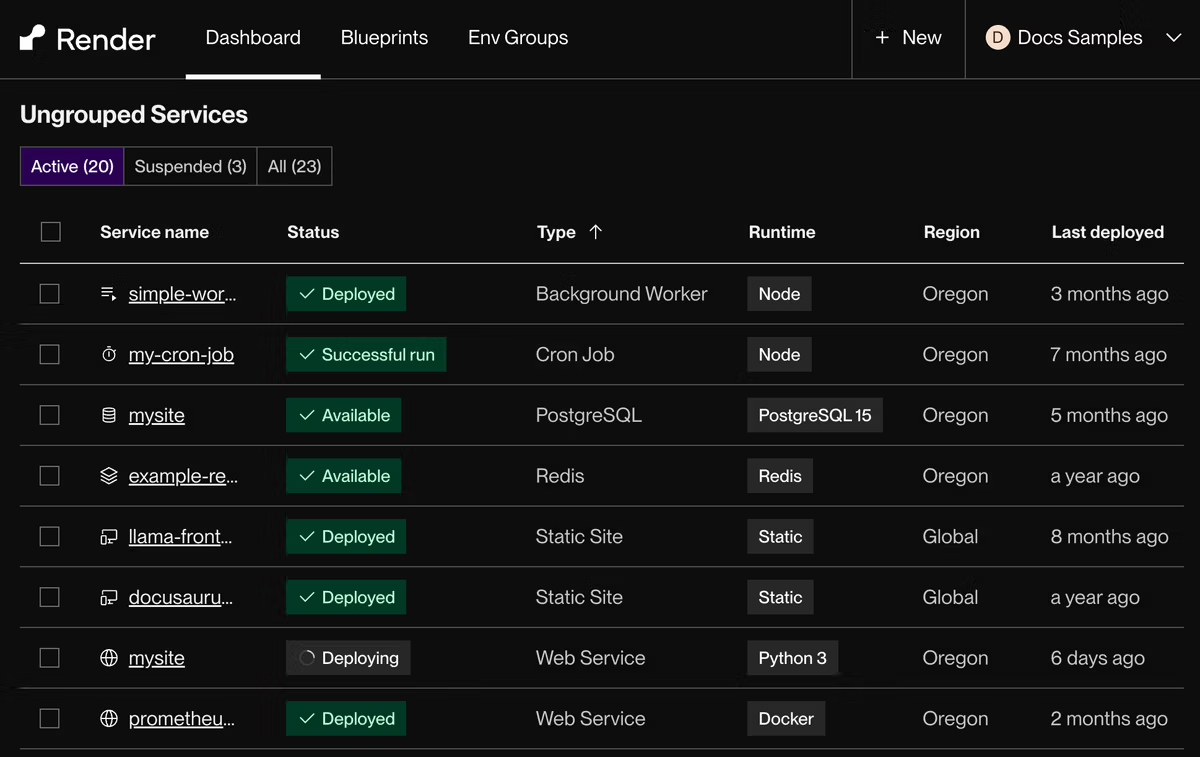
Render positions itself as a full-stack alternative to Netlify, offering much more than just static site hosting. Developers appreciate its balance between simplicity and backend flexibility, making it a popular choice for projects that need more than just frontend support.
* Full-Stack Capabilities: Render provides backend services, databases, and even cron jobs in addition to static hosting. This makes it a stronger option than Netlify for developers building dynamic apps.
* Simple Git Integration: Deployments are triggered directly from Git repositories, similar to Netlify and Heroku, which streamlines workflows for many teams.
* Backend Support: Compared to Netlify, Render’s backend hosting options give developers more freedom and flexibility in building complex applications.
* Pricing Clarity: Render offers a clearer pricing model than Vercel, which makes it easier for teams to estimate and control costs.
That said, Render still comes with limitations. While it provides backend services, it does not offer AI-driven scaling or built-in cost optimization. As projects grow, teams may still face rising infrastructure costs and scaling challenges.
* Kuberns Advantage: Kuberns solves these pain points by combining full-stack deployment with AI-powered scaling and 40% AWS cost savings. Developers can host frontend, backend, and databases together with one-click deployment, all while keeping infrastructure costs under control.
For a detailed breakdown of how Render compares with Kuberns, see our guide on [Render vs Kuberns](https://docs.kuberns.com/docs/comparison/render-vs-kuberns).
### 4. Railway
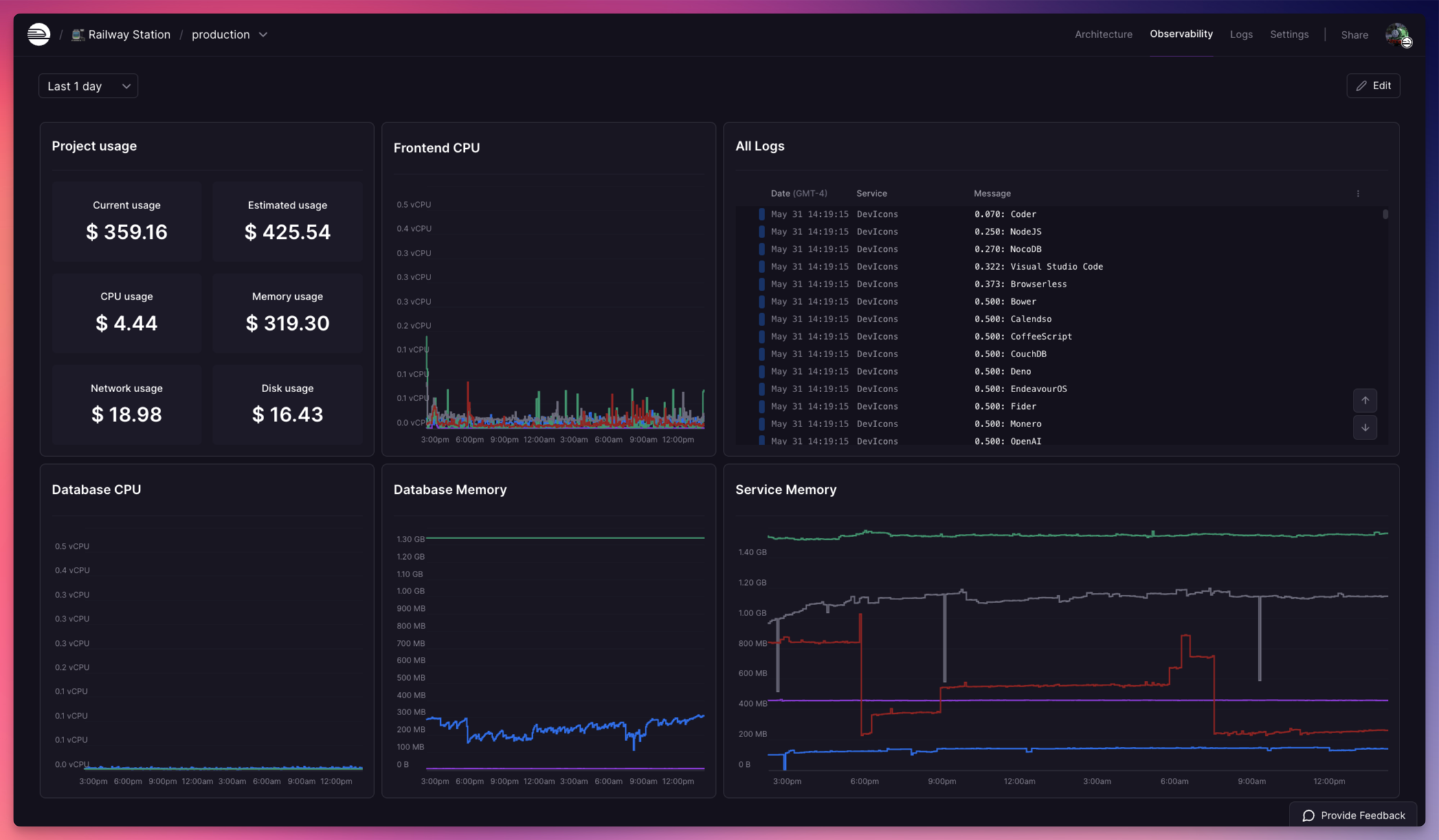
Railway is designed for developers who want to launch projects quickly without heavy setup. It provides a smooth developer experience and is especially popular among indie developers and small teams.
* Fast Prototyping: Railway makes it easy to spin up projects in minutes, making it a great choice for prototypes, hackathons, and early-stage apps.
* Backend and Database Support: The platform supports deploying backend services, APIs, and databases with minimal configuration, going beyond what Netlify offers.
* Simple User Interface: Railway’s clean UI allows developers to connect repositories and deploy without needing advanced DevOps knowledge.
While Railway shines in speed and simplicity, it is not always the best fit for production-ready workloads. Scaling larger applications can become challenging, and performance under heavy load may require additional work.
* Kuberns Advantage: Unlike Railway, Kuberns is built for production-scale applications. With AI-managed scaling, built-in monitoring, and 40% AWS cost savings, Kuberns ensures apps not only launch fast but also grow reliably as traffic increases.
For a complete comparison of the two platforms, check out our detailed guide on [Railway vs Kuberns](https://docs.kuberns.com/docs/comparison/railway-vs-kuberns).
### 5. Heroku
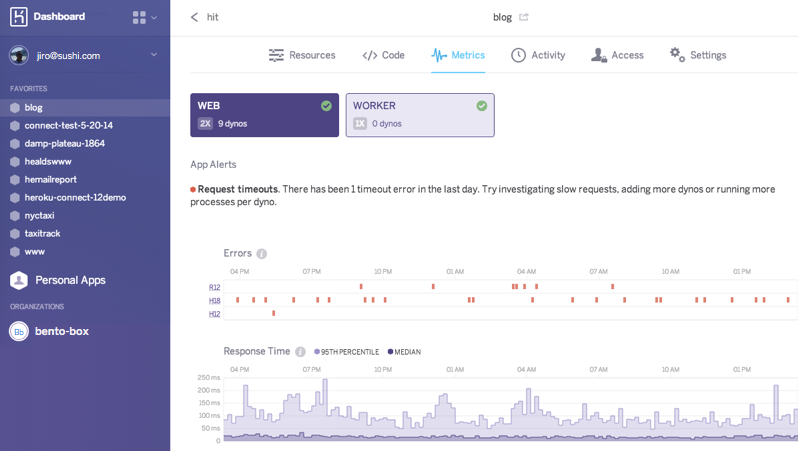
Heroku is one of the oldest and most recognized names in the PaaS space. It pioneered the concept of easy cloud deployment and is still widely used by startups, educators, and small teams. Its beginner-friendly design and extensive marketplace make it appealing to those new to deployment platforms.
* Quick Backend Deployment: Heroku allows developers to deploy backend applications rapidly without worrying about infrastructure.
* Add-On Marketplace: With a large ecosystem of add-ons, developers can integrate databases, monitoring, and third-party services directly into their apps.
* Beginner-Friendly: Its simple interface and documentation make it accessible to developers with little to no DevOps experience.
Despite its strengths, Heroku has some well-known limitations. Its performance under heavy traffic often requires scaling to larger dynos, and its pricing quickly becomes expensive for production workloads.
* Kuberns Advantage: Kuberns provides the same backend flexibility at a fraction of the cost. With AI-powered scaling, 40% AWS cost savings, and built-in monitoring, Kuberns gives teams everything they expect from Heroku, but in a more modern, cost-effective package.
For a full breakdown of how the two platforms compare, see our guide on [Heroku vs Kuberns](https://docs.kuberns.com/docs/comparison/heroku-vs-kuberns).
### 6. DigitalOcean App Platform

DigitalOcean’s App Platform is a developer-friendly alternative to Netlify that simplifies deployment compared to managing raw servers. It is positioned as a cost-effective solution and integrates tightly with DigitalOcean’s wider cloud services, making it a popular choice for startups and small teams.
* Affordable Infrastructure: App Platform is generally cheaper than AWS or GCP, which appeals to developers looking for a budget-friendly option.
* Simple Deployment: It streamlines application hosting by removing the need for manual server setup and maintenance.
* Startup-Friendly: With its predictable pricing and straightforward controls, it suits smaller teams that need a balance between affordability and flexibility.
However, while DigitalOcean App Platform reduces infrastructure complexity, it still relies heavily on manual scaling and requires more developer involvement compared to modern AI-powered platforms.
* Kuberns Advantage: Kuberns goes beyond simple infrastructure control by offering AI-driven automation and up to 40% AWS cost savings. This allows developers to focus on building their applications instead of managing infrastructure. With monitoring, scaling, and full-stack support included, Kuberns provides a more complete solution for teams ready to grow.
For a deeper look at how these platforms compare, check out our blog on the [best DigitalOcean alternative for startups and solo developers](https://kuberns.com/blogs/best-digitalocean-alternative-for-startups-and-solo-developers/).
### 2. Vercel

Vercel is often considered one of the strongest competitors to Netlify, especially for developers working with React and Next.js. Its edge network, fast build times, and seamless frontend deployment experience have made it a popular choice for modern frontend projects.
* Frontend-First Platform: Vercel is highly optimized for static sites and frontend-heavy frameworks. If you are building marketing pages or React-based applications, it offers excellent performance.
* Ecosystem Strength: With deep integration into the Next.js framework (developed by Vercel itself), it has become the go-to choice for frontend developers in particular.
* Scalability at the Edge: Vercel’s edge network allows for global delivery and fast performance, which is ideal for content-heavy apps and frontend-driven projects.
However, the limitation with Vercel is backend support. Developers still need to rely on external providers for APIs, databases, or long-running processes. This makes it less suitable for full-stack applications.
* Kuberns Advantage: Unlike Vercel, Kuberns provides full-stack capabilities out of the box. Developers can deploy frontend apps, backend services, and databases in one place, all with one-click deployment. On top of that, Kuberns delivers 40% AWS savings, built-in monitoring, and AI-driven scaling, making it a more complete choice for production workloads.
For a deeper breakdown of how the two platforms compare, see our full guide on [Vercel vs Kuberns](https://docs.kuberns.com/docs/comparison/vercel-vs-kuberns).
### 3. Render

Render positions itself as a full-stack alternative to Netlify, offering much more than just static site hosting. Developers appreciate its balance between simplicity and backend flexibility, making it a popular choice for projects that need more than just frontend support.
* Full-Stack Capabilities: Render provides backend services, databases, and even cron jobs in addition to static hosting. This makes it a stronger option than Netlify for developers building dynamic apps.
* Simple Git Integration: Deployments are triggered directly from Git repositories, similar to Netlify and Heroku, which streamlines workflows for many teams.
* Backend Support: Compared to Netlify, Render’s backend hosting options give developers more freedom and flexibility in building complex applications.
* Pricing Clarity: Render offers a clearer pricing model than Vercel, which makes it easier for teams to estimate and control costs.
That said, Render still comes with limitations. While it provides backend services, it does not offer AI-driven scaling or built-in cost optimization. As projects grow, teams may still face rising infrastructure costs and scaling challenges.
* Kuberns Advantage: Kuberns solves these pain points by combining full-stack deployment with AI-powered scaling and 40% AWS cost savings. Developers can host frontend, backend, and databases together with one-click deployment, all while keeping infrastructure costs under control.
For a detailed breakdown of how Render compares with Kuberns, see our guide on [Render vs Kuberns](https://docs.kuberns.com/docs/comparison/render-vs-kuberns).
### 4. Railway

Railway is designed for developers who want to launch projects quickly without heavy setup. It provides a smooth developer experience and is especially popular among indie developers and small teams.
* Fast Prototyping: Railway makes it easy to spin up projects in minutes, making it a great choice for prototypes, hackathons, and early-stage apps.
* Backend and Database Support: The platform supports deploying backend services, APIs, and databases with minimal configuration, going beyond what Netlify offers.
* Simple User Interface: Railway’s clean UI allows developers to connect repositories and deploy without needing advanced DevOps knowledge.
While Railway shines in speed and simplicity, it is not always the best fit for production-ready workloads. Scaling larger applications can become challenging, and performance under heavy load may require additional work.
* Kuberns Advantage: Unlike Railway, Kuberns is built for production-scale applications. With AI-managed scaling, built-in monitoring, and 40% AWS cost savings, Kuberns ensures apps not only launch fast but also grow reliably as traffic increases.
For a complete comparison of the two platforms, check out our detailed guide on [Railway vs Kuberns](https://docs.kuberns.com/docs/comparison/railway-vs-kuberns).
### 5. Heroku

Heroku is one of the oldest and most recognized names in the PaaS space. It pioneered the concept of easy cloud deployment and is still widely used by startups, educators, and small teams. Its beginner-friendly design and extensive marketplace make it appealing to those new to deployment platforms.
* Quick Backend Deployment: Heroku allows developers to deploy backend applications rapidly without worrying about infrastructure.
* Add-On Marketplace: With a large ecosystem of add-ons, developers can integrate databases, monitoring, and third-party services directly into their apps.
* Beginner-Friendly: Its simple interface and documentation make it accessible to developers with little to no DevOps experience.
Despite its strengths, Heroku has some well-known limitations. Its performance under heavy traffic often requires scaling to larger dynos, and its pricing quickly becomes expensive for production workloads.
* Kuberns Advantage: Kuberns provides the same backend flexibility at a fraction of the cost. With AI-powered scaling, 40% AWS cost savings, and built-in monitoring, Kuberns gives teams everything they expect from Heroku, but in a more modern, cost-effective package.
For a full breakdown of how the two platforms compare, see our guide on [Heroku vs Kuberns](https://docs.kuberns.com/docs/comparison/heroku-vs-kuberns).
### 6. DigitalOcean App Platform

DigitalOcean’s App Platform is a developer-friendly alternative to Netlify that simplifies deployment compared to managing raw servers. It is positioned as a cost-effective solution and integrates tightly with DigitalOcean’s wider cloud services, making it a popular choice for startups and small teams.
* Affordable Infrastructure: App Platform is generally cheaper than AWS or GCP, which appeals to developers looking for a budget-friendly option.
* Simple Deployment: It streamlines application hosting by removing the need for manual server setup and maintenance.
* Startup-Friendly: With its predictable pricing and straightforward controls, it suits smaller teams that need a balance between affordability and flexibility.
However, while DigitalOcean App Platform reduces infrastructure complexity, it still relies heavily on manual scaling and requires more developer involvement compared to modern AI-powered platforms.
* Kuberns Advantage: Kuberns goes beyond simple infrastructure control by offering AI-driven automation and up to 40% AWS cost savings. This allows developers to focus on building their applications instead of managing infrastructure. With monitoring, scaling, and full-stack support included, Kuberns provides a more complete solution for teams ready to grow.
For a deeper look at how these platforms compare, check out our blog on the [best DigitalOcean alternative for startups and solo developers](https://kuberns.com/blogs/best-digitalocean-alternative-for-startups-and-solo-developers/).
 ## Why Kuberns is the Best Netlify Competitor for Modern Teams
When you compare Netlify competitors, each one offers something valuable but also comes with trade-offs. Vercel is strong for frontend frameworks but lacks deep backend support. Render and Railway are solid for full-stack development, but scaling large projects can get tricky. Heroku is beginner-friendly, but costs rise quickly as apps grow. DigitalOcean provides affordable infrastructure, but it requires more manual setup and DevOps effort.
Kuberns is the only platform that removes these compromises.
* It offers 40% AWS cost savings with transparent pricing that beats traditional PaaS models.
* It supports frontend, backend, and databases in one unified workflow.
* It delivers one-click deployments that make setup faster than Render, Railway, or Heroku.
* It brings AI-powered scaling and monitoring, ensuring apps are production-ready without added complexity.
* It eliminates hidden fees and per-user charges, which makes it ideal for startups, IT agencies, and growing teams.
If you want a platform that is cost-efficient, full-stack, and production-ready from day one, Kuberns is the perfect choice in 2026.
## Conclusion
Netlify is a solid choice for static sites, but for modern full-stack applications, developers need more. That is why competitors like Vercel, Render, Railway, Heroku, and DigitalOcean have grown in popularity.
Yet among all these platforms, Kuberns leads as the top Netlify competitor in 2026. It combines ease of use, AI-powered automation, and significant cost savings into one powerful solution.
If you are looking for a smarter way to build, deploy, and scale your apps, Kuberns is your best bet.
[👉 ](https://dashboard.kuberns.com/)[Ready to move beyond Netlify? Try Kuberns today and save 40% on AWS costs while simplifying your deployments.](https://dashboard.kuberns.com/)
## Why Kuberns is the Best Netlify Competitor for Modern Teams
When you compare Netlify competitors, each one offers something valuable but also comes with trade-offs. Vercel is strong for frontend frameworks but lacks deep backend support. Render and Railway are solid for full-stack development, but scaling large projects can get tricky. Heroku is beginner-friendly, but costs rise quickly as apps grow. DigitalOcean provides affordable infrastructure, but it requires more manual setup and DevOps effort.
Kuberns is the only platform that removes these compromises.
* It offers 40% AWS cost savings with transparent pricing that beats traditional PaaS models.
* It supports frontend, backend, and databases in one unified workflow.
* It delivers one-click deployments that make setup faster than Render, Railway, or Heroku.
* It brings AI-powered scaling and monitoring, ensuring apps are production-ready without added complexity.
* It eliminates hidden fees and per-user charges, which makes it ideal for startups, IT agencies, and growing teams.
If you want a platform that is cost-efficient, full-stack, and production-ready from day one, Kuberns is the perfect choice in 2026.
## Conclusion
Netlify is a solid choice for static sites, but for modern full-stack applications, developers need more. That is why competitors like Vercel, Render, Railway, Heroku, and DigitalOcean have grown in popularity.
Yet among all these platforms, Kuberns leads as the top Netlify competitor in 2026. It combines ease of use, AI-powered automation, and significant cost savings into one powerful solution.
If you are looking for a smarter way to build, deploy, and scale your apps, Kuberns is your best bet.
[👉 ](https://dashboard.kuberns.com/)[Ready to move beyond Netlify? Try Kuberns today and save 40% on AWS costs while simplifying your deployments.](https://dashboard.kuberns.com/)
 ## FAQs
### 1. What is the best Netlify competitor in 2026?
Kuberns is the best competitor, offering AI-powered deployments, full-stack support, and 40% AWS cost savings.
### 2. Which Netlify competitor is the most affordable?
Kuberns, with transparent AWS-based pricing and no hidden platform fees.
### 3. Can I migrate from Netlify to Kuberns?
Yes. Kuberns supports one-click migrations with staging environments and zero downtime.
### 4. Why choose Kuberns over Vercel or Render?
Unlike others, Kuberns provides frontend, backend, databases, monitoring, and cost savings in one platform.
---
- [More Alternatives articles](https://kuberns.com/blogs/category/alternatives/1/)
- [All articles](https://kuberns.com/blogs/)
## FAQs
### 1. What is the best Netlify competitor in 2026?
Kuberns is the best competitor, offering AI-powered deployments, full-stack support, and 40% AWS cost savings.
### 2. Which Netlify competitor is the most affordable?
Kuberns, with transparent AWS-based pricing and no hidden platform fees.
### 3. Can I migrate from Netlify to Kuberns?
Yes. Kuberns supports one-click migrations with staging environments and zero downtime.
### 4. Why choose Kuberns over Vercel or Render?
Unlike others, Kuberns provides frontend, backend, databases, monitoring, and cost savings in one platform.
---
- [More Alternatives articles](https://kuberns.com/blogs/category/alternatives/1/)
- [All articles](https://kuberns.com/blogs/)