# What Is Google Cloud Platform (GCP)? Complete Guide 2026
> What is Google Cloud Platform? Explore GCP services, pricing, and why most developers deploy faster on Kuberns without the complexity of raw cloud.
- **Author**: sofia-castellano
- **Published**: 2026-06-22
- **Modified**: 2026-06-22
- **Category**: Deployment Guides
- **URL**: https://kuberns.com/blogs/what-is-google-cloud-platform/
---
Google Cloud Platform is Google's public cloud infrastructure, the same global network that powers Search, YouTube, and Gmail. It offers compute, storage, databases, AI, and analytics services at hyperscale. But for most developers and startups trying to ship a production app, the experience of actually using GCP is a long way from that headline.
This guide breaks down what GCP is, what each core service does, where it genuinely excels, and where it creates friction. It also covers the deployment path most teams take when they want production-grade infrastructure without the operational overhead that GCP brings. If you are still deciding between [cloud deployment models](https://kuberns.com/blogs/cloud-deployment-models/), that guide is a useful starting point before diving into any specific platform.
If you want the short answer: [Kuberns](https://kuberns.com) is what most development teams reach for when they need GCP-level infrastructure without the setup complexity. Connect your GitHub repo and deploy in under 5 minutes, no cloud account, no Dockerfile, no IAM configuration needed.
---
## What Is Google Cloud Platform?

Google Cloud Platform is a suite of cloud computing services that runs on Google's own global infrastructure. It spans over 200 products across compute, storage, networking, databases, analytics, AI and ML, security, and developer tools.
GCP competes directly with Amazon Web Services and Microsoft Azure in the hyperscale cloud market. As of 2026, it holds roughly 11 percent of the global cloud market behind AWS (31%) and Azure (24%). Teams evaluating GCP against other hyperscalers often look at [AWS alternatives](https://kuberns.com/blogs/best-aws-alternatives-for-cheaper-cloud-hosting/) as part of the same decision.
GCP is purpose-built for scale. It is the platform of choice for enterprises with large structured datasets, AI research teams, and organisations deeply embedded in the Google ecosystem. For those workloads, it is genuinely strong.
For teams building and deploying standard web applications, though, the gap between "spinning up a GCP project" and "having a live production app" is measured in hours, not minutes. That is the trade-off that pushes most developers toward managed platforms like [Kuberns](https://kuberns.com), where the infrastructure is already configured and a GitHub push is all it takes to go live.
---
## GCP Core Services Explained
### Compute Engine

Compute Engine provides virtual machines running on Google's infrastructure. You choose a machine type, operating system, region, and storage configuration, and Google provisions the server.
This is raw IaaS. You are handed a Linux box and everything else is your responsibility: the runtime, the web server, SSL certificates, deployment pipelines, and security patches.
### Cloud Run

Cloud Run is GCP's serverless container platform. You package your app in a Docker container, push it to Google Artifact Registry, and Cloud Run runs it without requiring you to manage a VM.
Cloud Run handles scaling automatically and charges only for actual compute time during requests. It is the most developer-accessible part of GCP, but it still requires a Dockerfile, IAM service account configuration, and careful attention to cold start behaviour for infrequently accessed services.
### Google Kubernetes Engine (GKE)

GKE is Google's managed Kubernetes service. It provisions and manages Kubernetes clusters on Compute Engine, handling control plane operations while you manage workload configuration, Helm charts, and cluster networking.
GKE is powerful for teams running microservices at scale. It is also one of the most operationally demanding platforms available. Most applications simply do not need it, and the teams that adopt it without a Kubernetes background spend more time debugging infrastructure than shipping features. If you are evaluating whether Kubernetes is right for your project, the [top Kubernetes alternatives guide](https://kuberns.com/blogs/kubernetes-alternatives-you-need/) covers lighter options worth considering.
### Cloud SQL

Cloud SQL is GCP's managed relational database service supporting PostgreSQL, MySQL, and SQL Server. It handles automated backups, failover, and patching. Production-grade instances start at $50 to $80 per month.
### Cloud Storage

Cloud Storage is GCP's object storage service, comparable to AWS S3. It stores files, build artifacts, backups, and static assets with high durability and global availability. Free tier covers 5 GB per month.
### BigQuery

BigQuery is GCP's serverless data warehouse and analytics engine. This is where GCP leads the market. BigQuery queries petabyte-scale datasets in seconds using SQL syntax and integrates natively with Vertex AI for ML workflows. For data-heavy products, it is a compelling reason to choose GCP.
### Vertex AI

Vertex AI is Google's unified ML platform for training, deploying, and managing machine learning models. It supports custom models and Google's foundation models, with deep Gemini integration for generative AI workloads.
### Firebase

Firebase is Google's mobile and web application platform. It provides a real-time NoSQL database, authentication, cloud functions, and hosting, all designed for frontend-heavy and mobile apps. Firebase is the most accessible part of the GCP ecosystem and the easiest entry point for teams new to Google's cloud products. For a direct comparison of Firebase against other deployment platforms, the [Vercel vs Cloudflare vs Firebase guide](https://kuberns.com/blogs/vercel-vs-cloudflare-vs-firebase/) breaks down the differences clearly.
### Cloud Build

Cloud Build is GCP's CI/CD pipeline service. It runs build steps defined in a YAML configuration file and integrates with GitHub and Artifact Registry. Configuring it correctly requires solid familiarity with GCP IAM and service account permissions. Teams moving away from manual CI/CD configuration are increasingly adopting [AI-driven DevOps agents](https://kuberns.com/blogs/understanding-devops-ai-agent-the-future-of-ai-in-devops/) that handle pipeline logic automatically.
---
## Where GCP Actually Excels
GCP is not the right fit for every team, but it leads the market in specific areas:
**Data analytics at scale.** BigQuery is arguably best-in-class for querying and analysing large structured datasets. If your product's core value is built on large-scale data processing, GCP deserves serious evaluation.
**Machine learning and AI.** Google's ML infrastructure is world-class. Vertex AI, TPU access, and Gemini integrations give data science teams capabilities that go beyond what most other clouds offer.
**Global network performance.** Google operates one of the largest private fibre networks in the world. For applications that require consistently low latency across global regions, GCP's networking is a genuine differentiator.
**Google ecosystem integration.** Teams running Google Workspace, Google Analytics, or Google Ads at scale benefit from native GCP integrations that would require third-party connectors elsewhere.
---
## Where GCP Creates Friction for Development Teams

For teams building and shipping web applications, GCP creates friction that is worth understanding before committing:
**Project and billing setup is slow.** Every GCP resource lives inside a project tied to a billing account. Getting a new project provisioned with the right APIs enabled, billing linked, and IAM permissions configured correctly takes hours for first-time users.
**IAM is genuinely complex.** GCP's Identity and Access Management model is granular and powerful, but configuring it correctly for a multi-service production application requires dedicated expertise. Misconfigured IAM is a leading cause of both security incidents and deployment failures on GCP.
**No zero-config deployment path.** GCP does not auto-detect your stack. Whether you use Compute Engine, Cloud Run, or App Engine, you configure runtime settings, build steps, and service definitions manually.
**Cold starts on Cloud Run.** Cloud Run scales to zero when idle, meaning the first request after inactivity can take several seconds. Minimum instances mitigate this but add to cost.
**Egress charges add up.** Data transfer out of GCP is billed per gigabyte beyond a small free tier. For applications serving global users or transferring large volumes of data between services, egress costs can be significant. The same problem exists on AWS, and [practical cloud cost optimisation strategies](https://kuberns.com/blogs/cloud-cost-optimisation/) apply across both platforms.
---
## How to Deploy an App on GCP vs Kuberns
Here is what deploying a Node.js web app looks like on each platform in practice.
### Deploying on GCP Cloud Run
1. Install the `gcloud` CLI and authenticate
2. Create a GCP project and enable billing
3. Enable the Cloud Run, Artifact Registry, and Cloud Build APIs
4. Write a Dockerfile for your application
5. Build and tag the container image
6. Push the image to Google Artifact Registry
7. Deploy the container to Cloud Run with service configuration flags
8. Configure IAM to allow unauthenticated access for public apps
9. Set environment variables via the GCP console or CLI
10. Set up Cloud Build triggers for CI/CD on git push
That is a full day of setup before your first endpoint serves a real user. For experienced GCP engineers, it is manageable. For most development teams, it is time that should be spent building product.
### Deploying the Same App on Kuberns

[Kuberns](https://kuberns.com) is an Agentic AI deployment platform. It reads your project, detects your stack automatically, builds your app, provisions infrastructure, issues SSL, and delivers a live HTTPS URL. No cloud account. No Dockerfile. No IAM configuration. You can read a full breakdown of how it works in the [what is Kuberns guide](https://kuberns.com/blogs/what-is-kuberns-the-simplest-way-to-build-deploy-and-scale-full-stack-apps/).
Here is the full process:
#### Step 1: Sign Up on Kuberns
Go to [kuberns.com](https://kuberns.com) and click **Deploy with AI**. Free credits worth approximately $14 are included for 30 days with no credit card required. If you are deploying a Node.js app specifically, the [Node.js deployment guide](https://kuberns.com/blogs/how-to-deploy-nodejs-app/) covers the exact steps in more detail.
#### Step 2: Connect Your GitHub Repository
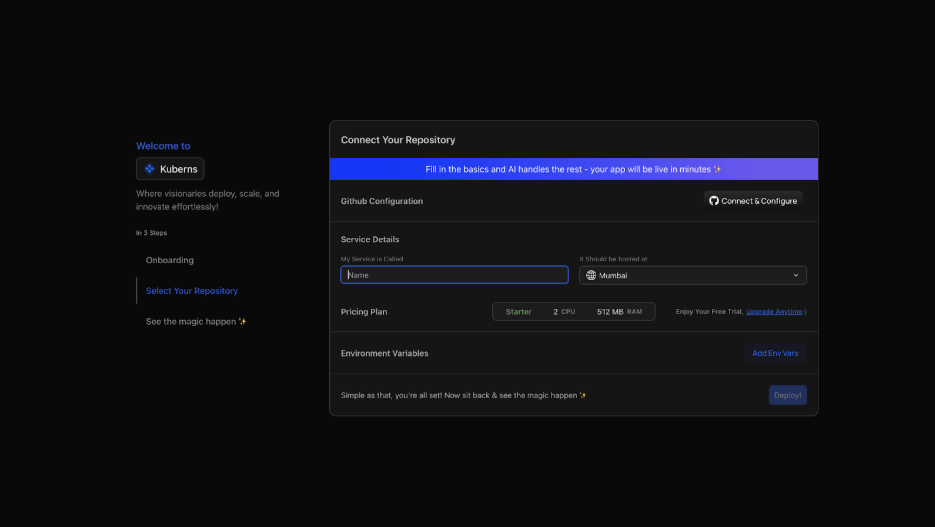
On the **Creating a Service** page, connect your GitHub account and select your repository and branch. Kuberns scans your project and automatically detects your runtime (Node.js, Python, Go, PHP), framework, build command, and start command. Nothing to fill in manually.
#### Step 3: Add Your Environment Variables

Add your API keys, database connection strings, and secrets in the Environment Variables section. Add them individually or upload a `.env` file directly. Every value is encrypted at rest and injected securely at runtime.
#### Step 4: Deploy

Click **Deploy**. Kuberns installs dependencies, runs your build command, starts your app on enterprise-grade cloud infrastructure, provisions a live HTTPS URL, and configures CI/CD so every future push triggers an automatic redeploy. The whole process takes under 5 minutes.
#### Step 5: Your App is Live

Your app is live with a `*.kuberns.app` URL. Add a custom domain with a single DNS record. Real-time logs, deployment history, autoscaling, and uptime monitoring are all available in the dashboard with no additional setup.
 ---
## GCP vs Kuberns: Side-by-Side
| Feature | Google Cloud Platform | Kuberns |
|---|---|---|
| Stack auto-detection | No | Yes, AI-driven |
| Dockerfile required | Yes (Cloud Run / GKE) | No |
| IAM configuration | Required | Not required |
| CI/CD on git push | Manual setup via Cloud Build | Built-in, automatic |
| Managed SSL | Manual or complex config | Automatic on every deploy |
| Autoscaling | Yes, but requires configuration | Automatic, AI-driven |
| Starting price | Free tier, then $40 to $120/month for basic setup | $7/month |
| Egress charges | Yes, billed per GB | Included |
| Time to first deployment | Hours to days | Under 5 minutes |
| DevOps expertise required | Yes | No |
| Free trial | $300 for 90 days | ~$14 for 30 days |
---
## Who Should Use GCP?
GCP is the right choice for teams with requirements that map directly to its strengths:
**Large-scale data analytics teams** running multi-terabyte datasets where BigQuery's performance delivers real value.
**ML and AI research teams** that need GPU and TPU access, Vertex AI pipelines, and Gemini API integration at scale.
**Enterprise organisations** already invested in Google Workspace that need native integration across products.
**Teams with dedicated cloud engineers** who have the expertise to manage GCP IAM, networking, and service configuration correctly.
For everyone else (individual developers, small teams, funded startups, and companies without a dedicated DevOps hire), GCP's complexity outweighs its advantages for most typical app deployments.
---
## The Faster Path to Production
GCP is a serious platform. Its AI and data services are world-class, and its global network is among the best available. But for most teams building and deploying web applications, it is far more infrastructure than the job requires.
The time spent configuring IAM roles, writing Cloud Build YAML, managing Docker images, and diagnosing service account permission errors is time not spent building product. That trade-off makes sense for large enterprises with dedicated cloud teams. For everyone else, [Kuberns](https://kuberns.com) delivers the same enterprise-grade infrastructure without the operational overhead.
Connect your GitHub repo, set your environment variables, and get a production-grade app live in under 5 minutes. Every subsequent push redeploys automatically.
For teams evaluating alternatives to GCP, the [Google Cloud alternatives guide](https://kuberns.com/blogs/google-cloud-alternatives/) covers the full landscape of options available in 2026. If cloud costs are the primary concern, the guide on [how to reduce cloud infrastructure costs](https://kuberns.com/blogs/cloud-cost-optimisation/) is also worth reading alongside it.
[Start deploying on Kuberns for free](https://dashboard.kuberns.com/)
---
## GCP vs Kuberns: Side-by-Side
| Feature | Google Cloud Platform | Kuberns |
|---|---|---|
| Stack auto-detection | No | Yes, AI-driven |
| Dockerfile required | Yes (Cloud Run / GKE) | No |
| IAM configuration | Required | Not required |
| CI/CD on git push | Manual setup via Cloud Build | Built-in, automatic |
| Managed SSL | Manual or complex config | Automatic on every deploy |
| Autoscaling | Yes, but requires configuration | Automatic, AI-driven |
| Starting price | Free tier, then $40 to $120/month for basic setup | $7/month |
| Egress charges | Yes, billed per GB | Included |
| Time to first deployment | Hours to days | Under 5 minutes |
| DevOps expertise required | Yes | No |
| Free trial | $300 for 90 days | ~$14 for 30 days |
---
## Who Should Use GCP?
GCP is the right choice for teams with requirements that map directly to its strengths:
**Large-scale data analytics teams** running multi-terabyte datasets where BigQuery's performance delivers real value.
**ML and AI research teams** that need GPU and TPU access, Vertex AI pipelines, and Gemini API integration at scale.
**Enterprise organisations** already invested in Google Workspace that need native integration across products.
**Teams with dedicated cloud engineers** who have the expertise to manage GCP IAM, networking, and service configuration correctly.
For everyone else (individual developers, small teams, funded startups, and companies without a dedicated DevOps hire), GCP's complexity outweighs its advantages for most typical app deployments.
---
## The Faster Path to Production
GCP is a serious platform. Its AI and data services are world-class, and its global network is among the best available. But for most teams building and deploying web applications, it is far more infrastructure than the job requires.
The time spent configuring IAM roles, writing Cloud Build YAML, managing Docker images, and diagnosing service account permission errors is time not spent building product. That trade-off makes sense for large enterprises with dedicated cloud teams. For everyone else, [Kuberns](https://kuberns.com) delivers the same enterprise-grade infrastructure without the operational overhead.
Connect your GitHub repo, set your environment variables, and get a production-grade app live in under 5 minutes. Every subsequent push redeploys automatically.
For teams evaluating alternatives to GCP, the [Google Cloud alternatives guide](https://kuberns.com/blogs/google-cloud-alternatives/) covers the full landscape of options available in 2026. If cloud costs are the primary concern, the guide on [how to reduce cloud infrastructure costs](https://kuberns.com/blogs/cloud-cost-optimisation/) is also worth reading alongside it.
[Start deploying on Kuberns for free](https://dashboard.kuberns.com/)
 ---
## Frequently Asked Questions
### What is Google Cloud Platform used for?
Google Cloud Platform is used for hosting web applications, running virtual machines, managing databases, building AI and ML models, processing large-scale data with BigQuery, and running containerized workloads with Google Kubernetes Engine. It is most commonly adopted by enterprises with data-heavy workloads and teams already in the Google ecosystem.
### Is GCP harder to use than AWS?
GCP and AWS are both complex IaaS platforms with steep learning curves. Both require significant DevOps knowledge to deploy and maintain a production application correctly. For teams without a cloud engineer, a managed platform like [Kuberns](https://kuberns.com) removes that complexity entirely.
### Is Google Cloud Platform free?
GCP offers a Free Tier with always-free usage limits on select products, including 1 f1-micro VM per month and 5 GB of Cloud Storage, plus a 90-day free trial with $300 in credits for new accounts. Beyond the free tier, costs can grow quickly without active management.
### What is the difference between GCP and AWS?
AWS holds a larger global market share and has a broader third-party ecosystem. GCP leads in data analytics (BigQuery), machine learning (Vertex AI), and networking performance. Both require dedicated cloud engineers to use effectively in production.
### Can I deploy an app on GCP without DevOps experience?
Not easily. Even Cloud Run requires IAM setup, project configuration, billing account linking, and service-specific configuration. For developers without DevOps experience, [Kuberns](https://kuberns.com) is the better option: connect your GitHub repo, set your environment variables, and deploy in under 5 minutes with no cloud account required.
### What is Google Cloud Run and how does it compare to Kuberns?
Cloud Run is a serverless container platform that requires a Docker image, Artifact Registry push, and IAM permissions before anything runs. Kuberns requires none of that: no Docker, no IAM, auto-detection of your stack, and deployment from GitHub in under 5 minutes.
### How much does Google Cloud Platform cost for a small app?
A basic GCP setup for a small web app typically costs between $40 and $120 per month, plus egress charges. Kuberns starts at $7 per month with transparent pay-as-you-go pricing and no hidden egress charges.
### What are the main GCP services developers use?
Compute Engine (VMs), Cloud Run (serverless containers), Google Kubernetes Engine (managed Kubernetes), Cloud SQL (managed databases), Cloud Storage (object storage), BigQuery (data analytics), Vertex AI (machine learning), Firebase (mobile and web backends), and Cloud Build (CI/CD pipelines).
---
- [More Deployment Guides articles](https://kuberns.com/blogs/category/deployment-guides/1/)
- [All articles](https://kuberns.com/blogs/)
---
## Frequently Asked Questions
### What is Google Cloud Platform used for?
Google Cloud Platform is used for hosting web applications, running virtual machines, managing databases, building AI and ML models, processing large-scale data with BigQuery, and running containerized workloads with Google Kubernetes Engine. It is most commonly adopted by enterprises with data-heavy workloads and teams already in the Google ecosystem.
### Is GCP harder to use than AWS?
GCP and AWS are both complex IaaS platforms with steep learning curves. Both require significant DevOps knowledge to deploy and maintain a production application correctly. For teams without a cloud engineer, a managed platform like [Kuberns](https://kuberns.com) removes that complexity entirely.
### Is Google Cloud Platform free?
GCP offers a Free Tier with always-free usage limits on select products, including 1 f1-micro VM per month and 5 GB of Cloud Storage, plus a 90-day free trial with $300 in credits for new accounts. Beyond the free tier, costs can grow quickly without active management.
### What is the difference between GCP and AWS?
AWS holds a larger global market share and has a broader third-party ecosystem. GCP leads in data analytics (BigQuery), machine learning (Vertex AI), and networking performance. Both require dedicated cloud engineers to use effectively in production.
### Can I deploy an app on GCP without DevOps experience?
Not easily. Even Cloud Run requires IAM setup, project configuration, billing account linking, and service-specific configuration. For developers without DevOps experience, [Kuberns](https://kuberns.com) is the better option: connect your GitHub repo, set your environment variables, and deploy in under 5 minutes with no cloud account required.
### What is Google Cloud Run and how does it compare to Kuberns?
Cloud Run is a serverless container platform that requires a Docker image, Artifact Registry push, and IAM permissions before anything runs. Kuberns requires none of that: no Docker, no IAM, auto-detection of your stack, and deployment from GitHub in under 5 minutes.
### How much does Google Cloud Platform cost for a small app?
A basic GCP setup for a small web app typically costs between $40 and $120 per month, plus egress charges. Kuberns starts at $7 per month with transparent pay-as-you-go pricing and no hidden egress charges.
### What are the main GCP services developers use?
Compute Engine (VMs), Cloud Run (serverless containers), Google Kubernetes Engine (managed Kubernetes), Cloud SQL (managed databases), Cloud Storage (object storage), BigQuery (data analytics), Vertex AI (machine learning), Firebase (mobile and web backends), and Cloud Build (CI/CD pipelines).
---
- [More Deployment Guides articles](https://kuberns.com/blogs/category/deployment-guides/1/)
- [All articles](https://kuberns.com/blogs/)