# What Is Heroku and Is It Still Relevant in 2026
> Heroku is a popular PaaS for deploying projects without managing servers. See how it works, pricing and what AI-powered deployment platforms offer.
- **Author**: parth-kanpariya
- **Published**: 2025-12-26
- **Modified**: 2026-03-25
- **Category**: Deployment Guides
- **URL**: https://kuberns.com/blogs/what-is-heroku/
---
Heroku is a Platform as a Service, or PaaS, that allows developers to deploy applications without managing servers directly. Instead of provisioning cloud infrastructure manually, developers push their code to Heroku, and the platform runs it inside managed containers called dynos. [Explore the pricing details here](https://kuberns.com/blogs/heroku-pricing-explained/).
When Heroku launched, it made deployment significantly simpler. It introduced automation for build processes and infrastructure management, eliminating the need to configure raw servers. For many startups and developers, this was a big shift from a traditional cloud setup.
However, [Heroku deployment](https://kuberns.com/blogs/heroku-app-deployment/) is not fully automatic. Developers still configure environment variables, choose dyno types, attach add-ons for databases or caching, and manage scaling decisions. The infrastructure is abstracted, but the deployment workflow still requires manual setup and ongoing adjustments.
Another major shift has been pricing. Heroku no longer offers a traditional free tier for running applications. Every application now requires paid dynos and paid add-ons from the start. For many teams, this changed how they evaluate Heroku for new projects.
In 2026, deployment expectations have evolved again. Developers now look for AI platforms that automate the entire deployment process, not just the infrastructure layer.
This is where the [Agentic AI-powered deployment platform](https://kuberns.com/) comes in. Instead of configuring services and scaling rules manually, developers connect their code and let the platform handle setup, deployment, and ongoing management automatically.
This guide explains what Heroku is, how it works today, where it fits, and how modern Agentic AI platforms are reshaping application deployment.
TL;DR
If you just want the quick answer, this will help you:
* Heroku is a Platform as a Service that lets developers deploy applications without managing servers directly. It simplified deployment compared to traditional cloud infrastructure.
* However, deployment on Heroku still requires manual configuration, dyno management, and add-on setup.
* The free tier has ended, and all applications now require paid dynos and services.
* In 2026, there is an Agentic AI platform called Kuberns that automates the entire deployment process, not just infrastructure.
* [Agentic AI](https://dashboard.kuberns.com/) reduces manual setup further by handling deployment and operational management automatically.
If you want to understand how Heroku works, where it fits today, and how modern deployment has evolved beyond traditional PaaS, keep reading.
## What Is Heroku Used For and How Does It Work?
[Heroku](https://en.wikipedia.org/wiki/Heroku) is mainly used to deploy and run web applications without managing servers directly. It became popular because it offered a simpler alternative to setting up virtual machines, networking, and infrastructure on cloud providers.
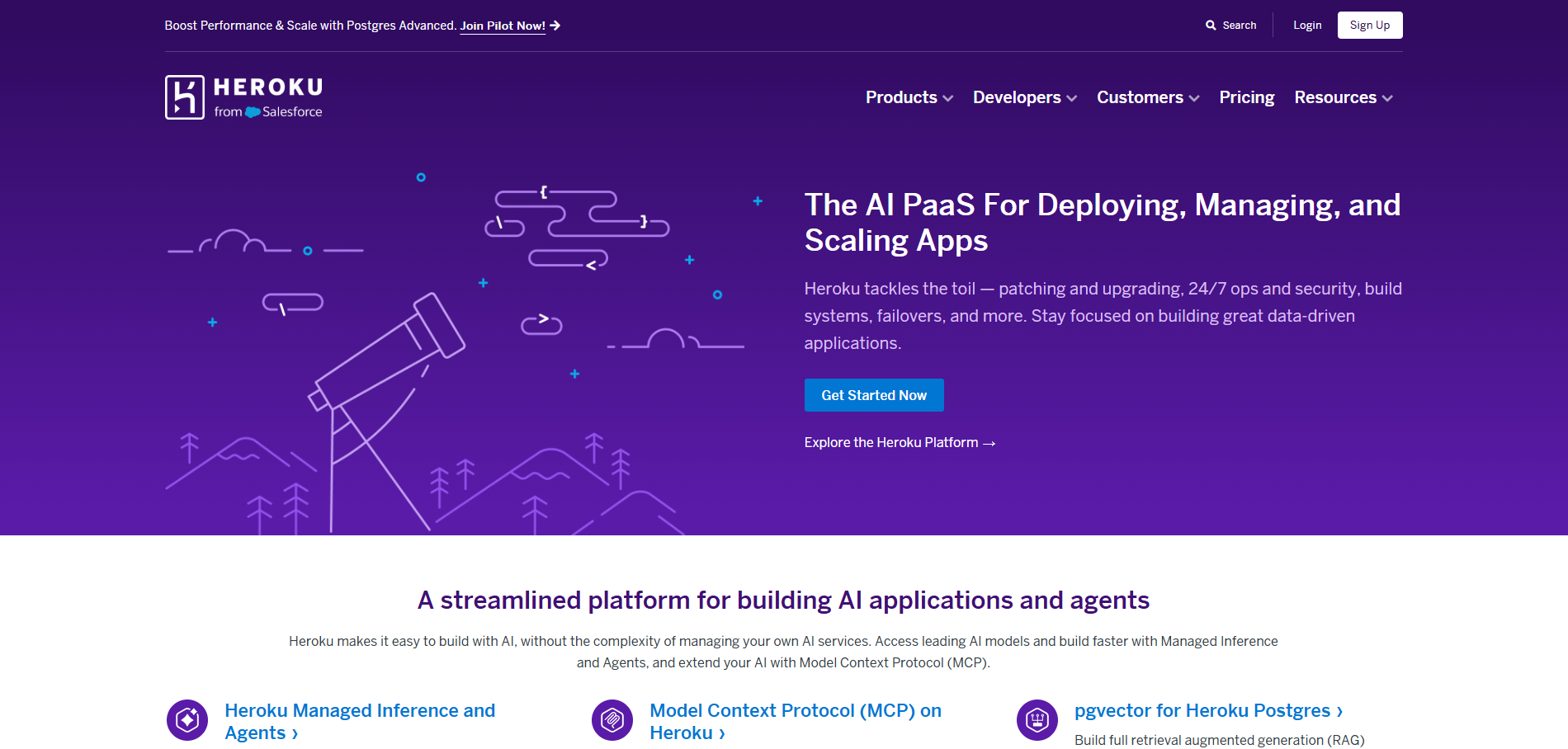
Developers often choose Heroku when they want to move quickly from writing code to running an application online. It is commonly used for backend APIs, full-stack applications, internal tools, MVPs, and early-stage products. It supports multiple programming languages, which makes it flexible for different types of projects.
When you deploy an application on Heroku, it runs inside containers called dynos. Each application has its own environment, configuration settings, and connected services such as databases or caching tools. You create an app, push your code, and Heroku builds it using predefined build systems.
While Heroku manages the underlying infrastructure, developers still make several decisions during deployment. You configure environment variables, attach add-ons, select dyno types, and decide how many dynos should run. If traffic increases, you manually scale by adjusting dyno counts or upgrading plans.
The process is structured and reliable. But it is not fully automatic. Deployment is simplified compared to raw cloud infrastructure, yet it still requires setup and configuration at each stage.
### What are the limitations of using Heroku in 2026
Heroku helped make cloud deployment more accessible. But developer expectations in 2026 are different from when Heroku first became popular.
One major change is pricing. The free tier is no longer available. Every application now requires paid dynos and paid add-ons. Even small projects or early experiments involve monthly costs from the beginning.

Another limitation is that deployment still depends on manual configuration. Developers choose dyno sizes, connect services, manage scaling, and monitor usage. While Heroku hides servers, it does not remove the responsibility of managing how the application runs.

Operational work also continues after deployment. Teams monitor logs, adjust scaling, review performance, and control costs over time. These tasks are manageable, but they require ongoing attention.
Heroku simplifies infrastructure compared to managing cloud services directly. However, it does not automate the full deployment lifecycle from start to finish.
> This is where teams have started asking a new question: If infrastructure can be abstracted, can deployment itself be automated completely? That question leads to the next evolution in [application deployment with agentic AI](https://kuberns.com/).”
#### Looking for a Modern AI Alternative to Heroku?
If you are exploring what Heroku offers and wondering whether it is still the right choice in 2026, this guide will help you.
## Go Beyond Traditional PaaS: Use Agentic AI For Deployment by Kuberns
Heroku simplified cloud infrastructure. It removed the need to manage servers directly. That was a major shift when it first launched. But in 2026, the expectation is different.
Developers do not just want infrastructure abstraction. They want the entire deployment process to be automated. They want to connect their code and see it running without configuring dynos, attaching add-ons, managing scaling, or adjusting cloud resources manually.
This is where [Agentic AI by Kuberns](https://dashboard.kuberns.com/) changes the model.
Instead of asking developers to configure how an application runs, an Agentic AI-powered platform handles setup, deployment, and operational adjustments automatically. The system understands what your application needs and manages the environment for you from the start.

With [Kuberns](https://kuberns.com/), you connect your GitHub repository and click deploy. There are no infrastructure setup steps, no scaling configuration screens, and [no per-user pricing](https://kuberns.com/pricing). The platform handles deployment and ongoing management automatically in the background.
The goal is simple. Deployment should feel like publishing your work, not managing a cloud environment.
> “As platforms evolve beyond traditional PaaS, [Agentic AI](https://kuberns.com/) represents the next phase of application deployment. It reduces manual effort, simplifies pricing, and allows teams to focus on building instead of configuring infrastructure.”
## Why Teams Choose Kuberns Over Heroku?
The difference is not just features. It is the amount of manual work that remains after you click deploy.
| Category | **Kuberns (Agentic AI)** | Heroku |
| ----------------------------- | ------------------------------------ | ---------------------------------------------------------------------- |
| Deployment Model | **Agentic AI for Deployment** | Traditional PaaS |
| Setup Process | **Connect GitHub and click deploy** | Create app, configure dynos, attach add-ons, set environment variables |
| Configuration Required | **Fully automated** | Manual configuration during setup |
| Add-ons & Services | **Handled within the platform** | Attach and manage separately |
| Pricing Model | **Usage-based, no per-user pricing** | Dyno-based + add-ons |
| Operational Work After Deploy | **Minimal ongoing effort** | Monitor, adjust, manage resources |
| Time to First Deploy | **Live under 15 minutes** | 30–50 minutes depending on setup |
## Conclusion
Heroku changed how developers approached deployment. It removed the need to manage servers directly and made getting an application online much easier than traditional cloud infrastructure. But in 2026, expectations have shifted again.
Heroku still works for many use cases. But it follows a traditional PaaS model where setup, scaling, and configuration decisions remain part of the developer’s responsibility.
[Agentic AI](https://kuberns.com/) represents the next step.
Instead of asking you to configure how your application runs, Kuberns automates the entire deployment lifecycle. You connect your code, click deploy, and the system handles setup, infrastructure, and management in the background.
If you are evaluating Heroku in 2026, it may be worth exploring how deployment has evolved beyond traditional PaaS.
[Deploy your next application with Agentic AI](https://dashboard.kuberns.com/)
## Frequently Asked Questions about Heroku
### Is Heroku still free?
No. Heroku no longer offers a traditional free tier for running applications. Every app requires paid dynos and paid add-ons. This change has led many developers to reconsider Heroku for hobby projects, MVPs, and early-stage products.
### Is Heroku still a good choice in 2026?
Heroku remains a reliable platform for teams seeking a managed PaaS and comfortable with manual setup and ongoing configuration. However, in 2026, many teams look for platforms that require less setup, less operational work after deployment, and more predictable pricing, which is why alternatives like Kuberns are increasingly considered.
### What are the limitations of Heroku?
Some common limitations include dyno-based pricing that increases over time, manual configuration during deployment, reliance on add-ons for essential services, and ongoing operational tasks such as scaling and monitoring. The removal of the free tier has also impacted smaller projects.
### What are dynos in Heroku?
Dynos are the containers that run your application processes on Heroku. You choose the type and number of dynos based on your workload, and pricing increases as you scale up dynos or add more process types.
### Can I migrate from Heroku to Kuberns?
Yes. Applications running on Heroku can typically be migrated by connecting the same codebase to Kuberns. The main difference is that Kuberns removes the need to reconfigure dynos, scaling rules, and infrastructure during and after deployment.
### What is the best alternative to Heroku?
Modern alternatives to Heroku include Agentic AI platforms like Kuberns that automate the entire deployment process from code connection to production, reducing manual setup and ongoing infrastructure management.
### How is Kuberns different from Heroku?
Heroku simplifies infrastructure but still requires manual configuration and dyno management. [Kuberns uses Agentic AI](https://kuberns.com/) to automate deployment from start to finish. Developers connect their GitHub repository, click deploy, and the platform handles setup, scaling, and operational management automatically, with no per-user pricing.
### Who should choose Kuberns over Heroku?
Teams that want minimal setup, less operational overhead, and predictable cloud costs in 2026 often choose Kuberns. It is especially useful for startups and growing teams that want to focus on building features instead of managing deployment and infrastructure.
---
- [More Deployment Guides articles](https://kuberns.com/blogs/category/deployment-guides/1/)
- [All articles](https://kuberns.com/blogs/)
 ## Frequently Asked Questions about Heroku
### Is Heroku still free?
No. Heroku no longer offers a traditional free tier for running applications. Every app requires paid dynos and paid add-ons. This change has led many developers to reconsider Heroku for hobby projects, MVPs, and early-stage products.
### Is Heroku still a good choice in 2026?
Heroku remains a reliable platform for teams seeking a managed PaaS and comfortable with manual setup and ongoing configuration. However, in 2026, many teams look for platforms that require less setup, less operational work after deployment, and more predictable pricing, which is why alternatives like Kuberns are increasingly considered.
### What are the limitations of Heroku?
Some common limitations include dyno-based pricing that increases over time, manual configuration during deployment, reliance on add-ons for essential services, and ongoing operational tasks such as scaling and monitoring. The removal of the free tier has also impacted smaller projects.
### What are dynos in Heroku?
Dynos are the containers that run your application processes on Heroku. You choose the type and number of dynos based on your workload, and pricing increases as you scale up dynos or add more process types.
### Can I migrate from Heroku to Kuberns?
Yes. Applications running on Heroku can typically be migrated by connecting the same codebase to Kuberns. The main difference is that Kuberns removes the need to reconfigure dynos, scaling rules, and infrastructure during and after deployment.
### What is the best alternative to Heroku?
Modern alternatives to Heroku include Agentic AI platforms like Kuberns that automate the entire deployment process from code connection to production, reducing manual setup and ongoing infrastructure management.
### How is Kuberns different from Heroku?
Heroku simplifies infrastructure but still requires manual configuration and dyno management. [Kuberns uses Agentic AI](https://kuberns.com/) to automate deployment from start to finish. Developers connect their GitHub repository, click deploy, and the platform handles setup, scaling, and operational management automatically, with no per-user pricing.
### Who should choose Kuberns over Heroku?
Teams that want minimal setup, less operational overhead, and predictable cloud costs in 2026 often choose Kuberns. It is especially useful for startups and growing teams that want to focus on building features instead of managing deployment and infrastructure.
---
- [More Deployment Guides articles](https://kuberns.com/blogs/category/deployment-guides/1/)
- [All articles](https://kuberns.com/blogs/)
## Frequently Asked Questions about Heroku
### Is Heroku still free?
No. Heroku no longer offers a traditional free tier for running applications. Every app requires paid dynos and paid add-ons. This change has led many developers to reconsider Heroku for hobby projects, MVPs, and early-stage products.
### Is Heroku still a good choice in 2026?
Heroku remains a reliable platform for teams seeking a managed PaaS and comfortable with manual setup and ongoing configuration. However, in 2026, many teams look for platforms that require less setup, less operational work after deployment, and more predictable pricing, which is why alternatives like Kuberns are increasingly considered.
### What are the limitations of Heroku?
Some common limitations include dyno-based pricing that increases over time, manual configuration during deployment, reliance on add-ons for essential services, and ongoing operational tasks such as scaling and monitoring. The removal of the free tier has also impacted smaller projects.
### What are dynos in Heroku?
Dynos are the containers that run your application processes on Heroku. You choose the type and number of dynos based on your workload, and pricing increases as you scale up dynos or add more process types.
### Can I migrate from Heroku to Kuberns?
Yes. Applications running on Heroku can typically be migrated by connecting the same codebase to Kuberns. The main difference is that Kuberns removes the need to reconfigure dynos, scaling rules, and infrastructure during and after deployment.
### What is the best alternative to Heroku?
Modern alternatives to Heroku include Agentic AI platforms like Kuberns that automate the entire deployment process from code connection to production, reducing manual setup and ongoing infrastructure management.
### How is Kuberns different from Heroku?
Heroku simplifies infrastructure but still requires manual configuration and dyno management. [Kuberns uses Agentic AI](https://kuberns.com/) to automate deployment from start to finish. Developers connect their GitHub repository, click deploy, and the platform handles setup, scaling, and operational management automatically, with no per-user pricing.
### Who should choose Kuberns over Heroku?
Teams that want minimal setup, less operational overhead, and predictable cloud costs in 2026 often choose Kuberns. It is especially useful for startups and growing teams that want to focus on building features instead of managing deployment and infrastructure.
---
- [More Deployment Guides articles](https://kuberns.com/blogs/category/deployment-guides/1/)
- [All articles](https://kuberns.com/blogs/)