# What Is Linode? The Complete Guide to Akamai Cloud in 2026
> Learn what Linode is, how Akamai Cloud works, what products and pricing it offers, and whether IaaS hosting is actually the right choice for your team.
- **Author**: harsh-kanani
- **Published**: 2026-06-15
- **Modified**: 2026-06-15
- **Category**: Deployment Guides
- **URL**: https://kuberns.com/blogs/what-is-linode/
---
Linode is a Linux-based cloud infrastructure platform founded in 2003 and acquired by Akamai in 2022 for approximately $900 million. Now operating as Akamai Cloud Computing, it offers Linux virtual machines, managed Kubernetes, object storage, and GPU instances across 41 global regions. Linode sits in a clear position in the cloud market: more capable than shared hosting, more approachable than AWS or Google Cloud.
This guide covers what Linode is, what products it offers, how pricing works, who it is built for, and whether IaaS is actually what your team needs in 2026.
### TL;DR
- Linode is a developer-focused IaaS cloud platform, now rebranded as Akamai Cloud Computing after a 2022 acquisition
- Core products include Linodes (VMs), LKE (managed Kubernetes), NodeBalancers, Object Storage, Block Storage, and Managed Databases
- Pricing starts at $5/month for a Nanode (1 GB RAM)
- Linode is best for teams with Linux and DevOps skills who need full server control
- Teams who want deployment without server management should look at AI-native PaaS platforms instead
## What Is Linode (Akamai Cloud)?
Linode was founded in 2003 by Christopher Aker, one of the oldest independent VPS providers in the industry. In 2022, Akamai Technologies acquired it for approximately $900 million. In February 2023, Akamai completed a full rebrand to Akamai Cloud Computing (Akamai Connected Cloud). The underlying product remains recognisably Linode: Linux VMs, clean dashboard, predictable pricing.
The acquisition expanded the platform from 11 original data centres to 41 compute regions across 36 cities globally. Akamai's CDN is now natively integrated with cloud compute. Enterprise compliance certifications (ISO, SOC2, HIPAA) opened the platform to regulated industries. GPU plans were introduced, including the NVIDIA RTX PRO 6000 Blackwell for LLM serving, anchoring the Akamai Inference Cloud product launched in October 2025. The control panel, documentation quality, and monthly-capped pricing structure remained unchanged.
> If you are already comparing Linode to other providers, see the full breakdown of the [best Linode alternatives in 2026](/blogs/linode-alternatives/) to understand where each platform fits.
## What Products Does Linode (Akamai Cloud) Offer?
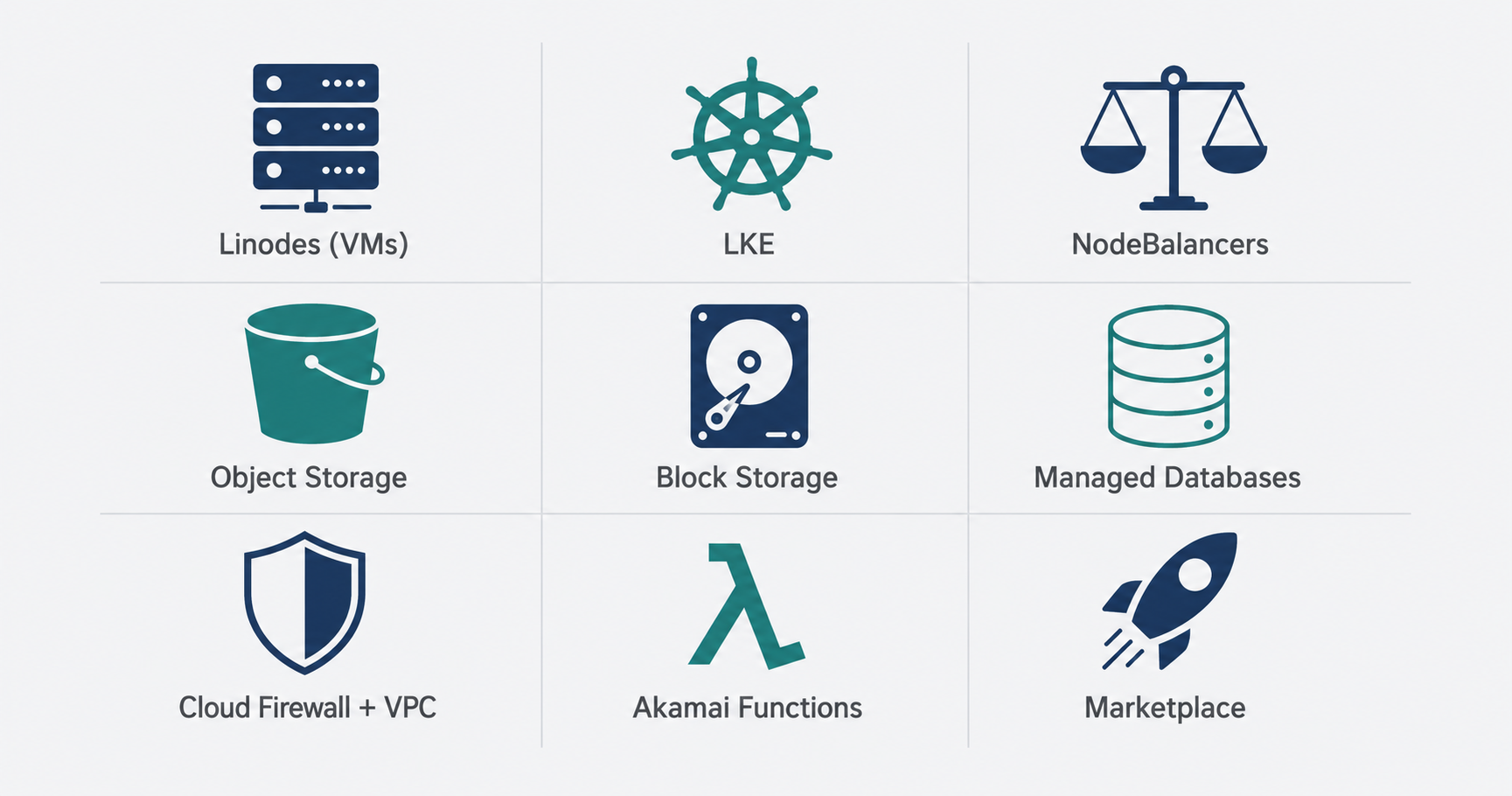
Linode's product catalog covers compute, storage, networking, databases, and application infrastructure.
**Linodes (Compute Instances):** The core product: Linux VMs in multiple tiers. The Nanode starts at $5/month (1 vCPU, 1 GB RAM). Shared CPU plans suit development and variable workloads. Dedicated CPU plans (G6, G7, G8 EPYC) give you exclusive physical cores for consistent production performance. High Memory plans are suited to in-memory databases and caching. GPU plans using NVIDIA hardware (including the RTX PRO 6000 Blackwell) power AI inference workloads via Akamai Inference Cloud.
**LKE (Linode Kubernetes Engine):** Managed Kubernetes with a free control plane. You pay only for worker nodes, starting at $60/month. Integrates with NodeBalancers, Block Storage, and Container Registry.
**NodeBalancers:** Managed load balancers for distributing traffic across multiple Linodes without configuring Nginx or HAProxy yourself.
**Object Storage:** S3-compatible storage for files, backups, and static assets, fully compatible with AWS S3 SDKs and tooling.
**Block Storage:** Attachable SSD volumes that persist independently of your Linode instance.
**Managed Databases:** Fully managed MySQL and PostgreSQL with automated backups, failover, and patching.
**Cloud Firewall, VPC, and Akamai Functions:** Network-level security, private networking, and serverless compute for event-driven workloads. One-click Marketplace deployments cover WordPress, Docker, LAMP, and more.
> For a direct side-by-side of how Linode's product surface compares to DigitalOcean, see [Linode vs DigitalOcean vs Kuberns](/blogs/linode-vs-digitalocean-vs-kuberns-ai/).
## How Does Linode Pricing Work in 2026?
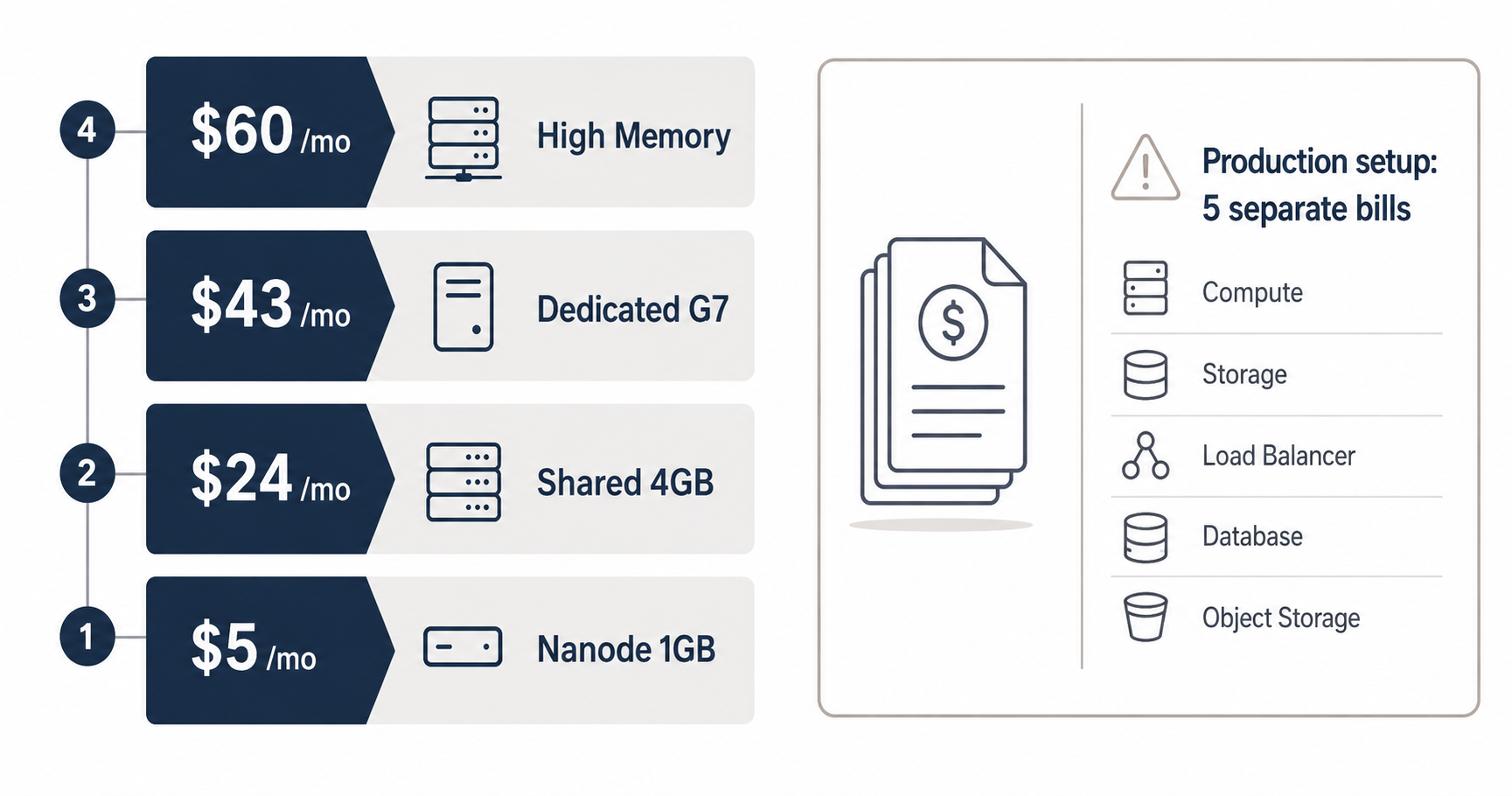
Linode pricing is structured around monthly caps, which makes it more predictable than AWS or GCP billing. You are not surprised by per-request charges or egress multipliers on the compute side. Here is a summary of current entry-level pricing across the main products:
| Product | Starting Price |
|---|---|
| Nanode 1 GB (Shared CPU) | $5/month |
| Linode 4 GB (Shared CPU) | $24/month |
| Dedicated CPU G6 4 GB | $36/month |
| Dedicated CPU G7 4 GB | $43/month |
| High Memory 24 GB | $60/month |
| LKE (Kubernetes) | $60/month (worker nodes) |
| Managed Databases (PostgreSQL) | Starting ~$15/month |
| Object Storage | Based on storage + transfer |
| NodeBalancers | ~$10/month per balancer |
One important note: Linode prices increased after the Akamai acquisition. Some long-term users noted that the post-2023 pricing is less aggressive than it was when Linode competed as an independent provider. There is no free tier. Unlike some PaaS alternatives, Linode requires a paid plan from the start, though new accounts typically receive credits to get started.
Billing complexity also increases as you layer products. A production setup on Linode typically includes a Linode instance, Block Storage volume, NodeBalancer, Managed Database, and Object Storage, each billed separately on its own line.
> If cost is a primary driver, see how Linode pricing compares in our [Linode vs Vultr vs Kuberns breakdown](/blogs/linode-vs-vultr-vs-kuberns-ai/).
 ## What Is Linode Good For? Use Cases and Limitations
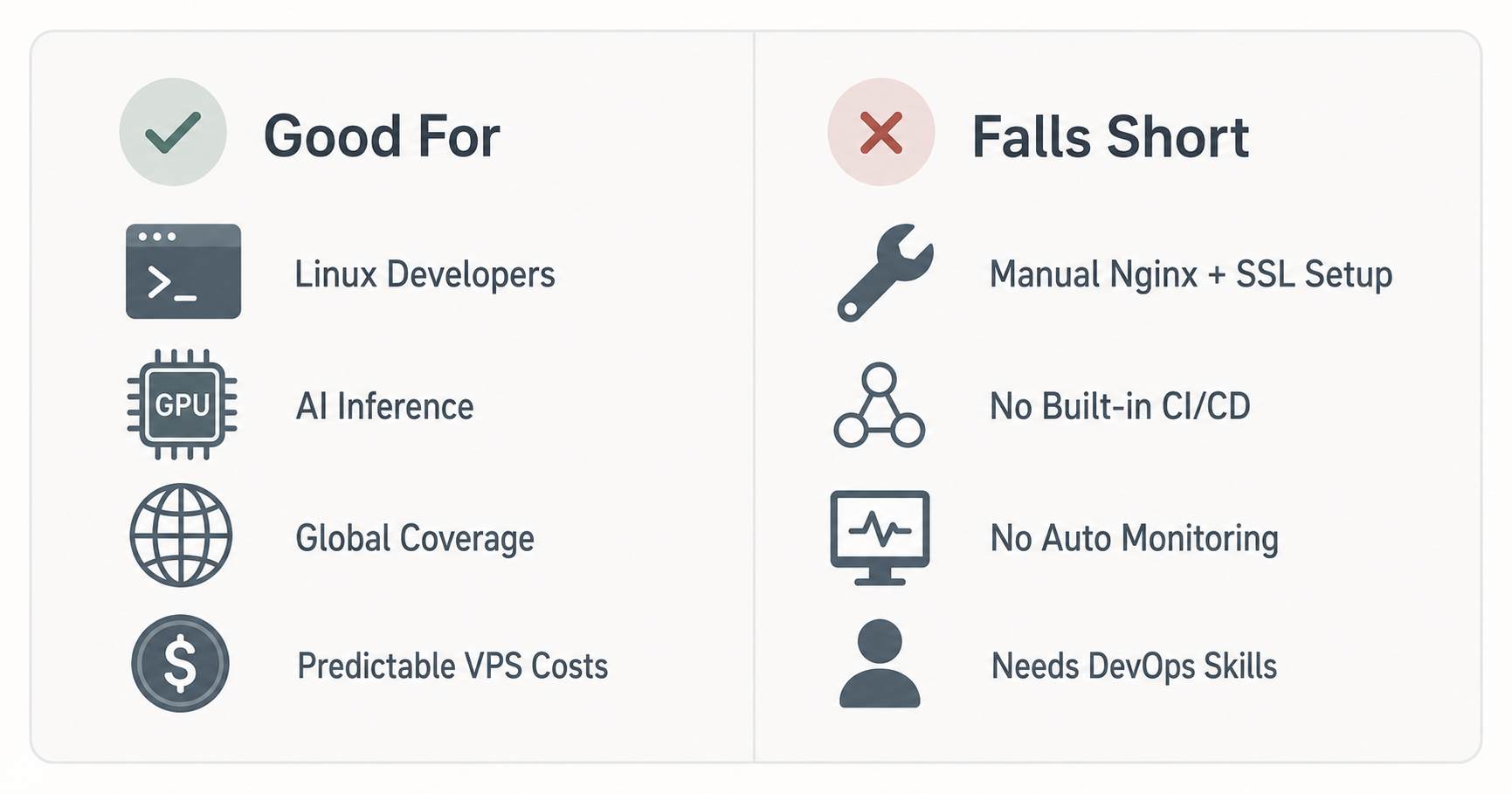
Linode is a strong fit for specific teams and workloads, and a poor fit for others.
**Where Linode works well:** Linux-confident developers who want full root access and a clean VPS environment. Teams with custom OS or kernel requirements a managed PaaS cannot accommodate. Budget-conscious infrastructure teams who need predictable monthly VPS costs. GPU and AI inference workloads via Akamai's RTX PRO 6000 Blackwell plans and Akamai Inference Cloud. Teams needing global data centre coverage in regions where AWS and GCP are expensive or limited. For a broader view of the IaaS landscape, see the [top 10 IaaS cloud providers](/blogs/top-10-iaas-cloud-providers/) compared across price and features.
**Where Linode falls short:** Linode is IaaS. It gives you servers, not a deployment platform. Deploying an application means configuring Nginx, setting up SSL, writing CI/CD pipelines, and managing environment variables yourself. There is no AI-native layer that detects your stack or configures your environment. Monitoring, backups, and auto-scaling must be assembled independently. For teams without a dedicated DevOps engineer, that operational overhead is the real cost of Linode. It does not appear on the monthly invoice.
> See how the [DigitalOcean vs Linode comparison](/blogs/linode-vs-digitalocean-vs-kuberns-ai/) plays out across pricing, managed services, and developer experience for teams evaluating both platforms.
## Do You Actually Need IaaS, or Do You Need Something Smarter?
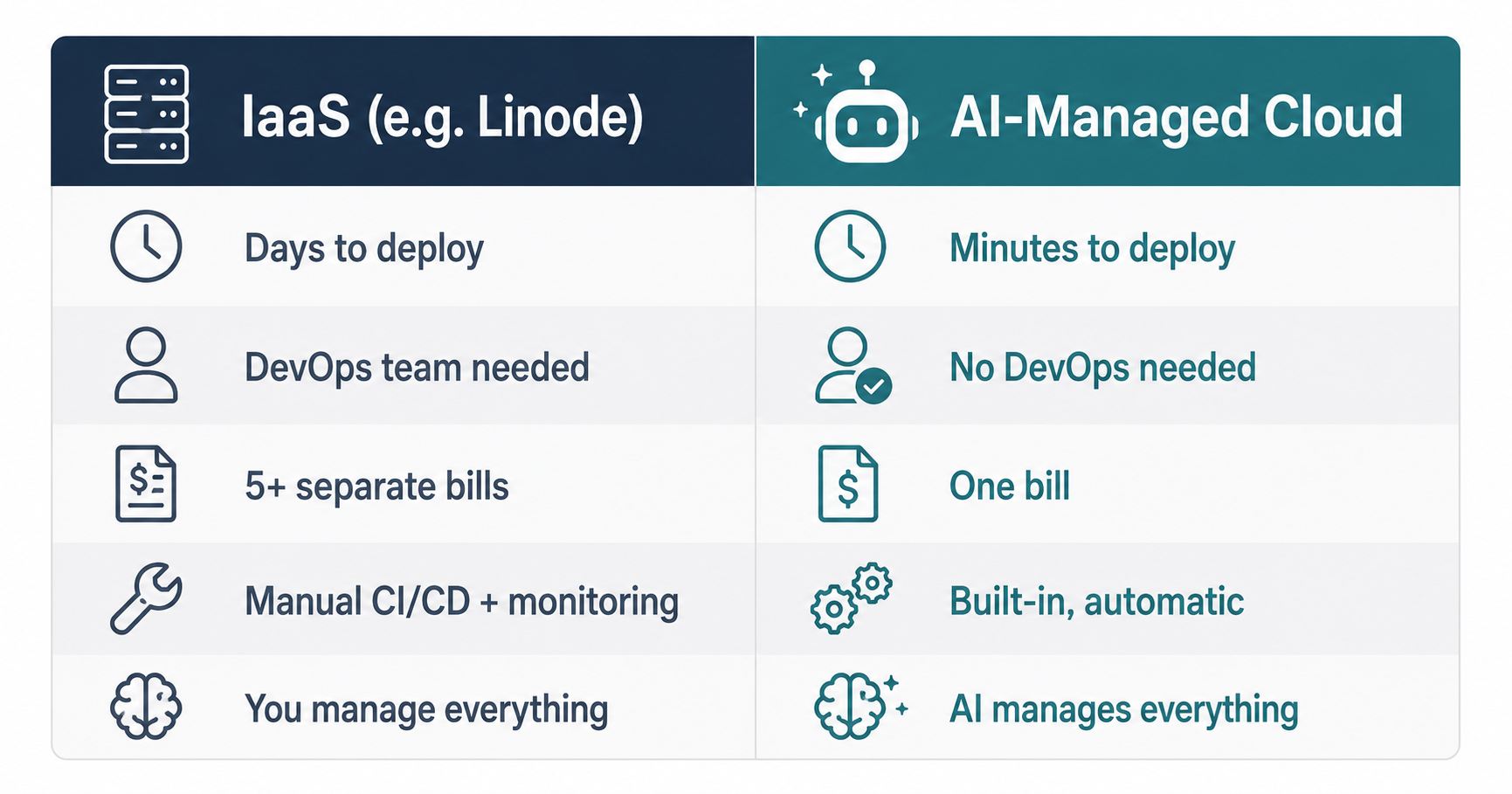
IaaS is the right call for teams with strong Linux skills, a dedicated DevOps function, and workloads that genuinely require root access. For a framework on when IaaS actually makes sense versus when it is working against you, see [how startups and enterprises use IaaS to scale](/blogs/how-startups-and-enterprises-can-use-iaas-services-to-scale-faster/) and where it stops being the right tool. For everyone else, the real cost of IaaS is not the server bill. It is the operational tax. The gap between "I have a Linode instance" and "my app is deployed, monitored, and backed up" is where most teams lose weeks.
### What Is Kuberns?
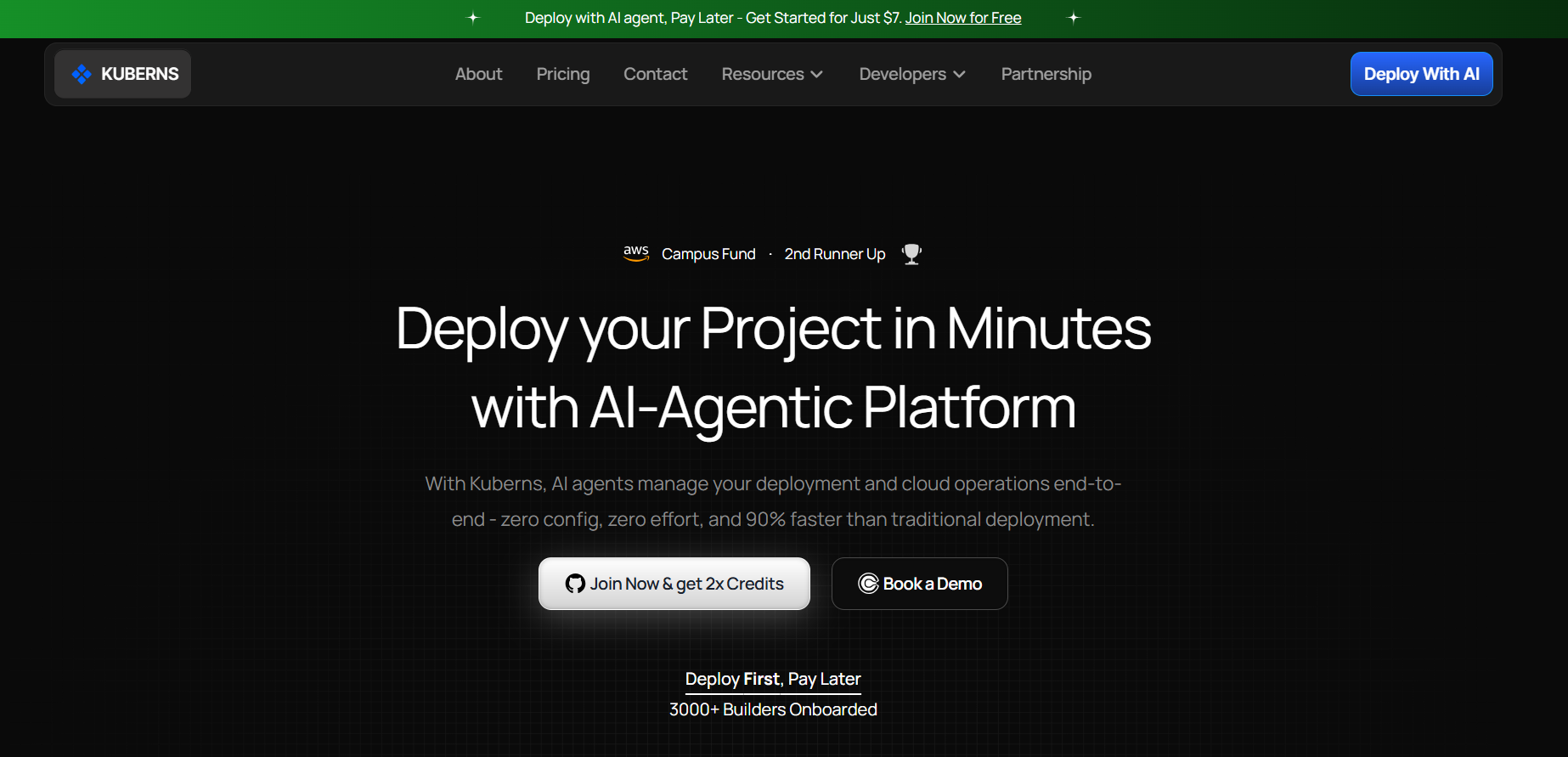
[Kuberns](https://kuberns.com) is an agentic AI deployment platform. Connect your GitHub repository, click deploy, and the AI handles the rest: environment detection, VPC setup, CI/CD, SSL, monitoring, backups, and auto-scaling. No YAML. No Nginx config. No DevOps engineer needed.
Built on AWS, Kuberns delivers up to 40% cost savings versus direct AWS pricing and 95% faster setup than manual IaaS. One bill, one platform. No assembling separate tools for storage, monitoring, and networking. If you are still evaluating which IaaS platform to pick before making the jump to managed deployment, the [IaaS platform comparison guide](/blogs/pick-the-best-iaas-platform/) covers what to look for. For teams ready to move away from manual server management entirely, Kuberns is one of the most practical [Linode alternatives](/blogs/linode-alternatives/) available.
### Kuberns vs Linode: IaaS vs AI-Managed Cloud
| Feature | Kuberns | Linode (IaaS) |
|---|---|---|
| Deployment | AI deploys in minutes via GitHub connect | Manual VPC, load balancer, CI/CD setup. Takes days or weeks |
| Infrastructure time | ~0 hrs/week, 95% faster setup | 10–40 hrs/week on configs, tuning, cost management |
| Pricing | One bill, pay for compute only | Separate charges: compute, storage, bandwidth, monitoring, networking |
| CI/CD, monitoring, backups | Built-in and automatic | Assemble and maintain every tool yourself |
| DevOps knowledge required | None | Linux and server administration required |
> If you are weighing the IaaS vs PaaS decision more broadly, the [IaaS vs PaaS vs SaaS breakdown](/blogs/iaas-vs-paas-vs-saas/) covers exactly when each model makes sense, and the [best IaaS cloud hosting guide for businesses](/blogs/best-iaas-cloud-hosting-solution-for-businesses/) is worth reading before you commit to a provider.
## Conclusion
Linode (Akamai Cloud) is a well-built IaaS platform with a long track record, competitive VPS pricing, and a product catalog that has grown significantly since the 2022 acquisition. GPU plans, 41 global regions, and CDN integration make it genuinely capable for teams with the technical depth to use it well.
The real question is whether your team needs IaaS at all. If you need root access, custom OS control, or AI inference infrastructure, Linode delivers. If you need your application deployed and running in production without a DevOps function to support it, [Kuberns](https://dashboard.kuberns.com) is built for exactly that.
## What Is Linode Good For? Use Cases and Limitations

Linode is a strong fit for specific teams and workloads, and a poor fit for others.
**Where Linode works well:** Linux-confident developers who want full root access and a clean VPS environment. Teams with custom OS or kernel requirements a managed PaaS cannot accommodate. Budget-conscious infrastructure teams who need predictable monthly VPS costs. GPU and AI inference workloads via Akamai's RTX PRO 6000 Blackwell plans and Akamai Inference Cloud. Teams needing global data centre coverage in regions where AWS and GCP are expensive or limited. For a broader view of the IaaS landscape, see the [top 10 IaaS cloud providers](/blogs/top-10-iaas-cloud-providers/) compared across price and features.
**Where Linode falls short:** Linode is IaaS. It gives you servers, not a deployment platform. Deploying an application means configuring Nginx, setting up SSL, writing CI/CD pipelines, and managing environment variables yourself. There is no AI-native layer that detects your stack or configures your environment. Monitoring, backups, and auto-scaling must be assembled independently. For teams without a dedicated DevOps engineer, that operational overhead is the real cost of Linode. It does not appear on the monthly invoice.
> See how the [DigitalOcean vs Linode comparison](/blogs/linode-vs-digitalocean-vs-kuberns-ai/) plays out across pricing, managed services, and developer experience for teams evaluating both platforms.
## Do You Actually Need IaaS, or Do You Need Something Smarter?

IaaS is the right call for teams with strong Linux skills, a dedicated DevOps function, and workloads that genuinely require root access. For a framework on when IaaS actually makes sense versus when it is working against you, see [how startups and enterprises use IaaS to scale](/blogs/how-startups-and-enterprises-can-use-iaas-services-to-scale-faster/) and where it stops being the right tool. For everyone else, the real cost of IaaS is not the server bill. It is the operational tax. The gap between "I have a Linode instance" and "my app is deployed, monitored, and backed up" is where most teams lose weeks.
### What Is Kuberns?

[Kuberns](https://kuberns.com) is an agentic AI deployment platform. Connect your GitHub repository, click deploy, and the AI handles the rest: environment detection, VPC setup, CI/CD, SSL, monitoring, backups, and auto-scaling. No YAML. No Nginx config. No DevOps engineer needed.
Built on AWS, Kuberns delivers up to 40% cost savings versus direct AWS pricing and 95% faster setup than manual IaaS. One bill, one platform. No assembling separate tools for storage, monitoring, and networking. If you are still evaluating which IaaS platform to pick before making the jump to managed deployment, the [IaaS platform comparison guide](/blogs/pick-the-best-iaas-platform/) covers what to look for. For teams ready to move away from manual server management entirely, Kuberns is one of the most practical [Linode alternatives](/blogs/linode-alternatives/) available.
### Kuberns vs Linode: IaaS vs AI-Managed Cloud
| Feature | Kuberns | Linode (IaaS) |
|---|---|---|
| Deployment | AI deploys in minutes via GitHub connect | Manual VPC, load balancer, CI/CD setup. Takes days or weeks |
| Infrastructure time | ~0 hrs/week, 95% faster setup | 10–40 hrs/week on configs, tuning, cost management |
| Pricing | One bill, pay for compute only | Separate charges: compute, storage, bandwidth, monitoring, networking |
| CI/CD, monitoring, backups | Built-in and automatic | Assemble and maintain every tool yourself |
| DevOps knowledge required | None | Linux and server administration required |
> If you are weighing the IaaS vs PaaS decision more broadly, the [IaaS vs PaaS vs SaaS breakdown](/blogs/iaas-vs-paas-vs-saas/) covers exactly when each model makes sense, and the [best IaaS cloud hosting guide for businesses](/blogs/best-iaas-cloud-hosting-solution-for-businesses/) is worth reading before you commit to a provider.
## Conclusion
Linode (Akamai Cloud) is a well-built IaaS platform with a long track record, competitive VPS pricing, and a product catalog that has grown significantly since the 2022 acquisition. GPU plans, 41 global regions, and CDN integration make it genuinely capable for teams with the technical depth to use it well.
The real question is whether your team needs IaaS at all. If you need root access, custom OS control, or AI inference infrastructure, Linode delivers. If you need your application deployed and running in production without a DevOps function to support it, [Kuberns](https://dashboard.kuberns.com) is built for exactly that.
 ## Frequently Asked Questions
### What is Linode used for?
Linode (now Akamai Cloud) is used for hosting web applications, running backend APIs, deploying containerised workloads with Kubernetes, storing files with S3-compatible Object Storage, and running GPU workloads for AI inference. It is popular with developers and infrastructure teams who want Linux VPS hosting with full root access and predictable pricing.
### Is Linode the same as Akamai Cloud?
Yes. Akamai acquired Linode in 2022 for approximately $900 million and completed a full rebrand in February 2023. The platform is now officially called Akamai Cloud Computing. The underlying product is still the same Linux VPS infrastructure Linode built, with Akamai's global network, CDN, and security capabilities added on top.
### What is a Nanode in Linode?
A Nanode is Linode's entry-level compute plan: 1 vCPU, 1 GB RAM, 25 GB SSD storage, and 1 TB of outbound transfer for $5 per month. It is designed for lightweight workloads: personal projects, development environments, low-traffic websites, and microservices testing.
### Is Linode good for beginners?
Linode is more approachable than AWS or Google Cloud, but it is still an IaaS platform that requires Linux knowledge to use effectively. You manage your own servers via SSH, configure Nginx, handle SSL, and set up your own CI/CD pipelines. Beginners who want deployment without server management are better served by a PaaS or AI-native platform like [Kuberns](https://dashboard.kuberns.com).
### How much does Linode cost per month?
Linode pricing starts at $5 per month for a Nanode (1 GB RAM). Shared CPU plans range from $12 to $48 per month. Dedicated CPU plans start at $36 per month (G6) and $43 per month (G7). High Memory plans start at $60 per month. Managed Databases, Object Storage, LKE, and NodeBalancers are each billed separately on top of your compute cost.
### What is LKE (Linode Kubernetes Engine)?
LKE is Linode's managed Kubernetes service. Akamai manages the control plane at no charge. You pay only for the worker nodes you provision, starting at around $60 per month for a basic cluster. LKE integrates with Linode's NodeBalancers, Block Storage, and Container Registry, and is suited to teams that have already adopted containers and want to run Kubernetes without managing the control plane.
### Is Linode good for production?
Linode can support production workloads for teams with strong Linux and DevOps skills. It offers a 99.99% uptime SLA for compute, Dedicated CPU plans for consistent performance, and managed databases for production data. The trade-off is that production-grade reliability requires you to configure monitoring, backups, CI/CD, and failover yourself. It does not come assembled.
### What changed after the Akamai acquisition?
After the 2022 acquisition and 2023 rebrand, the platform expanded from 11 data centres to 41 compute regions across 36 cities globally. Akamai integrated CDN and security capabilities, added enterprise compliance certifications, introduced GPU plans for AI inference, and launched Akamai Inference Cloud in October 2025. Some pricing increased relative to pre-acquisition Linode rates.
### What is the difference between Linode and AWS?
Both are IaaS platforms but differ significantly in scope and complexity. AWS has over 200 services, enterprise tooling, and complex metered billing. Linode has a smaller, cleaner product surface focused on compute, storage, networking, and Kubernetes, with more predictable pricing. Linode is generally cheaper and simpler for straightforward workloads. AWS covers enterprise and hyperscale use cases that Linode does not address.
### What is a good Linode alternative?
The best Linode alternatives in 2026 depend on what you are optimising for. [DigitalOcean](/blogs/what-is-digitalocean/) and Vultr are direct IaaS alternatives with similar pricing and developer focus. For teams who want managed deployment without server management, [Kuberns](https://dashboard.kuberns.com) is an AI-native PaaS that handles CI/CD, monitoring, backups, and scaling automatically.
---
- [More Deployment Guides articles](https://kuberns.com/blogs/category/deployment-guides/1/)
- [All articles](https://kuberns.com/blogs/)
## Frequently Asked Questions
### What is Linode used for?
Linode (now Akamai Cloud) is used for hosting web applications, running backend APIs, deploying containerised workloads with Kubernetes, storing files with S3-compatible Object Storage, and running GPU workloads for AI inference. It is popular with developers and infrastructure teams who want Linux VPS hosting with full root access and predictable pricing.
### Is Linode the same as Akamai Cloud?
Yes. Akamai acquired Linode in 2022 for approximately $900 million and completed a full rebrand in February 2023. The platform is now officially called Akamai Cloud Computing. The underlying product is still the same Linux VPS infrastructure Linode built, with Akamai's global network, CDN, and security capabilities added on top.
### What is a Nanode in Linode?
A Nanode is Linode's entry-level compute plan: 1 vCPU, 1 GB RAM, 25 GB SSD storage, and 1 TB of outbound transfer for $5 per month. It is designed for lightweight workloads: personal projects, development environments, low-traffic websites, and microservices testing.
### Is Linode good for beginners?
Linode is more approachable than AWS or Google Cloud, but it is still an IaaS platform that requires Linux knowledge to use effectively. You manage your own servers via SSH, configure Nginx, handle SSL, and set up your own CI/CD pipelines. Beginners who want deployment without server management are better served by a PaaS or AI-native platform like [Kuberns](https://dashboard.kuberns.com).
### How much does Linode cost per month?
Linode pricing starts at $5 per month for a Nanode (1 GB RAM). Shared CPU plans range from $12 to $48 per month. Dedicated CPU plans start at $36 per month (G6) and $43 per month (G7). High Memory plans start at $60 per month. Managed Databases, Object Storage, LKE, and NodeBalancers are each billed separately on top of your compute cost.
### What is LKE (Linode Kubernetes Engine)?
LKE is Linode's managed Kubernetes service. Akamai manages the control plane at no charge. You pay only for the worker nodes you provision, starting at around $60 per month for a basic cluster. LKE integrates with Linode's NodeBalancers, Block Storage, and Container Registry, and is suited to teams that have already adopted containers and want to run Kubernetes without managing the control plane.
### Is Linode good for production?
Linode can support production workloads for teams with strong Linux and DevOps skills. It offers a 99.99% uptime SLA for compute, Dedicated CPU plans for consistent performance, and managed databases for production data. The trade-off is that production-grade reliability requires you to configure monitoring, backups, CI/CD, and failover yourself. It does not come assembled.
### What changed after the Akamai acquisition?
After the 2022 acquisition and 2023 rebrand, the platform expanded from 11 data centres to 41 compute regions across 36 cities globally. Akamai integrated CDN and security capabilities, added enterprise compliance certifications, introduced GPU plans for AI inference, and launched Akamai Inference Cloud in October 2025. Some pricing increased relative to pre-acquisition Linode rates.
### What is the difference between Linode and AWS?
Both are IaaS platforms but differ significantly in scope and complexity. AWS has over 200 services, enterprise tooling, and complex metered billing. Linode has a smaller, cleaner product surface focused on compute, storage, networking, and Kubernetes, with more predictable pricing. Linode is generally cheaper and simpler for straightforward workloads. AWS covers enterprise and hyperscale use cases that Linode does not address.
### What is a good Linode alternative?
The best Linode alternatives in 2026 depend on what you are optimising for. [DigitalOcean](/blogs/what-is-digitalocean/) and Vultr are direct IaaS alternatives with similar pricing and developer focus. For teams who want managed deployment without server management, [Kuberns](https://dashboard.kuberns.com) is an AI-native PaaS that handles CI/CD, monitoring, backups, and scaling automatically.
---
- [More Deployment Guides articles](https://kuberns.com/blogs/category/deployment-guides/1/)
- [All articles](https://kuberns.com/blogs/)