# Why AI Managed PaaS Beats IaaS for Developer Teams in 2026
> Raw IaaS gives you control but costs dev teams weeks in setup and thousands in DevOps. Here's why AI managed PaaS wins for most developer teams in 2026.
- **Author**: harsh-kanani
- **Published**: 2026-05-08
- **Modified**: 2026-05-08
- **Category**: AI & DevOps
- **URL**: https://kuberns.com/blogs/why-use-paas-instead-of-iaas/
---
For most developer teams, AI managed PaaS is the better choice. IaaS gives you raw infrastructure control, but that control comes with DevOps overhead, security patching, and configuration complexity that most teams neither need nor have time for.
The real cost of IaaS is not the server bill. It is the DevOps engineer you had to hire to manage it, the three weeks spent configuring networks and load balancers, the 2am outage because nobody set up health checks, and the 500 hours per year your best developer spent on YAML instead of shipping features.
If your team spends more time managing infrastructure than building product, this is the guide that explains what to do instead.
**TL;DR**
- IaaS = raw virtual infrastructure you manage yourself. Right for large teams with dedicated DevOps.
- Managed PaaS = the provider handles infrastructure, you focus on code. Right for most dev teams.
- AI managed PaaS = PaaS plus agentic AI that reads your repo and auto-provisions your entire stack in minutes.
- Hidden cost of IaaS: DevOps engineering ($80K to $150K/year) + setup time + ongoing maintenance.
- Bottom line: if you do not have a dedicated DevOps team, you probably do not need IaaS.
## What Is IaaS and Who Actually Needs It

Infrastructure as a Service (IaaS) is a cloud model where the provider gives you raw virtual machines, storage, and networking. You manage everything above the hardware layer: the operating system, runtime, middleware, databases, security patches, and scaling configuration.
> **Evaluating your cloud options?** See exactly what each provider controls, what you manage, and what that overhead actually costs your team. [The 10 most widely used IaaS cloud providers compared side by side.](https://kuberns.com/blogs/top-10-iaas-cloud-providers/)
IaaS makes sense when your team fits one of these four profiles:
- You need custom OS-level configuration that a PaaS cannot provide
- You have a dedicated DevOps or platform engineering team of 10 or more people
- Your industry requires compliance that mandates dedicated physical hardware
- You are running specialized workloads like GPU clusters for ML training
If your team does not match any of those four, you are paying for complexity you do not need. Most early-stage and mid-size teams do not match any of them.
## The Hidden Cost of Raw IaaS That Never Appears on the Pricing Page
The monthly invoice for IaaS looks manageable. What the pricing page does not show is everything else.
| Cost Item | IaaS (Raw) | AI Managed PaaS |
|---|---|---|
| Server setup | 4 to 20 hours | 0 hours |
| SSL certificate | Manual setup and renewal | Automatic |
| Database provisioning | Manual configuration | Automatic |
| CI/CD pipeline | Build from scratch | Built-in |
| Auto-scaling | Manual YAML configuration | Automatic |
| Security patching | Your responsibility | Provider handles |
| DevOps engineer required | Yes | No |
| Time to first deployment | Days to weeks | Under 5 minutes |
A mid-level DevOps engineer costs $80,000 to $150,000 per year in salary as per [Index.dev](https://index.dev). For most early-stage teams, that is more than their entire annual cloud bill. Even if you avoid the hire and a developer handles infra instead, 10 hours per week of infrastructure work adds up to 500 hours per year that did not go toward the product.
> **Still paying more than you should?** Most teams only look at the server invoice. This guide covers every hidden cost layer, including the one that shows up on your engineer's timesheet and never on your AWS bill. [The complete guide to cloud cost optimisation that most teams skip.](https://kuberns.com/blogs/cloud-cost-optimisation/)
## What AI Managed PaaS Actually Handles in 2026

Platform as a Service (PaaS) is a cloud model where the provider manages the entire infrastructure layer. You write and push code. The platform handles the rest.
A modern AI managed PaaS handles all of this automatically:
- Server provisioning and scaling
- SSL certificate issuance and renewal
- Database setup and connection string injection
- Environment variable management
- CI/CD pipeline on every git push
- Auto-scaling based on real traffic
- Health checks and automatic restarts
- Logs and monitoring
> **Choosing a PaaS in 2026?** Stop guessing on pricing and feature lists. Every major PaaS platform compared with real deployment speed data so you can pick the one that actually fits how your team ships. [See the full comparison here.](https://kuberns.com/blogs/best-paas-providers/)
In 2025, PaaS still required some configuration. In 2026, agentic AI platforms read your repository, detect your framework and runtime automatically, and provision the correct infrastructure without a single config file from you.
What managed PaaS does not handle, to be clear: custom network topology, specialized GPU workloads, bare metal compliance requirements, and complex multi-region active-active setups. Those are genuine IaaS use cases.
> **Wondering what actually happens when you click Deploy?** What fires, what gets provisioned, and what no one tells you it skips. Worth reading before you commit to any platform. [One-click deployment explained in full.](https://kuberns.com/blogs/what-does-one-click-deployment-do/)
 ## The 5-Factor Decision Framework: IaaS vs AI Managed PaaS
Use this to decide in under two minutes which model fits your team.
| Factor | Choose AI Managed PaaS | Choose IaaS |
|---|---|---|
| Team size | Fewer than 5 engineers | 10 or more with dedicated DevOps |
| Time to deploy | Need to ship this week | Long-horizon infrastructure build |
| Monthly cloud spend | Under $10,000 | Enterprise scale with a full infra team |
| Stack type | Web apps, APIs, SaaS, bots | Custom kernels, GPUs, bare metal compliance |
| In-house expertise | No DevOps on the team | Full infrastructure team already in place |
The pattern is consistent: if you are a lean team with a standard stack and no dedicated infra engineers, managed PaaS wins on every factor. Not because IaaS is bad, but because the overhead is real and the benefit only materializes at scale.
> **Building a startup and not sure which cloud model to bet on?** This is the decision framework lean teams use to scale without a platform engineering hire. [How the fastest-growing startups pick cloud platforms without burning their runway.](https://kuberns.com/blogs/cloud-for-startups-to-scale-without-burning-budget/)
## Why the 2026 Developer Profile Has Moved Away From IaaS

The developer building software in 2026 looks different from the one in 2020.
AI coding tools like Cursor, Bolt, and Lovable have created a new class of builder: people who can ship full-stack products without deep infrastructure knowledge. Vibe coding is real. The ability to go from idea to deployed product in days is now accessible to solo founders, designers, and non-traditional developers.
IaaS is completely incompatible with this workflow. You cannot build an app in two days with AI assistance and then spend three weeks configuring VPCs, setting up load balancers, and writing systemd service files.
> **Built your app with Cursor or Bolt and not sure what comes next?** This is the missing piece between vibe coding and actually having users. [Vibe deployment: the fastest way to get an AI-built app live without touching a server.](https://kuberns.com/blogs/what-is-vibe-deployment/)
> **Curious how AI is changing the DevOps job itself?** Agentic AI is replacing tasks that used to take an entire team. Here is what that means for lean engineering teams shipping in 2026. [How AI in DevOps is reshaping the way software gets deployed.](https://kuberns.com/blogs/ai-in-devops-and-developer-workflow/)
The developer profile has changed. The infrastructure model needs to change with it.
## Why Kuberns Is the Best AI Managed PaaS in 2026
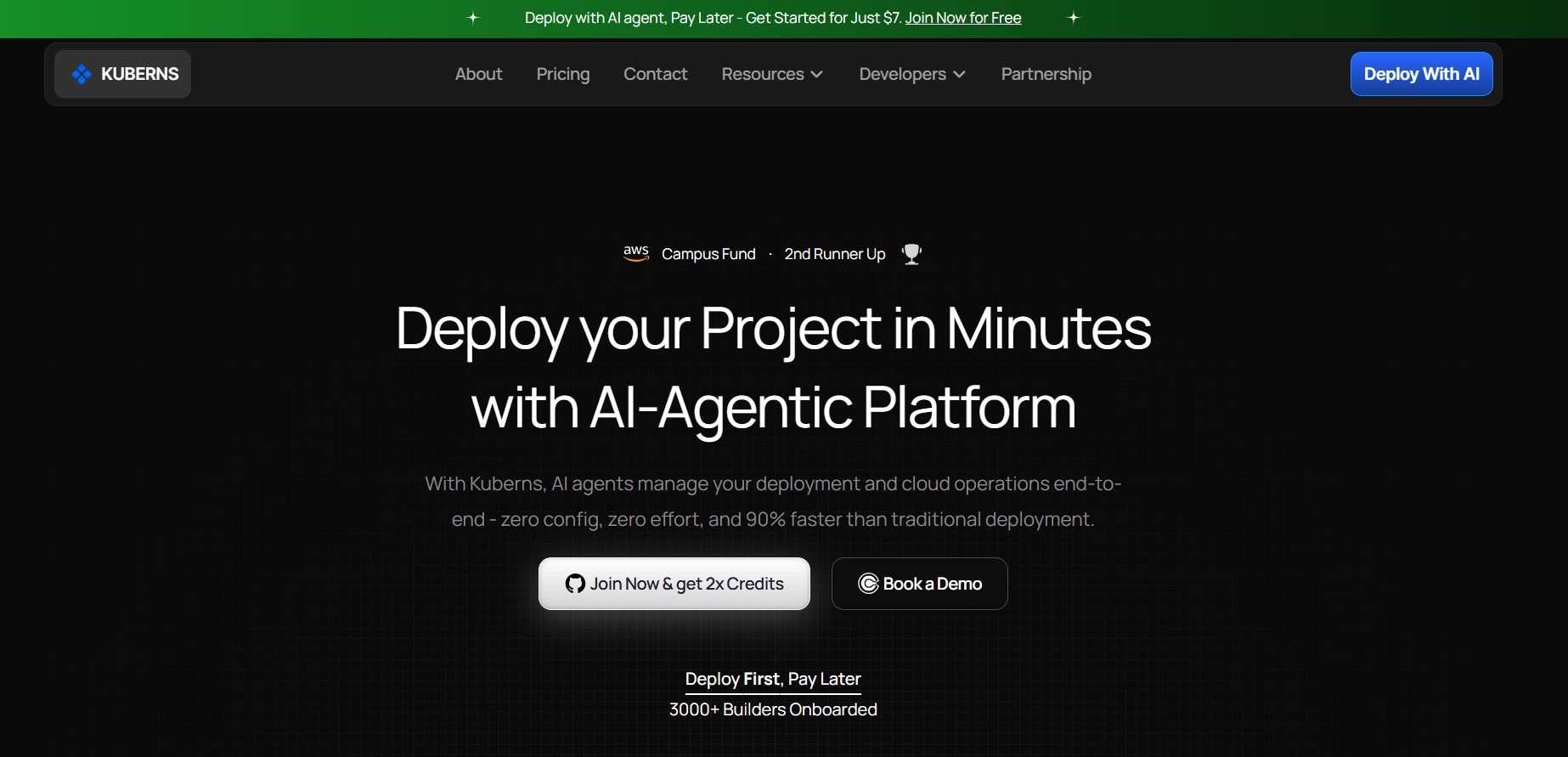
Kuberns is an agentic AI cloud deployment platform built on AWS. It connects to your GitHub repository, reads your code, detects your framework and runtime automatically, and provisions your entire infrastructure stack without a single configuration file from you.
Most PaaS platforms still make you choose an instance type, write a build command, configure a database connection, and wire up your CI/CD pipeline manually. Kuberns eliminates every one of those steps. The agentic AI reads your code and handles them for you.
Here is everything Kuberns provisions automatically the moment you connect your repo:
- AWS server sized to your application type and expected traffic
- Database created, connected, and injected as a ready-to-use environment variable
- SSL certificate issued and renewed without any action from you
- Environment variables managed securely through a clean dashboard
- CI/CD pipeline activated on every push to your main branch
- Auto-scaling that adjusts resources based on real-time traffic, not guesswork
- Health checks and automatic restarts if your app crashes
- Unified logs and monitoring in a single dashboard
No YAML. No Dockerfiles. No DevOps engineer. No 2am outages from a misconfigured health check.
Here is where Kuberns pulls ahead of both raw IaaS and traditional PaaS on the metrics that matter to dev teams:
| What Matters | Raw IaaS | Traditional PaaS | Kuberns AI Managed PaaS |
|---|---|---|---|
| Time to first deploy | Days to weeks | Hours | Under 5 minutes |
| DevOps knowledge required | High | Medium | None |
| Auto-scaling | Manual YAML | Limited or paid add-on | Built-in, AI-managed |
| Database setup | Fully manual | Semi-automated | Fully automatic |
| Cost vs raw AWS | Baseline | 10 to 20% more | Up to 40% less |
| Config files required | Many | Some | Zero |
| Supports any stack | Yes | Limited | Yes |
Teams using Kuberns save up to 40% on cloud costs compared to managing raw AWS. The agentic AI continuously right-sizes infrastructure based on actual usage rather than leaving over-provisioned servers running at idle. You get enterprise-grade AWS infrastructure without paying for an engineer to manage it.
Kuberns is built for the developer who wants to ship, not the DevOps engineer who wants to configure. If your stack is Node.js, Python, Go, PHP, Ruby, Java, or any containerised application, Kuberns detects it and deploys it without you writing a single deployment script.
> **New to Kuberns?** Teams switching from Heroku, Railway, and raw AWS explain what made them move. The full platform explained in plain English so you know what you are getting before you sign up. [What Kuberns actually is and how it works.](https://kuberns.com/blogs/what-is-kuberns-the-simplest-way-to-build-deploy-and-scale-full-stack-apps/)
**Deploy in 3 steps:**
1. Connect your GitHub repo to Kuberns
2. Set your environment variables in the dashboard
3. Click Deploy and get a live HTTPS URL in under 5 minutes
[Start a free trial with $14 in credits, no credit card needed.](https://dashboard.kuberns.com/)
## Conclusion
IaaS is powerful. It is also a full-time job.
For most developer teams in 2026, that job should not be yours. Solo founders, lean startups, and small engineering teams ship faster and spend less when infrastructure is managed by a platform rather than by the team itself.
If your team is spending hours on YAML configs, server patches, and networking setup instead of building features, that is the signal to switch. AI managed PaaS handles the infrastructure layer so the team can stay focused on what actually moves the product forward.
[Try Kuberns free](https://dashboard.kuberns.com/) and deploy your first app in under 5 minutes.
## The 5-Factor Decision Framework: IaaS vs AI Managed PaaS
Use this to decide in under two minutes which model fits your team.
| Factor | Choose AI Managed PaaS | Choose IaaS |
|---|---|---|
| Team size | Fewer than 5 engineers | 10 or more with dedicated DevOps |
| Time to deploy | Need to ship this week | Long-horizon infrastructure build |
| Monthly cloud spend | Under $10,000 | Enterprise scale with a full infra team |
| Stack type | Web apps, APIs, SaaS, bots | Custom kernels, GPUs, bare metal compliance |
| In-house expertise | No DevOps on the team | Full infrastructure team already in place |
The pattern is consistent: if you are a lean team with a standard stack and no dedicated infra engineers, managed PaaS wins on every factor. Not because IaaS is bad, but because the overhead is real and the benefit only materializes at scale.
> **Building a startup and not sure which cloud model to bet on?** This is the decision framework lean teams use to scale without a platform engineering hire. [How the fastest-growing startups pick cloud platforms without burning their runway.](https://kuberns.com/blogs/cloud-for-startups-to-scale-without-burning-budget/)
## Why the 2026 Developer Profile Has Moved Away From IaaS

The developer building software in 2026 looks different from the one in 2020.
AI coding tools like Cursor, Bolt, and Lovable have created a new class of builder: people who can ship full-stack products without deep infrastructure knowledge. Vibe coding is real. The ability to go from idea to deployed product in days is now accessible to solo founders, designers, and non-traditional developers.
IaaS is completely incompatible with this workflow. You cannot build an app in two days with AI assistance and then spend three weeks configuring VPCs, setting up load balancers, and writing systemd service files.
> **Built your app with Cursor or Bolt and not sure what comes next?** This is the missing piece between vibe coding and actually having users. [Vibe deployment: the fastest way to get an AI-built app live without touching a server.](https://kuberns.com/blogs/what-is-vibe-deployment/)
> **Curious how AI is changing the DevOps job itself?** Agentic AI is replacing tasks that used to take an entire team. Here is what that means for lean engineering teams shipping in 2026. [How AI in DevOps is reshaping the way software gets deployed.](https://kuberns.com/blogs/ai-in-devops-and-developer-workflow/)
The developer profile has changed. The infrastructure model needs to change with it.
## Why Kuberns Is the Best AI Managed PaaS in 2026

Kuberns is an agentic AI cloud deployment platform built on AWS. It connects to your GitHub repository, reads your code, detects your framework and runtime automatically, and provisions your entire infrastructure stack without a single configuration file from you.
Most PaaS platforms still make you choose an instance type, write a build command, configure a database connection, and wire up your CI/CD pipeline manually. Kuberns eliminates every one of those steps. The agentic AI reads your code and handles them for you.
Here is everything Kuberns provisions automatically the moment you connect your repo:
- AWS server sized to your application type and expected traffic
- Database created, connected, and injected as a ready-to-use environment variable
- SSL certificate issued and renewed without any action from you
- Environment variables managed securely through a clean dashboard
- CI/CD pipeline activated on every push to your main branch
- Auto-scaling that adjusts resources based on real-time traffic, not guesswork
- Health checks and automatic restarts if your app crashes
- Unified logs and monitoring in a single dashboard
No YAML. No Dockerfiles. No DevOps engineer. No 2am outages from a misconfigured health check.
Here is where Kuberns pulls ahead of both raw IaaS and traditional PaaS on the metrics that matter to dev teams:
| What Matters | Raw IaaS | Traditional PaaS | Kuberns AI Managed PaaS |
|---|---|---|---|
| Time to first deploy | Days to weeks | Hours | Under 5 minutes |
| DevOps knowledge required | High | Medium | None |
| Auto-scaling | Manual YAML | Limited or paid add-on | Built-in, AI-managed |
| Database setup | Fully manual | Semi-automated | Fully automatic |
| Cost vs raw AWS | Baseline | 10 to 20% more | Up to 40% less |
| Config files required | Many | Some | Zero |
| Supports any stack | Yes | Limited | Yes |
Teams using Kuberns save up to 40% on cloud costs compared to managing raw AWS. The agentic AI continuously right-sizes infrastructure based on actual usage rather than leaving over-provisioned servers running at idle. You get enterprise-grade AWS infrastructure without paying for an engineer to manage it.
Kuberns is built for the developer who wants to ship, not the DevOps engineer who wants to configure. If your stack is Node.js, Python, Go, PHP, Ruby, Java, or any containerised application, Kuberns detects it and deploys it without you writing a single deployment script.
> **New to Kuberns?** Teams switching from Heroku, Railway, and raw AWS explain what made them move. The full platform explained in plain English so you know what you are getting before you sign up. [What Kuberns actually is and how it works.](https://kuberns.com/blogs/what-is-kuberns-the-simplest-way-to-build-deploy-and-scale-full-stack-apps/)
**Deploy in 3 steps:**
1. Connect your GitHub repo to Kuberns
2. Set your environment variables in the dashboard
3. Click Deploy and get a live HTTPS URL in under 5 minutes
[Start a free trial with $14 in credits, no credit card needed.](https://dashboard.kuberns.com/)
## Conclusion
IaaS is powerful. It is also a full-time job.
For most developer teams in 2026, that job should not be yours. Solo founders, lean startups, and small engineering teams ship faster and spend less when infrastructure is managed by a platform rather than by the team itself.
If your team is spending hours on YAML configs, server patches, and networking setup instead of building features, that is the signal to switch. AI managed PaaS handles the infrastructure layer so the team can stay focused on what actually moves the product forward.
[Try Kuberns free](https://dashboard.kuberns.com/) and deploy your first app in under 5 minutes.
 ## FAQ
### Q: What is the main difference between IaaS and PaaS?
IaaS gives you raw virtual infrastructure that you configure and manage yourself. PaaS gives you a complete platform where the provider manages the infrastructure and you focus entirely on your code. The key difference is where the responsibility boundary sits.
### Q: Is PaaS more expensive than IaaS?
On the invoice alone, IaaS can appear slightly cheaper. But when you include the cost of DevOps engineering, configuration time, security maintenance, and ongoing operations, managed PaaS is almost always cheaper for teams under 10 engineers.
### Q: Can a startup use IaaS without a DevOps engineer?
Technically yes. Practically, it means the founder or a developer spends significant time managing infrastructure instead of building product. Most startups switch to managed PaaS once they calculate the actual cost of that trade-off in time and focus.
### Q: What is a managed PaaS platform?
A managed PaaS platform handles infrastructure provisioning, SSL certificates, database setup, CI/CD pipelines, and auto-scaling automatically. You connect your code repository and the platform handles everything required to get your app live and keep it running.
### Q: Which is better for solo developers: IaaS or PaaS?
PaaS. Solo developers do not have time to manage servers, configure networking, and maintain security patches while also building a product. Managed PaaS removes all of that overhead so you can focus on shipping.
### Q: What are examples of AI managed PaaS platforms in 2026?
Kuberns, Heroku, Railway, Render, and Fly.io are all PaaS platforms. Of these, Kuberns is the only one that uses agentic AI to automate the full deployment stack including servers, databases, SSL, and CI/CD without any configuration files from the developer.
### Q: What does IaaS stand for?
IaaS stands for Infrastructure as a Service. It refers to cloud platforms that provide raw virtual machines, storage, and networking that customers configure and manage themselves. Common examples include AWS EC2, Google Compute Engine, Hetzner, and DigitalOcean Droplets.
### Q: When should a developer team choose IaaS over PaaS?
When they need custom OS-level configuration, specialized hardware like GPU clusters for machine learning, strict compliance requirements that mandate dedicated physical hardware, or when they are running large-scale workloads with a full-time platform engineering team already in place.
---
- [More AI & DevOps articles](https://kuberns.com/blogs/category/ai-devops/1/)
- [All articles](https://kuberns.com/blogs/)
## FAQ
### Q: What is the main difference between IaaS and PaaS?
IaaS gives you raw virtual infrastructure that you configure and manage yourself. PaaS gives you a complete platform where the provider manages the infrastructure and you focus entirely on your code. The key difference is where the responsibility boundary sits.
### Q: Is PaaS more expensive than IaaS?
On the invoice alone, IaaS can appear slightly cheaper. But when you include the cost of DevOps engineering, configuration time, security maintenance, and ongoing operations, managed PaaS is almost always cheaper for teams under 10 engineers.
### Q: Can a startup use IaaS without a DevOps engineer?
Technically yes. Practically, it means the founder or a developer spends significant time managing infrastructure instead of building product. Most startups switch to managed PaaS once they calculate the actual cost of that trade-off in time and focus.
### Q: What is a managed PaaS platform?
A managed PaaS platform handles infrastructure provisioning, SSL certificates, database setup, CI/CD pipelines, and auto-scaling automatically. You connect your code repository and the platform handles everything required to get your app live and keep it running.
### Q: Which is better for solo developers: IaaS or PaaS?
PaaS. Solo developers do not have time to manage servers, configure networking, and maintain security patches while also building a product. Managed PaaS removes all of that overhead so you can focus on shipping.
### Q: What are examples of AI managed PaaS platforms in 2026?
Kuberns, Heroku, Railway, Render, and Fly.io are all PaaS platforms. Of these, Kuberns is the only one that uses agentic AI to automate the full deployment stack including servers, databases, SSL, and CI/CD without any configuration files from the developer.
### Q: What does IaaS stand for?
IaaS stands for Infrastructure as a Service. It refers to cloud platforms that provide raw virtual machines, storage, and networking that customers configure and manage themselves. Common examples include AWS EC2, Google Compute Engine, Hetzner, and DigitalOcean Droplets.
### Q: When should a developer team choose IaaS over PaaS?
When they need custom OS-level configuration, specialized hardware like GPU clusters for machine learning, strict compliance requirements that mandate dedicated physical hardware, or when they are running large-scale workloads with a full-time platform engineering team already in place.
---
- [More AI & DevOps articles](https://kuberns.com/blogs/category/ai-devops/1/)
- [All articles](https://kuberns.com/blogs/)